
I want to tell you about the time a shopping mall sold for one hundred dollars.
Not a hundred thousand. A hundred. One bill, Ben Franklin’s face on it, traded for 1.1 million square feet of American retail outside Pittsburgh, a building that once held a food court and a carousel and a mall Santa. The lender was owed 142 million on it. They handed over the keys, took the hundred bucks, and felt good about the deal.
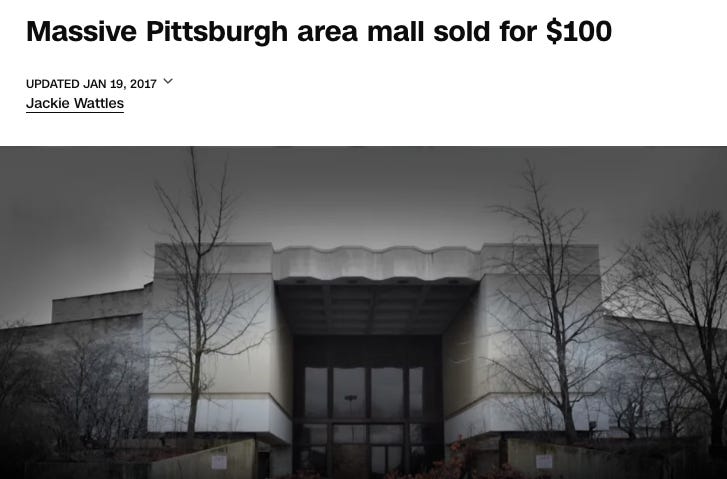
When I first read that, I assumed it was a typo, or some tax trick, or a story that fell apart on the second click. It did not. And the more I pulled on it, the more I realized this one absurd transaction is a tiny, sped-up version of something enormous and slow that is happening right now to office towers all over the country. Buildings that sold for hundreds of millions are changing hands for a third of that, a fifth, sometimes less than the parking garage underneath them.
You already know the story everyone tells about this. Greedy investors paid stupid prices, ignored the obvious fact that the internet would let everyone work from home, and got exactly what they deserved.
I am going to try to talk you out of that story, because it is comforting and it is wrong, and what is actually underneath it is a lot stranger and a lot more interesting than greed.
Here is the part that should bother you. The people who bought these buildings were not dumb. Most of them were pension funds and insurance companies, which is to say the most cautious money on the planet, the money whose entire job is to never, ever blow up. They ran the models. They knew about working from home. And they walked into one of the biggest asset wipeouts in modern history anyway, calmly, doing the responsible thing.
So forget greed. The real mystery is sharper and weirder: how did the most careful investors alive lose this much money, this predictably, while doing nothing a sensible person in their chair would have done differently?
The answer is one equation. It is almost insultingly simple. It is also the most important thing in this essay, and we are going to spend the whole piece staring at it, because every time you look at it a little harder it tells you something a little bigger, until at some point you look up and realize it stopped being about offices a while ago.
Let me introduce the person who is going to lose all the money.
Meet Carol
Let’s give the money a face. Call her Carol.
Carol runs the pension fund for a few hundred thousand schoolteachers. This means Carol has roughly forty billion dollars and exactly one rule: do not, under any circumstances, blow up the schoolteachers. Carol does not chase moonshots. Carol does not buy magic beans. Carol buys boring things that pay steady money for thirty years, because in thirty years a kindergarten teacher in Ohio is going to want her pension to exist.
In 2015, Carol buys a gleaming office tower full of bankers in a major city. Solid building, blue-chip tenants, ten-year leases, the works.
Every sober person in finance nods. This is the most Carol thing Carol could possibly do. Office towers are the oatmeal of institutional investing. Nobody gets fired for buying the oatmeal.
Hold onto Carol. We are going to follow her all the way down, and at the bottom we are going to find out that her safest, most oatmeal decision was secretly the riskiest bet in the building. Not because she was careless. Because of what she was actually buying, which was not what it looked like.
What is a building, actually
Quick question, and it sounds dumb on purpose. When a company pays rent, what is it buying?
Not bricks. Not the elevators. Not the marble lobby that smells like a fancy hotel. A company pays rent to have somewhere to put its people. Rent is the fee for desks that have humans sitting at them. A law firm with 4,000 lawyers fills a tower. The same firm with 400 lawyers keeps two floors and waves goodbye to the rest.
Which means Carol did not buy a building. Carol bought a bet on a number. The number is how many white-collar workers need a place to sit. The granite and the elevators are a costume. Underneath, she is holding a financial claim on the size of the knowledge workforce.
This is the first turn of the screw, and it already moves the furniture around. Carol believed she was buying a piece of the growing economy. The equation says she bought a quantity of occupied desks. For seventy years nobody noticed the difference, because for seventy years there was no difference. We are about to find the difference. It is the whole game.
So let’s write the dumb little equation down. How much office space does the world need?
office demand = (number of office workers) × (space each one uses)
Two numbers, multiplied. Carol’s entire forty-billion-dollar life is downstream of these two numbers. Watch what happens when we poke the first one.
The number that everyone takes for granted
“Number of office workers” sits there pretending to be a simple fact, like the population of Canada. It is not a simple fact. A company’s headcount is something the company calculates, out of two deeper things: how much work it has to get done, and how much one worker can get through. You hire enough people to cover the work, then you stop.
So let’s crack open that first number and see what is inside. The equation grows a layer:
office demand = ( work to be done ÷ how much each worker gets done ) × space per worker
Now there is a fraction in the middle, and that fraction is the headcount. This fraction is the beating heart of the whole thing. Everything interesting that is about to happen, happens inside it.
Here is how the three pieces behaved for the seventy years that trained Carol and everyone like her. The bottom of the fraction, how much each worker gets done, went up every decade, because tools kept getting better. You would expect that to mean companies need fewer workers, the way a bigger bottom shrinks any fraction. The opposite happened. The top of the fraction, work to be done, went up even faster, because every time a kind of knowledge work got cheaper, companies discovered they wanted a mountain more of it. So the fraction grew. More workers, decade after decade. Meanwhile the third piece, space per worker, slowly shrank, through cubicles and open plans and the tiny daily humiliation of hot-desking.
The rising headcount beat the shrinking space, and office demand drifted gently up, year after year, dull and dependable, a savings bond cast in concrete.
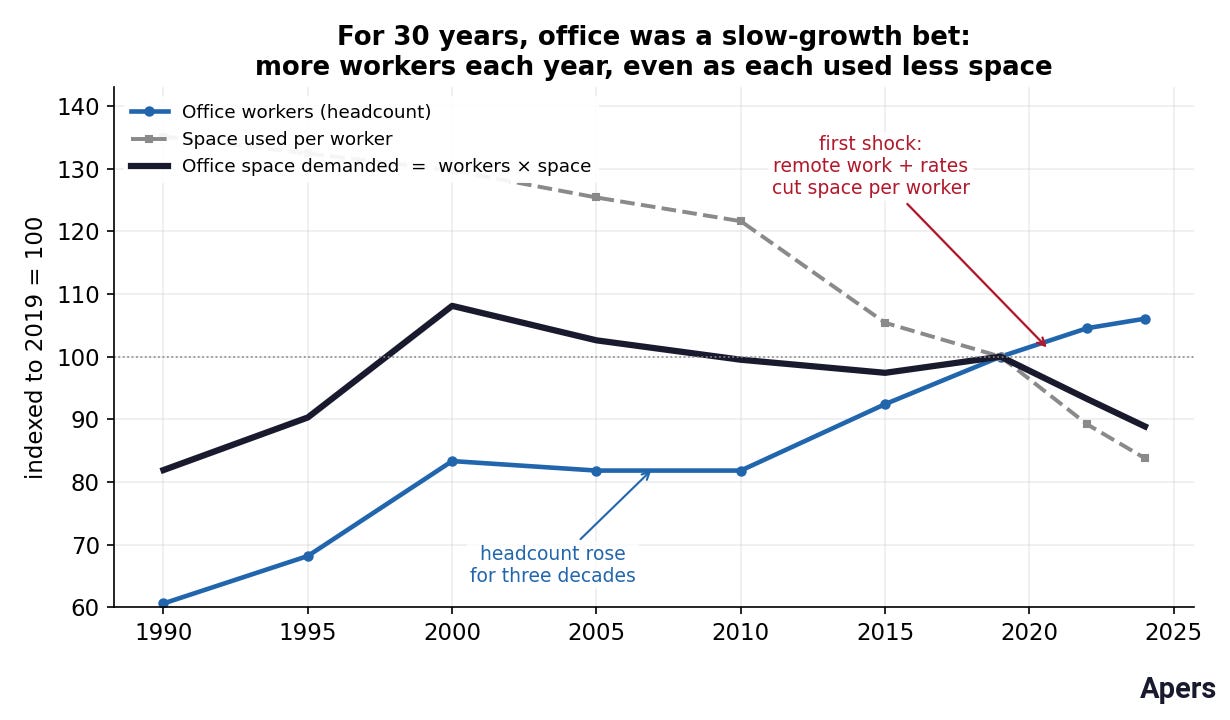
And now the equation shows you something that plain words tend to hide. Carol was never really betting on offices. She was not even betting on jobs. She was betting on a relationship between two numbers: that the top of the fraction would always outrun the bottom. That bet had a two-hundred-year winning streak.
Which raises a question the winning streak let everyone skip for two centuries. Why did the top always win?
This is the part I could not stop thinking about, so stay with me, because the answer is the soul of the whole thing.
Humans and machines had a deal
For about two hundred years, humans and machines had a Deal.
Nobody wrote the Deal down. Everybody honored it anyway. The Deal went like this: a machine could take over a task, but a human still had to stand one step above it, aiming the machine, judging what it spat out, deciding what to do next, owning the result. The spreadsheet would do the arithmetic, sure, but a person had to know which numbers mattered and what the answer meant.
So whenever a machine ate a task, it did not push the human out the door. It pushed the human up, onto the next step, the one the machine could not reach. Cheap calculation freed people into analysis. Cheap analysis freed people into judgment. There was always higher ground, just past where the machine could climb, and the freed-up worker climbed onto it. Multiply that across the entire economy, and that upward climb is the reason the top of the fraction kept exploding. Every machine created a new floor of human work standing on top of it.
The Deal, in one line: machines take the low ground, humans climb to higher ground, and there is always higher ground.
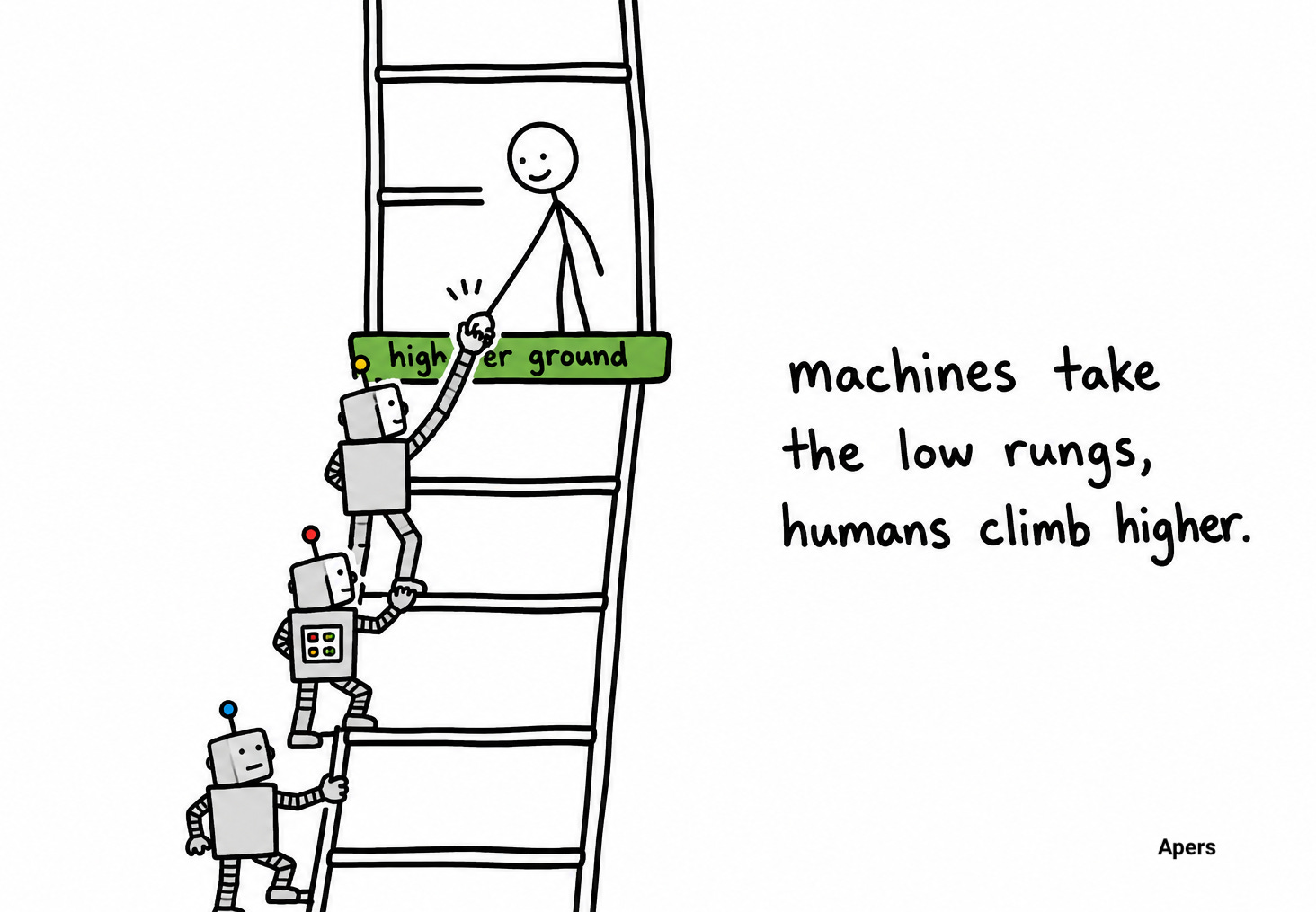
And the Deal held on exactly one condition, which almost nobody said out loud because it never needed saying. The machines cannot climb. As long as there was always one more cognitive rung above the tool, a place where only a person could stand, the people stayed employed, the fraction kept growing, and Carol’s tower kept filling up with bankers.
Read that condition one more time, because Carol’s forty billion dollars is sitting on top of it. The whole bet was safe for as long as, and not one day longer than, machines could not climb the ladder by themselves.
You can probably see where this is going.
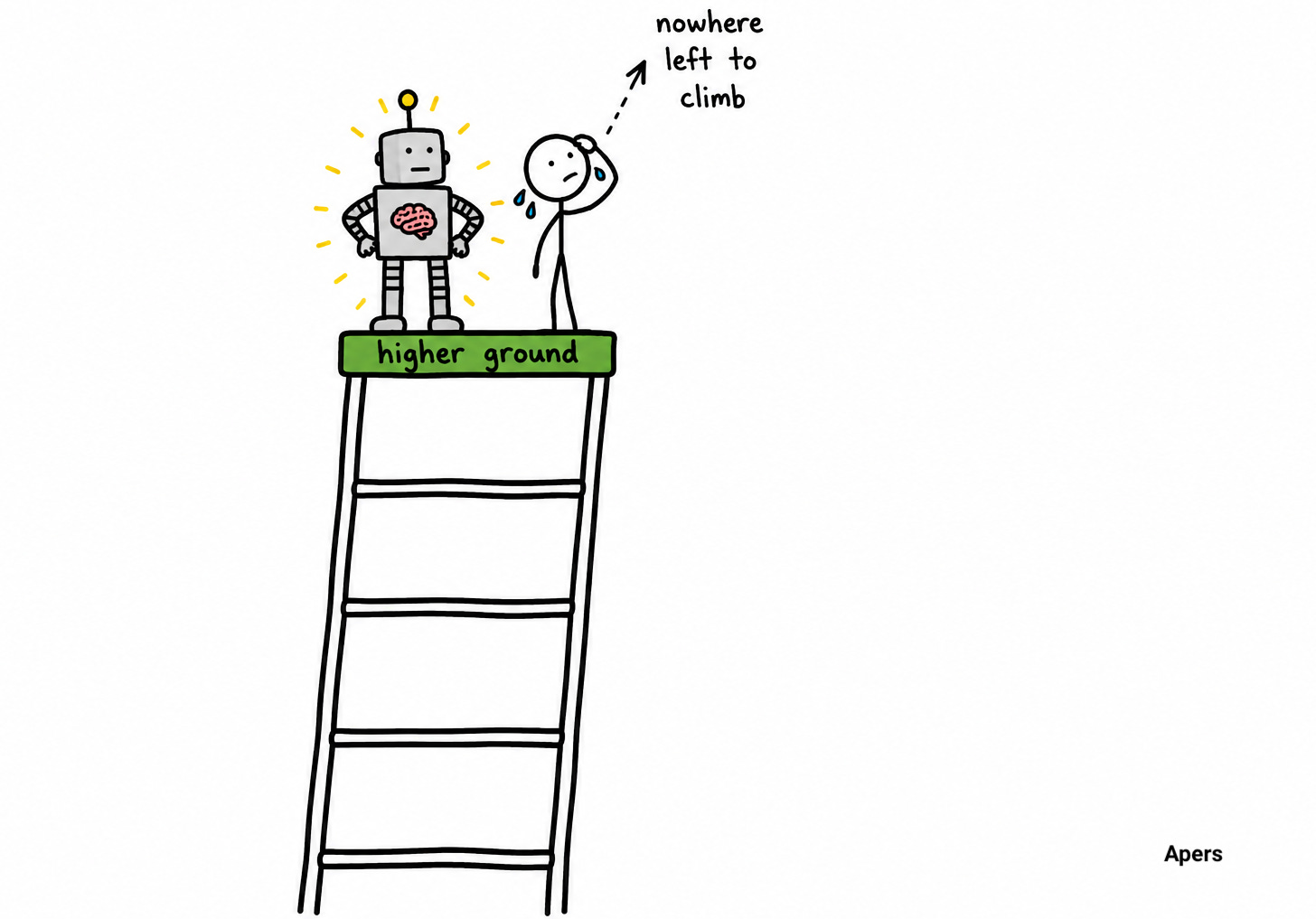
AI is the first machine we have ever built specifically to climb the ladder.
So about that one condition
The good thing about having a real equation is that you do not have to argue about AI with your hands. You can just take each piece of the equation and ask, calmly, what AI does to it. So let’s do that, one piece at a time.
Space per worker. Already hit. This is the crash you have already lived through. Working from home in 2020 did not touch the fraction at all, because the bankers and lawyers kept their jobs, so headcount held steady. What it hit was this last piece. People came in three days a week, then two, companies quietly let leases lapse, and space per worker fell off a cliff. Then 2022 interest rates blew up everything bought with debt, which was most of it. That is the famous office crash. It hit one piece, it is mostly baked into prices now, and the bleeding has slowed.
Quick aside, because it matters for whether Carol was a fool. By late 2021, the market had already priced in the work-from-home hit. What actually destroyed people was the interest-rate shock stacked on top, which nobody in 2015 could have put in a spreadsheet. Carol saw the obvious blow coming. The thing that got her was the ground moving underneath it.
The bottom of the fraction, how much each worker gets done. AI shoves it straight up, harder than any tool before it, and for the first time it shoves at the judgment and the next step, the exact higher ground that used to be the human’s safe perch above the machine.
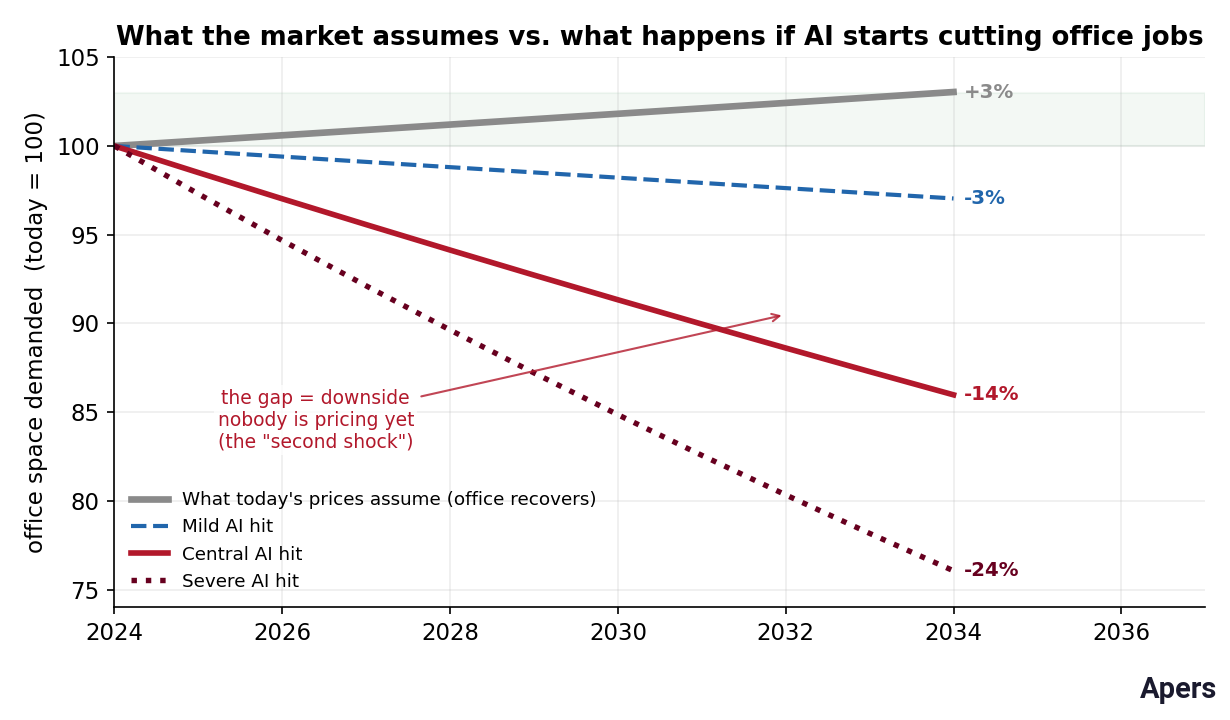
The top of the fraction, work to be done. This is the only piece still up for grabs, and Carol’s entire future hangs on it. When AI lifts the bottom, does the top race ahead to keep up, the way it has for two hundred years, so the fraction stays full? Or does the work stay roughly where it is, now done by way fewer people, so the fraction shrinks and the desks empty?
That one question is the second shoe, and right now the market is pricing it at zero.
Now, you might be thinking: hang on, the AI jobs apocalypse keeps getting promised and the unemployment rate is fine. You are right, and I want to be straight about it, because the loud version of this story is everywhere and most of it is junk. There is no white-collar job collapse in the big numbers yet. What there is, is an edge starting to fray, and it is the exact edge the equation says should go first. The bottom rung. Workers aged 22 to 25 in the most AI-exposed jobs have already seen their employment drop about 16 percent relative to everyone else. Young software developers sit nearly a fifth below their 2024 peak. AI is not coming for the senior people first. It is quietly removing the entry-level rung, the one that used to turn graduates into the very headcount the fraction is built from.
The same equation, two completely different answers
Run the equation across the whole stock of buildings and it does a strange thing. It does not give you one answer. It gives you two, and they point in opposite directions.
Picture the workers who survive the thinning. Fewer of them, more senior, more valuable, and their companies want them in the same room, in a place that does their best work justice and helps recruit the next ones. Those companies fight over the best towers, the ones with light and a good location and a cafe that does not depress you. For trophy buildings, the fraction holds, and space per worker might even rise as a few precious humans spread out. Some hit record rents in the middle of a so-called office apocalypse.
Down the street, the older building, the one whose whole reason to exist was to hold a lot of ordinary workers at a reasonable rent, watches its fraction fall through the floor. It loses tenants, then financing, then any future at all. It does not get cheap and find a second life as a bargain. It empties out, gets converted into apartments if its owner has the cash, and gets demolished if not.
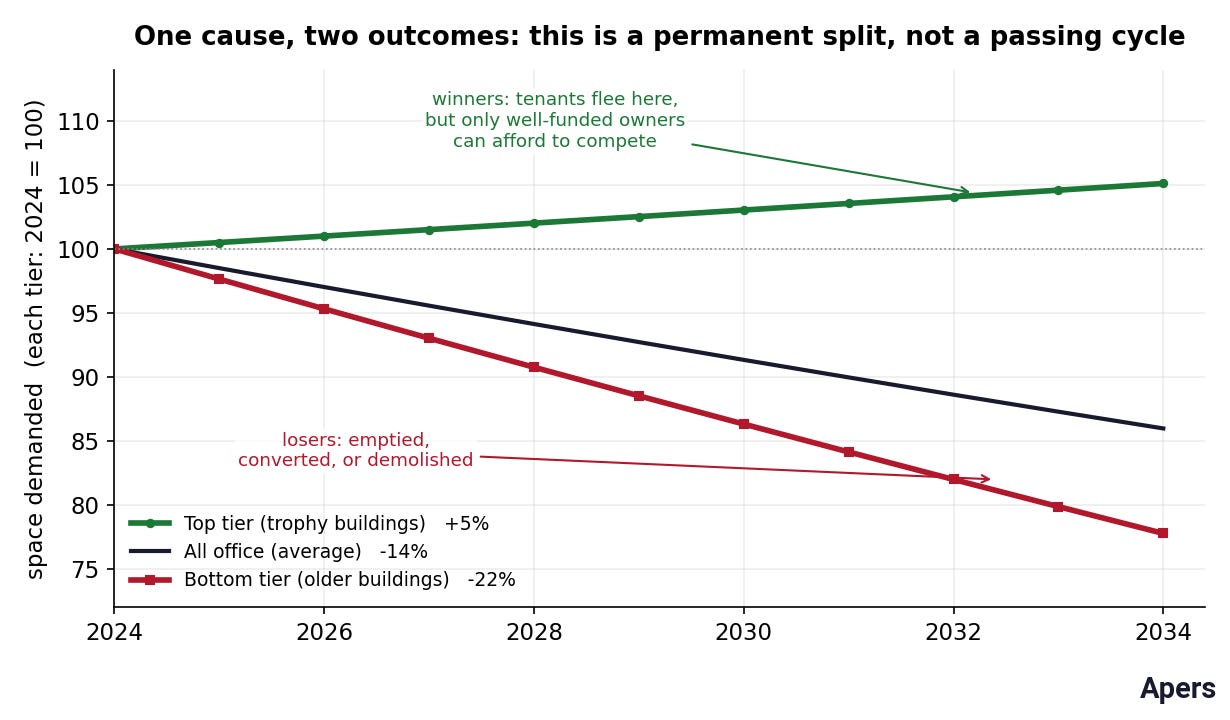
One cause, two opposite outcomes. People draw the shape as a K. And the K is the giveaway that this is structural and not just a bad year, because a normal cycle drags the whole market down together and then lifts it back together. Only a change in the actual terms of the equation rips it cleanly in half like this.
Wait. This was never about offices.
Up to now we have been reading the equation as a fact about office buildings. It is not a fact about office buildings. It is a fact about anything whose income depends on how many knowledge workers there are.
Swap the left side of the equation. Take out “office demand” and put in the revenue of the sandwich shop jammed into the base of Carol’s tower. Or the contract to clean forty floors every night. Or the commuter rail line whose entire reason to exist is the towers filling up each morning. Or the software company that charges by the seat and quietly assumes the seats keep multiplying. Or, one level up from all of them, the city itself, which wrote its whole budget around a downtown packed with high-earning people who pay taxes and buy lunch.
The right side of the equation barely changes. Every one of these is the same fraction in a different outfit: money riding on a rising count of human knowledge workers.
Carol’s tower is just the loudest member of this family. It is the most expensive, the most heavily borrowed against, and the only one with a price stapled to it that updates in public every quarter. So when the thing underneath the whole family starts to shift, the office is the one that screams first.
What the equation was measuring the entire time
Now strip the equation down to the bone and ask what it has actually been tracking, all these years.
Office value goes up and down with the amount of paid human thinking that needs a place to sit. That is what the whole asset class is. It is a meter. It measures one thing: how much the economy pays for human cognition.
A falling office value is that meter twitching. It is the price system noticing that the premium it has always paid humans for thinking, the premium that filled the towers and the sandwich shops and the trains, is starting to leak out.
And I promise you this is not a metaphor, because you can watch the money physically move. The same pools of capital that spent decades building towers to house human minds are now building windowless sheds in the desert to house GPUs. Office construction has fallen to its lowest in years while data center construction goes vertical. A dollar that used to become a desk is becoming a server rack. The returns to thinking are relocating, in poured concrete, out of the buildings we made for human cognition and into the buildings we are making for machine cognition. The office crash is the shadow that move throws on the wall.
We can even put a rough number on the one piece still in play, and this is the chart that holds the whole argument in one picture. It turns on a single dial: of all the time AI saves a company, how much do they pour back into doing more work, which keeps the top of the fraction climbing and the desks full, versus how much do they just keep as a smaller payroll?
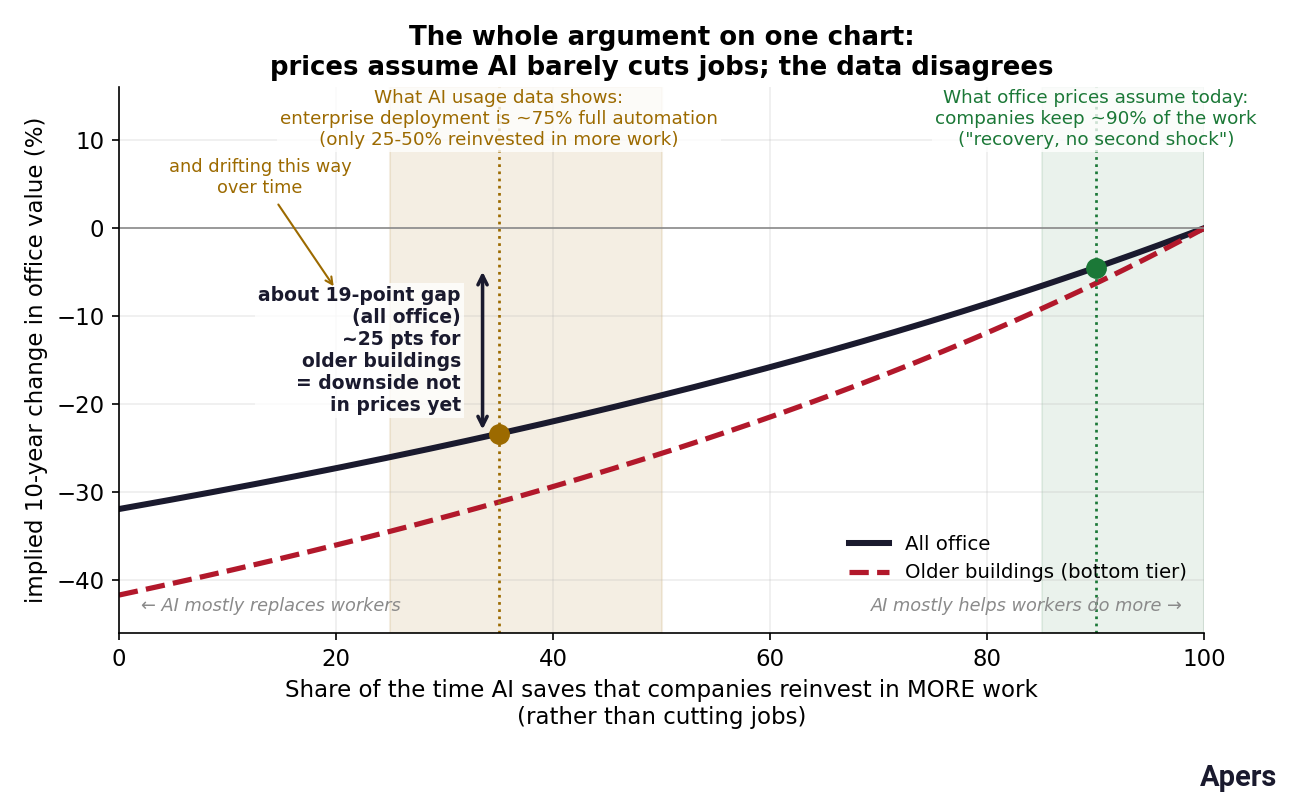
Today’s office prices sit far to the right of that dial. They are a bet that companies will pour almost all of the AI savings back into more work, that the Deal holds, that the next rung is still human. Then you go look at how AI is actually getting used inside real companies, where enterprise deployment runs about 75 percent full automation, the hand-it-the-task-and-take-the-output kind, not the friendly sit-beside-you-and-help kind. The dial the real usage points to is nowhere near where the prices are. That gap, very roughly 19 percent of value across office and closer to 25 percent for the older buildings, is the second shoe, still unpriced, sitting on top of the crash that already happened.
One honest catch, because the sharp reader is already raising a hand. You cannot read that dial to a decimal point. Going from how people chat with an AI to the labor content of the entire economy is a real leap, and anyone who hands you a precise number is bluffing. But you do not need a precise number. You only need to notice that the market’s number is sitting outside the range the evidence allows. The bet baked into office prices today is not “AI will be mild.” It is “AI will behave like every machine before it, and keep the Deal.” That is a specific claim, it can be proven wrong, and it gets lonelier every quarter.
Apers Insights is a reader-supported publication. To receive new posts and support my work, consider becoming a free or paid subscriber.
Carol’s real trade
Take the elevator back up to the street and stand next to Carol in 2015 with her gleaming tower, and let’s finally say what she was holding.
A long bet on office was a long bet on the size of the human knowledge workforce. Which was a long bet on the Deal, the two-hundred-year truce where machines complement minds. Which was, although it appeared on no page of the contract, a short bet against the arrival of a machine that thinks.
For seventy years, “long the economy” and “short AI” were the same trade, the exact same trade, because all the growth ran straight through human headcount. More output meant more workers meant more desks. The equation tied them together with a knot. AI is the moment the knot comes undone. The economy can boom while the office dies. Output can soar while the desks empty. And Carol’s tower, the biggest and most leveraged and most public bet on the old knot, is the first big asset to end up on the wrong side of the split and reprice in broad daylight, in front of everyone, every quarter.
That is what makes it the canary. Not the most poisoned thing in the mine. The first one with a voice.
The thing that gets me about this story is that nobody in it was stupid. Carol did the careful thing, the spreadsheet thing, the thing two hundred years of history paid out on every single time. The careful thing and the catastrophic thing turned out to be the same thing, and the only way to have dodged it was to bet against the most reliable pattern in the modern economy before the pattern broke. Try getting that one past your investment committee in 2015.
And the rest of the family is still standing on the same cracked piece of ground. Most of it does not trade on an exchange, so it will not reprice in a clean number on a screen. It will reprice slowly and quietly, as a town that thins out, as a tax base that sags, as a career that loses its bottom rung, as the soft two-hundred-year assumption that making more of anything will always, somehow, take more of us.
Carol was not wrong about the building. The building is fine.
She was wrong about the Deal.
And so, still, is almost everyone else.
*On the numbers: the dial in the last chart is a simulated model, not a crystal ball. It calibrates the three-part equation to the historical record, office-using employment from the BLS and space per worker from the big brokerages, then turns the single dial and reads off the result. The point is the shape of the relationship, and where today’s prices are standing on it, not a precise forecast.
Comments
Nothing yet. Say the first thing.
Sign in to join the conversation.