
Every punk becomes an oldhead. Same goes with any other scenester: metal, indie, hip-hop, literary, boxing, gaming, golf probably. But punk especially. A certain subculture hangs on long enough for people to age into and then grow out of and that happens enough times you don’t really recognize it. From there you have two choices. You can decide the problem is most likely you, given you are old now, scratch your grey goatee a while trying to find something new you don’t hate, and when you finally find a small trace of in-vogue sonic familiarity, get a little too enthusiastic over the new Billie Eilish or Olivia Rodrigo around whatever Gen Z person you’re trying to relate to. Or you can just go out an oldhead.
I’m reminded of my oldhead mentality often, one of many varieties and pastimes. Throughout my reading of Michael Mohr’s fictional memoir The Crew, a single question kept popping up in my head: You knew this was a YA novel, you know you don’t like YA, why did you agree to review this? To answer this question, I must explain how I too became an oldhead. If you allow me to Unc out very briefly.
I had my punk phase about seven years after The Crew takes place, and a couple hours south of its setting. It was my summer of wisteria. I would hang out with my friend, let’s call him Mike, a good decade older than me who had been a punk since the 90s, driving around Fullerton and Santa Ana, peeling through alternative record stores that smelled of mold and sawdust blasting Sheer Terror and Gorilla Biscuits. It started my senior year when all my friends had either been in classes above me or else severely distanced from the end of my relationship the year before. All I really did then when the lunch bell rang was walk around, listen to music, think about some girl at some other school that was not thinking about me, checking my flip phone for those occasions she would text me and send my dopamine soaring, and maybe write some lame lyrics I couldn’t even make into a song. Then I started hanging out with Mike. We’d known each other a while from church, the same tiny storefront church attended by X guitarist Billy Zoom. He’d give me albums to listen to, bands I wouldn’t have heard otherwise, and we’d text about it. Eventually he took me to see my favorite band, Suicidal Tendencies at the 2007 Sounds of The Underground Tour.
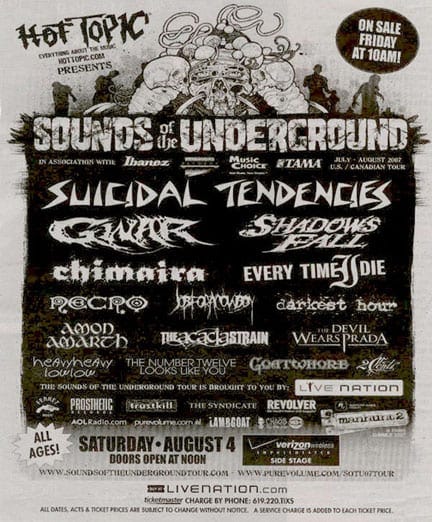
From the second they opened with the main riff of “You Can’t Bring Me Down,” and the pit nearly fifty feet wide opened up around me, I’d entered a new stage of consciousness, a high that couldn’t be matched with the thickest line of Colombian snow. From there I was hooked, in a span of nine months Mike and I went to all the local punk shows: TSOL, Narcoleptic Youth, DI, Agent Orange, Adolescents, Social Distortion, Anti-Nowhere League, Dropkick Murphys. Some of these bands I would talk to on Myspace. Jack Grisham told me to fuck off in so many ways (that I may or may not have caught onto), but then he’d tell an interesting story or two. Rikk Agnew, still known as a legend who had penned many of the era’s classics across many bands (“O.C. Life,” “Kids of the Black Hole,” “Only Theater of Pain”) drove up to my house on his way to the recording studio just to visit and give me some merch. My mother wanted to know what I was doing outside for so long, and I didn’t have it in me to tell her I gave our address to some guy on the internet claiming to be Rikk Agnew on Myspace. When Chickn, the guitarist of D.I. was diagnosed with cancer, most of those bands all got together to put on a benefit show for him. The Galaxy Theater was packed full that night, and bands and audience alike all hung out together at the venue and the whole thing felt more like a party of tight knit friends than anything so commercial as a “concert.” When Casey Royer posted on a bulletin telling all us young ones to surf instead of messing with hard drugs, and I messaged him and said that I didn’t know how to surf (not that I was doing hard drugs either, but for some reason that felt embarrassing to admit). The manager of the band page saying Casey would teach me. I was elated, but I was moved to Ohio before I could take him up on it. This was a couple years before Casey OD’d on heroin in front of his 12 year old son. The point is, all this for me was special. It didn’t matter that the scene was 25 years past its “moment” – I didn’t care that the drunk women in “pervert nurses” outfits hitting on me were about 15 years past theirs either. This was in the late 2000s, a good quarter century after any of these bands or their shows were considered dangerous, and well over a decade since police bothered with shutting them down. I wasn’t a punk; never partied at a squat house, never called myself an anarchist, never so much as dyed my hair. It wasn’t the punk lifestyle but it was a cooler lifestyle than I had before. If any of this sounds like I’m trying to establish some kind of punk credibility, trust me when I say everyone who complained about the scene getting infiltrated by milquetoast suburban kids were talking about people like me. “These aren’t real punks ,” the drunken oldheads would say. “Back in the 80s, we used to kick people when they fell down in the pit, now these pussies help each other up.”
After a year of all that I moved to Ohio and that era for me was over.

Another eight years later I moved to Seattle and sought out the punk scene again. I went to a show, maybe it was at El Corazon, possibly the Fun House, who knows what band; despite this being a far more recent memory, it’s a lot more hazy too. But I remember this: Around halfway into the band’s set, the show was stopped. A couple of cops came shrugging in, spoke with the owner outside, and about ten minutes later, the frontman got back onstage, resumed the show, and told everyone what happened. “So, uh, apparently that girl in the Forever 21 Ramones shirt got shoved in the mosh pit. She called the cops.” A couple people started laughing and the frontman continued: “It’s alright everyone, the show’s going on. Some Amazon exec just has to leave work early now to come pick up their daughter. Hey! To everyone from Bellevue, if you’re new here, don’t go in the mosh pit if you don’t want anyone to push you.”
The next day, the local Facebook groups were buzzing with the kind of 2016 discourse you would expect. A chorus of “How could that frontman make fun of that girl for asserting her space?” “Dude bros being dude bros.” “And people still think just because we’re in a progressive city that this scene for being safe for women.” And on the oppositional side, a few oldheads complaining that the scene was “woke” now, the kind that seemingly only existed on Facebook and never came to shows. I could have been one of those guys trying to “explain” the point of a moshpit, or that the whole appeal of punk was that it was the opposite of a safe space, but the desire to interact with any of those people at all had completely left me. There’s a profound pointlessness in arguing over how any subculture should be; at the end of the day either these are your people or they aren’t, and they weren’t mine.
Moreover, I was starting to get hip to the fact that you can no longer recreate the late 20th century mesoculture in a post-2012 urban environment. Every scene from that point of history onward is simply discourse.
I hear you.
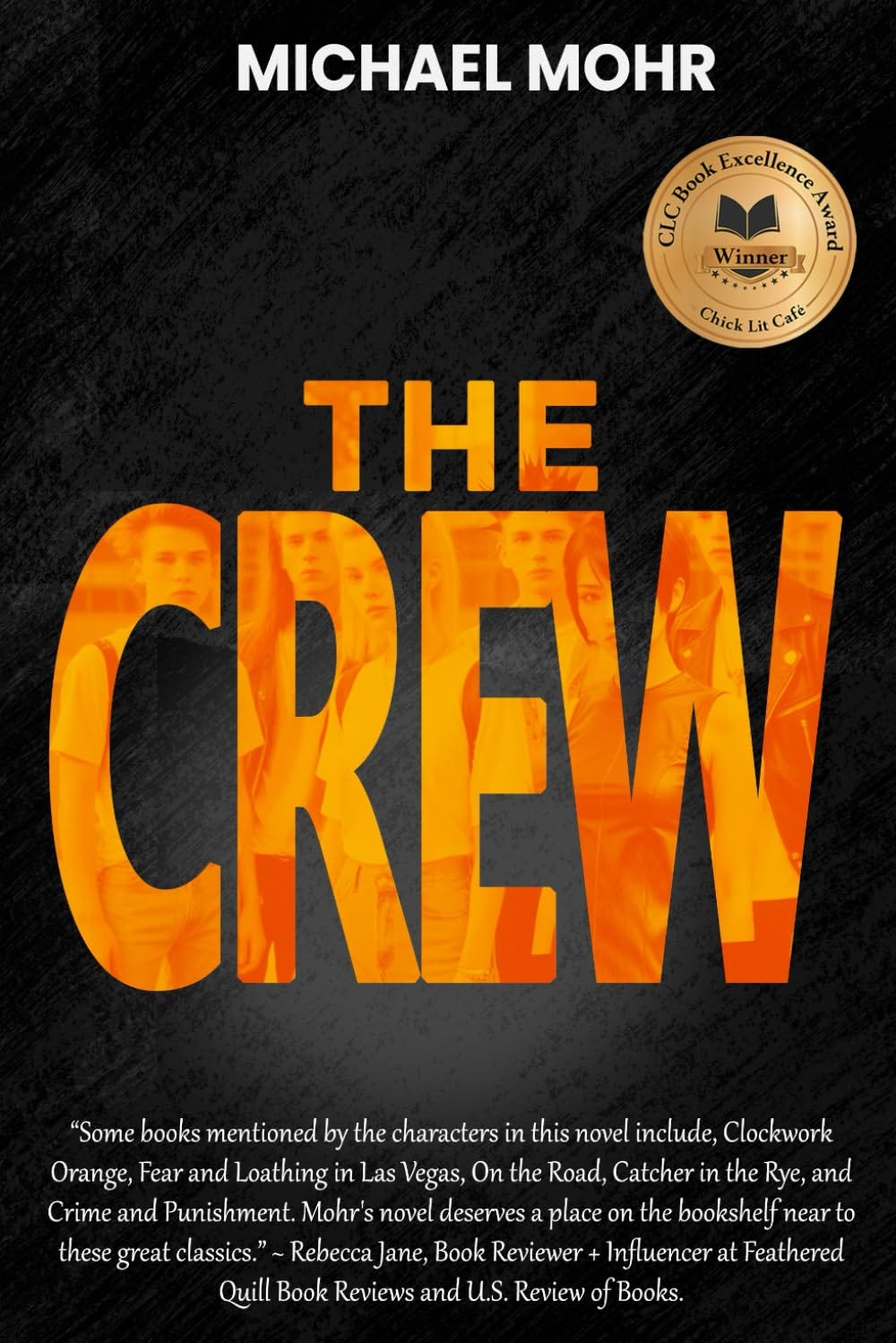
Michael Mohr’s The Crew can be read most charitably as a farewell to that particular time in life while keeping its wistfulness in check. It opens with sixteen year old Jack Donnigan riding shotgun with a kid named Demon Delorean (nickname D.D.), described as a “wild anarchist-punk-rock-rebel who took no prisoners” on their way to meet the Crew, who Jack will shortly be initiated into. Their politics are somewhat vague, identifying as “anarchists” but their ideological opposition seem to mainly consist of parents, teachers, and school. The sociopathic but allegedly charismatic leader goes by the name “Cannonball.” He is presumably inspired by Alex from A Clockwork Orange, given how often he’s directly compared to Alex from A Clockwork Orange. For reasons that are fairly obvious from the get-go but not fully revealed until later on (Jack is a nerd whose obvious desire for acceptance makes him extremely malleable), Jack is immediately accepted into The Crew. The initiation consists of him being doused in gasoline and set on fire, which he miraculously suffers no injury from. From there he is thrown into a world of DIY shows, moshpits, booze, drugs, and squat houses. His mother doesn’t like that he’s hanging out with those hooligans. His Catholic school soon also has it out for him. He meets a girl named Sarah whom he exchanges maybe three lines with before she stares into his eyes, says “Jack…” and a rapturous make out session, and relationship, ensues. There’s just one problem, Cannon has been trying to make Sarah his girl “for months.” Soon enough, Jack must choose between two lovers,1 and the chaos that ensues can be traced from his failure to do so.
For as much as they hate school, the entire crew are big fans of the high school English curriculum. After scolding Jack for not having seen Fight Club, D.D. demands he read 1984 and Brave New World as the first step to his “punk rock education.” Then he proceeds to tell his young squire about The Ramones, Iggy Pop, and Jim Morrison. When we’re introduced to Cannonball, the first thing to come out of his mouth is a quote from A Clockwork Orange, which would be referenced countless more times throughout the book. When Jack goes to his first show, Cannonball immediately starts talking about Crime and Punishment as soon as the band starts playing. A third punk named Bear, demands Jack read Fear and Loathing on the Campaign Trail. When driving off after stealing booze from Jack’s mothers liquor cabinet, Cannon yells “I feel like a character in Homer’s Iliad, like an epic hero escaping the wrath of some demon beast or something!” How far we have fallen this quarter century; you would be hard pressed to find a group of corporate accountants this well read in 2025, let alone a group of high school punks who hate school. One can almost forgive Cannon’s confusing The Iliad for The Odyssey, only the latter of which involves heroes escaping the wrath of any kind of “demon beasts.” Shouldn’t a high school kid named “Cannon” be at least a bit performative? One might be a bit less forgiving of the author himself, making this same error fifty pages later: “Like The Iliad, I’d descended into hell and returned.”
Despite the constant barrage of pop culture references, mostly revolving around the same five books: Crime and Punishment, A Clockwork Orange, Fight Club, On The Road (there’s lines such as “he lowered his gaze like Alex in A Clockwork Orange” in nearly every chapter), the Crew only seldom talks about music. They cover the basics in chapter one: The Ramones, Iggy, Morrison, and at one part they are listening to Living In Darkness by Agent Orange, a line that made the OC kid in me happy. They go to multiple shows of a single band, Unknown Society, but the music itself seems almost secondary to them, just background noise for these kids to drink, get high, break stuff, and skip school. All of that is fine, and would be true to life in many cases if these same kids weren’t so pop culture obsessed within other mediums, and if “punk” wasn’t the core of their group identity. What “punk education” instilled on a young boy in Oxnard, a city with an entire punk sub-genre named after it (“Nardcore”) wouldn’t at least include Dr. Know? Even this might be forgivable if punk identity wasn’t so core to the novel itself. How many times is “punk rock” used as a filler adjective? I marked four:
“D.D’s eyes lit up like a punk rock pinball machine.”
“She was stunning, like some midnight punk rock ghost-girl.”
“I caught the thing in my arms like some punk rock talisman.”
“We wriggled our way—like a punk rock gang—through the crowd, leather jackets and dirty, ripped jeans mixing in with the smell of boots, body odor and beer.”
Indeed, many things are “punk rock” in this novel, and one could argue that the sloppy prose embodies the sloppy playing of punk rock itself. The bigger problem might be the characters themselves. Jack Donnigan is well developed, believable and relatable, but Cannon starts as a cartoon character and only develops into a more sociopathic cartoon character. From the beginning, he demands everyone know he’s the leader, barking orders like a military captain such as for Jack to go pick a fight with a larger kid. Such blatant hierarchical enforcing would have been gauche in any punk circle I’ve ever been around, even if there was an unspoken hierarchy. It makes sense why Jack would be drawn to it, but not all the other punks. When Jack jumps on stage at an Unknown Society show, Cannon, who is in the audience and not in the band, takes it as a challenge to his leadership. It makes the whole novel seem more like a peewee biker gang drama than anything that has to do with punk rock. As for the love interest, early on Jack feels “the very serious, radiant, feeling, that there was something more to Sarah than just sexual attraction.” It is never really made clear what that is, other than perhaps being a feminist, an attribute Jack manages to dote on excessively without ever actually discussing feminism. And yet, no matter how immature the characters these are, the flabby pen of middle age always punctures through their interactions:
“What up, Dog?” he said.
“Not much, man. Kicking ass and taking names.”
Bone whooped. “That’s my man!”
From the tone of this review, you might gather that I wasn’t a fan of this book. I will admit that for the first half of it, the only thing that kept me going was snickering like a (punk rock?) mean girl at lines such as
D.D. parked the car and we entered the dragon’s lair, which consisted of an army of revolutionary energy.
A little over halfway in though, I was starting to be won over. Part of the appeal is watching Jack make terrible decision after terrible decision and knowing he would not stop spiraling until he blows up his life into epic proportions. Eventually I found myself no longer hate reading, but fully absorbed into Jack’s whirlwind of need, destruction of chaos. What shocked me further was reaching the end and feeling genuinely punched in the gut. That despite all the YA histrionics, I had just read something genuinely truthful. Though it never misses a beat piling up the coming-of-age tropes in the beginning, much of it is left out for good measure towards the end. After the inevitable fallout with Sarah, the Crew, his mother, there is no reconciliation. There is no hokey “You will always be a part of The Crew” moment, no knowing nod of mutual respect between Jack and Cannon after the latter has fully been revealed as a vile and despicable person; mercifully we are spared the tragic backstory meant to guilt us into sympathizing with him. Jack is truly on his own at the end, with the Crew to be fully in hindsight, ghosts to occasionally haunt his memory as he sets off to forge himself into someone new.
The Crew does away with many of the prevailing narratives about punk subculture, that it was fueled primarily by broken homes (a la Suburbia), revolutionary sentiment brought on by the Thatcher/Reagan era, or any one thing in particular. The idea that a middle-class kid from a safe neighborhood and loving family could be “punk” had been heavily mocked at least since the mid-80s when bands like Agnostic Front and Terror showed up and hardcore started concentrating in the inner cities and then continuing long after that scene went out of fashion. Even SLC Punk plays Stevo’s middle-class background for laughs despite ultimately being a very sincere film. On the surface, Jack Donnigan’s elation at this new world can simply be read as a typical adolescent desire for acceptance. And it is, but why to these people, why to Cannonball specifically? One thing this novel doesn’t flinch away from is the fact that contemporary life does come with severe strictures, and the life of a typical adolescent is as placid an existence as that of their cubicle chained parents. Post-Reagan/pre-Myspace youth involved constant surveillance, both at school and at home, and we have now accepted that to be a defining element of youth, as the internet comes to define it entirely. Jack Donnigan’s disaffection is treated with sincerity. The Crime and Punishment quote “Life had replaced theory” is used ad nauseum, but the crew ultimately provides Jack the portal to a fuller way of living he knows he couldn’t have had otherwise. That’s as good of a reason to be punk as any. But the punk police have their own strictures, punk too became theory, and life had to replace that as well.
I truly can’t hate this book. Its libertarian spirit and deeply felt yearning for a life well lived is too strong and too sincere. I can’t recommend it either. Without my own history, I don’t think I’d have bought into Jack’s arc. Perhaps the point of The Crew is that punk was always kind of lame, but even still, a novel should capture that lameness without embodying it. I do think this type of novel marks the end of a certain era in self publishing. You won’t see this type of clumsiness once lesser writers start relying on ChatGPT to push out their manuscripts, but you won’t see this type of honesty either. By the time Jack heads north on the 405 with his whole life in the rearview, I am genuinely rooting for him. Knowing he is an author avatar, I am glad to know he escaped not just the toxic punk scene but the placid Middle American conveyor belt of work, home, and death that drew him into it; instead enjoying life in Madrid, like a punk rock flamenco.
There’s a queer reading to this novel certainly. Towards the end:
I was so desperate for the continuation of his lurid friendship, his attention, that I would let all these things go, pretending they didn’t fully exist, in order to have another day with Cannon. What could I say: He’d taken me in.
Taken by itself, you might suspect this to have come from a Colleen Hoover novel. Cannon is as much Queequeg to Jack’s Ishmael as he is Ahab. What Cannon offers and what Jack ultimately yearns for is a queer flight from domesticity. Even the sex scene with Sarah in which Jack’s hand is “finding its way all over her bouncing breasts, tugging, tweaking, massaging” is ultimately his consummation with Cannonball.
Comments
Nothing yet. Say the first thing.
Sign in to join the conversation.