
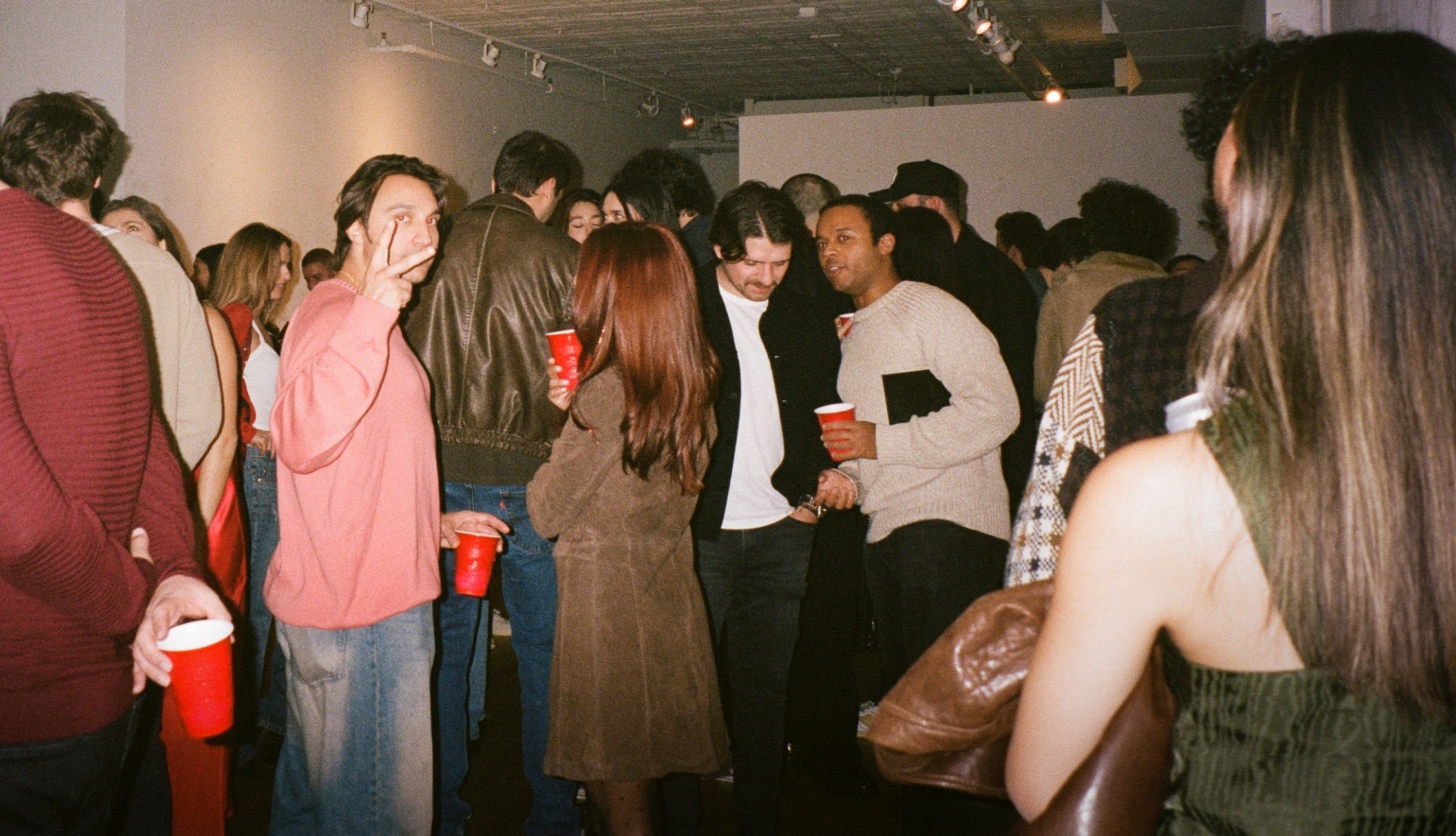
I suppose this is a thing I do now. Being invited to New York City twice in a year, having not been there in over 20 years, to hang out with the fine folks of the Substack literary scene was not what I expected out of 2025. Life can be strange. But do indulge me once again as I share my second trip to New York City, the launch party of Magazine Non-Grata, and several parties after with faces new and old, many of which you’ll need no introduction to. As before, all dialogue is not recorded but imaginatively reconstructed based on my contingent levels of sobriety and a decreasingly reliable memory. I may have exaggerated some things, misheard and misquoted some people, or otherwise rewrote their lines because I liked my version of their dialogue better. So, as you read this highly subjective and indulgent scene report, just remember: all writing is fiction.
In the month I got that notification with my name tagged in Notes, I was stricken with a creeping onset of lassitude. I had been so ambitious in the weeks before: I was going to finish and publish my 6000 word jeremiad on the horror of 2020s men’s fashion, I was going to finally write the second draft of my novel, maybe start a new one, I was going to investigate the sudden stoppage of a film mid-production by a highly revered but sidelined cult filmmaker and it would be an epic novelette length profile for The Metropolitan Review to rival the best of Sorondo’s, I was going to upskill myself into a different career before inflation swallowed my savings further and before AI made it impossible to do so, I was going to get fit again before the few remaining years I have left to do so naturally are up, do everything I had failed to do my entire life before the next two months were up. Despite my persistently low energy and general lack of organizational skills, I decided to tackle these goals one by one. Only with the most efficient and productive use of my time could I accomplish it all. So first I picked a Criterion film to watch, then I grabbed a beer, then I decided to fire up the PS4, and before I knew it, the better part of a month had passed.
I was drinking an Ayinger Celebrator and watching Zootopia when the notification came through. “Will personally guarantee you a place to stay if you come thru Adam Pearson. In case you’re inclined.” It was from Anthony Marigold, on a post announcing the launch party of Magazine Non-Grata. I assumed there was some irony I was missing here. I had never spoken with Marigold before; we had only orbited each other’s online circles. Sure, I had written that New York scene report back in May but that had been nearly six months back. Who would remember such a thing? I said “oh?” and figured that would be the end of it but then got the reply, “Will find a way. You have my word.”
To my girlfriend I said, “I guess New York is calling for my return.”
“We don’t have to keep ordering from this pizza place,” she said. “We can try somewhere else.”
“No, I mean…” I showed her my phone.
“Who’s Anthony Marigold?”
“This guy on Substack.”
“Someone you met in New York?”
“We haven’t met.”
“How is he gonna get you a place in New York? Is he paying for a hotel?”
“I don’t know, I assume he has place to crash.”
“This sounds like the beginning of a horror movie. You’re about to go to New York and get murdered.”
“I don’t think I’m actually gonna go.”
The thought was absurd. I had already planned a week’s vacation in San Diego for Christmas. That was my escape from the swamp for the next six months. No need for two escapes so close together.
“They’re trying to harvest your organs,” she said.
I mean what was the alternative scenario? That I’m such an important fixture to the New York literary scene, a city I had been to as an adult once, that people I don’t know would let me crash there just so I could grace their magazine’s launch party with my presence. Nothing suspicious at all.
We laughed the idea off and by the time the movie was over, the thought of New York had left my mind. I was fine without it. Didn’t need it. I would save some money and go there next year instead when I could afford a proper hotel with my own bathroom, not reliant on the good will of anonymous online strangers.
NEW
BY
December 13th, 2025, 6:00pm
If the sky was too blue on my first trip, if the city was a little too much what I’d hoped it would be, the cold now was something like an auger. From Manhattan to Williamsburg, I came up the steps of the subway station, with no gloves, hat, or scarf. The temp slipped below thirty, and here the light and tauntingly inert air that seemed almost friendly at first, the soft wind whispering “Why the haste? Tarry a while” became a hiss from between the alleys of cast iron walkups and newly raised condos, and I dug my hands into my coat pockets, raising the collar to protect my neck. The sun came down and a deathly loneliness pervaded the street; a frump and aging loneliness that once wore the garb of working-class bohemia and now grown up, combed its air, put on its Apple billboards and Nike retail outlets like a responsible adult to hang above its halal shops and arcade bars, but kept its printed scarf as a quiet assertion against the looming but nebulous reminder. There were no signs of outdoor life but a couple of anonymous swaying parkas a block ahead of me. I passed a darkened art noveau cocktail lounge with a solo drinker by the window, and a sprig of rosemary peeping out from his tumbler, the bartender with his back to him. The blue arrow on maps seemed to only occasionally move in the right direction. As I reached the block of the address given, I looked around, and found no sign of residential buildings, only a closed Korean fried chicken joint, an organic deli with chicken wraps and vegan food. I awkwardly passed a group sitting outside on their stoop, trying to not make it too obvious I was using my phone to get around, or avoiding them, walking around the block again fearing I might look as if I’m casing it.
The cold began to catch my throat, and I set my suitcase down, needing something to lean on. If this Anthony was a friend of someone’s whose novel I had negatively reviewed, this would be the perfect revenge prank. I began to dial the number when I heard someone say, “Adam?”
Two shrouded figures stood thinly outlined by the reticent streetlamp. The cold light brushed their anonymous frames with only the faintest distinction from the other and motes of snow floated and circled against the hems of their topcoats. One was entering a code in the gate, and the shorter one was looking at me. Except how would he recognize me? I have no pictures on Substack.
“I’m guessing you’re Anthony,” I said.
He put his phone down. “You can call me that.”
We shook hands and walked through the entryway of the courtyard, dragging my suitcase over the stump at the gate.
The taller one introduced himself as Liam.
“I appreciate you giving me a place to stay,” I said.
“It’s my pleasure,” said Liam. “I just hope the sleeping arrangements won’t be too…uncomfortable.”
“I know better than to come to New York for comfort,” I said. “As long as I’m not sharing a bed.”
“Heh.”
We walked up six flights of stairs with unadorned off-white walls. A faint smell of cleaning products. We reached the unit which seemed vast and middle class compared with my expectations of what a New York apartment should look like. I wondered what grand inheritance or soul crushing tech job he sold his soul to afford it. It soon became apparent as more and more men in cashmere shirts, stylish jackets, reared their heads from various small rooms that the unit was a small village. There were bookshelves with Booker Prize winner and NYRB editions. Raymond Carver, Jack Kerouac, Bresson’s Notes On The Cinematograph. We all talked fondly of the Raymond Carver story, So Much Water So Close To Home. I wondered if I was actually in Brooklyn or a Hollywood set for a show about Brooklyn. I was half expecting Hannah Horvath to come barging through in neurotic ecstasy searching for a previous month’s fling to unload upon. On the table was a stack of Magazine Non-Grata’s inaugural issue and a case of Coors Light. They offered me one from the case and I drank it. It was one of many things I’d learn to get cool with. It wasn’t as bad as I anticipated. I drank another. There was a shorter man with long hair that went by “Milk.” A giant golden retriever named Findlay humped an ottoman with a vigor unmatched in the most popular BookTok romantasies. There was a happy fraternal spirit in the room as if a major party was underway.
I flipped through a copy of Magazine Non-Grata, impressed with its glossy respectability. “Love the photographs, and the layout. It manages to be modern and clean without being sterile.”
“Well, thank you,” Liam said.
“You worked on this?”
“Designed it myself. Did some of the photography as well.”
“It’s excellent. Do you do photography full time?”
“Among other things. A lot of videography as well.”
“It all feels unreal,” Anthony said. “The issue is here. The party is underway. You’re here, Brandon’s coming, this online world of ours is materializing in the flesh.”
“It’s an exciting time,” I said. Findlay had moved on from humping the ottoman to my luggage. “Even the dog’s excited.”
He ignored this comment.
“Anyways…” I said, moving my luggage from the ground to a chair. “I suppose you’ve been working on this magazine launch for a while.”
“Among other things. I got a short story collection I’m finishing up. Just seeing the best way to get it out there. Every time I look for agents and see them describing their wish lists, it’s like, I don’t even really want to know this person.”
“I’ve been on querytracker.com once,” I said. “Something about it felt like the worst dating app I’ve ever been on.”
“Pretty soon all that will be irrelevant.” He took off his coat and hung it against the chair. “The publishing conglomerates have their sad little algorithms they put their faith in telling them what to sell, but they can’t sell anything. They sold their soul but for what? They’re losing their grip. We’ve got hundreds of people on the RSVP and no major publisher behind us.”
He spoke with neither the tortured weight of a too big axe to grind nor the reveries of one plagued with visions of shooting faster to the top than he actually is. He has a soulful, deliberate way of speaking, as if every piece of phenomena he observed was touched with Greek fate. For some reason I anticipated him being older, whiter, and balder. Perhaps because of his love for Henry Miller. He had black, shoulder length hair, swept back like a 90’s alternative singer, with the ghostly and whimsical eyes of Jeff Buckley. He wore a coarse woven off white sweater with thick black horizontal stripes like a long-buried ancestor of the Addams Family. One can imagine him having dwelled in the dirt for a hundred years and dug back up again by a descendent who planned to reanimate him only to find he had remained conscious all that time, and in that time, having witnessed wars of angels, the rise and collapse of civilizations, the severance and unmooring of all symbols from which those civilizations were founded upon, the disintegration of all words from their referents, with all that poetry inside him melting, waiting in its unremembered remembering until he can fully enter a new earthly being, only to then be dug up, to have forgotten it all, to have to spend his days wandering.
“In Boston, I live like a hermit,” he said. “I don’t do things like this often.”
“I’m surprised,” I said. “All your literary influence points to the ideal writer being the hard drinking, womanizing, rambler.”
“I did that for a long time, but I needed to be alone to find myself.”
“I’ve been something of a hermit for three years now,” I said. “And I know myself now less than ever. Who is anyone outside their relation to others?”
“Your orientation to others is your undoing. An artist has to face silence before he can face himself. What does an artist that can’t face himself have to offer? Morals, twitter takes, discourse novels.”
“I suppose.”
“It seems to have worked for you alright. I’ve read your writing. Tell me, do you think the great masterpiece of the century will come from Substack?”
“I think it can. It’s free of much of commercial administrative mechanisms that flatten contemporary novels. But is there a Faulkner or Joyce on Substack? I don’t know. Haven’t found them if so.”
“What do you think comes closest?”
“To a masterpiece?”
“Yeah.”
I had to think for a moment. “Well, I never got the chance to finish it, but probably Major Arcana.1 Seemed like the best written at least, with the most to sink your teeth in. But if you’re asking my favorite, I’m going to have to be cliche and say, The Wayback Machine.”
“That was a great one.”
“Well, what’s your pick?”
“Off the top of my head, American Pleasure by Judson Stacy. Some of the most beautiful writing I’ve come across this decade.”
“I haven’t read it. He seems like a nice guy though. We’ve talked some.”
“You’ve got to read it.”
“But is it a masterpiece?”
He shrugged. “Time will tell. But the next Moby Dick is coming from an author on Substack. That I know.”
Milk and Liam went out for a few things while Anthony heated something up from Chipotle. I was glad I had stopped at Mama’s Too earlier and wished I had gotten another slice of cacio e peppe. When they returned, it was time to go to the party. Each grabbed two stacks of magazines and booked it down the stairs. I grabbed some myself and descended what felt like leagues upon leagues of stairs winding down an endless vortex, huffing heavily by floor six, or maybe twelve, juggling the stacks atop my gut to avoid toppling into my oblivion. I reached the bottom and dropped the stack among the others and leaned against the wall. It’s no wonder there’s no fat people living in New York. As Anthony sauntered breezily down with a 12 pack in one arm and a stack in the other, I made a halfhearted gesture of going back up to grab more, and to my relief he shook his head saying, “that’s it.”
Our uber idled patiently as we stuffed it full of booze and magazines until the trunk could hardly shut, and soon we were over the bridge into Manhattan. I drank some kind of hard cider. It was too sweet. I would have rather had another Coor Light. I asked Liam more about what he did, what he wanted to do. Somehow, he was making Williamsburg rent strictly through freelance. His real dream however was making a film. He said it in a way that implied he had been contemplating it for a while, but before I could inquire further, we were let out.
Brandon Westlake was with us now, dazed from the days on the bus from Toronto to Newark and now here. He helped carry our baggage to the gallery with ease. Then we left to get more booze and chasers. The multiple gallons of vodka, bourbon and tequila would not be enough. I texted Alex Muka, “Bring some booze! I don’t know if it will be enough.” With Brandon I discussed William Faulkner and Cormac McCarthy. According to his own scene report, while I agreed that Faulkner had the wider range as a novelist, and the best of use of character, that Cormac was unbeatable by metrics of sheer force of language. It is true that I may have ceded the closing pages of part one of The Crossing to be the most beautiful of any of their passages, Cormac perfecting upon the foundation Faulkner had set up for him, but only a hair could that remain above the heights of Absalom, Abasalom or even The Bear, and his advancement from Faulkner doesn’t go nearly as far as Faulkner’s advancement from the language of Joyce and Conrad.
Something about Brandon reminded me of whoever that actor was that played Huey in The Boys. It’s a certain bone structure and way of speaking. A sort of elevation from the classic nice Midwestern boy. He walks with a mannered precision, waits for the crosswalk signal before crossing the street even with no cars nearby, apologizes to the homeless for not having spare change. But it’s deceptive niceness, a congeniality that comes from the ease that he could kill you if need be. You would hear the click of a pistol hammer before a cross word. From the sleeve of his jacket, you could see a tattoo starting on the back of his wrist that continues up until at least his forearm. I never asked he was military, but it seemed off if he wouldn’t be.
At the corner store, Anthony asked if I could grab some seltzer water. I took three or four from the shelf until I spotted individual pints of Samuel Smith Nut Brown Ale and had to abandon the mission. I could only carry so much. Nowhere can I find any of that where I live, brown ale is heavily neglected in the U.S because it’s too refined for the American mass-produced pilsner drinkers but doesn’t insist on itself the way an IPA does. A taste of a proper brown ale, and God smiles upon he who comes across a real ask of it, is the taste of old English austerity. It’s the type of beer of Milton wrote poetry about, and Samuel Johnson drank between eel pies when critiquing Milton’s excess. I was explaining all this to a girl in a long leather jacket and some guy she was back at the gallery after I’d had a few of them. They said, “Yeah man, it’s pretty good.”
The DJ came in to set up along with the bartender, a short young woman of some type of Slavic descent. She looked vaguely familiar, might have been a Substacker I had previously come across, but was I to assume everyone here was a Substacker? Am I just going to ask people what publication they write? Of course not, she was probably just some random girl.2 But before I could socialize any further, my belly had grumbled again, and I ducked out to find the nearest slice on Google Maps. See you when I see you. I went into the night intending to come back only once the party was in full motion.
The Full Motion - 8:11 pm
I’ll admit I was doubtful of the choice of venue initially. The thought of a gallery brought to mind finger sandwiches, boxed wine, and cardboard conversation. I’ve been at a few of these in New Orleans and there’s never much to do beyond look up at the Michalopoulos painting of some French Quarter mansion, stroke your chin while extending your attention beyond what the work demands, until someone in your party decides on a ninety-dollar 8 x 11 print and everyone can leave. There was no artwork hanging in the LES space gallery, only the overhead lights illuminating a sea of white. The artwork was everyone who came to be seen; further adornment would ruin the framing. Those shuffling in with their corduroy and puffer jackets both subject and object. The magazine, a prop.
Lillian was among the first of the people I recognized, though she understandably did not recognize me. Only retroactively do I realize the missed opportunity to have introduced myself as Worst Boyfriend Ever. We exchanged the usual pleasantries and something about her felt stiff. She hardly moved. She held her drink card still against her chest like a crucifix, tapping it with her leather index finger, her gaze fixed. Her husband was a larger man in all black, friendly, with a short grey beard and the aura of Santa Claus. I complimented Lillian on her short story for Stop Asian Hate, and to my surprise, she had read my story in The Metropolitan Review, The People Imagine A Vain Thing. Her husband was a reader, not a writer, but joked that he ought to write just to compete with her. I made an awkward joke about competing divorce memoirs, referencing Emily Gould to blank eyes. The whole exchange wasn’t going so smooth, and I used my empty cup as an excuse to dip towards the bar, where I saw a man in a plaid overcoat and big ears protruding beneath a Yankees hat. “I thought this was a classy event. Who let this guy in?” I said.
“It’s Mr. Highbrow over here,” Alex Muka said in his New Jersey croon as he turned around.
We embraced, and he got me a beer. Miller Lite.
“That’s a nice jacket there,” I said. “When did you get a sense of style?”
“This shit? My wife picked it out. I don’t wear shit like this.”
The heat was turned up to seventy and we made our way to the coat room. The racks were so stuffed with fog and puffer that you couldn’t see them. I threw my pea coat on top of the pile. We spoke to a guy in a varsity jacket who looked to have wound up in the Lower East Side almost by accident. “I’m no writer,” he said. “But I like to read. Jonathan Franzen. Graham Greene. Mostly I just played football and then I played music. That’s enough hobbies for me. Look at the chicks that go to bookstores and look at the chicks that go to shows. I know where my game is.”
“What kind of music?” I asked.
“Well mostly I play acoustic guitar and…”
“Nah,” said Alex, “Tell me about the football. Too many nerds in here, give me the sports.”
“Mostly played in college. I was a pretty decent linebacker until I fucked up my knee and they…”
“Boring,” I said. “If I wanted to hear about football I’d have stayed in the south.”
“Well, I was doing sort of an early John Mayer thing with a little Noel Gallagher. I’ve only really played in coffee shop so far but…”
“Gay,” Alex interjected. “Acoustic guitars are for soft boys.”
The man mostly rolled with it. “We actually went up against Michigan…”
“Boring,” I said.
“…with a Yamaha…”
“Gay,” Alex said.
I stepped out from the coat room and the entire gallery was packed boot to boot like ants on a discarded soup can the conversation from all around ballooned into almost a single identifiable sound, engulfing even the hip hop blasting from the speakers. Pretty soon everyone had to shout to hear themselves. The show lights were working overtime against the outside cold as even without my jacket I was beginning to sweat. Every three feet I took I somehow wound up in a new conversation. Everyone appeared an elaborate portrait, a promise to be seen fulfilled, wanderers finding a quick refuge of reconciliation. It was as if a violent magnetism radiated from every soul, as if I’d been spiked with molly. The whole world inside that gallery seemed fun and interesting and every human a delight. There was nothing of the tapered off cliques you would expect at this sort of thing. It was as if the wall in our psyches delineating friend, pariah, or wallflower. Around me I heard conversations ranging from Hegel to mysticism to Luis Buñuel, the downfall of New Yorker, Andrea Long Chiu as a closet Nietzschean aesthete. All this among other fragments: “And so I just asked like as a pure hypothetical if he could nuke any country on the map which would it be and he was like ‘none’?’ And it’s like, I don’t really know how to relate with the kids anymore” and “whoever that Moravagine person is has to be the saddest, most miserable man alive.” “you think that’s a man? the writing style codes female for me.” “no the writing definitely codes male.”
I made my way to the bar and asked for a gin and tonic. No more tonic, just gin. That was fine with me. Once they were out of that too I switched to bourbon on the rocks and talked to some guy that from a short distance looked like Tiny Tim. He wore all black denim, with long black parted hair that made me nostalgic for the mid 2000s. He looked to be about my age. I asked what he did. Music? A Novel in the works?
“I’m a software engineer,” he said. He could see that I wasn’t satisfied with that answer and said, “I write poetry too.”
“Where can I read it?”
“Well, it’s not published anywhere.”
“You could publish it on Substack.”
“What’s that?”
I never know how to answer that question, and I always make a farce of attempting to. It makes for awkward conversation anytime someone’s asks me what I’ve been up to.
I found Brandon Westlake again and we talked some more. I was perhaps six drinks in at this point, and despite my earnest attempt to not go in any drunken monologue, the topic of our creative projects had come up. “I mean yeah, I guess I was a musician for half a decade but I didn’t even record anything. So why even mention I was a musician? No evidence of those years at all except a few photos at some shows. So then I became a writer. Except, why even mention that either? That novel I worked on for two years probably won’t see the light of day. So I guess I’ve done nothing, and now my life is half over.”
“Ahh,” he said in an awkward tone of consolation. “Don’t say that. You’ve got a lot of life left in you.”
“I’m thirty five,” I said, as if making an unassailable counterpoint.
“You know what might help your writing? Actually, I’ll tell you what every modern writer could use: a reacquaintance with the symbol.
“You mean like Jungian psychology?”
“Jung is important to it but I’m not talking about psychology. I’m talking about the symbol and the role it played in myth. Writers like Joyce, Faulkner, McCarthy, all of them had the symbol deeply ingrained into them.
“I think they all just really knew their Bible and Greek mythology.”
“They did, but that’s why they had such powerful use of the symbol. The symbol is at the raw center of myth. It’s more primal, stripped down. The modern writer has lost touch with it. We can still read Homer and Dante, but not the way they read Homer and Dante.”
I told him to send me some essays on it in a few days when I was sober, and we migrated back towards the front, joining Lillian, her husband, and Alex who seemed in the midst of a flowering bromance.
To Lillian I admitted both my neglect and curiosity of Saul Bellow and Nabokov. “I have Lolita, I’m just never quite in the mood to read about that particular topic. And though I hear it’s not the best entry point, I also have Ada, or something.”
“Or Ardor?”
“That’s the one.”
“Yeah if the whole pedophilia thing is what you’re trying to avoid, maybe don’t start with that one.”
The conversation soon moved to Bellow. Her eyes widened as she explored the incest in his work as well and the deeper connections the two writers had to incest as a whole. I don’t know how to describe this reverie she was in, not professorial, something more wide-eyed and obsessed, the sort of frenetic disquisition you might hope to find in a half century old issue of NYRB. She was winning me over now. Her unshifting posture and gaze which I had before attributed to a sort of awkwardness now revealed itself the product of unflinching presence and attentiveness that rarely seemed out of place before COVID and never before the smartphone. Some people who look at you really look at you, listening, waiting to put your foolish thoughts in their own scene report,3an endangered species in our era that you don’t realize how much you miss until you come across one.
I asked her about her novel.
“It’s kind of hard to talk about,” she said. “I don’t really have an elevator pitch.” And sure, we all like to pretend we don’t like talking about the thing we spend 90% of our time thinking about. Words about works in progress are all imprecations of a sort, so the instinct is healthy, but then most people will talk on and on about it once they truly feel to have adequate permission. But Lillian did seem like a deer in the headlights then, and talking about it seemed like a genuine torment. When an opening for a different topic came up between Alex, Brandon, and her husband, she jumped like Butch Cassidy and The Sundance Kid.
What I did get out of her was something that seemed like typical Sci-Fi genre fair only in the briefest summary: colonized planets, Martians, starship battles, a paradox onsetting technology. Fine, I don’t remember the specific premise and I never do —even in bookstores I’m more likely to flip to a random page to get a feel for its prose long before I’d read the flap — but the form itself is more like a midcentury literary novel. Very interior. Very day in the life. The narrator suffers the banality of the day to day. Presumably, he’s going to have some affairs. Has anyone attempted this before? I’m sure of it. But this sounds unique enough I would prioritize reading it over many better hyped Substack novels and given her deep immersion with the great 20th century stylists, she just might be the one to pull it off. So, we shall see.
The music cut off and the room went quiet; all had gathered towards the rear portion of the gallery in murmuring anticipation not for the readings, not even for the personalities who would get on stage and read them, but simply for anything that might make the remotest gesture towards the momentous. So ravenous these sidelined and disaffected of the freefalling creative class who had come from East Village and Williamsburg and Toronto burrowing through the heart of every Saturday night in search of a new geist, so free in that blanket white space of sweat, liquor, cocaine and bodies that Anthony, washed of any inward theatrical burden in that instance of stomp and echo and speaking to the crowd with the same hushed normalcy he spoke with in the apartment earlier, was riposted by a crescendoing pandemonium making him into the carnival ringleader of its reflection, getting louder as he began the announcements, until it became clear how little it mattered whether he was introducing a reading or the raising of Lazarus. He might have presented a windup toy from the Dollar General and the crowd would not have been less eager.
He called forth an attractive young brunette with hoop earrings and an oversized blouse with a single fastened button. Whatever skincare she had used glossed her face and refracted the overhead gallery lights. She had kindly dough eyes unsubdued by the jaded ambition which they largely concealed. I assumed she must have been in the city two years, but her personal essay revealed a decade of it on her shoulders or longer. She was introduced as “Annalisa” without surname or any indication of a pseudonym. “Post Nut Clarity on the J-Train” she began. As she described the various adventures in copulation across the city, collecting lovers “the way other women collect perfumes—each one a different way to smell like someone else, to cover the stench of my own emptiness.” The crowd gasped at her scandalous excursions, oof-ed at the sordid kinks of the men across the city, fell reverently silent at the spiritual toll it had all taken on her. It was the perfect vignette to read in front a of a crowd. Like the perfect sermon, bawdy enough to entertain, reproaching enough for the flock to feel sustenanced. Though unlike similar personal essays I’ve read on Substack and through various lit mags, the reproach seemed to be directed at the narrator herself rather than towards the audience for delighting in its titillation and thus being complicit in the author’s grander victimization. This seemed a bit more Catholic than that, a confessional that truly saw itself as the principal agent behind its sin rather than the piano key behind a more sinister force.
To stage right, I spotted James Tussing, whose searing and exquisite dissertation on the works of Alice Munro had recently appeared in the journal, Literary Imagination. Though I had met him at Matthew Gasda’s reading back in May, I had not been able to fully conjure his face until that moment. His hands were folded reverently in front of him, but upon hearing the line “I learned to use my body like a business card, networking horizontally,” he fought back an eyeroll like a squirrel hiding a secret nut.
When the speaker had finished, the crowd erupted louder and more raucous than any house show I had ever been to. Everyone clamored for more. The crowd was still ravenous; any small time musician or comedian would have killed to have gotten in front of them. That was to be the only reading, however. Anthony thanked everyone for coming and told them to enjoy the party. There was a mild disappointment at the cessation of any continued performance; myself mostly, as Alex Muka was terrified that he would have to read his “white rice recipe” soon after. I said he should go up next, partly to see him shit himself, but mostly because I knew this was the crowd that would eat it up. I suppose I was a little hammered by this point as I was more shouting than nudging. Anthony gave me a slightly remonstrative shake of the head and I piped down and went back to the bar.
In through the front door came two familiar figures, one of them the King of New York himself. The crowd turned around as he passed through as if un-parting the sea. From the tail of his blazer followed Mo Diggs, who I had spoken to once on Substack live cameras off, but had never met. He looked a foot taller than Ross and leaned down to get to everyone’s eye level as they made their way through the gallery.
I bumped into Tussing and discussed the Alice Munro story I had read on the plane. “To Reach Japan.” It was my own introduction to her work. The plot was simple enough but the deeper thought behind it that Tussing had so elucidated in his recent essays I could make heads of but not tails. Munro’s prose is simple and unadorned, but deceptively so. So many sub plots and disparate elements and the closing lines centered on a figure I had initially thought nugatory to the narrator’s overall emotional arc. I would have had to read it at least once more to have an intelligent thing to say about it, so I didn’t try. Instead, I just asked “Why Harry?” James explained showing no weariness of the topic despite the hundreds of pages he must have written on it by this point. The music was turned up now, and every other word he said was punctuated and superseded by alternative hip hop bass. He went on in his typical loquacious manner, and I tried to catch of it what I could. What is any party after a certain age but a contest of who can best pretend to have understood what they heard? From the topic of Munro, we briefly touched on opera and the films of Bresson (I was recently enraptured by The Diary of a Country Priest which I had just watched on the plane). It turns out that whatever obscure topic you might be too cagey and socially aware to discuss with the people in your day-to-day life, James is interested in it and can speak to it better than you can. Also from Gasda’s event, I spotted someone whose name I couldn’t remember but whose face I recognized instantly. I couldn’t tell if he had indulged a sniff of coke or if his eyes always looked like that.
Ross had finally waded his way into my side of the room and said, “Glad you finally made it out.”
“Almost didn’t,” I said. “But they gave me a place to crash so I figured, why not.”
Ross scoped the room. “Well, you should see what I have planned next year. When we launch our print mag finally, the party will be like nothing you’ve seen yet. Did you pledge enough for a print copy? It shouldn’t be too late.”
“Not yet. I’ll have to do that soon. Is one of my pieces in it?” I asked, not quite trusting my voice to not betray the selfish eagerness of a child going through presents under a Christmas tree to find their name on a tag.
“Not in this one…but it’s not a quality issue. Like we’re not necessarily going these are better than all the rest its more, trying to decide the best pieces, for a specific moment. We’ll definitely have one of yours come out in a future issue.” The consolation was not entirely necessary, if I were asked to name a piece of mine that was somehow more deserving than the others, I wouldn’t have been able to. Maybe the short story, probably my biggest source of pride of anything I’ve had published, which had the fewest readers but the highest praise. Whatever creative validation that story had given me with having been published, I have long used up. People congratulated me for being a “published author” months after I had forgotten about it and it still seems like a farcical label to apply to myself. Would it make any difference if I saw it on premium glossy paper?
“I’m sure it will be great. I’ll have to buy it once it comes out,” I said, convincing absolutely no one.
He went on to make the rest of his rounds, stopping to talk to Anthony. I couldn’t hear the conversation. Their postures rounded and straightened, arms wide, feet narrow, like two showcased animals that might either square up or go back to resting beside the watering hole with no real determinant beyond the afternoon heat and the progress of a hearty meal’s digestion.
Shortly after he informed me of a party going on later in Brooklyn. It was Mike Crumplar’s birthday. I had always wanted to meet him. Admittedly I’ve only read his larger pieces, like his smackdown of a Peter Vack film and the scene’s reprisal though a “fascist hate ritual” they later subjected him to. Though his work has since changed its tenor since the closing of Sovereign House that seemed to be Dimes Square’s center stage, those earlier pieces had a sensationalism and moralism that far transcended similar banal offerings of the 2010s into something almost Victorian. They were the 2020s equivalent of those chapters in Melville’s Pierre when Pierre Glendinning stays with The Apostles, a group of transcendentalist proto-scenesters. I told Alex Muka about this party.
“Who’s Crumps?” he asked.
“Mike Crumplar.”
“Who?”
“Dimes Square guy.” I couldn’t think of a better explanation.
Alex and I returned to what I now considered my core group, for tonight anyways, Lillian, her husband4, and Brandon who were talking about strange militia activity north of the border. With Lillian, I discussed a novel we had both reviewed, Social Distancing by Scott Spires. I had covered it in The Metropolitan Review and she on her Substack.
“Was your review more mixed?” I said. “I can’t think off the top of my head any flaws with that novel, but maybe there was something I missed.”
The music was still blaring, and neither could fully hear the other. Her eyes touched the ceiling, and she paused for a moment of quiet contemplation. “I guess, if I had to think of flaws…I guess in your review you spent half of the time talking about yourself. Like maybe you didn’t really want to engage with the material?”
I nodded along. She might not have heard the question right, but it was too late to turn that ship around. Besides, I’d dished out more than my fair share of criticism not to receive it in turn.
“Don’t get me wrong,” she continued. “You engage with the material quite well when you do engage with it. Perhaps you're just afraid of it? Like maybe you’re just used to writing about yourself and more comfortable with…”
I was doing well here I think, nodding along, lightly stroking my beard, appearing neither offended nor disinterested nor too affected. I should stop writing about myself so much, I agree. Even these scene reports are sending me dangerously down the path of career memoirist, which I never wanted to be, a vocation I always viewed with a mild contempt, especially having been to so many writing courses where the absolute worst of the lot openly admit to taking up the craft because “wait until they hear about my life story, now that’s going to be a best seller.” But it is as Muka told me back in June: once the ‘I’ enters your work, you will never be rid of it.
“By the way, have you seen Chris Jesu Lee yet?” Lillie said. “Supposedly he’s here but I can’t find him. anywhere”
“I think I saw him.”
“And no one thought to introduce me to him? Everyone knows I’m a fan.”
“Let’s go find him.”
The gallery was slammed with people we had to weave between bar, DJ, and protruding circles of conversation. We squeezed through the crowd and saw him towards the back standing a bit on towards the rear of a conversation circle. He was pale and at the end of a week’s long cold. We took that moment to pounce. Lillian introduced herself first, gushing at this and that he wrote. I told him I thought his Asian American Psycho essay was a classic. He thanked us. Still, I could tell it was taking every bit of his fortitude just to stand there. He had come despite being ill, why? FOMO? I could think of no other reason. And how lucky is to be a man in your thirties and still have something to miss out on beyond retirement and home ownership. The idea of getting over FOMO is often celebrated in our culture as a marker of maturity, but truly to have overcome it entirely means to have missed out enough already that there’s nothing left to miss out on. Few an event in New Orleans gets me off my ass anymore, despite people traveling for them from all over the U.S. In any other part of America besides Los Angeles, what is there even to become past a certain age when you have not become already? A middle manager, perhaps. A parent. A homeowner. A Costco member. For the reconciled of the world all that is enough, for the rest, only a place like New York is ever acceptable, a city of infinite becoming where becoming is the only constant reality you face, never the more suburban terror of already became.
I was finishing off the last of my bourbon now. Two drops of Bulleit in the melted ice. And to an exhausted Chris I said, “I think about that one essay you wrote, you said Millennials believe in potential too much. We’re the perpetual students. And I think that’s dead on. I just can’t figure out though, for some of us, what besides the idea of potential do we really have?”
“Uh, not sure. What’d you say your name was again?”
“I’m saying, I’ve seen so much of everywhere else, that to live a suburban life is to accept that time has run out. Try to be a rock star again. Become a writer instead that at this point maybe that seems more age appropriate somehow. To just strive and strive forever hoping the carrot on the stick you’ve been chasing doesn’t fully disappear before you die. Which is the worse death? I can’t figure it out.”
"Uh…yeah.” The crowd started to move and he managed to escape. I turned toward the side kitchen to grab the remaining brown ale, but the music had been cut off and staff started coming from the back ushering us to the front. They were kicking us out. I moved past them into the bathroom. The ladder to the second story window seemed sky high laying against the brick with white paint seemingly thrown rather than brushed on it. In the shower there was a table and above it was hanging abstract seemingly water colored with mud.
I got out and forgot about the brown ale. There was Ross herding a few other Litstackers out for the next haunt, a party in Park Slope, Brooklyn. Never heard of it but couldn’t be too far away, Williamsburg was just a hop and a skip. Somehow on my way out I got in a conversation with a woman named Charlie. We were talking about Substack, and then writing, and something about a dildo.
“I’m sorry, what about a dildo?” I said.
“I said I’m trying to enter a new field though!” she said.
I went outside where Muka stood by the entrance. “The wife said I can’t leave Manhattan tonight.”
“What do you mean? We’re just going to Brooklyn. It’s like two train stops away.”
“Sorry, what wifey says goes.” He said it with his usual grin, as with full pride in his completed arc from party boy to eternal wife guy. There is but a thin line between Muka the person, Muka the writer, and Muka the online personality. No one can accuse him of inauthenticity. What you see is what you get. So he went on the hotel where ethical life called, so I joined up with Ross, Mo, Lillian, her husband, James, and Chris, where the aesthetic life called us, in search of a revitalized 20th century, taking subway to subway to congregate in its ruins.
Through the trepid cold the steaming sleet and Lower East Side exhaust we found the train, the wrong train, at least once. I didn’t mind so long as I could just follow and not think. We were packed in the train now, Santas and salary men all growing cold and sober. I gripped the pole and conversed with Mo, and the chattering among us was lulling, the heat blasted at our feet and the screech of the train drowned out all. Lillian and her husband began to exchange looks, peeved at the ever growing distance between us and their hotel. I reminded myself I had plenty of time to be cozy when I returned home and the discomfort was almost revitalizing, wandering from West Village to Williamsburg to Lower East Side to Lower Brooklyn and (before the night was over) back to West Village and back to Williamsburg like a city sized merry go round that would empty out all thoughts and lull me to sleep, a defense against rumination by sheer centrifugal force. We were now outside in the scrimmaging snow flurries walking by skyscrapers and T Mobile ads, unsure if it was Manhattan still or downtown Brooklyn, and were on a train once again. Always in motion, any hour of the day. All we want is so much motion that death can’t keep up. Only we can’t keep up either.
Off the train Lillian asks me where it was we were going again.
“Party with Crumps.”
“Who’s Crumps?”
“Mike Crumplar.”
“Mike Crumplar?”
“Dimes Square guy.”
Came off the subway and the old yellow signage for a place called Sharlene’s came into view. I might have appreciated that old wood paneled quaintness a bit more had it been a bit less cold and I was a bit less sober and packed in. The place was more crowded than LES gallery at the party’s peak. Louder. Less like a synchronized excitement in search of some new geist and more like the last bomb shelter in sight everyone had to pack in before the Russians dropped Ol’ Betsy. Ross let off his coat and led the way. We could hardly walk from the entrance to the table where Michael Crumplar was supposed to be, moving so much as an inch required a rude assertion of space bordering on violence. Tin cans of twentysomethings gathered clustered around the bar, somehow all able to hear each other, even recognize each other in that dark mass of youthful effluvium so compressed that word, thought, and limb divorced of any particular. It was everyone and no one’s foot you were stepping on. The only particular words I could make out were what Lillian might have yelled or whispered in my ear, “What the fuck is this?”
I shrugged. Clearly we couldn’t be staying here. Ross had stopped and turned towards a table which meant we had arrived at our destination. Crumps was sat down bowered by two girls on either side. Ross introduced us and I told him I was a fan of his work and he said thanks man, and he sat down. That remained our sole interaction. Two more people clustered between us, and I realized I’d have had to get past three people in order to make conversation with him. It was like standing in line to take a picture with Mickey in Satan’s version of Toontown. Maybe that’s part of the appeal of having your birthday party in a bar so packed people can’t get to you, it makes it seem like everyone is there because of you. My voice had been hoarse before we got there and to utter the simplest comprehensible thought was like brushing my throat with steel wool. Mo gave me a look like Yeah man, this ain’t it. We agreed to get coffee the next day, and he was out of there.
Whatever fancies I had of being a twenty something New Yorker in spirit were decimated in that bar. It was a frenzy that made me lust for open savannas, grassy knolls, rock formations in Utah where a single campfire can be seen from ten miles off, dilapidated Victorian mansions in the middle of the bayou with a personal library and no company beyond an old witch who sometimes visits me at the well. I wanted to go back to the suburbs. I wanted to say “Maybe Applebee’s isn’t so bad.” I wanted to be shot lightyears into some distant desert planet with nothing but a habit to wear and black bread to feast mouthing silent prayers to no god in particular, no other soul to step around, a one man dumb show in the infinite inviolate dark.
Lillian looked at me again, “This place is bullshit.”
“It’s a little overstimulating,” I said.
Anthony messaged me. “We’re having some people over at Liam’s if u guys wanna come thru.”
No way was I herding these cats halfway around the borough after that whole journey. Ross was deep in conversation with Crumps and the ladies seated beside him. Lillian and her husband looked like either one of them might pull out a kitchen knife and start slashing their way to the exit. Chris Jesu Lee seemed even more pallid and sickly than he did at the gallery. James Tussing, the gent, bought gin and tonics for us, and we chatted in noiseswept shouts until I felt like my part of the bargain for having journeyed there, a bargain of no relevance to anyone beyond me, was fulfilled. I asked Lillian and her husband if they wanted to join me for Marigold’s party in Williamsburg, but for some unmysterious reason they declined. They wanted to be nowhere but their hotel. I bid them farewell and Lillian’s husband told me I could stay with them whenever I’d like in D.C. I said that would be nice.
Chris Jesu Lee said he was going to lose his voice entirely if he stuck around. For reasons beyond my comprehension of the nebulous subway system, he had the same train stops back to East Village that I needed to take to Williamsburg. We took the train together, which I was grateful for, fatigued at this point by constantly navigating Google maps. We talked languidly, both exhausted, him at the tail end of his cold, myself at the beginning of mine, of which I was in desperate denial of, knowing I would be going to Disneyland the following week and terrified of catching something during prime flu season in New York and ruining it. I told myself my throat was only scratchy because of the cold and all the talking. I would keep telling myself that over the next couple days. He got off and his stop and I was alone once again, staring at Google maps as the little arrow icon floated past the Brooklyn bridge.
It was a little after one when I reached the Williamsburg loft again. I didn’t know the key code, but someone came up from behind me and entered it, so we both walked the journey up the arduous stairs.
“I’m so fucked up, Jesus,” the other guy said. And then “almost there, two more flights.”
I dialed Anothony. “What unit was it again?”
“4B.”
“Okay.” I hung up.
I dialed him again. “What floor?”
“4.”
I heard the music through the door, some kind of hip hop. I didn’t recognize any of the songs so I assumed it was all new stuff, but the vocals weren’t autotuned to shit, so I then assumed then it must have just been old stuff I hadn’t heard before. The table at the far end with the drinks on top had one empty chair. Next to it was Brandon Westlake. I grabbed a beer and he we talked a while, his sleep deprivation so severe now it was nearly making him hallucinate. He couldn’t stay long, however, the bus back to Toronto was leaving in two hours. The blue tooth speaker shouted in front of us. I moved it to the right.
“So, Adam Pearson is your real name?” He said. “Why not use a real picture if you’re using your real name?”
“It was never about being anonymous. I just don’t like my face.”
“It’s not that bad,” he said, as if he were looking at a knee scrape.
“Why not keep a little mystery?” I said. “When Freddie DeBoer changed his profile picture that he seemingly took on his laptop to show his sad middle-aged face in a dark room, did it warm his subscriber’s spirits? It didn’t warm mine.”
The clusters of couches on the other side of the room were entirely full. Anthony was in a sweater now, orange fur coming down the sleeves, nearly sinking into the sofa. On both ends he was surrounded by women. He sat eased and silent with that look of cool forlornness Emerald Fennell has been trying to milk out of Jacob Elordi for years. He was silent, only speaking occasionally, and everyone leaned slightly in his direction as if pulled by an invisible vortex. After Brandon left, I moved towards a lone chair by the cluster of couches to the right of Liam Stimpson. We talked further about film. Certainly, there was some midcentury master of yore he longed to step into the shoes of, like every writer does.
“I don’t have anyone I want to emulate necessarily,” he said. “But Kubrick is the master. Just on a technical love. There’s no debate about it.”
“I’ve not really seen enough Kubrick,” I said. “The Shining, A Clockwork Orange, and Dr. Strangelove. That’s it.”
“Dr. Strangelove is a masterpiece. Nothing about that film has aged. Every scene is still relevant. You also need to see Paths of Glory.”
“So it’s his war films you like. Is that a theme in your own film?”
“I haven’t made one.”
“But you have one in your head.”
He leaned back in contemplation. “Yeah, but it’s not about war. This is about time, memory, the seasons. The cyclical nature of love and loss. The plot itself is simple,” and he went on to explain it in far more spectacular fashion than I can recreate here, describing how certain takes would extend to the temporality of grieving as the protagonist contends with the death of his father soon after the end of a long term relationship, all over a multi-year time span. The spring of love and autumn of death. The seasons end and his life undergoes the flatness of bureaucratization. Though no creative prospects remain for him on the horizon, he begins writing fiction, the only seasonality or renewal remaining is inward. So, a coming-of-age story. I suppose a proper cinephile might tell me that none of this is original, pointing to Terrence Mallic or Joachim Trier as evidence it has been done before, I’d like to see more films like this. If only getting them made weren’t such an uphill battle.
To the right of me was Annalisa was chatting with a Buddy Holly-ish young man with a face round and innocent like an eggshell. The discussion I assumed followed from her reading.
“I think in my heart of hearts I’m asexual,” she said. “Sex, for me, is really just about making new friends. I try to tell people, don’t have sex with me if when it doesn’t lead anywhere, we’re not at least going to be friends afterwards.”
“I get it,” the young man said. “I guess just from guy’s perspective, it’s just this intense loathing of self…like, you resent her, because she’s tainted with you.”
“Yeah, like, you remember when we were trying to do the friends with benefits things thing, and it was like, that’s not working, so we went back to being friends.”
“Right. It’s way better like this.”
For once I was simply eavesdropping and not actively involved in any conversation. It all sounded a bit silly but if I didn’t quite understand her logic, I at least thought I understood the world she was trying to live in. An updated ideal of late 60’s free love, where someone you had sex with was still an aspect of your community with some minimal level of mutual care that a community would have entailed, even if it wasn’t binding or otherwise romantic. It’s an ideal I’ve always found to some extent more Christian than the predominant modes in which sex is permitted, be it the mutual dependency and annihilation concomitant with traditional middle and lower American monogamy, the more transactional cycle of drink, hookup, repeat that used to define bachelorhood, or the collect them all, self-marginalizing, disgust threshold maximizing “polycule.” But who am I to say what world she can or can’t live in, or what kind of life is possible or impossible in a place like New York, which I’ve realized is as remote from the standard twenty first century American life as anywhere else in the country? But men are men everywhere, more enamored with their messy love lives than they’re given credit for, disdainful of beauty they can’t possess. Not all though, surely, and I was wishing Brandon was still here. For some reason I could see them hitting it off. Many a hip urban woman I’ve known fall hard for a man like Brandon: just geeky enough to charm the parents and exude some stability, roguish enough for that stability to seem not so flat and suburbanizing, who can do her taxes and disappear back into the northern wilds before anyone feels to encumbered. Though of course, the distance would never work out, and even if it did for a while, Brandon, as both a serious artist and man of military precision would ultimately make her feel compartmentalized years or months down the line, and it would only take him forgetting to mention her to the wrong relative at the wrong time and then—Ah, but what am I rambling about? I don’t know these people; one of them I never spoke but two words to. And yet, you live long enough that the shapes of people you meet to know start resembling with eerie fidelity the shapes of people you used to know, and the shapes haven’t misled me yet.
By the time 3 am rolled around, Milk came out of his room in a panic. To Anthony he said, “My fucking brother is in my bed.”
“Damn dude,” Anthony said.
“When did he even get here?”
I could hear the snoring down the hall. Large shoes hovered off the edge of the bed.
But soon he was up, a drunken stumbling giant. He swayed to the right like a palm tree in a hurricane and balanced himself on Milk’s shoulder. He looked at me. “Who is this guy? Is he chill? He don’t look chill. Should I fucking kill him?”
Milk went on, “Eric what are you even doing in my fucking bed? Where have you been out to?”
His gaze didn’t leave me. “Yo, I said are you chill?” To his brother, “Should I fucking kill this guy?”
At that point I was worried he might. He was one wrong movement away from toppling over and I was directly in his path. He walked over to me and put his arm on his shoulder. “Is this weird?”
“A little,” I said.
“It’s kind of fucked up right?” He said. “You know what is like really fucked up though? I went on this date, and me and this chick had been talking for a while, and you know I wasn’t like super into her anything, I was just kind of whatever about it, but we were having dinner right?”
“So it was a dinner date?”
“Yeah, a dinner date. I mean were at a bar, but they were serving food. Anyways, I was maybe a little drunk, but not even that drunk, and we were just talking, and I was like, ‘Hey, why don’t you come over and give me a kiss?’ and she was just like ‘Ehh maybe not.’ So I was just like, whatever, and I got the fuck out of there.”
“I’ve had plenty of those kinds of nights. Was this a girl you met on the apps?”
“No, I’ve known her a little while. And that’s the messed-up thing, it’s like I know I wasn’t super smooth or anything but it’s like, come on, you know what this. You think we’re going out to dinner just as friends?” Fuck it, I think I’m going to drive back to Connecticut.”
“Bro, you are not good to drive,” Milk said.
“Nah dude, I think I’m good,” Eric said.
“You are not.”
They argued for a while, and I sat back down. Anthony pulled out some air mattresses and started blowing them up.
Finally, Milk went into his room and Eric said he was going out for some food and left. I looked to see what was open still on DoorDash as well, but then remembered the stairs, and grabbed another beer instead.
When Milk came back to the living room, he said “Where’s my brother?”
“Went out for some food,” Anthony said.
“Nothing’s even open,” Milk said. Then a moment later, “Shit!” He scurried out the door.
I plugged in my mattress and turned it on as the golden retriever began sniffing around it.
“If I had to talk to one more person tonight, I couldn’t take it,” Liam said.
“Same. I need a hole to crawl into for three months,” Anthony said.
“If all that attention tonight just from launching a little magazine is normal, I could not imagine being someone with actual notoriety.”
“I would just never leave the house.”
“I’m not even part of this and my throat is still fucked from all that talking,” I said.
A few minutes later Milk came rushing back in, agitated, fearsome. “My fucking drunk ass brother is driving to Connecticut!”
“Oh shit,” Anthony said.
He took off his coat. “I was following him. I just had this feeling he was up to something. He saw me and just fucking took off! I ended up chasing him for two blocks and almost slipped on the ice. He outran me though, and he has the keys!”
“Damn dude,” Anthony said. “You want me to call him?”
“I’ve been calling him he won’t pick up.”
“I’ll try calling him.”
No one had any luck. He would ring once or not at all and just go straight to voicemail.
“He’s just, he is not okay to drive! That fucking idiot.” Milk seemed almost on the verge of tears. “He’s my brother, man. I don’t want anything to happen to him.”
“I know man, I know.” They had a brief, almost formal hug. “Maybe he’ll be alright. Did you see him get in the car?”
“No but he has the keys.”
Milk went back into his room, presumably to keep calling his brother. Maybe even his parents. I couldn’t tell.
Anthony sat on his mattress. “Well, hell of a night.”
I was lying down on the other side of the couch now and I couldn’t see him. I looked at my phone and saw it was 4 am. There was one blanket and I folded up my jacket for a pillow. I laid back now, feeling once again, like I had stepped into a time machine back into my early college days. Late drunken nights crashed out on the floor of some town I’d never been to around people I didn’t know but who had started to feel like old friends. It all felt sort of tribal, something from my youth I had not expected to experience once again since my mid-twenties, certainly not to be repeated in my mid-thirties. And something this non-linearity of time, this off script evening, and this cosmic disregard of normalcy gave me a sweet comfort. If only all the kinder moments of youth could return so cyclically. If there is any comfort the universe could offer, it is its unpredictability. As I closed my eyes I thought of a thick cloud in the night moving me through an endless circle.
With the slam of the door, I awoke. Eric barged through, took off his shoes and plopped on the couch. “Don’t have the key card to get out of the garage.” And again, I was asleep.
The snow was still falling when I awoke Sunday morning and the streets were already a feathered white. This time I regretted stepping outside with neither hat nor scarf, buried my hands in my peacoat and searched for anywhere heated I might sit down and have a coffee. I’d been awake for hours already without a drop of caffeine; every coffee shop around seemed like a small standing room only. The wind was piercing my face and to walk any further than a few blocks seemed like agony. Eventually I found a small Colombian coffee shop with empanadas and took a seat there, ordered some kind of coffee I’d never heard of, that was just basically espresso and sugar with some cream with a regional name.
I met Mo Diggs at a coffee shop deep into Bushwick. The street was lined with Ecuadorian bakeries and taco shops advertising pastor from the trompo. The coffee shop was much larger on the inside than expected, with the baked goods stands and the espresso machines up front segued by a wide open space with a few tables selling hand soaps and Christmas ornaments, and to the back, a cluster of tables and chairs all knitted together. Not a single table open or even an empty chair; everyone so close together it might as well have been a cuddle party with laptops. On this entire trip so far, the most personal space I’d had was on the plane. I ordered my coffee and orbited around some, far enough to not be orbiting too obviously, close enough I could grab a table the second someone got up and carried their laptop with them. I managed to snatch one a few minutes before Mo came through the door. He pulled out his chair, put his coat on the back of it, and sat down. It was too hot. Everywhere in New York was either too cold or too hot. Why crank the heat all the way to 70 when everyone is layered up?
“You look a lot different than how I imagined you,” Mo said. “It’s almost kind of jarring.”
“What were you expecting?”
“Your writing just gives off a kind of a twink vibe. I guess I pictured you this super skinny person chain smoking cigarettes or something. Maybe lowkey emo.”
“Yeah, I get that.”
“It’s good to be a bigger dude around where you’re staying though. People are less likely to mess with you. I guess my problem with some of that scene last night is, they seemed a little…too cool?” Mo said. “But you don’t seem to have that problem.”
“That’s good to hear.”
As with Lillian or maybe more so, Mo looks at you with a fixed intensity. His right eye has a subtle twitch. Despite his height, he always seems to want to be on eye level; a man who would half kneel before looking down on you. Here, people look at you. In Seattle people’s eyes slouch demurely downward, sometimes to the side, sometimes up, as if cast with some secret shame that could be revealed if someone were to look too closely. In the south, men speak at a third degree angle; occasional eye contact, but primarily looking various degrees outward on some landed object, or if walking and talking, swiveling their heads like cattle.
We talked about different upcoming projects we had in the works, the inscrutability of counter culture in the twenty first century. He doesn’t find it quite as inscrutable as I do, he just believes it can no longer be delineated along political lines, whereas I’m not even sure what a counterculture could look like in the twenty-first century. The one truly headline making radical political act committed in the U.S. this decade was from a guy that read Tim Ferris and Walter Goggins. His manifesto is filled with pop culture cliches. What about the “New Romanticism” people are talking about on Substack? All these in person readings and parties and growing anti-tech sentiment? Can’t any of this be a counterculture? To this I say we’re all feeding on more or less the algorithm, in person or online, and to not do so would mean to stop any kind of counterculture from taking root. The best you can hope for is enough distinction between the fractured cultures to find one to your liking.
After a few hours I left to go check into my hotel. It was on some shoddy main street empty but for a few screaming homeless and a couple dilapidated fast food restaurants. The four hours of tepid sleep the night before was beginning to wear off, and there was another party to go to later on: another prominent Substacker. One whose expose took the literary world by storm and became something of a micro celebrity overnight. I had plenty I wanted to ask him, but the questions all seemed to melt away in the leftover stew of my mind. I opened my room’s window to let out the heat and shut it as the above ground J train screeched by. Then once again, I was asleep.
It was around 9:15 pm when I showed up at the Brooklyn Inn. I was thankful for the norm to be fashionably late around here, because I’m never on time anywhere. My fifteen minutes trip to the Strand became half an hour, and then I needed some Khinkali and Georgian wine. So, I showed up when I showed up and found no one I recognized was there. Maybe it was the wrong Brooklyn Inn? Oh well, it was cold enough and the bar was cozy enough that I wasn’t leaving. Then I saw James Tussing walk by. He wore a neatly pressed white button and sat beside me. This time I bought the drinks, two dry martinis with gin and lemon peel. I prefer them with a little absinthe, but it seems like most places outside New Orleans never has any. The place felt old and mahogany, with glasses stacked high and candle bulbs on the walls. It was the rare kind of place I feel at home at. I only found out after it was some legacy bar that had been around since the 1800s. Must every beautiful place be over a hundred years old?
The door swung wide and Ross led the brigade. Behind him was Tom Watts of Pilcrow, then, appearing from the corner of my eye like a lightning bob in monsoon season5 there was The Man of The Hour, and a woman I didn’t recognize but thought might be one of his podcast co-hosts once she spoke.
Ross introduced us.
“Adam Pearson.”
“Vincenzo Barney.”
I told him was a huge fan of his Vanity Fair piece. I admired how he dared infuse some romanticism into a sordid but complicated story and asked him how Augusta Britt was doing.
“She’s doing good,” he said. “We’re hoping to get the full biography out soon. It’s all in negotiations right now.”
I remember how angry everyone was when that article came out, the Cormac McCarthy scholars especially. Cormac himself had read one of Barney’s critical works and liked it enough he sent it to his lifelong on and off again lover. Then the woman reached out to Barney himself, telling him who she was, and offering to give him the whole story. Cormac was famously disinterested in other writers, preferring the company of scientists instead, and generally ignored people who wanted to discuss his work. That Vincenzo Barney, a non-scholar, should have gotten his nod of approval when so many more “serious” McCarthy scholars had gotten nothing but the cold shoulder from him for decades must have felt like their absentee father finally bought the that toy truck they always wanted but for the neighbor down the street. The literary world was enraged at Barney. Hundreds of sour grapes criticized his florid prose style in lieu of industry standard journalese. That he wrote the piece in the tenor of love story, faithful to Augusta Britt’s own framing, rather than hammer its square peg through a MeToo sized hole will someday be seen a major inflection point for journalism in the 2020s.
“I was waiting for the moral grandstanding to come in, but it never did,” I said.
Barney smiled. “I’m still amazed how little pushback I got on that. The editors were fairly hands off.”
He wore a plain pullover hoodie, jeans, and sneakers, about as casual and comfortable in the cold as anyone I’d seen this trip. He was living in New York only part time. I asked him if his podcast host, the legendary critic, Christian Lorentzen was joining us. He had mentioned returning to New York in a previous episode of “Quality Lit Game.”
“I can text him,” Barney said.
“I want to say he’s doing some reading?” Clementine said.
“That’s right,” Barney said. “I don’t remember where though.”
“He didn’t really sell us on it. I’m not sure if even he wanted to go.”
They went outside to smoke, and the cold was getting more and more aggressive. It was a more piercing which seemed to grip my heel bone like a claw. For a moment I was worried I had gotten snow in my boot.
“The winter doesn’t get that bad here,” Ross said. “It’s mostly not much colder than this. Not like Boston.”
I went back inside and Tom came in after me saying “Too cold, can’t do it.” I unlaced my right boot and slid the back half of my foot out and pressed it against the heat vents. I’d have felt a bit awkward if the room wasn’t so dim. I couldn’t quite tell if my heel was actually wet. I held it against the hot blowing metal grates for several minutes and still the gripping ice hand would not melt. After a while Ross came back in. We talked about his novel, and I asked him if Zohran had a favorite book.
“You know, I don’t think I’ve ever talked with him about books. I’m going to have to ask him next time I see him. Speaking of novels, did you ever finish yours?”
“Well, you know…” I started hemming and hawing. I had failed to deliver the major profile I was working on to TMR, and so I went on about how everyone’s lips were sealed, NDAs. It all felt kind of pathetic to admit. Then I went on about this and that piece for my personal Substack I spent months on and also didn’t finish, this and that with the job search, this dread, that crisis, this so and so…
He nodded slowly like a doctor observing a mental patient. “Well look, maybe forget about the profile. What about just a book review? Can you handle that?”
“A book review? Yeah, I can handle a book review.”
“Okay good. This one is a little on the weirder side, but you don’t mind that, do you?”
“I don’t mind weirder fiction as long as it’s not ‘weird fiction.’ I don’t like Lovecraft and can’t stand his imitators.”
“Nothing like that. It’s more sci-fi, but literary. I’m gonna send you a copy. But look…” His voice was steady and diagnostic. “It’s time for you to produce a novel. Whether that’s rewriting what you already wrote or writing the new one, I can’t tell you. But don’t let all this other stuff get in the way.”
Thus the King of LitStack spoke. I wasn’t sure if I was given this advice because he sees a novel as the ultimate delineation between serious and non-serious writers, or if it was based on the strengths and weaknesses of everything I’d written for TMR, fiction and non-fiction. Either way, I was glad to have the clarity. Who are any of us kidding? We all want to be told what to do. We just don’t like hearing it from the type of people that like telling others what to do, as those types of people seldom live the lives anyone actually wants. But unlike some middle manager or old high school friend with a new business idea every six months, guys like Ross don’t need to impose themselves as mentors to bolden their own sense of accomplishment. When they give advice, they do it briefly, only when they sense it is needed, and is therefore never argued with. It’s the difference between a man of influence and someone that’s trying to sell you a course.
Barney, James, and Clementine and filed back in and we headed towards the back where a large pool table stood between two hanging lights, dim against the black siding and maroon painted walls. Mirrors hung above the rows of bar stools reflecting our whole little brat pack like a midcentury portrait. A gaggle of youths hung around the pool table, shooting with a nearly professional aptitude. A young man with slicked blond hair and a blue cashmere turtleneck, and a woman auburn bushy hair and a washed red sweater, along with three others who seemed to have walked straight out of a small but wealthy town sometime after World War II. It was a Norman Rockwell painting in person. We all had an easier time believing they were vampires than actual early twenty somethings in the year 2025. I almost wanted to ask them for tax advice.
For some reason or other I was volunteered to play the next winner, despite being quite terrible at pool. But I played anyways, got a few stripes in without embarrassing myself too badly. The young man had come from Connecticut and had brought his girlfriend there for his birthday. He had an easy gentility about him, insisting I was playing just fine, while also guiding his girlfriend scored round after round. It’s hard to visualize him now without attaching a posh British accent to him, but he was not British. We talked for a little while, said “good game” when it ended, and then I went back to the bar for a Guinness. When I came back, I had found the opportunity to ask Vincenzo Barney something that had been on my mind for a while.
“So Cormac and Augusta...did he by chance ever ask her to pretend to be his sister?”
He didn’t laugh. His answer was too thorough to have not heard that question many times. “So, in The Passenger and Stella Maris, he needed the incest plot to express a forbidden love. That incest was an allegory for his forbidden love with Augusta, not something he was interested in in itself. Now Outer Dark, which was written before he met Augusta, is very much inspired by Greek mythology, which naturally, incest is a large part of. I actually wrote about it on my first post. That was the one Augusta first commented on.”
“Is it behind a paywall?” I asked, sipping my $9 Guinness.
“Yeah,” he said almost apologetically. “It’s behind a paywall. I can send you a copy if you’d like.”
I told him I would appreciate that. In the couple of hours, I had spent the equivalent of maybe four months of premium subscription to his Substack on alcohol. It was soon time for him to head out, and I told him I enjoyed meeting him and wish we could have still spoke longer and that I was looking forward to his book. He said I was going to love it, that the Vanity Fair article was just scratching the surface of the whole story.
During all of that, Ross got a text from a friend who had just broken the story about Rob Reiner’s murder. And soon, he too had to leave.
“I’ve got meet with a few congressmen,” he said.
“Oh, writing a piece?”
“No, just government business.”
He left without elaborating further.
It was then me, Tussing, and Tom left. All of us without any urgent business the next morning. We all decided to have one last drink. I ordered a few more gin martinis, or perhaps I had moved onto Manhattans by that point, and we went into the walled off room which only now had available seats. It was four walls and three tables with a small opening. The candle bulbs spored like lightning bugs against the maroon, and the entire room curled in a seraphic warmth. I sipped my drink and asked Tussing where I should start with Hegel. I told him I had only just read The Very Short Introduction series on him by Peter Singer. Despite having a clear answer a few weeks later on Substack, he told then that he wasn’t sure.
“What about Kojeve’s Introduction to the Reading of Hegel?” I asked.
“It’s an excellent read, but a bit more about Kojeve than Hegel,” he said.
“Kojeve was one creepy guy,” Tom said. “Have you seen that one picture of him? In the sunglasses, he looks like what I’d imagine on the Big Brother Is Watching poster.”
“That was sort of his thing,” Tussing said.
“I honestly can’t tell if he’s trying to be a third world dictator or the CIA agent looking to install one.”
And here I was drinking, nodding along, pretending to only be lost on half of their references instead of 90% of them. If I were reading this dialogue rather than listening to it, I would have needed to use Google every other sentence. I managed to interject here and there when I had something sensible to contribute, and they both had the courtesy not to show any awareness of my intellectual and cultural inferiority, and still the effect was all very tranquil. I would have listened to them talk night long.
“And there was his Latin Empire.”
“This supposed Catholic civilizational bloc that is not meant be an ethnostate.”
“To prevent capitulation to the Soviets, of course…”
And they swapped stories of academia, the last glory days of the quirky genius type professors before their bureaucratic replacements stepped in. Eventually TV came up somehow. I confessed my love for Breaking Bad, the last show I ever watched religiously. It felt like a low brow thing to talk about with erudite Tussing, but you eventually realize after talking to him enough just how snobby he isn’t. People who truly live the life of the mind have no need to belabor the point. I asked him what he thought of Death of Virgil, what I was hoping to read soon. He wasn’t a fan.
Of J.M. Coetzee I asked, “Is there an argument to be made that Disgrace is the ultimate proto-woke novel?”
“Absolutely not,” Tom said.
““And I don’t even mean in a bland 2010’s way. I’m saying the novel goes to natural moral conclusions the culture wars circled around without going all the way.”
He wasn’t having it. “I don’t think it can be simplified in any kind of moral resolution legible to our political discourse.”
James came to my defense. “But that’s what he means. He’s asking if the novel works as a kind of transcendent wokeness, not the cheap kind that dominated 2010s culture.”
“Let me put the question a different way,” I said. “If the novel puts Lucy as its moral center, and it’s hard to argue that it doesn’t, would you say then that Coetzee ultimately shares her ethical diagnosis?”
“I don’t think he does,” Tom said. “But he presses on that nerve, and that’s what makes the novel so brilliant.”
We ended the night with Tom making the case for us to read 2666. I don’t remember what that case was, but I was convinced. After an hour we all went our separate ways. James got in an Uber and I walked five empty blocks in the punishing chill for my bus stop. I waited there ten minutes in the windy dark before going to another one. I was sober before I stepped on the bus.
The final day I kept to myself. I roamed Chinatown, eating rice rolls, pineapple buns, Malaysian jerky and braised duck. I had a pint of real cask ale in Midtown. And all the while I felt as if whatever truth of the city that was withholding itself from me, the truth that had not yet dropped, I was lucky enough to have evaded for another trip. It had remained a magical place full of fun, friendly, intellectual people and great food. That’s not how I characterize any place I ever stay for too long, put the staging had not fallen apart yet. I felt that it must soon, and I felt no sadness at leaving it. Even a day longer would have been far too long; the whole dream would have collapsed. When you don’t live in a place, there’s no difference between party friends and friend friends, so they’re all your friends because there’s always a party. Nor do I have to chase down a landlord to fix heating once it goes out. Nor do I have to get mugged on occasion. Nor have to watch the novelty of it all die in real time as it’s subsumed by the day to day.
As far as if any of this can be called a real “movement,” a literary renaissance, or anything else, that all mattered even less to me. Who that’s having a good time needs to be recognized by The New Yorker? I don’t have any hopes of literature influencing mass culture ever again, but that justmeans we don’t have to capitulate to it. If we have walled but bridged gardens to keep certain aspects of American culture alive, for people to enter when in need of nourishment, leave when it no longer suits them, what more can you ask for? We enter the age where the mind is outsourced to technology by people who don’t believe in the soul. All we can do is hold onto places where it can still live, with all the performance and artifice that comes with it. So let’s do this again. Let’s get drunk and pretend the occasion is historic. If in a hundred years no one remembers, we’ll all be too dead to be embarrassed.
A week of sleep deprivation threw me off it and I had to put it down for another time. I was manically reading it from 3 to 5 am and a few too many nights of that, my reading faculties no longer worked, and those first two hundred pages slipped right off the brain. I would have put down any book I started that week. I still think about the ideal conditions for a re-read: maybe when I’ve returned to Ohio for a stay, passed the probably now shuttered comic shop, return to my community college campus a few miles away. All that aside, I will have to read all of it before I can attempt my next novel. There’s too much thematic overlap not to.
For those who haven’t read the other reports, this turned out to be Sudana Krasniqi
So she thinks it’s stupid I don’t want to be seen in public reading “Lolita.” Well, poltroonish probably, but stupid? I guess that all depends on what kind of conversations you’re in the mood to have with strangers on a train. With that said, she makes it sound as if I am seeking a Nabokov novel to read in absence of Lolita, when actually I was just asking which one I ought to read first. I was always planning on reading Lolita eventually. With that, I think my real aversion to Lolita that night and the weeks prior have more to do with Nabokov himself and his general aestheticism and a disinterest in novels typically of the “transgressive genre” (if Lolita even falls in that genre to begin with) in lieu of the more transcendental works I was attracted to at the time: the films of Tarkovsky and Bresson, the writings of Simone Weil, Hermann Broch, and Kierkegaard. I’ve since read Fear and Trembling and about half of Gravity and Grace since that conversation, and with the pressure of all my desires, complaints, and perhaps my identity at large pushed through a sieve, I have a feeling that by the time I’m done with it I’ll be ready for some pure ungodly aestheticism once again. At that point I will probably not care whether it is Lolita, Pnin, or Pale Fire, so long as its virtuosity saves me from any further notion of kenosis, whether in service of Weil’s self-effacement or Kierkegaard’s absolute duty.
As she didn’t name him in her piece, I’m assuming he wants to be anonymous.
It’s a reference, it’s not plagiarism!
Comments
Nothing yet. Say the first thing.
Sign in to join the conversation.