
One thing about me is that I'm actually very nosy.
A lot of the time, this does not mean I have to read every buzzy book that everyone is talking about, but this time for some reason- that’s exactly what it means. Enter Yesteryear, the tradwife novel where the protagonist gets transported back to the 1850s to actually live out the fantasy that she’s selling online. It’s been sooooo talked about in the way that sometimes makes me not want to read it at all, but for some reason I woke up this week and said, I must read this book. (It might have something to do with the Nabokov reading group I’m currently in, and while I’m enjoying it a lot, his prose is really intense. I needed a break with something more modern and easy to digest.)
There’s a lot of critique of this book, but first we must start with a refresher on what a “twist” is. There is no “big twist” in this book. A woman is in the 21st century and then she’s in the 19th. SHE GETS THERE SOMEHOW. We may not know what that somehow IS but we know it must must must exist. The fact that there is an unknown or a mystery does not a twist make, my friend. A twist is something that blindsides you, that took you unawares, that was almost undetectable but after a shift of perspective the whole story makes sense.
Understanding the “how” of a plot setup is not a twist. I’m feeling particularly sensitive about this right now because of the way people were talking about “The twist” of the recent movie The Drama. For context, here’s the trailer.
Zendaya’s character says something that shocks everyone else. We know as viewers going into it that she says something, we just don’t know WHAT. To go to the theater and hear the things she says— that is not a twist! That is called watching the movie.
Anyways, sorry for my outburst. Yesteryear is a great premise, and unfortunately not one that I believe was executed as well as it could have been.
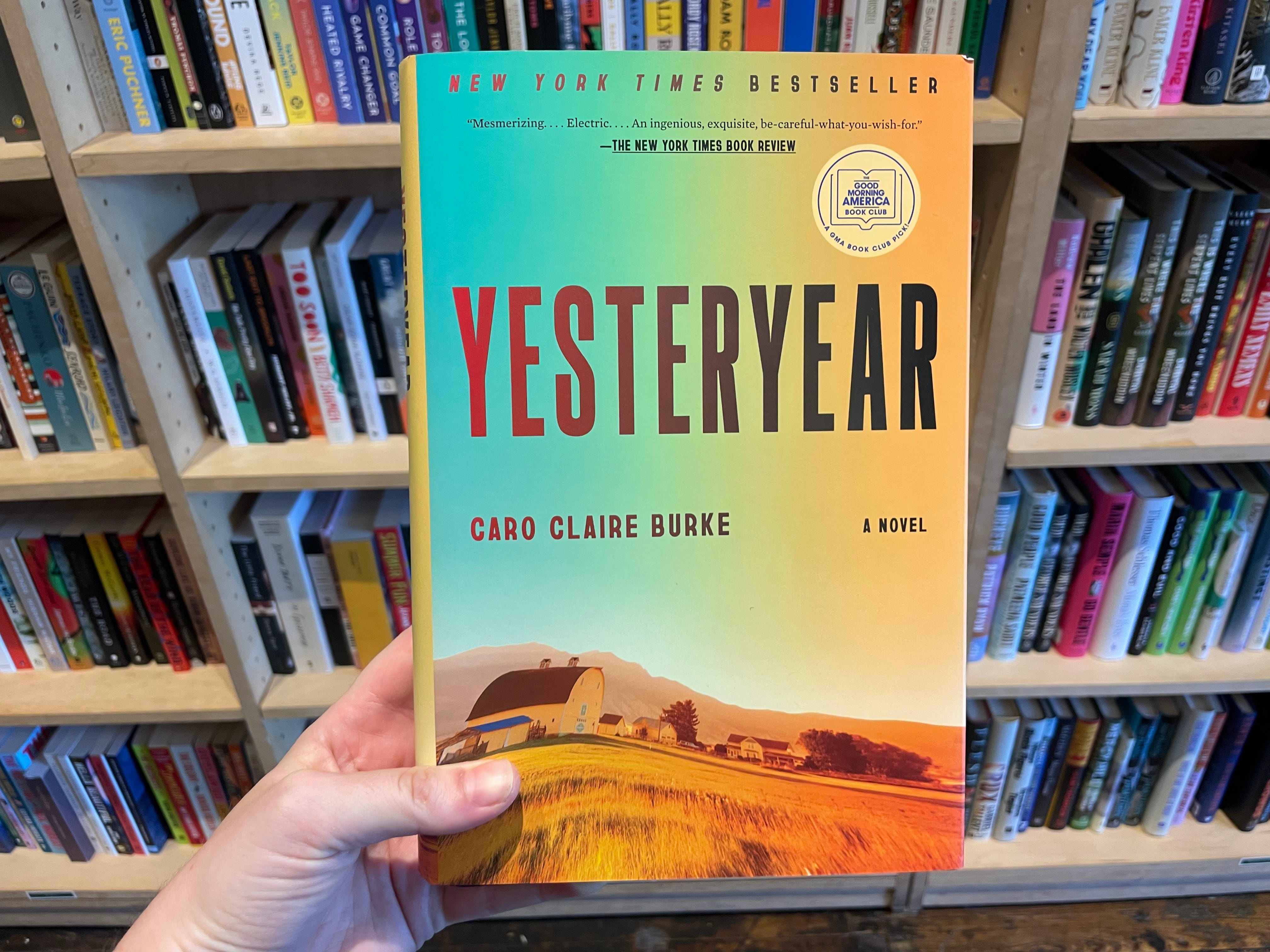
First of all, the distance between the lived experience of the author and that of the character is a debate that often kicks off around literature, and is not a pandora’s box that I’m looking to open. However, it was very clear to me that the person constructing the main character was not a fundamentalist christian. Or Mormon, or X or Y Or Z, because the specifics of her religion are never actually established. This is one of the faults here. I do really appreciate the author for inhabiting and humanizing someone on the other side of things that are “so polarizing now” but I think the lack of actual religious thought and ways in which doctrine would inform worldview, actions, and internal dialogue really does this character a disservice, and makes the whole novel lesser for it. The author has pushed back against this line of criticism, saying that the ambiguity was a conscious choice - and I believe that. However, it’s not one that I think works.
I think that it could have worked, but only if the novel wasn’t written in 1st person. Within 1st, we are in the main characters head - and if she’s a religious person she will be thinking religious thoughts. The teachings of her church should show up in the way she approaches problems and decisions and actions.
I know that there are people out there who are very different from me, who organize their lives around faith and an interpretation of the world that takes into consideration a whole set of rules that I do not consider. They really believe in that faith and try to act in accordance with those rules. For all that Yesteryear treats its main character like a real human without demonizing her, it never really gets to the truth of acting through faith, or interrogating (or suppressing) the inherent contradictions of having faith.
But we get very little reference to God in this character’s narration, and when it’s there it’s flippant -thank god! oh my god! god knows! That kind of stuff. Spelled out - it’s a secular view of god. There’s also many instances where the main character pretty accurately describes the power dynamics at play, and rolls her eyes at how little people think about women -but it’s clear that the worldview those sentiments are being formed by is the secular liberal worldview. There is a deep contradiction within the narrator because her author never fully lets go.
But if this character had been approached and described from an outside 3rd person narrator - even a close 3rd- I think that lack of relationship to god would be less jarring or objectionable. And, our observation of this character would better mimic the voyeristic and parasocial relationship that instagram followers have with influencers, which could have been an interesting thing to explore. And, we could have gotten more of a spelling out of the power structures at play, that don’t feel true to thoughts from within the main character.
Second of all, the sections that are actually back in time are extremely boring. I was much more interested in the backstory. This is ironic, because the whole selling point of the novel is “tradwife gets sent back to the REAL past!!!!” But, nothing really happens there. She is incredulous and doesn’t like it and she never really gets over that. Sean DeLeon has a great article about his problems with this here, essentially that the author engineers a situation and then doesn’t have the character engage with it at all. We don’t get any real exploration of the differences between the two timelines because the character spends the whole time incredulous.
The whole time I was reading, I couldn’t get Kindred out of my head. I read it many years ago now, but I remember being very affected by it. For those who don’t know, Kindred by Octavia Butler (1979) follows a black American woman who suddenly finds herself in the 1800s and is captured and enslaved. She travels back and forth through time, but she does not spend the entirety of her past sections thinking “omg I can’t believe this is happening” because she’s literally being forced to be a slave and she needs to interact with those around her and survive. Yesteryear’s 1800’s sections are extremely lackluster and underdeveloped in comparison.
Finally, “the twist.” (Or, the explanation and justification for the premise.) Honestly??? I didn’t mind it! It clarified a few things that were odd about the 1800’s sections and while the execution didn’t work for me, the concept wasn’t the worst. There are the problems (spoiler in the footnote)1 but if those sections had been more about the actual trials that someone in that time with those resources would have to go through, and less about “I can’t believe i’m still here” I think that those implausibilities would have been more excusable.
Anyways, that was a fun little detour into The Discourse. Ultimately, I found the writing to be competent and at times enjoyable, there were a lot of well thought out scenes with little metaphors or stuff that made me think “Oh that’s clever.”
Did I love the book though? not really. It’s clearly a book written for the zeitgeist and I’m not sure that any of us will be talking about it in a year from now.
I’m taking up more space with writing here because the footnote below is a mild spoiler so i’m just typing more so you don’t have to see it if you don’t want to
please subscribe if you want to
please comment if you have thoughts
i’ve been writing these into the void
and i’d love to hear what people think and respond to them
thank you very much
okay spoiler below
goodbye
why does she suddenly suffer memory loss out of nowhere??
No posts
Comments
Nothing yet. Say the first thing.
Sign in to join the conversation.