
During quarantine, I would sit alone on the floor of my childhood bedroom and watch videos on YouTube of Phoebe Bridgers playing to empty stadiums and wait for the jolt I got when I heard her say,
“Hey, I’m Phoebe,”
Thanks for reading A Passing Moon! Subscribe for free to receive new posts and support my work.
in her cool and rockstar and SoCal way. I would look around the four walls I was contained by, having not interacted with anyone other than my parents in person for months, and say, “she’s Phoebe.” Does that mean I’m not? Does that mean we’re the same? Does that mean we both are, but in different ways? In my defense, everyone was going a little crazy.
In elementary school, I got an official certificate from the principals office with my name spelled incorrectly. People pronouncing my name incorrectly, or telling me with enthusiasm that they loved my name, thought it was so pretty, or stuttering over the way it was spelled.
It wasn’t until late middle school or maybe high school that people en mass started responding with “oh, like friends!” I was born before the show came out, and the irony is that my parents are the kind of people to nix a name because it’s very popular.
In high school I had a short collection of books with Phoebe as a character. One was The Catcher in the Rye, and the other two I don’t remember. In high school one of my teachers said “oh, my dog’s name is Phoebe,” on the first day of school. I’ve met a lot of canine Phoebes, and not a lot of human ones.
Now there are a lot of Phoebes, in literature anyways. I still very rarely run into any in real life. One of the biggest books of 2024 followed a Phoebe who was going to kill herself. There are more British Phoebes than American ones. Phoebe Waller-Bridge, Phoebe the actress from Bridgerton.
In grad school, I wrote a short story about a protagonist named Phoebe who listens to a singer named Phoebe introduce herself and tried to capture the electricity I’d felt, the out of body-ness that hearing it gave me, the way my name feels tied to the essence of me, the ways in which a name is completely outside of the machinations of a persons thoughts, the ways it’s contradictory, and the ways it is a metaphor for the mystery of consciousness. Or something or something or something. Some things are inarticulable but the only choice is to try to articulate them.
A fellow student with a name that has probably never left the top 100 list of most popular baby names since it had been written in the Bible, but had written a short story in which she named the protagonist “Electra” wrote this about my story:
It could be just me and my experience...but Phoebe is not an uncommon name. I don’t’ think this takes anything away from your essay, the disconnect - I just wouldn’t point it out as I image I’m not the only reader who has heard the name a lot.
Now a name like Electra...:)
That might be her experience but when I was in college a friend with the most generic name you could think of asked me if I ever felt more or less pressure to be unique because of my unique name. I wish I remembered how he phrased it, but he said he always felt the need to stand out more because he had a hum-drum name, and wondered if I didn’t have that anxiety because my name already made me stand out.
Now look, the woman who wrote that about my story might really have that life experience, where she’s surrounded by Phoebes, but in my most gracious and empathetic heart I can’t really believe her. First of all, the fact that she called it an essay (which it was not, we were in a fiction workshop) should have had her accepting my experience more. And second of all — okay this is not about her, this is about me. And all this to say, my name is Phoebe. And even if you’ve met one other Phoebe in your life or a thousand and think it’s the most common name, within the world of the story, the character is grappling with her sense of self and her name.
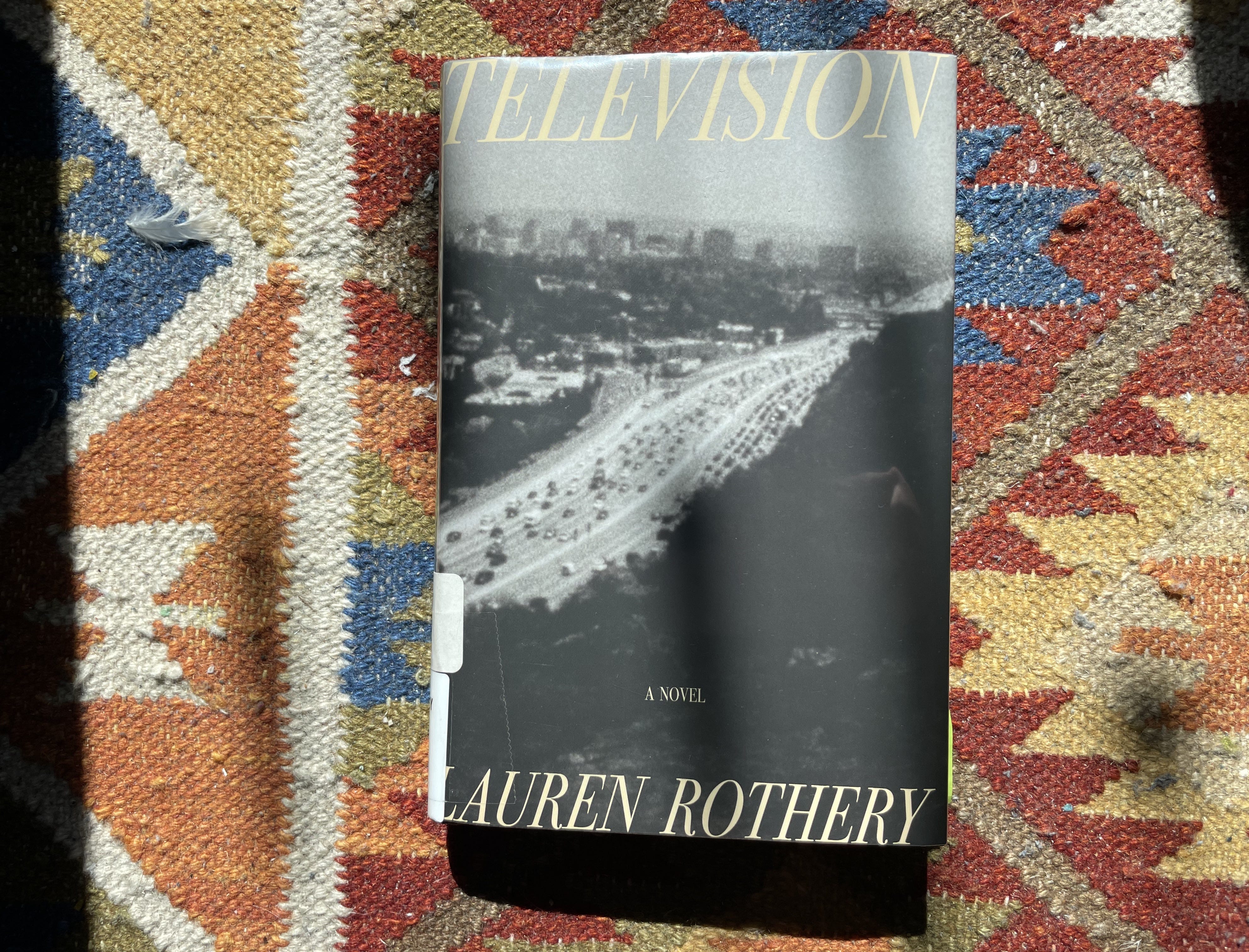
All this to say, I read Television by Lauren Rothery and there is a character named Phoebe. I will try not to harp on how it feels to read a book with a character who has my name in it but I will inevitably fail.
If it had been published a decade ago, Television would have been called a novella. But what’s in a name, right?
The summary of Television bears little to the actual experience of reading it. A movie star raffles off his paycheck for an upcoming blockbuster movie. It sounds like the “high concept” story that all agents seem to be drooling for, but it’s not. The raffle is very much in the background, almost to the point that it didn’t affect the whole at all.
The reality of Television was a pleasant experience to read. Almost philosophical at times, it seemed like a collection of little moments in different peoples lives, things they’re struggling with but mostly concepts they’re thinking about.
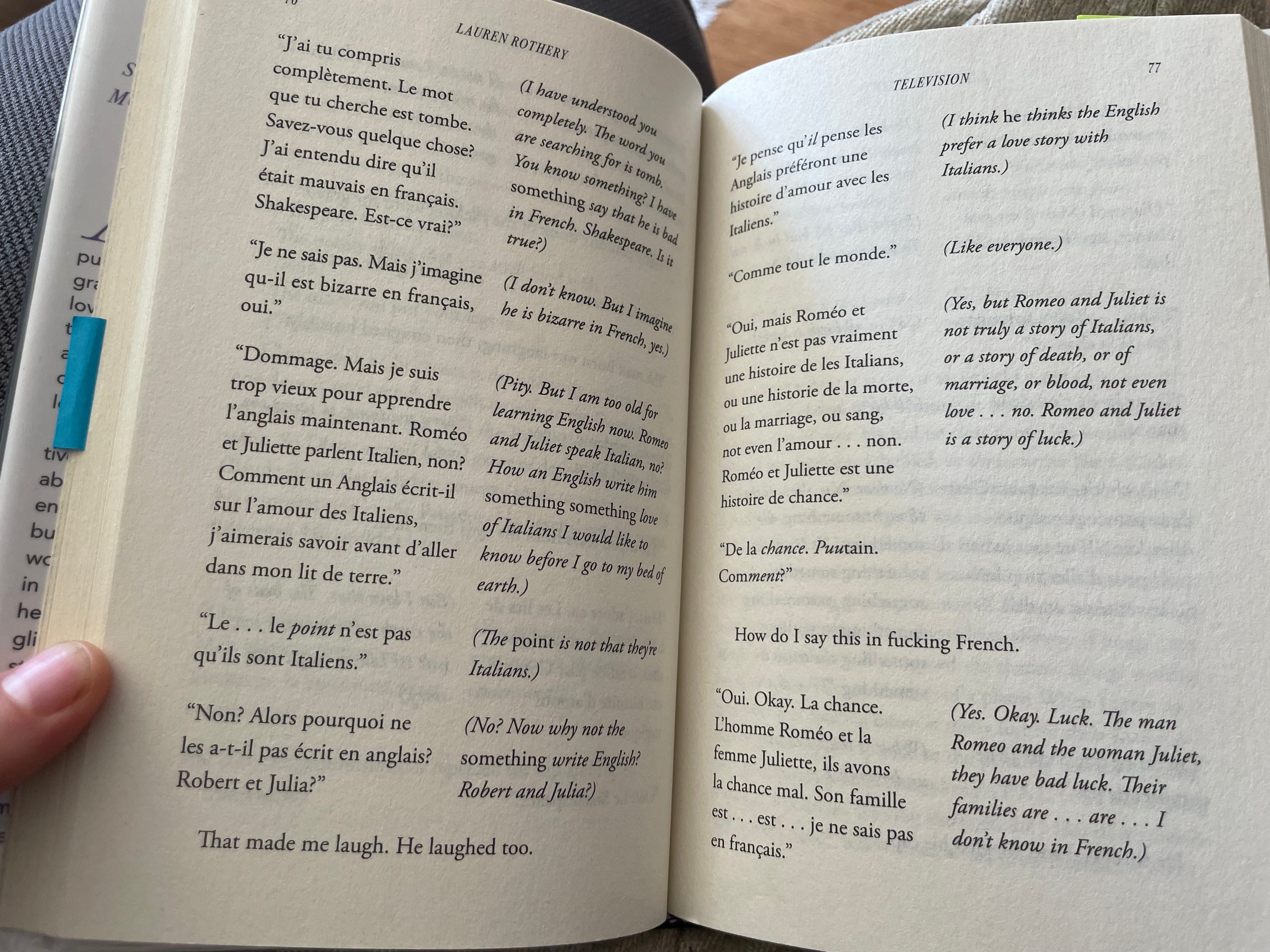
That’s the famous aging actor and his best friend-sometime-lover, whom he met before he’d became successful. The book is told in alternating first person chapters from each of their point of view, and mostly that’s fine. Except for sometimes when there’s this weird narrative distance, where it becomes clear that both characters are telling the story as though it all happened very far in the past? There’s some moments where that’s warranted, like the story of them meeting and becoming friends, but when they’re discussing the more propulsive engine of the plot, it is kind of disorienting and undercuts any semblance of tension. I don’t know. Are they writing this story? Who are they writing it for? I’m always a bit disoriented when narrators address some form of audience without setting up the fact that they’re writing to an audience. What are the rules here? Do they know they’re characters in a novel? Anyways, eventually those two voices are joined by the seemingly unconnected Phoebe. She’s an aspiring screenwriter who’s left LA recently to close up her recently deceased grandparents’ house in France. These sections seem to me to be the most playful, including dialogue like this:
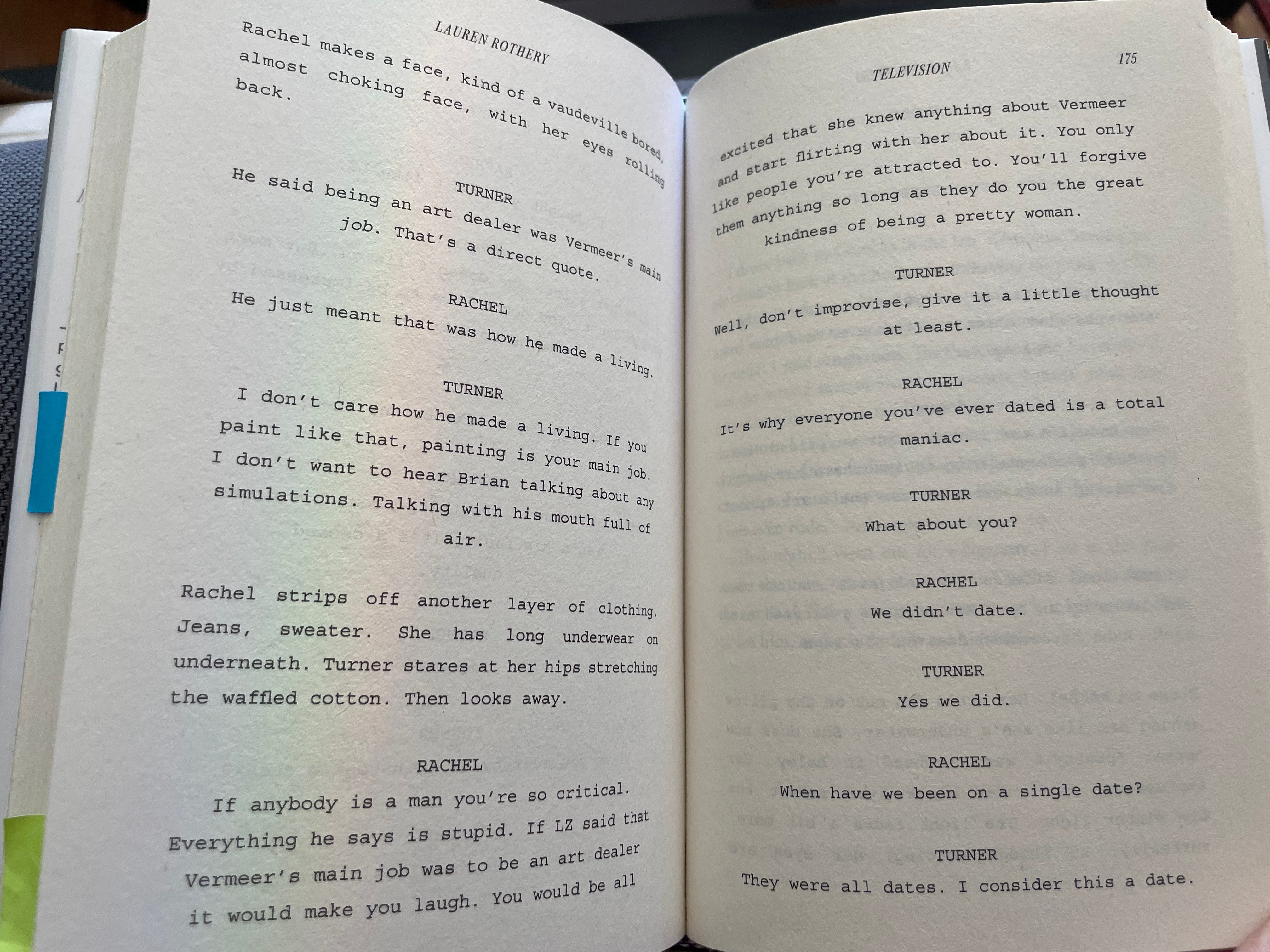
And full scenes from the script that Phoebe is struggling with:
There’s a lot in here that very easily could have felt like cheap tricks and, to the merit of the writing, did not. For all of the characters.They all worked together to fit into the world of the book. I’m also thinking of one of the actor’s sections where he lists what will happen if he has a drink and that list devolves into narrative in a way that I really found fun, but on the page it was more difficult to photograph so that’s all I’ll say about it.
The whole time I was reading, I was stuck between two ideas. One was Jonathan’s insistence that “Maybe the real [X] is the friends we made along the way!” is the most consistently funny joke structure. The other, from Meryl, was the concept of “no-orgasm books” in which there may be interesting things happening in the middle but it never really leads to anything.
With small books like this, where the sentences are interesting and the narrative describes exquisite and poignant moments, how much do I need to enjoy the concepts and ideas without really understanding why they’re all laid out next to each other? Did this book really not lead up to anything or did I just miss it?
In my head, there was a way to turn that sentiment back around to my Phoebe story and bring this whole review full circle, but I’m having trouble implementing it on the page. Something about how I clearly didn’t get my point across in that story which led to (perhaps willful..) misunderstanding from the reader. Is there something similar happening in this novel? Is it my fault or the authors that I didn’t quite understand the ending, even though I appreciated a lot of the middle? Maybe sometimes you align with some parts of a story and not others. There are some little gems in this book that I think will stick with me, even if I already couldn’t quite tell you how the novel ended. I think that’s okay? But even here I know that I’m not articulating myself well. Oh well, at least I gave it a go. Maybe in this case the novel’s length works in its favor, if I had been stuck trying to connect disparate threads for twice as long I don’t think i’d be as charitable. But as it is, I think it overall is worth it.
Thanks for reading A Passing Moon! Subscribe for free to receive new posts and support my work.
Comments
Nothing yet. Say the first thing.
Sign in to join the conversation.