
I did, in fact, get burnt on the beach.1 However, I also saw dolphins. So everything evens out in the end! 2
If you were reading my last post carefully, you might have gleaned that this weekend we’ll be talking about Pale Fire, also by Vladimir Nabokov. Much less incendiary than Lolita but much more formally interesting. My guy definitely likes to play with perspective, and move around where in the narrative the actual story lies. I do love that.3
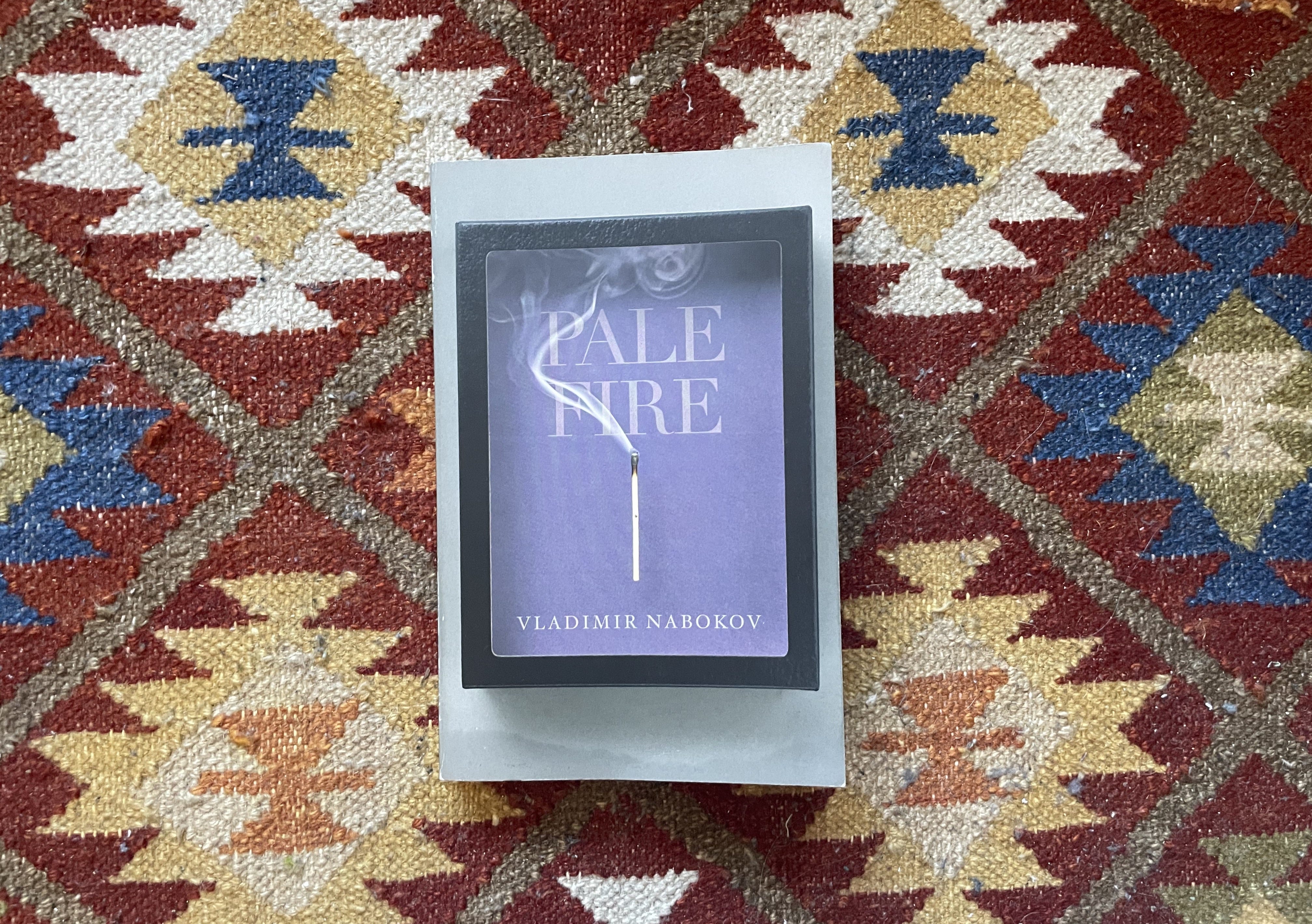
Pale Fire of the title actually refers to a poem by poet Francis Shade, which takes up about 30 pages of the whole book. Before the poem we get a foreword by Charles Kinbote, an acquaintance of Shade. He tells us in the foreword that Shade has passed away and Kinbote is publishing the poem with his own commentary.4
Kinbote asserts that while he only knew Shade for a few months, they were extremely close, and his commentary will be instrumental in the understanding of the poem.
What follows is a poem that is clearly about Shade’s own life, follows his childhood and his relationship with his wife and the loss of his daughter. I particularly like the beginning of the poem, which is
I was the shadow of the waxwing slain
By the false azure in the windowpane;
I was the smudge of ashen fluff— and ILived on, flew on, in the reflected sky. 5
The concept of shadows and doubles and switching fate is consistent through this work.6
The commentary by Kinbote tells a much different story.7 Some notes are completely over-explaining things that are clear in the text, and others have him going on a complete tangent. We learn that Kinbote is a refugee from the eastern country of Zembla8. It becomes clear that Kinbote wanted Shade to write a poem about the story of his homeland, and although he alludes to notes and drafts of the poem that include his stories, nothing in the actual text suggests that Shade had any intention of writing about Kinbote’s country.
Instead, we get Kinbote’s story of his country’s exiled king Charles the Beloved in long notes on unrelated lines of the poem. Honestly, these scenes were the hardest to get through for me, especially towards the beginning. Nabokov has a knack for really obscuring the meaning of his writing - this works at a narrative and structural level and is one of the reasons pale fire is such a cool book, but at a line level it is hard for me to get through. It’s a matter of style preference though.
As Charles’s story unfurles throughout the notes in the commentary, the reader starts to wonder whether or not Kinbote is talking about himself?! Here’s where things get interesting. Is he telling the truth, or is he creating a more fanciful past for himself and in fact he’s got a more boring past that he’s running from?
The thing about reading and then writing about older and very famous literature is that I feel a little silly writing my interpretation of it that is essentially rehashing and cherrypicking thoughts and arguments that many people have made before me. I’ll link to this really great essay on the novel if you’re interested in reading more.9
But I wouldn’t read any kind of criticism like that until you’ve read the book. This is one that’s hard to talk about without “revealing” anything about what slowly unfurls through the reading of it, which is arguably the best part of reading it. I’ll say this. A really cool premise, and one that you really have to work for and pay attention to in order to get the full meaning. I don’t think I really appreciated everything on first reading, and would like to eventually reread it in order to fully grasp all of the clues and what we’d today call “easter eggs,” or small details that shift the way we interpret everything else around it.
I’m never sure how to feel about books that are better appreciated after a second reading. (or movies you have to watch twice). The experience alone should be enough, right? But then, there’s something really satisfying about picking things apart and excavating meaning that can only come from extended attention and care. And maybe I would have caught more if i’d been reading more slowly and intentionally the first go around. A complex story structure means some people will miss some things, but I think that’s okay. 10
That’s why we talk about what we read with other people, right?11
One last thought - Nabokov really knows how to nail endings. Of paragraphs, of chapters or sections, but especially the whole final page of this book. I wish you all had read the rest of the book so I could quote the final long paragraph, but unfortunately I cannot go against my staunch anti-spoiler morals.12 also, I dont’ think it would hit as hard out of context, it is so good in part because of all that has come before it. It really does make the long boring sections and labyrinthine knots to untie all worth it for that ending, I’ve gotta say.
Until next time!13
In case you missed it, this is a reference to last weekend’s post on Lolita by Nabokov. You can read it here -

stay tuned for what I read on the beach…
You can read my own perspective-forward short story here if you’re at all inclined https://d32313d7-e2fc-41e9-8d82-ebca80345985.usrfiles.com/ugd/d32313_6e0b033cba7e480188450bd02106de02.pdf#page=52
There were a few footnotes in my Lolita post. Jonathan had to help me fix a tech-y thing with it before I posted it and he said “I thought you hated footnotes? why are you using them?” And he’s right, I have gone on record saying that I hate footnotes. It is the one reason i’ve never read DFW. And I stand by it- it’s because I find it really messes up the flow of reading the actual text. Having to break from the line to find the corresponding number, either at the bottom of the page or, even worse, having to flip to a separate section and totally lose your flow. However, on substack it isn’t so bad because you can just click the little number and it shows you what I’ve hidden down here. It similarly isn’t so bad in Pale Fire because you can read the whole poem first without regards to the commentary. Kinbote suggests in his foreword that you should buy two copies so you don’t have to flip back and forth, but I just didn’t flip back to every moment he referenced and usually just read the commentary straight through. every so often I flipped back to see what moment he was referencing in the poem but it really is not that related at all and I dont think you lose much by not doing so.
I do not know what is going on with the spacing here. I cannot figure out how to fix it.
We love a motif
I’ve been trying to really lean into the footnotes in this post to stay on theme.
a fictional country, name taken from a Pope poem. Shade is a Pope scholar so it’s all connected.
https://newrepublic.com/article/63440/bolt-the-blue
there’s been screenshots of tweets/threads floating around substack of people wanting shorter sentences, easier vocabulary, shorter paragraphs, and if you don’t agree you’re ablest. yikes yikes yikes! I wish I could believe they were satire but unfortunately I don’t.
aka write about it on substack???
famously, my mom offered me $100 to tell her what happened at the end Deathly Hallows when it came out, and I made her read the book.
You won’t see a post from me next week as I know I will not have read anything between now and then, and I’ll be at my parents for the 4th of July. Sorry in advance to disappoint all my loyal followers :(
Comments
Nothing yet. Say the first thing.
Sign in to join the conversation.