

Whenever I take the family for a day trip, they always find the last few kilometers the most arduous. I think developers sometimes feel the same about testing.
Thanks to recent advances in GenAI we’ve built a testing platform that will speed up the last leg of our builds. It’s called TARA, Testing Assistant in Research and Automation, and by reducing the manual workload for testers it enhances the productivity and efficiency of our software testing teams and speeds up delivery.
As a Lead Quality Engineer I love being at the cutting edge of technology and finding ways to solve complex problems that have a real-world impact. I also get satisfaction from helping make people’s daily tasks easier and more efficient. Working on TARA was such a pleasure for me for these very reasons.
TARA – ANZ’s test acceleration platform
As part of the Quality Engineering Center for Enablement (C4E) Team in Engineering and Platforms, our goal for TARA was to create a tool that could assist testers by automating test cases, execute those tests, and even maintain them by identifying and fixing issues as they arise.
Because of our desire for flexibility and scalability, we decided to adopt a modulated approach. By breaking the project into modules, it becomes easier to manage; and each component can then be developed independently while ensuring each integrates seamlessly with the other. Modulation also allows for easier updates and improvements in the future.
As for deciding which modules to focus on, the team prioritised areas that would deliver the most value to testing engineers. This ensured TARA’s core functionalities would address the most pressing pain points and bottlenecks in the testing process.
The three modules currently live on the TARA platform are:
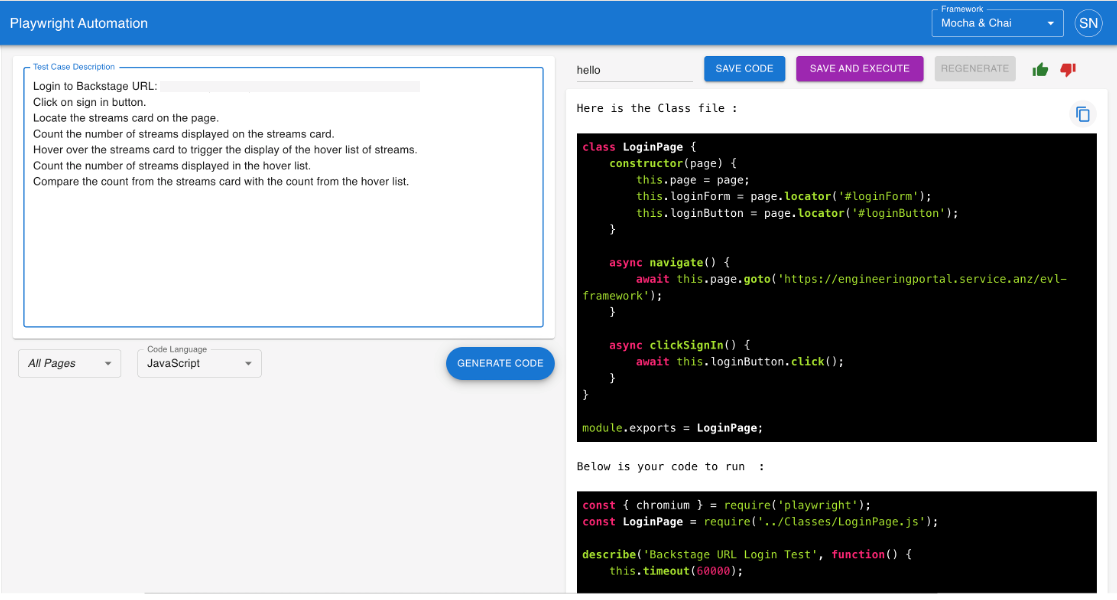
UI Automation – converts the simple English text to Playwright Automation Code, along with saving to GitHub, execution and self-healing.
API Automation – converts the simple English text to Supertest Automation Code, along with saving to GitHub, execution and self-healing
askTARA – intelligent conversational assistant that answers queries grounded on project data in Confluence.
A fourth module, Prism, is in development. Prism curates the testing artifacts from Jira and provides valuable insights to the testing team / management.
An interesting nuance of our modulated approach is that each module builds upon the foundation laid by the others. For instance, to transform requirements into test cases effectively, you first need a curated and structured set of data, which comes from tools like Confluence and Jira. This is where modules like askTARA and Prism come into play.
TARA’s building blocks
We used a combination of tools and technologies to build TARA. The technologies we chose had to enable a scalable, high-performance infrastructure for managing and processing data – all crucial to TARA’s operations and success.
React was chosen for the front-end because of its flexibility and strong community support, making it easier to build dynamic user interfaces.
Python and Lang Chain were chosen for orchestration as they help in integrating and managing the different AI components smoothly.
Flask was chosen for the backend because of its simplicity and synchronous nature – ideal characteristics for our use cases.
Vertex AI was leveraged to access and integrate pre-trained models from Gemini. This ensured that we could incorporate state-of-the-art AI capabilities without having to build models from scratch.
AlloyDB and Postgres were chosen as our database solutions.
AlloyDB provides high performance and compatibility with Postgres.
Postgres offers a reliable and flexible relational database system.
Collaboration – the key to success
Despite the obvious need for such a platform to help streamline our testing process, the biggest contributor to TARA’s success was the early cross-functional collaboration between various divisions and technology teams within the bank.
Working closely with different teams and early adopters gave us invaluable insights and helped us refine TARA in ways we wouldn’t have anticipated on our own. Their willingness to pioneer the use of TARA allowed us to gather crucial feedback from diverse perspectives and make improvements early on.
It also ensured that everyone was aligned to the project goals from the beginning and that TARA was well-rounded, aligned with the bank’s overall goals, and practical and effective in real-world applications.
From an external perspective, we worked closely with the Jira and Confluence teams to ensure seamless integration of data from their platforms.
Benefits of TARA
While it’s still early days – TARA launched in May 2025 – the benefits we’re seeing are already impressive and multi-dimensional.
In one of the projects, we’ve seen that single test cases that used to take two days to automate can now be done in half a day! This is a significant improvement in efficiency, boosting productivity and making life easier for the engineers involved.
Another notable impact of TARA is how teams are using it to help them transition from commercial to open-source automation tools. While this wasn't something we foresaw happening in development, it speaks to the flexibility that we tried to build into the product from the beginning.
Prathibha Panneer Selvam, Quality Engineer at ANZ, has been using TARA since launch and considers it a dependable teammate ‘who’s always there.’
Across the board it makes things much easier and quicker. AskTARA is now my go to for navigating complex internal documentation, the Playwright automation module significantly reduces manual testing efforts by generating reliable scripts from natural language, and SuperTest empowers our backend teams to validate APIs efficiently – reducing rework and speeding up delivery.’
I can honestly say that the TARA modules don't just support our work – they enhance it.’
TARA’s future
Like any good piece of software, TARA is still evolving. Here’s some of the exciting next steps we’ve planned:
Expanding TARA’s capabilities in AI-assisted test case generation and further integrating it with other tools and platforms used within the bank.
Integrating with MCPs to streamline the management of test environments.
Expanding TARA’s capabilities in accessibility testing to help ensure that all applications are user-friendly for everyone before they’re live.
Enhancing progression automation by making it easier for teams to move through different stages of testing seamlessly.
Ultimately, the goal is to continuously improve and adapt TARA to meet the evolving needs of the bank and its engineers, ensuring it remains a valuable asset in the long term.
Santhosh Reddy Gujja is a technology leader and Quality Engineering strategist. He drives innovation in automation, tooling, and test orchestration at scale.
As the Product Owner of TARA, an AI-powered testing assistant, he focuses on enhancing QE productivity through intelligent automation and Testing as Code.
His work spans financial services and telecom, with deep expertise in Testing Tools and GenAI platforms.
This article contains general information only – it does not take into account your personal needs, financial circumstances and objectives, it does not constitute any offer or inducement to acquire products and services or is not an endorsement of any products and services. Any opinions or views expressed in the article may not necessarily be the opinions or views of the ANZ Group, and to the maximum extent permitted by law, the ANZ Group makes no representation and gives no warranty as to the accuracy, currency or completeness of any information contained.
Comments
Nothing yet. Say the first thing.
Sign in to join the conversation.