
Chris and I walked up to see the silent retreat cabins after dinner as the sun was setting. The cabins are only fifteen minutes up the mountain from where we live, but I’d never gone up to see them before. They seemed like sacred dwellings I should leave be, and I didn’t want to disturb those in silence.
But on this summer evening, our curiosity got the better of us. We walked up slowly and carefully, making sure not to disturb anything or anyone.
The highest cabin on the hill sits next to a ravine — a deep arroyo that swells with gushing water when the monsoon drops its moisture in just the right spot higher up the mountain. Many years could pass between moments when that particular arroyo runs with water, but the earth is carved and scarred from centuries of the occasional, very specifically-placed deluge.
We walked quietly past the highest cabin toward the ravine, approaching several large cottonwoods jutting up from the deep ditch, kept alive by the rare heavy flow of water that’s passed through this particular spot.
The high desert is covered in piñon and juniper, but cottonwoods only grow where water flows.
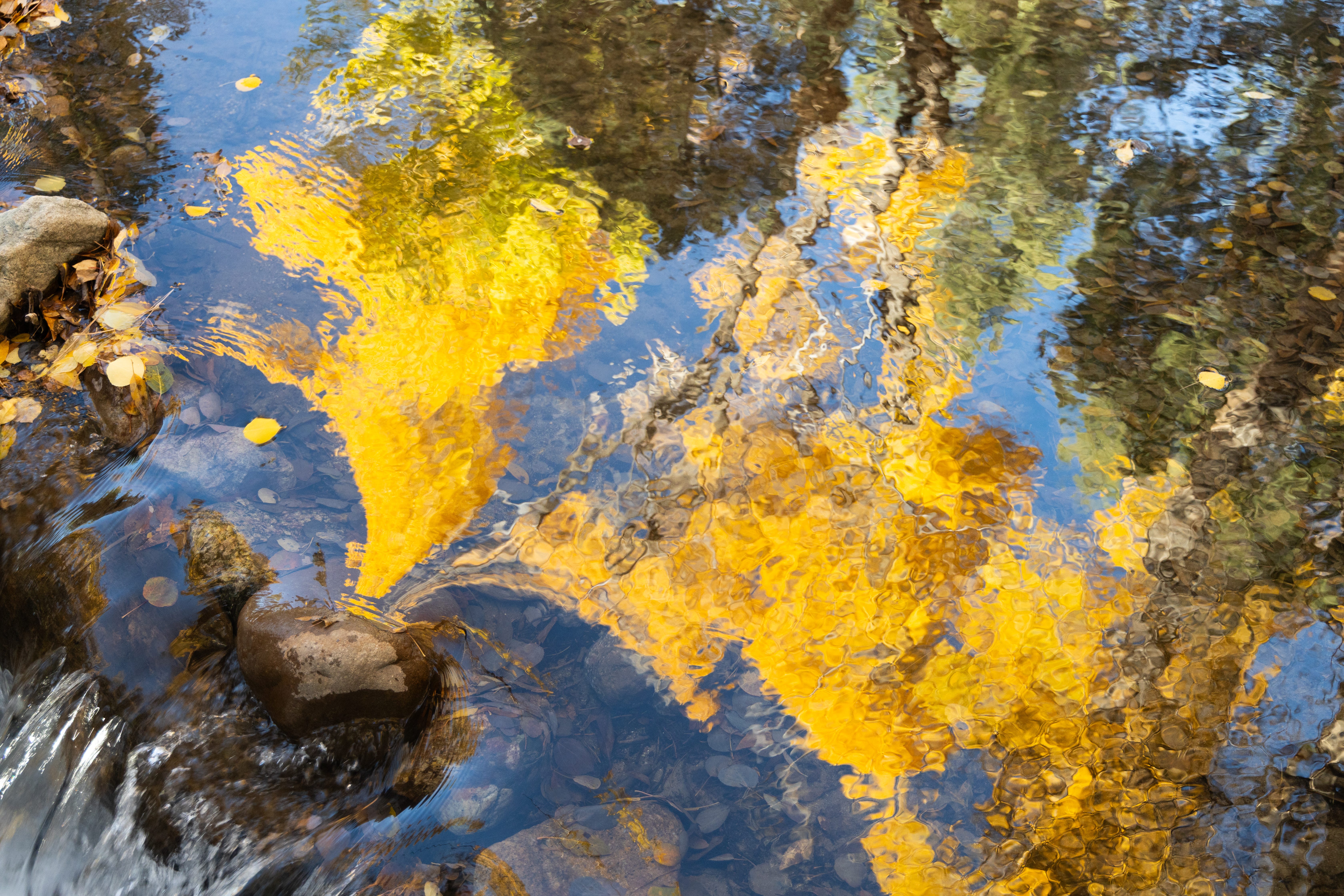
I’ve always loved cottonwood trees. The color of their leaves in spring and autumn is so bright that they look luminescent, as if each leaf contains a tiny lightbulb, especially when backlit by the sun. In spring, the leaves are a brilliant neon green — the first sign of life after the cold winter. In autumn, the leaves radiate with a deep golden yellow that looks astonishing against red desert rock. Cottonwoods are hearty desert creatures full of life and vibrance, even when everything around them is dry and barren.
In winter, when they shed their leaves, each tree is revealed as an individual being with a unique personality. No two trees look the same — each possesses distinctly twisted limbs that give them one-of-a-kind, animate characteristics.
Months after our visit to the cabins, I recounted the experience to a friend over dinner. “The creek runs up there,” I said with total confidence and excitement. Chris looked at me with that distinct look of Aquarian skepticism. “The creek? No. It’s just a ravine,” he said.
I started to defend my memory of the creek, insisting that it ran up the hill at a particular angle such that when you climb fifteen minutes up, you would run into it. But once I stopped rattling off in defensiveness, I realized that mostly all I remembered were the cottonwoods. Yes, most cottonwoods grow next to a creek, but some grow in ravines too, especially at higher altitudes.
Many years ago, I lived in a cabin at the top of a hill in Topanga Canyon, CA during a challenging time in my life. One night, I had a dream. I was astral projecting over the cabin, looking at the scene below. The roof was gone, so I could see inside from above. All the foliage from outside the cabin was growing into it, weaving and winding through the windows, doors and walls. All the plants inside the cabin were also overgrown and overflowing into the outdoor space, making it hard to tell where the cabin ended and the forest began.
In the dream, I remember thinking about how this borderlessness was where I belonged, and where I felt I was headed — a place where the lines between inside and outside were blurred, a place full of life, a place that overwhelmed my senses with beauty and abundance.
I woke up and looked around. I could see the walls of my cabin clearly. There were no trees growing through them, and yet my first thought was “You’re already here.”
I wept. Despite the pain and grief of that period in my life, I felt so grateful to be in such a beautiful place, working to create a life for myself that felt more like home. Perhaps the waking world manifested its surroundings in a more practical way than the dream world, but I knew that even this unembellished reality was miraculous.
Since then, when I’m asked what I mean when I say that I’m a “spiritual” person, I describe this dream. I believe that our reality is far more spectacular than what we see with the naked eye. I feel grateful, every day, that I get to take part in this great mystery of life. I feel enchanted by my surroundings – the people, the earth, the energy. I try to live with reverence for the beauty I see around me — even when my eyes can’t fully grasp its magnitude.
The sacredness of the retreat cabin and the beauty of the cottonwoods at sunset had morphed into an imaginary creek-side paradise in my memory. “That’s so something I would do,” I said, laughing.
Reflecting on my exaggerated memory, I realize I have a tendency to see the world through a lens of enchantment. I focus on the beauty, the love, the magic — not because I think life is perfect, but because I’ve chosen to interpret my life and surroundings as miraculous. Water does flow through that arroyo, after all. I wasn’t conjuring something from nothing; I was just choosing the narrative arc I wrote myself into.
I’m not in denial about the pain and suffering in this world, but I see and experience that pain as part of a larger story. As grief and love are two different expressions of the same thing, I try to treat both the highs and lows with reverence. I want to experience the depth of all things. I am motivated to wake up every day because the eros of life and love move me to do so.
Life becomes a love story the moment we choose to write the miraculous into each ordinary moment.
May we all fall in love with our own story.
Comments
Nothing yet. Say the first thing.
Sign in to join the conversation.