
Editor’s note (April 2026): I first wrote this piece a few years ago. As my son, Sahil, heads into Nationals this weekend, I’m sharing an updated version—with a few new reflections from the journey since.
Dear friends,
As my son Sahil prepares to compete in the 2026 JV National Quiz Bowl Championships this weekend, I find myself returning to a question I first asked years ago:
Is this trivia, or something more?
To him and to all the competing students, my warmest wishes. May your minds be sharp, your teamwork steady, and your joy in the game intact.
Some things haven’t changed. The early mornings. The quiet intensity before a match. The astonishing sweep of knowledge—from Hawking and astrophysics to Captain Underpants—that still humbles me every time I watch.
And yet, something has.
A few years ago, on a sweltering July afternoon in Lexington, Massachusetts—where the first shots of the American Revolutionary War were fired—I struck up a conversation with a fellow tourist, a teacher from Washington state. When she heard that my then 11-year-old son was an avid quiz bowl player, she asked, almost offhandedly, “You mean quiz bowls as in trivia?”
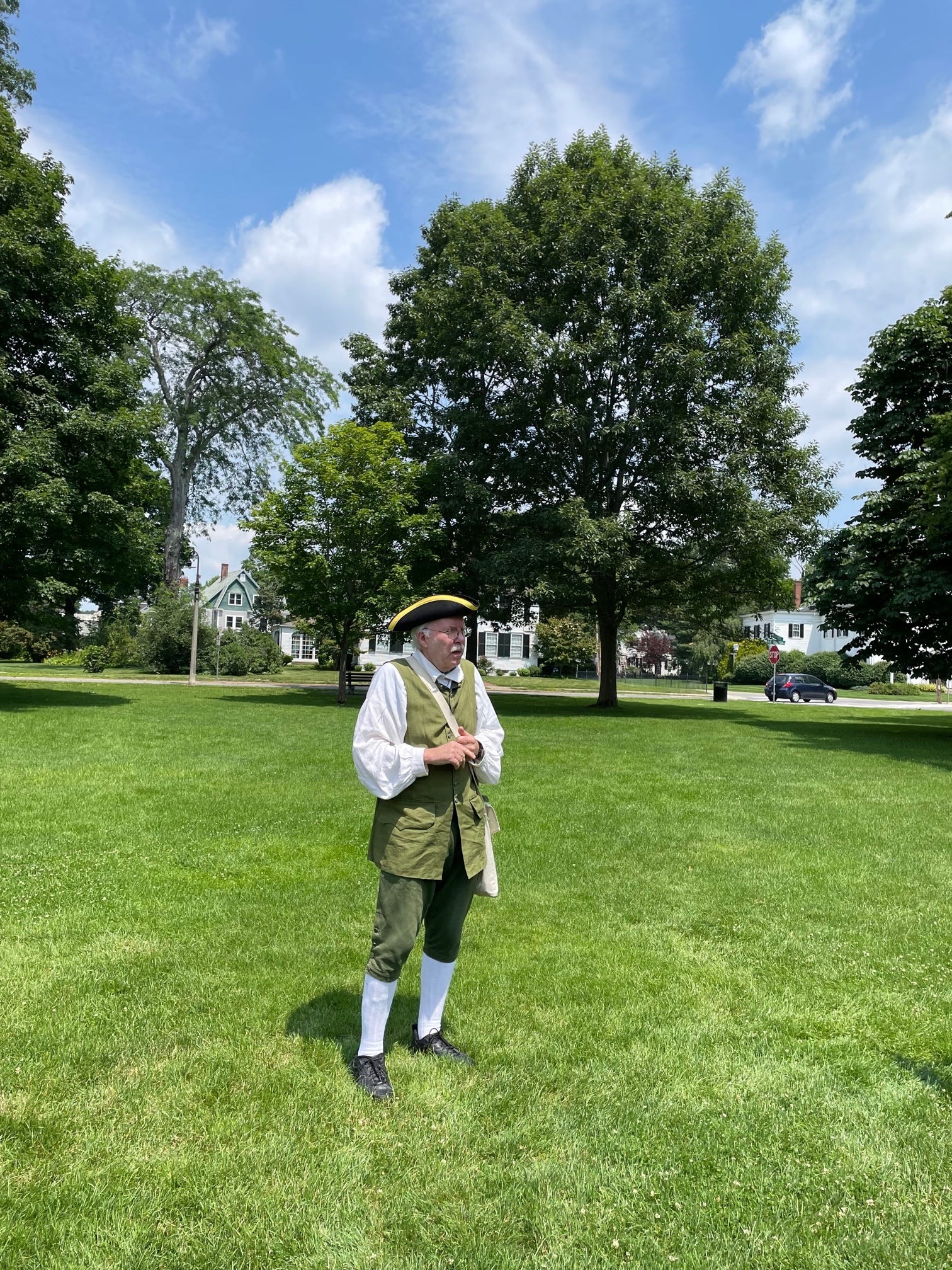
I paused. Felt, faintly, a tug somewhere within. And then said yes.
It wasn’t the first time I had heard the word “trivia” used in this context. In America—where I have spent more than half my life—it is the norm. Perhaps less so in India, where I grew up, where “knowledge” might sit a rung or two higher. “Trivia,” after all, carries a certain lightness—a triviality.
That day, perhaps worn down by the heat or by our fifth historic site in as many days (fueled, of course, by our son’s insatiable appetite for history), the word lingered longer than usual.
Because doesn’t the pursuit of knowledge—and life—go hand in hand?
I have always believed that the more we learn—the more aware we become, and the more we grow.
Could we have a better word, Your Honor?
And yet, over the years, watching Sahil and hundreds of students like him, I have come to see that perhaps the question is not about the word itself—but about what we do with it.
At the Middle School National Championships in Chicago a few weeks later, I witnessed once again what I have come to expect, and yet never take for granted: grit, endurance, teamwork, and an astonishing breadth of knowledge across 160 competing teams.
From Hawking to hip-hop, from medieval battles to modern children’s literature, these students must be ready for everything under the sun—and, quite literally, beyond it.
Surely, I thought, this adds up to something more than trivia.
But does it?
Does stacking up facts—however dazzling—lend meaning to life? Or are they simply mental knick-knacks, quietly accompanying us through the years like a birthmark or a mole—present, but not particularly transformative?
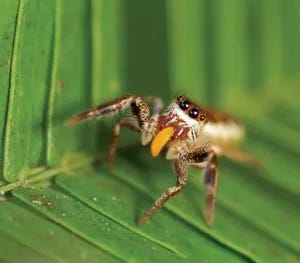
Does it matter, for instance, that Charles Darwin, father of the theory of evolution, had a lifelong fascination with earthworms? That his final book on worms outsold On the Origin of Species when it was first published? Or that Rudyard Kipling has a spider named after him?
(Yes, I will come back to that.)
Perhaps the answer is: it depends.
It depends on what we do with the “trivia” we carry within us.
Over time, I have come to see that the accumulation of facts is only the beginning. At some point, those facts must connect, deepen, and transform into something more enduring: insight. Judgment. Wisdom.
If we allow those connections to happen.
I think of it as a quiet progression—a kind of mental alchemy.
Text within this block will maintain its original spacing when published
Trivia becomes knowledge. Knowledge becomes understanding. And understanding, when lived, becomes wisdom.
Or, to borrow from the French, l’art pour l’art—art for art’s sake—suggests that not everything must serve a purpose. One can quiz for the sheer joy of quizzing, just as one creates art for the sake of beauty alone. There is nothing inherently wrong with that.
Quiz bowl, after all, is a formidable workout for the mind. (Two full days of back-to-back rounds can feel like running a marathon—only this one unfolds entirely within the brain.)
And yet, we also know that ignorance—far more than trivial knowledge—is the root of much suffering in this world.
So perhaps this journey—from trivia to knowledge to wisdom—is not trivial at all, but quietly essential.
Go ahead, then. Learn all 43 battles fought by Napoleon. Know the terrain of Pratzen Heights, the timing of Wavre, the sequence of victories and defeats. But also recognize that his downfall lay not in what he did not know, but in who he was—his ego, his stubbornness, his fateful march into the Russian winter.
And perhaps, in knowing all that, choose to live differently.
That would be a meaningful outcome.
Which brings me back to Kipling.
We remember him for the tenderness of The Jungle Book—for Mowgli, for Baloo, for stories that shaped our childhoods. And yet, we cannot ignore The White Man’s Burden, with its deeply troubling vision of empire and race.
How do we hold both?
We admire the beauty of If—with its call for restraint and inner steadiness. And yet, we cannot forget the worldview of the man who wrote it.
And then, of course, there is the spider—Bagheera kiplingi—named after him.
How does that fit into the moral ledger?
Perhaps this is where trivia becomes something else—not just knowledge, but a way of grappling with complexity and contradiction. With the uncomfortable coexistence of brilliance and blindness.
If nothing else, I confess: I am relieved that a spider bears his name.
That, too, is one way to make peace with a piece of trivia.
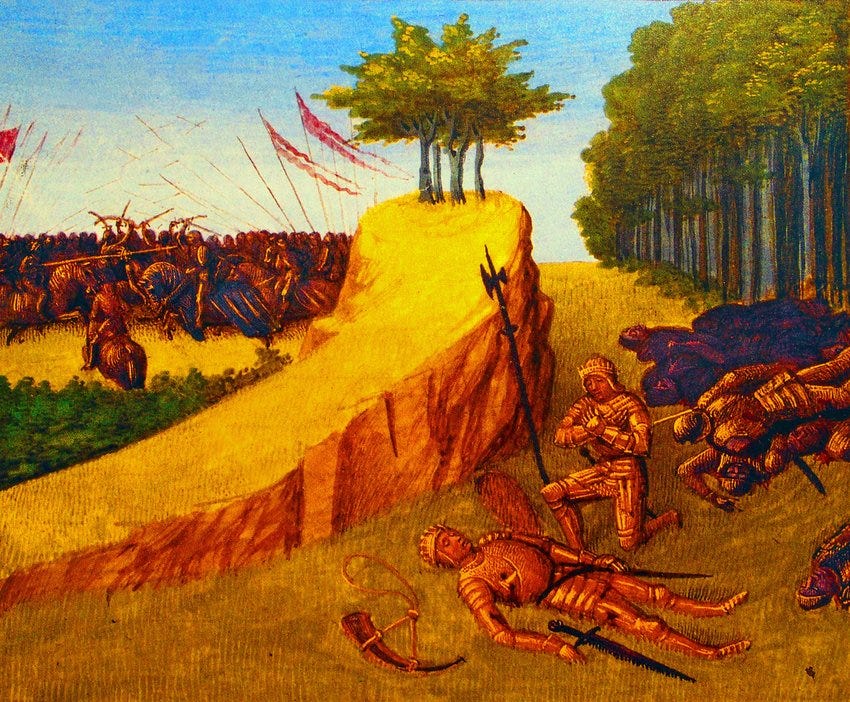
One of my favorite moments in this journey came at the International History Olympiad in Princeton in 2022.
In a nail-biting semifinal, Sahil edged into the finals on the very last question—answering, with unmistakable flourish: “Battle of Ronceveaux!”
A medieval battle. From The Song of Roland.
I smiled.
Because, in that moment, something from my own past quietly resurfaced, finding its place in his world.
And that, I realized, is enough.
Enough to remind us that nothing we learn is ever entirely lost. That it waits, patiently, for its moment to matter.
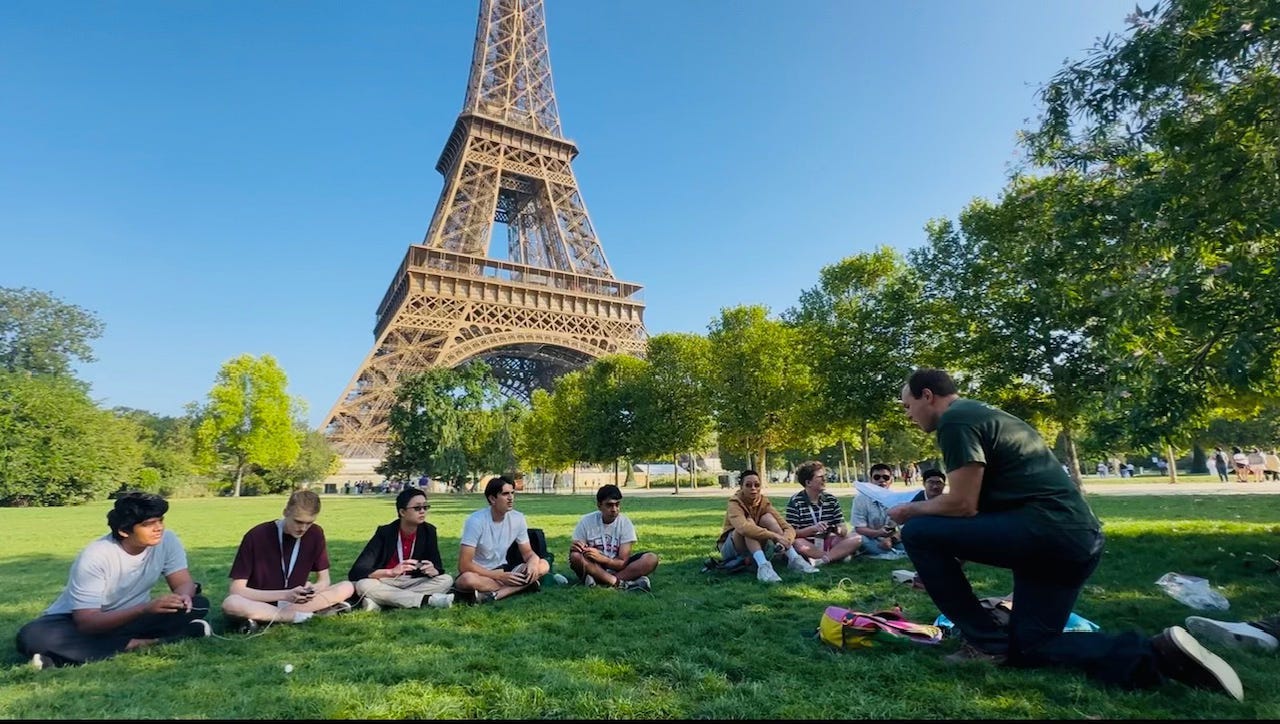
This past summer in Paris, the experience scaled in ways I could never have imagined.
Under the shadow of the Eiffel Tower, I watched him compete again—this time as a high schooler, buzzing alongside some of the brightest students from around the world. Not many can say they’ve taken a French history quiz with Gustave Eiffel’s tower as their backdrop.
In the weeks leading up to the competition, our home had been filled with conversations on Sartre, Haussmann, Delacroix, and the long line of French kings—topics I had once studied, now resurfacing in entirely new ways.
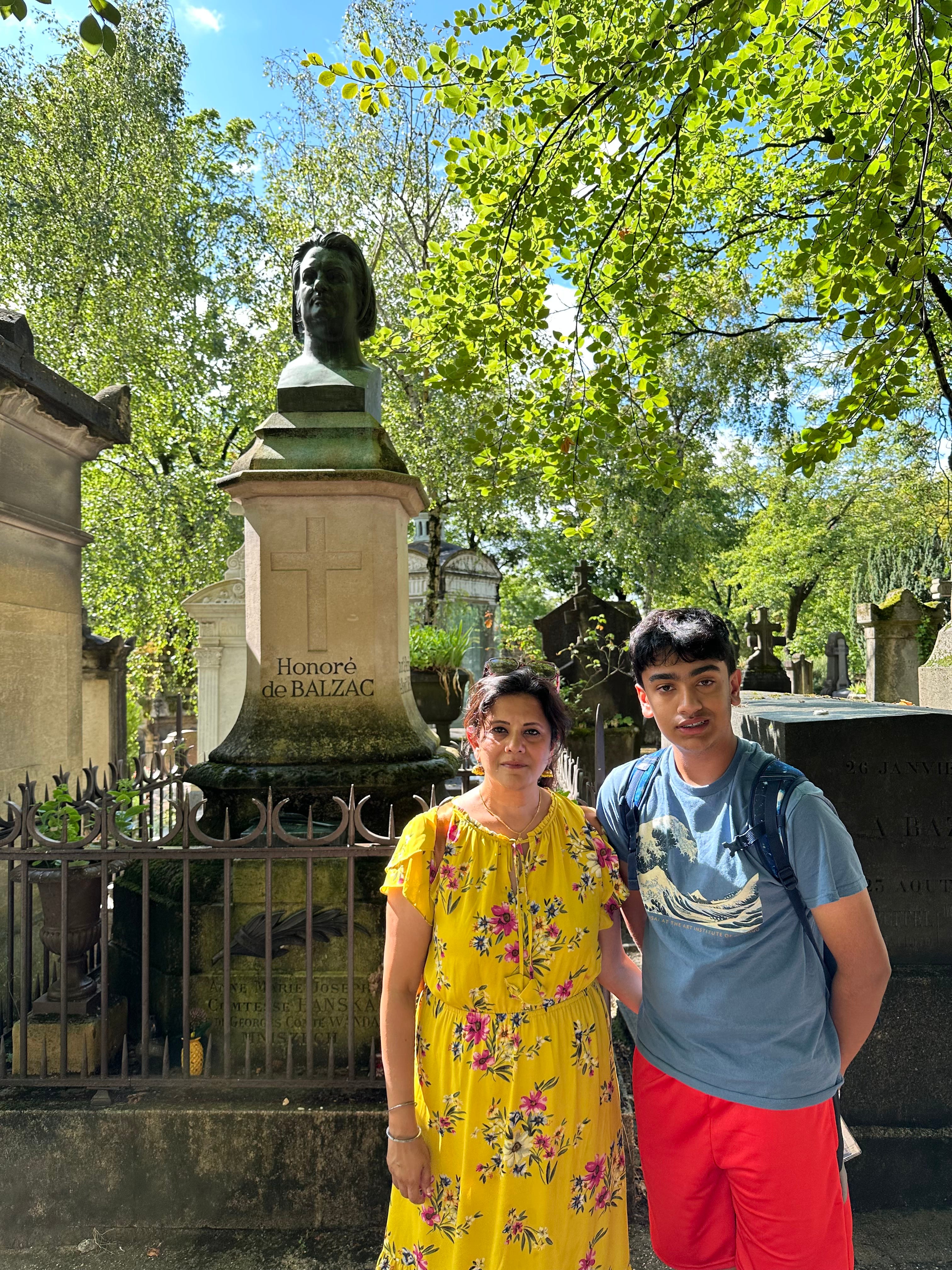
And in a quieter moment, walking through Père Lachaise, he helped me find Balzac’s grave—bringing together, in a single afternoon, my past and his present.
These are the moments organizations like International Academic Competitions make possible for students every year.
Not just the recall of facts—but the thrill of connection, across time, place, and generations.
As Sahil heads into Nationals this weekend, I find myself returning to that question I once asked on a hot July afternoon in Lexington.
Is this trivia? Or is it knowledge?
Perhaps the better question is this: what does it become?
What begins as the pursuit of answers often grows into something larger—a way of thinking, seeing, and being.
For that, I am deeply grateful—to the coaches, the community, and organizations like International Academic Competitions that make this journey possible for so many students.
In the end, it isn’t just about knowing more.
It is, quietly and profoundly, about becoming more.
Meaningfully yours,
Anu Prabhala
If this piece resonated, consider subscribing to Imperfectly Perfect—a free space where I explore the journeys that shape how we see the world, and ourselves.
If this stayed with you, feel free to share it—especially with someone who believes learning is more than just facts.
For questions about the International Academic Competitions or the 2027 International History Olympiad—likely in either Berlin, London, or Lisbon—please contact Executive Director, David Madden, at david@iacompetitions.com.
No posts
Comments
Nothing yet. Say the first thing.
Sign in to join the conversation.