A few months ago I was listening to a podcast with the wonderful Alain Bertaud, principal urban planner for the World Bank for two decades.1 He was on the Ideas of India Podcast with Shruti Rajagopalan, one of my favorite podcasts. That podcast upended the way I viewed slums, a topic I have been researching for nearly 8 years.
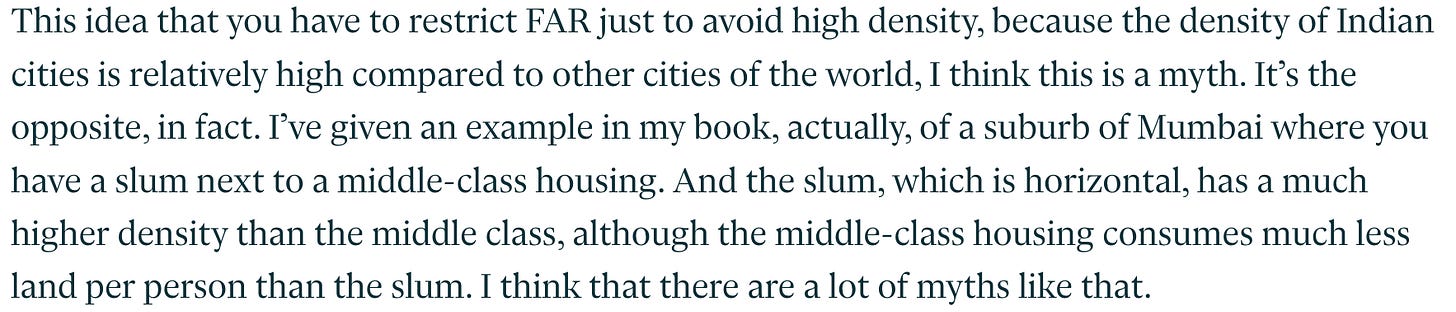
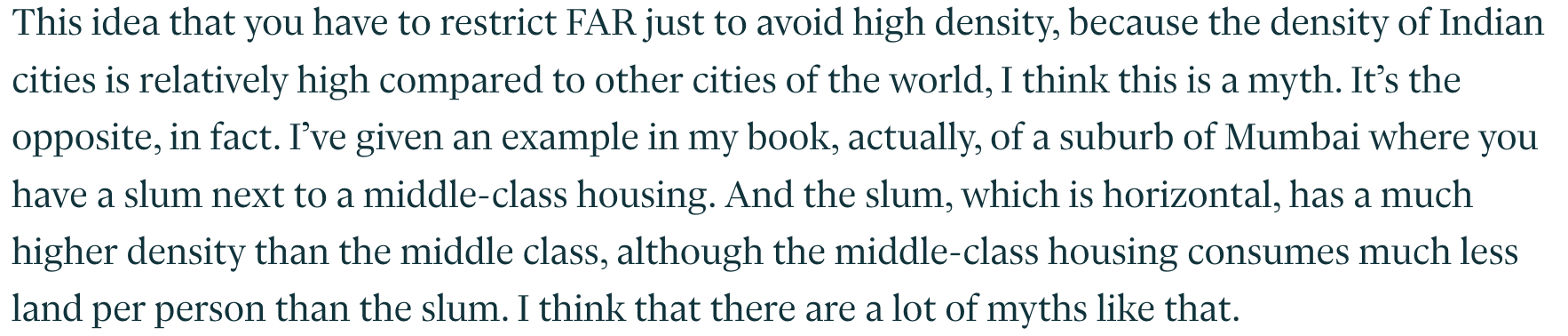
Most people think of slums as very dense spaces. For example, in Mumbai, you might have 6 or more people living in roughly 3 meter by 3 meter (9 x 9 foot) of floor space! But Alain pointed out that slums are, in some sense, less dense than middle class housing in apartment buildings. The reason is that, because slums are typically one to two levels high, while apartments are, e.g., 10 levels high, slums have fewer persons per square meter of land.
Here is the relevant section of the podcast:
—Alain Bertaud on Shruti Rajagopalan’s Ideas of India podcast
Alain’s basic point is that the density of slums depends on your denominator. They are more dense than middle class housing, as measured as persons per floor space, but much less dense when measured as persons per are of land.2
A great way to visualize this point is to look at this picture I took a few years ago as I was flying out of Mumbai airport to go to Addis Ababa, Ethiopia. You can clearly see that that the airport is surrounded by slums with blue roofs. (The blue is from the tarp that covers leaky, corrugated metal ceiling to protect residents from rain.) Just beyond the slums are middle-class housing in tall buildings. Measured per unit of land, clearly the buildings are more dense the the blue-tarp slums.
View of slums outside the Mumbai airport, from a departing airplane
Alain’s observation — and this picture — raises an interesting question: why are slums not land dense? While slums are filled with poor people, they paradoxically seem to consume more land per capita than the middle-class in a city with high average land prices. How is that possible.
There are two alternative answers. One is legal, the other is economic. Both are relevant, but in different locations. And I think the economic explanation explains more slums than the legal one. So I’ll quickly explain the legal explanation, but focus on the economic one.
The legal explanation is simple. Some land is valuable, but the government limits tall building construction on it. In those places, slums may emerge. And slums tend to be just one two two floors tall. The picture above from my plane out of Mumbai provides an example. The government restricts development around the airport because it wants to create air space for planes to take-off and perhaps to limit the level of noise pollution. (Fewer buildings mean less people, which means less people who night suffer from airplane noise.)
The only puzzle with the legal explanation is why slums can arise even though land regulations prohibit development. The answer is a combination of low state capacity and lack of care. First, slums typically arise in countries where the government has limited state capacity. While they can pass regulation, they cannot easily enforce regulations. Moreover, it is easier to enforce regulations against wealthy players who have something to lose from monetary penalties. These factors mean that it is easier for the Indian government to penalize big developers than to penalize poor squatters. Thus they can control large buildings, but not low-level slums.
Second, the government may care less about the harms from airport pollution to poor squatters than to middle class residents. This could be because the squatters are themselves violating property rights by living on government or other owners’ private land. Or it could be because the middle class are better organized to fight for their rights.
If you listen to the podcast with Bertaud, you see a bit of the legal explanation. He is talking to Rajagopalan about so-called FAR regulation that limits the height of buildings. Such regulations, at the extreme, enable the emergence of slums precisely because they reduce the density of people on land, increasing the price of floorspace to the middle class. Slums are able to get around such regulations because it is hard to enforce laws against slum dwellers.
While there is some merit to the legal explanation, it likely does not explain the bulk of slums, and thus the bulk of the puzzle why slums are not as land-dense as middle class apartment buildings. The reason is that land regulations are poorly enforced against all actors — not just slums — and, in many places, non-existent.
What can explain why slums coexist with land-dense apartment buildings in a city is that land around a city varies substantially in quality. Areas that are near amenities like parks and less at risk of damage from weather are high quality. Areas that are near garbage dumps or power plants and at risk of flooding or landslides are low quality. Ignoring legal regulation, tall building locate on high quality land, while slums locate on low quality land.
An easy way to show this is to consider what would happen if a slum were to emerge on land that is high quality and suitable for an apartment building. The slum would be demolished and replaced by an apartment building. The slum is poorly built, so could not, itself be made taller. Even if that were not the case, squatters typically do not have the capital to invest in raising building height. By contrast, a potential developer would be able to access capital markets and use those funds to lobby or bribe city officials to demolish the slum, and invest in infrastructure to create a taller building. The developer would recover its costs by selling units to middle class households. Slum dwellers have no legal rights to the land they occupy, so they are unlikely to be able to stop repossession of their land.
The only place where this would no happen is where land is of such poor quality that builders would not find it profitable to develop an apartment building. On such land, squatters can be confident that they would not soon be displaced.
One might object that perhaps slum dwellers would make profits by building on high quality land so they could sell out to developers when the demand for land rises. That thinking would make sense if slum residents were legal owners of land. But they are not. They are squatters, so property owners do not have to pay them to take over land. The only resistance slum dwellers can offer is that they can protest or riot. That may slow development for a bit. It won’t last forever because protest requires collective action, and collective action is hard to sustain. Especially if slum residents come from different communities.
In case you need more convincing, one can derive the result that low rise buildings — like slums — only emerge on low quality land in a spatial equilibrium model. (I borrow this model from the literature on economics of sky scrapers.). The key assumptions are that individuals value land quality, floor space, and building height, and that the cost of construction is increasing and convex in the height of buildings. Intuitively, developers only build taller buildings if there is substantial willingness to pay, because of convex costs of height. How much people are willing to pay is driven by preference for location or land quality. So tall buildings only show up where land quality is sufficiently high. Low buildings — i.e., slums — show up where land quality is to low to justify building tall buildings.
I will quickly sketch a formal model that yields this result. Utility for homogenous workers is an increasing function of land quality x, floor level s, floor space f, and a tradable good g:
\(U(x,s) = \beta e^{\tau x} s^w g^a f^{1-a}\)
where remaining terms are utility function parameters. (Note that building floor and land quality are substitutes.) The worker’s budget constraint is
\(g+p(x,s)f=y\)
where I normalize the price of the tradable goods, p(x,s) is the hedonic price of floor space, that price is increasing in land quality and what floor you live on, and y is income. Constrained utility maximization yields an indirect utility function of the form
Note that indirect utility is increasing in income, land quality, and floor level, but decreasing in price of floor space. Because workers are assumed homogeneous, we can solve for price of floor space to obtain a demand curve for floor space.
Note how I have defined h(x,y), which I will use again. The indirect utility also allows us to see how land quality and floor level are substitutes. Holding floor space and income constant we can draw out an indifference curve in x-s space and see that it has the usual pattern for substitutes.
We turn to building developers to derive a supply curve. Note that the average price of floor space at location of quality x is
and S is total building height (rather than floor level s). This is demand for location x as a function of height.
To derive the optimal height of buildings by location, we to consider firm profit. Suppose developer profits are
\(\pi(x,S)=p(x)S-cS^\theta-r(x)\)
where \theta > 1 implies increasing costs of height height and r(x) is the land price in location of quality x. Plugging in land price from the last equation into the profit function and then maximizing profits with respect to building height reveals that optimal land height is increasing in land quality so long as the cost of building height is sufficiently convex (i.e., \theta > \gamma+1):
This is sufficient to be show that slums, which have low S* (equal to 1 or 2), must have very low land quality, and that taller building must have higher land quality. This equation also shows that, for any given level of income of workers, there is a minimum quality level of land below which there will be no building at all, not even slums. An implication is that, over time, the quality of even (low height) slums improves with city income!
Although this model has shown that my explanation for why slums are not dense is correct in equilibrium, I can do a bit more to complete the model. I can use a free-entry condition to derive the price of land. Free entry implies profits have to be zero, which means land price is
This equation says that land prices are increasing in how much worker values living on higher floors (because of \gamma, which is a function of w) and decreasing in the convexity of the cost of building taller buildings (\theta).
Putting this all together, we see that slums are built on low quality land. One weakness of my model is that all workers are identical. So, all buildings, whether low or high quality, are occupied by people of the same income. The main difference between these places is that 1 or 2 story buildings have cheap floor space p(x) because they are on lo quality land. To make this model more realistic, we should introduce workers that vary in income. Such a model will yield the intuitive and realistic result that low income individuals will sort into slums.
Implicit in this point is that the density per unit of floor space does not fully offset the higher number of floors in middle class housing. To make this clear, note that
Density per unit of land = (A) density/floor space x (B) floor space/land space
Middle class housing has sufficiently high B to offset higher A in slums.


Comments
Nothing yet. Say the first thing.
Sign in to join the conversation.