
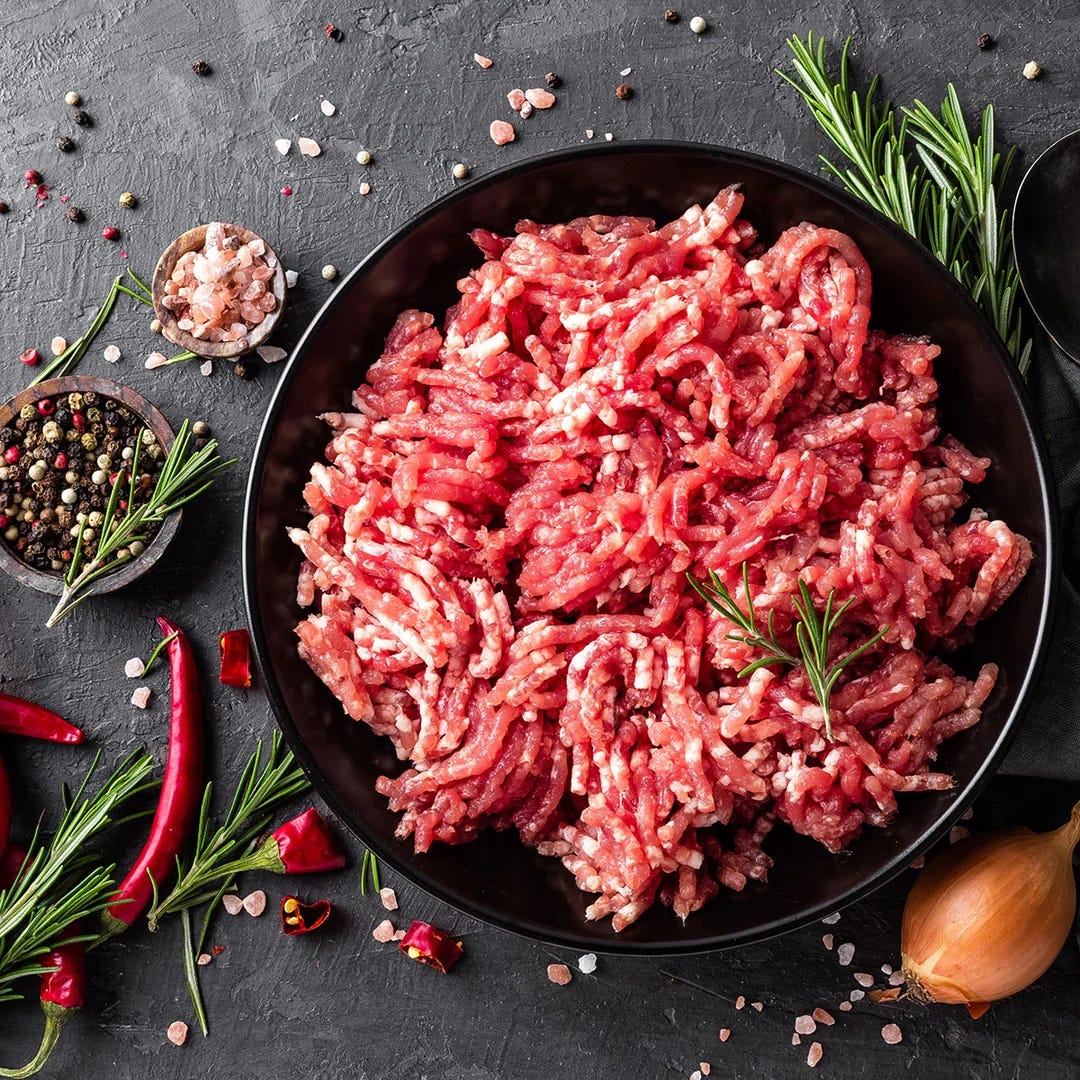
I was watching the TV1 news last night – purely for anthropological research purposes, as I often explain to my friends – and noted with interest the story on surging beef mince prices. Mince is now selling for as much as $24 – that’s 23% higher than a year ago. This, for a meat that New Zealanders have long considered “budget”.
Skyrocketing prices has been driven by high global demand for New Zealand’s beef products – primarily by demand out of the US. But infuriatingly – as is common with the media treatment of these stories – there was no attempt to probe more deeply into the underlying causes. Instead they opted for a cute sidebar story on the fate of the humble mince pie, that crucial Kiwi staple. (Because, despite evidence to the contrary, we are all still living in the 1970s.)
So down the rabbit hole I go. Though not that far, as it turns out. Because the underlying causes are easily discovered.
Indeed, the high global demand is driven by US – and to a lesser extent, Chinese – demand. The US is the biggest consumer of beef products overall, accounting for 22% of global consumption. So, that being the case, why is the US not producing more meat to satisfy domestic demand?
There are a number of factors (increased input costs and a depleting work force among them), but the biggest is prolonged drought.
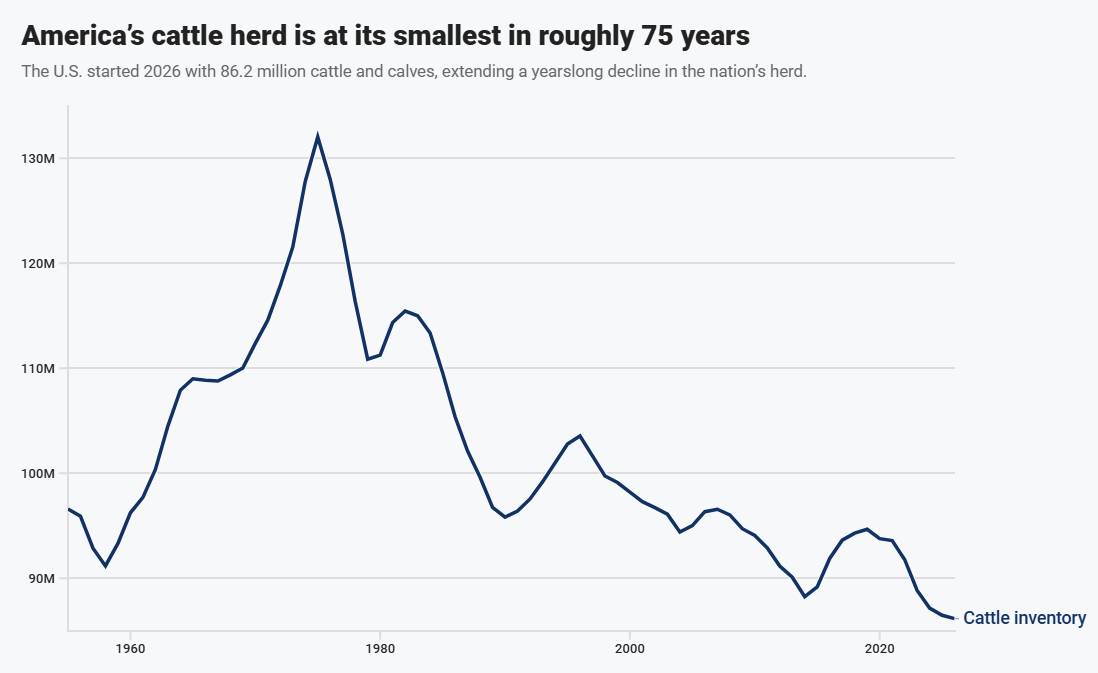
Years of extremely dry weather have depleted grasslands and water supplies across the US West and Plains, leaving ranchers without enough feed or water to sustain their herds. Many have been forced to sell cattle early, including cows needed to produce the next generation of calves, meaning that a rebound to previous stock numbers will take much longer – even if conditions improve. As a result, the US cattle herd is now at its smallest in about 75 years – despite much higher levels of consumption.
Of course drought has always happened, and cannot solely be attributed to climate change. But back in 2022, climate scientists established through climate attribution that human-caused climate change is responsible for roughly 40% of the unusual intensity of prolonged droughts in the American West and Central Plains. In fact, they found that the last 22 years have been the driest in at least the last 1,200 years.
US consumer’s insatiable demand for beef has held steady, despite the soaring prices. Rather than explore alternatives, instead the US has turned to the global market to satisfy demand, and we are – literally – paying the price. So not only does this show that US demand for beef is “inelastic” – i.e., tolerant of increased prices – it also suggests that food security is not a major concern.
Thanks for reading An Uncommon Land! This post is public so feel free to share it.
This is of course an attitude that we share with the US. As I have written about before, successive government have failed to recognise food security as an issue. Unlike the UK for example, New Zealand has never undertaken a food security assessment, or developed a food security assessment. Instead we are reassured by our own industry hype that “we feed 40 million people” with the food we produce (though mysteriously, no one seems to know where that figure came from). Surely, if we can feed 40 million people, we can feed ourselves?
Well no, it seems not. As I outlined in my recent address to the Reality of Everything Symposium, despite overall abundance at a national level, many households in New Zealand experience food insecurity due to affordability and access issues, disproportionately affecting Māori and Pasifika families. We know that one in five children regularly experience food insecurity. (Read transcript here.)
My talk also makes the following points:
New Zealand’s apparent food abundance masks significant vulnerabilities. Although our country produces more food than it consumes, it remains heavily dependent on imports for staple foods such as cereals and plant proteins, leaving it exposed to climate, trade and geopolitical disruptions.
Food production depends on fragile global supply chains. Industrial agriculture relies on imported fuel, fertiliser, machinery and agricultural chemicals, meaning disruptions to international trade could significantly reduce New Zealand’s capacity to produce, process and distribute food.
The dominant model of food production carries high environmental costs. Livestock production, which occupies 90% of all New Zealand’s productive land, requires substantially more land, energy and water than plant-based foods, while contributing disproportionately to greenhouse gas emissions, biodiversity loss and water pollution.
Diversifying food production would strengthen resilience and deliver multiple benefits. Expanding production of cereals, legumes and other plant foods, protecting highly productive soils and supporting local food systems could improve food security while reducing environmental impacts and improving public health.
And at a household level, there are things we can do to reduce our exposure to escalating meat prices. As many New Zealanders already do, we can include more non-animal proteins into our diet, without compromising flavour, while also boosting healthfulness, as Professor Alistair Woodward outlined in his expert talk to the Symposium.
Previously I have sung the praises of lentils, which, prepared well, are a delicious and nutritious substitute for beef mince. In this post, I shared my recipe for plant-based spaghetti bolognese, and lentils can be used to make a fantastic shepherd’s pie (I will share that one at a later date).
But I have also talked about the need to diversify away from predominantly export-oriented, low-value animal proteins. This makes sense from a food security, but also an economic resilience, perspective, as fellow presenter, Hillmarè Schulze set out in her symposium address on Trade in an unstable future.
Finally, this is yet another example of the reality that all the problems we are facing are interconnected. Despite the habit of many politicians - aided and abetted by the media, economists and other analysts - to separate issues out as if they are independent of each other, and using public sentiment to justify action or inaction, the cost of living crisis is - ultimately - a climate issue.
Climate change is not a big issue for New Zealanders …
·
Feb 14

In our MMP political environment, all (it seems) politicians care about is public opinion. There are political polls every few weeks, the results breathlessly relayed to us by the media: which party has gained a point or two and which ones have slumped; which leader is most popular (or, perhaps more…
What I want from our new government in 2026
·
Aug 9
In many of my posts I have spoken in general terms about what I would like our government to do. So here I have drawn up what I am calling a ‘reverse manifesto’. (Definition: A bottom-up platform or document created by citizens or civil society outlining issues that the government must address and proposing policies in …
No posts
Comments
Nothing yet. Say the first thing.
Sign in to join the conversation.