
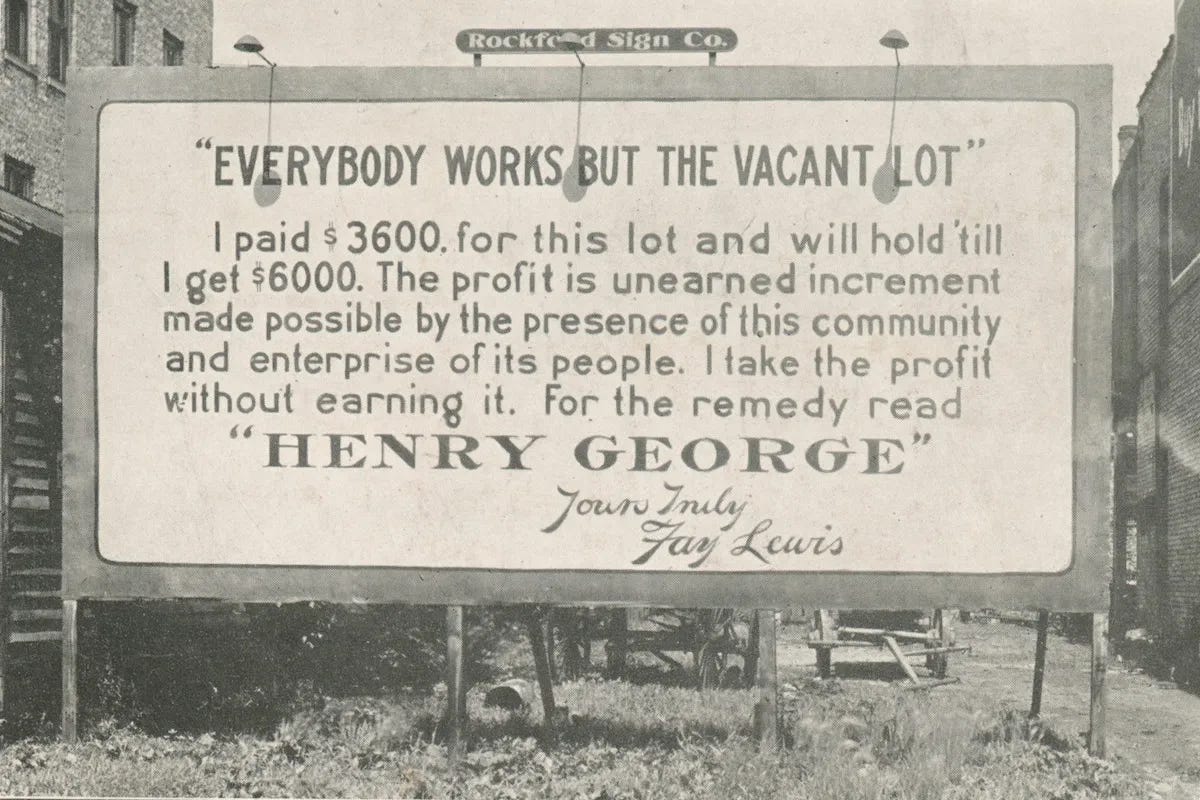
The Opportunity Party is proposing a Land Value Tax of 1.75%, arguing that this will make the tax system fairer, and will discourage land-banking and excessive property speculation. This idea has a proud heritage, one that intersects with New Zealand’s own economic history. And some scholars even argue that it was in response to the threat presented by Henry George’s original proposal for a land tax that the neoclassical school of economics was established, redefining land as just another form of capital, allowing its advocates (and their wealthy backers) to argue that income from land was a legitimate return on ‘capital’ rather than unearned. And their argument has prevailed ever since.
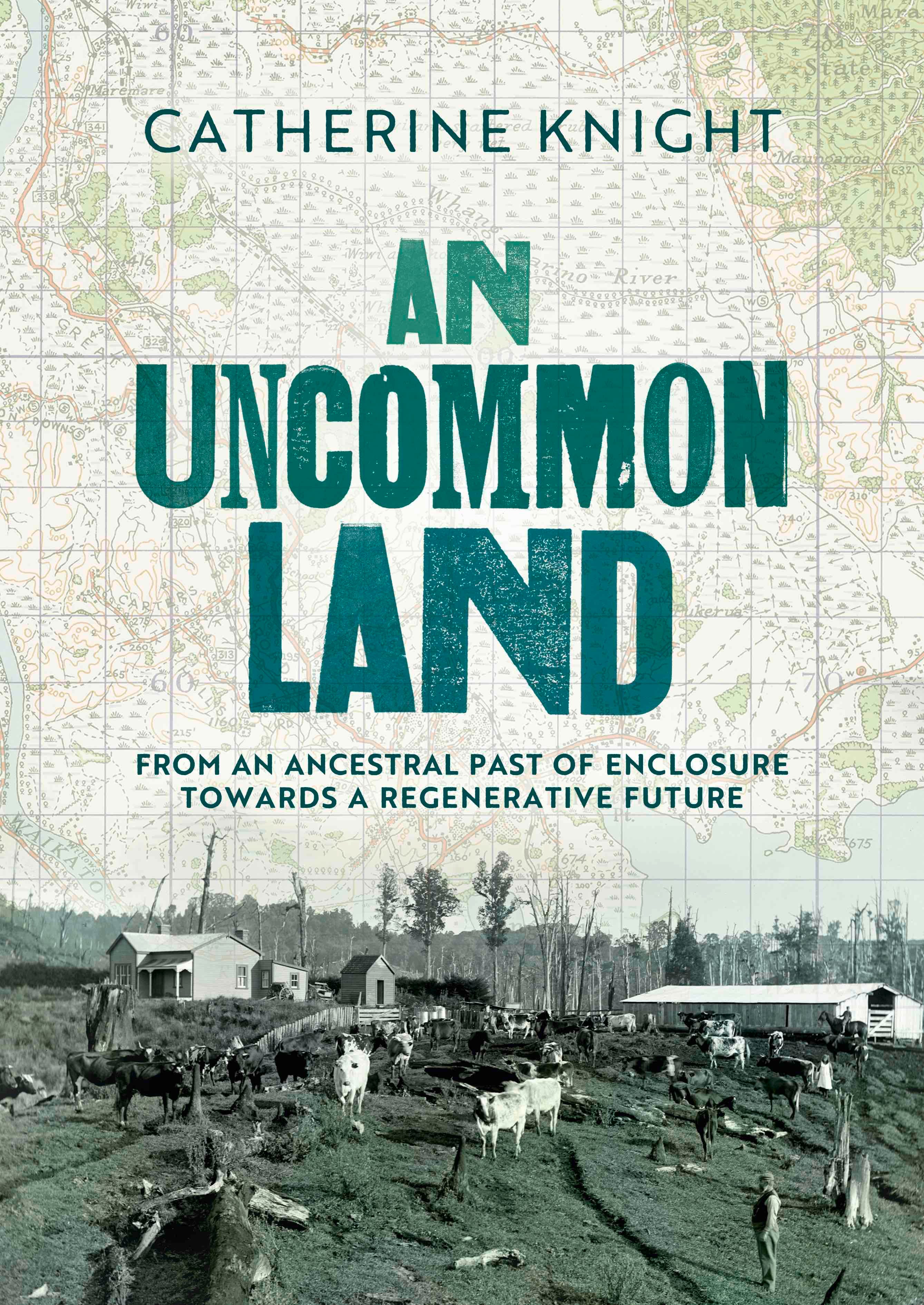
I traverse this fascinating legacy in my book An Uncommon Land, and thought I would take the opportunity to share an excerpt from the book.
Henry George and the Single Land Tax
While the idea of commons did not survive the journey to New Zealand, a closely related idea did make it to our shores and even found its way into legislation – for a time. That idea was the single land tax, developed and energetically advocated by American political economist and journalist Henry George. In his book Progress and Poverty, published in 1879, George famously declared: ‘We must make land common property.’ This is not to be confused with a communist agenda to nationalise land; rather, it is a recognition that land is a common inheritance, and that free access to land is a right of all people and not a commodity to be monopolised by the wealthy. In this sense, George’s views aligned strongly with those of English political economist John Stuart Mill (1806–73) whose ideas had strong currency among some in New Zealand, even beyond his death. Mill argued that land was ‘a thing that no man made, which exists in limited quantity, which was the original inheritance of mankind, and which whoever appropriates, keeps others out of possession’.

But both George and Mill drew their ideas from a much earlier thinker: one of the original physiocrats (an 18th-century group of French economists who believed that agriculture was the source of all wealth), Francois Quesnay, who rose from humble beginnings to become physician to French king Louis XV in the mid-1700s. Quesnay used his knowledge of the human system to help explain the economic system. As an analogy to blood coursing through the human body, Quesnay saw agriculture as the lifeblood of the economy. It was only through agricultural surplus that other economic activities were enabled, such as the products made by artisans and sold by merchants.
Thanks for reading An Uncommon Land! This post is public so feel free to share it.
As such, in Quesnay’s ground-breaking tableau économique (1758) – an economic model laying the foundations of the physiocratic school of economics – only the farmers and agricultural labourers were considered as the ‘productive class’. Quesnay, along with the other physiocrats, advocated for a tax on land that would redistribute the wealth from the landlords to the rest of society, and especially to the tenant farmers. For example, just as it is argued today, land taxes could be used to invest in infrastructures, such as wagon roads connecting the countryside with towns, making it easier for farmers to bring their harvest to market. Quesnay and other physiocrats considered that it was unwise to tax the artisans and merchants because this would simply be converted to higher prices, which would in turn eventually be passed on to the only ‘productive class’, the farmers.
So too the central argument in Progress and Poverty was that ‘economic rent’ of land (primarily a product of its location) should be shared by society. Economic rent is a neoclassical economics term which for the purpose of this discussion simply means the unearned income derived from the ownership of land due to its location, as well as the infrastructure, services or amenities around it. George argued that because this value came from the efforts and investment of society as a whole rather than from the landlord, the additional value accruing from it should be redistributed to society in the form of a tax. This would disincentivise behaviours such as land-banking – that is, holding undeveloped land for years at a time waiting for its value to increase as a result of others’ investment and development in the surrounding area.
In fact, George went further and argued that a land-value tax (i.e. a tax on just the land – not on any buildings or developments on it) should be the only tax, and that capital and labour should not be taxed. His arguments gained a lot of support around the western world and, in the United States, Progress and Poverty was a best-seller, second only to the Bible. Equally, though, George’s ideas met with fierce opposition – especially from those with the most to lose: the wealthy, land-owning elites whose interests would be eroded by such a tax. In New Zealand his ideas found both enthusiastic adherents and vehement detractors, but they likely influenced the Rating on Unimproved Value Act, introduced in 1896. This legislation enabled taxes to be levied on land at a local level, though these remained optional and only one of a suite of taxes – rather than a single tax as George advocated.
More generally, and as highlighted by Ganesh R Ahirao and Morgan Edwards in their recent address to the Reality of Everything Symposium (recordings of their talk and other expert talks now available on the website), tax is a critically important tool in the fiscal policy toolkit: to redistribute society’s wealth more equitably and to dampen down inflationary consumption, among other important functions.
Let's hope that this proposal will stimulate some informed debate about how to reform the tax system to create a fairer society that values and protects its shared inheritance.
‘The government is like a household’
·
Mar 7

One of the expert briefings I am really looking forward to at the upcoming Reality of Everything Symposium is entitled ‘Unleashing public finance’. In it, leading economist Dr Ganesh Ahirao and doctoral researcher Morgan Edwards will tell us about the reality of public finance, debunking the mythology we have been inculcated with since neoliberalism bec…
No posts
Comments
Nothing yet. Say the first thing.
Sign in to join the conversation.