
I first came across Max Ritts’ work while I was doing my masters a few years ago, reading about ocean noise pollution. Of all the papers I encountered, Ritts’ work on conservation acoustics with Karen Bakker struck a chord, not least because it took a critical approach to the use of sound in conservation practices with their own set of political and economic imperatives.
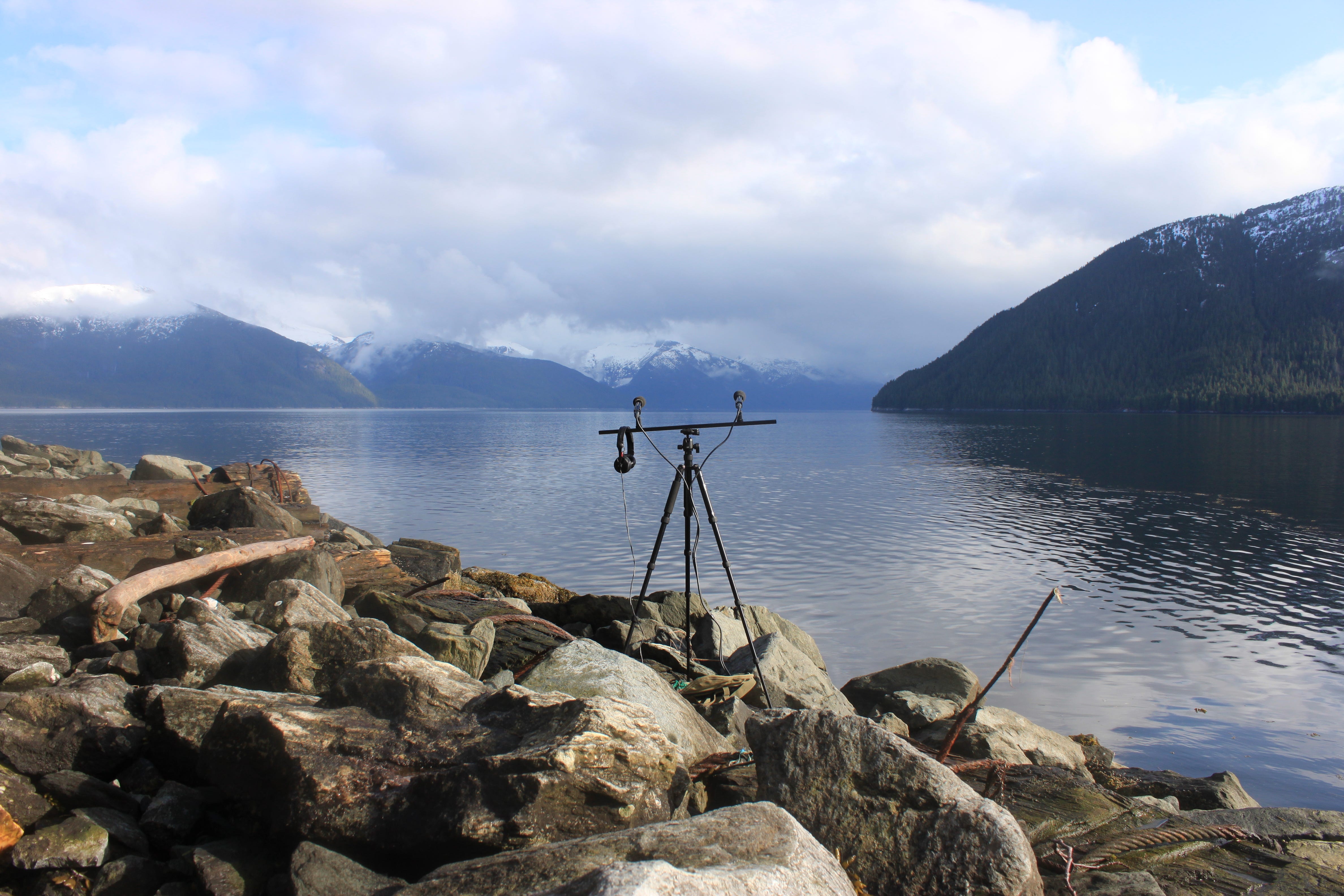
Assistant Professor of Geography at Clark University, and about to take up a position at Toronto Metropolitan University (TMU) in July 2025 where he is originally from, Ritts’ new book A Resonant Ecology takes some of these ideas and applies them to a long-standing fieldwork engagement with the First Nations territories of the North Coast in Canada, exploring sonic expressions both in a conservation and a cultural context - from whale song to indigenous noise music.
Interrogating the use of nature sounds and underwater recordings to showcase the region’s wildlife, Ritts explores how “colonial capital can co-opt sonic efforts to protect the coast” and illuminates the ways in which sound is exploited as a data resource in its own right. Working across scales and communities - human and non-human - to expose how sound can both perpetuate and refuse capitalist colonialism, “Ritts challenges the idea that the sonic realm is inherently liberatory and reveals sound to be a powerfully uncertain object.”
Or as he tells me over video call, sound is not necessarily an object at all, but a set of relations. Instead, drawing on Stuart Hall’s assessment of cultural studies, Ritts is interested in “understanding the terrain of struggle through sound”. In what was a sprawling and detailed interview, I’ve pulled together parts of our conversations in which Ritts introduces the idea of sonic capital and unpacks some of his nuanced approach to sound as an area of study in geography and ethnographic research, in the hope that it will lead you to explore his work – the recent publication A Resonant Ecology – in more detail.
I was initially drawn to your work because it was one of the few places where I’d read a nuanced critique of an assumed inherent virtue in sound. In A Resonant Ecology you describe this as “the notion that recent turns to sound are inherently progressive in nature and, if properly socialized, will only aid in the realization of ecological consciousness needed today.” I thought this would be a nice place to start.
There is a lot of good geography work around the critique of sound that I was drawing from in the space of capitalism and colonialism. Michael Gallagher, Jonathan Prior, AM Kanngieser and Sandra Jasper were all doing work in this area. I was reading a lot of sound studies too. Jonathan Sterne and his idea of the Audiovisual litany really informs the critique - that sound is invested with these ecological qualities, as mystical, as apparently spherical, as intimate, and that somehow positions it as better or superior to an objectifying, distancing vision.
I think we need to interrogate that assumption, and the point of A Resonant Ecology's theoretical introduction is to say that sound is a non-innocent object of ecological politics, and for all these reasons. For the fact that it can be used for digital capture and surveillance, but also for the way that noise gets mobilised continuously to marginalise and suppress particular perspectives and voices, and of course indigenous peoples and whales have differently experienced that history.
I wanted to make the point that to study these kinds of tendencies we need to take very careful consideration of place. If you take the totality of sound cultures in one specific place at once specific time then you have to be more attentive to the tensions and contradictions around the progressive ecological valences of noise. The community in Dodge Cove could be articulating this ecological politics around sound preservation while also not necessarily questioning their settled-ness as white settlers to the area. Well, noise in music is articulated very differently for a different community that's in the same development context. In other words, the geography part is really important. It's all happening on the North Coast at around the same time, and that allows you to test these assumptions about whether sound is inherently good or not.
One specifically technoscientific initiative you look at is the application of what is called SmartOceans. Could you explain what this is and how it provided a lens for tehse ideas?
SmartOceans was a proposal from this initiative Ocean Networks Canada to wire the coast for sustainable development. It runs on the assumption that ecological spaces can be managed more efficiently, more responsively through the intermediation of digital technologies - so smart meaning smart technological networks, of sensors and data capture and so forth. It's a very appealing pitch, and I think in the chapter I relate some of the successes of their pitch because people were faced with little alternative vision for the coast. We're going to get development, we're going to get shipping, we might as well deal with it the best that we can and maybe we can even train our kids and get some new jobs in the meantime.
What is the sonic component of the SmartOceans project?
A lot of it is hydrophones, but there are other kinds of sound recording technologies and whole arrays of underwater sensing tools. Accelerometers, and instruments to measure salinity and depth and other kinds of noise and vibration. It's all being data-fied and turned into predictable management data streams that can be implemented for decision making. Hydrophones would be the one that links to whales directly, but it also included things like geological sounds, the idea being that maybe there'd be a vibration from an earthquake that they could capture acoustically before it hit the region.
What impact is this hoped to have on the relationship between whales and shipping?
The vision is being realised in the Lower Mainland, which is to reroute shipping lines, and one day, in a fantasy, maybe whales themselves could be rerouted by appealing to them acoustically somehow. But right now, it’s moving shipping lanes in accordance with sightings or soundings of whales, and implementing vessel slow-downs.
Could you explain how this relates to your idea of sonic capital?
One way to look at it is to look at the ocean noise question in more detail. I'm not saying that ocean noise is the sound of capital because it happens to be the sound that ships make when they transport commodities around the world. What I'm saying though is that sonic capital emerges as an input to capital’s valorisation. Specifically, what you have is the creation of all sorts of new assets like different kinds of algorithm technologies that attempt to predict or regularise behaviours of animals by listening to them more carefully, because of the ocean noise issue.
What I'm talking about is that these services, these commodities that come out of managing ocean noise, are tools of risk assessment and these tools are examples of sonic capital, because they create value for service providers. They're basically selling these services off the back of an acoustically injured animal or the risk of an acoustically injured animal, and the service package is an example of sonic capital generation. It's the example of how sound provides input to capital’s valorisation to the realisation of new streams of capital. It's not the ocean noise, it's the service that is sonically mediated that comes out of the response to the ocean noise.
It begs the question then for whom the bioacoustics monitoring of an environment is useful and to what end?
Like with Andreas Malm's book Fossil Capital, his point is that when capital passes through carbon and combusts to create carbon dioxide, value is being created for certain people, namely for the owners of the oil companies, even though we're all facing the effects of the production of carbon dioxide. And in a similar sense, ocean noise is a generalised effect, but the profits for dealing with it go to certain people.
I want to return to another quote in the introduction of A Resonant Ecology which caught my attention and I think follows on from this discussion nicely: “The proposition of sound as a kind of freely available resource has gained a wide institutional uptake: raw material for extractive industries, digital arts, surveillance states and innovative techno-sciences alike.”
This is something we can trace across multiple concurrent streams of cultural activity. The growing interest in eco-management, in sound art, the accessibility of certain new kinds of sound art - in site-specific installations and in conservation work - is all being enabled by digitalisation. There is a lot to say about tracing those concurrences out in more detail and if I have time I'd like to do that at some point.
In your 2021 paper Conservation Acoustics, co-authored with Karen Bakker, you talk about sound as digital data containing the promise “of disembodied experience, in which we learn by staring at screens rather than by sensing the world around us.” I wonder if you could expand on this a little bit?
When I think about this I try to resist the impulse to nostalgia, because I think there is a real desire to say something as simple as “scientists used to listen and now they don’t listen anymore”. And that almost gets into the acoustic ecology moment that I'm not trying to associate myself with. It is a romanisation of listening, which then becomes a question of privilege of who gets to do those things. I think scientists have long treated sound as a data input and done great things with it despite the fact that they've been objectifying it and putting it into statistical graphs.
I think the best scientists that I've met are the ones who are able to do that and also demonstrate empathetic listening and creative listening. It's these multidimensional appreciations that I want to cultivate in my critique in the book, and these are the people I end up learning from the most.
I suppose one possible consequence of treating sound as data is that it can remove context, affect and the space for uncertainty or ambiguity?
Another paper I wrote with Jennifer Gabrys and Trishant Simlai when I was working on the SmartForests project identified this weird tendency to equate the conservation priorities of elephants and tigers with the detection of poachers, both of which rely on acoustic means. Gunshot detection algorithms were being used by forests and park services in Central Africa to allow these systems to identify both would be poachers and would be protected animals.
And yet it's the same idea, the same logic that would identify either of them, meaning a signal that is picked up on an algorithmic system that classifies it as this or that, and the fact that the poacher could be a conservationist figure or it could be a farmer, is not allowed within that system. And likewise the animal might not be an animal at all, it might be misidentified. So there are these emerging ambiguities around the human and the non-human as well as between the classifications of the human and the non-human.
Which challenges this idea of sound as a stable entity that can be reliably interpreted for meaning?
Yeah, exactly. It's the abstraction and the consolidation of a single sound object rather than a set of relations - a web of relations. It’s that idea from Pierre Schaffer that there is great pressure to achieve a kind of narrative structure. We will never get to the sound itself. It's impossible to listen without a narrative.
A Resonant Ecology is published by Duke University Press.
Thanks for reading Through Sounds! Subscribe for free to receive new posts and support my work.
Comments
Nothing yet. Say the first thing.
Sign in to join the conversation.