
When demand is strong and alternatives are weak, even a poor buying experience often does not stop customers.
“Once someone has decided to buy a Ferrari, it is almost impossible to talk them out of it. The sale happens in spite of the salesperson, not because of them“.
Think about your own experience as a buyer. If you endured a clumsy, arrogant, or chaotic buying process and still signed, asl yourself why:
The product or service was almost unique in the market?
The decision was too urgent to postpone?
Switching to an alternative would have been painfully costly?
In these situations, the product or context compensates for the salesperson. Yet the higher the stakes, the more they scrutinise the sales process: how the salesperson listens, explains, challenges, and respects their constraints. But is when the purchase doesn’t fail into these options than they walk away.
Most customers cannot easily judge a salesperson’s real intentions or long‑term reliability. So they use simple but powerful signals:
Does this person feel authentic, or are they playing a role?
Do they respect my ideas, constraints, and values?
Do I feel safe being transparent about my problems and risks?
When the interpersonal relationship feels wrong, trust collapses. Very often, it is not the price, the product, or the timing, it is the feeling that “something is off” in how the salesperson behaves.
Effective persuasion, as Robert Cialdini has shown, depends on principles like reciprocity, consistency, social proof, liking, authority, and scarcity. But these principles only create sustainable value when they are signals of integrity, when behaviour and values are aligned.
Persuasion aims to reciprocal benefit. Manipulation only to gain benefit from the counterpart.
Persuasion can be taught. Techniques can be learned. But the ability to use them ethically and fluidly usually comes from friction: from losing deals, facing rejection, handling objections that really hurt, and navigating complex stakeholders.
People who have end up working in “easy mode”, strong brand, weak competition, overheated demand, rarely need to reflect on their own behaviour.
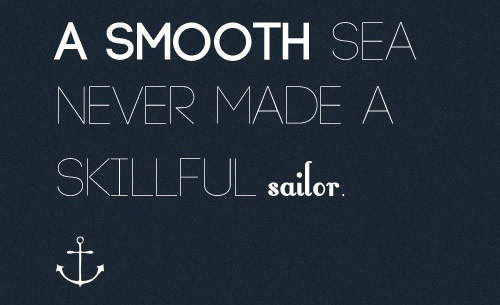
The sea is too calm. And as sailors say, no one becomes a good sailor on a smooth sea.
People who have had to overcome difficult conditions are people whose experience matters. They have achieved internal transformations forged by experience:
They have had to rethink beliefs that did not work.
They have had to discover more effective ways of listening, questioning, and advising.
They have had to keep promises when it would have been easier to disappear.
This repeated exposure to difficulty builds something that is very hard to fake: a deep, almost instinctive care for the other person’s situation. Over time, that matures into reliability. And reliability, consistently demonstrated, becomes character.
Resilience is not a motivational slogan. It is a capability forged by being hit, regrouping, be hit again and still choosing to show up for the customer one more time.
In the same way, salespeople who have learned to sell in crowded, competitive, or sceptical markets often carry a different posture:
They know how to uncover real problems, not just surface needs.
They know how to challenge the customer respectfully when their assumptions are leading them to a poor decision.
They see commitment as something mutual and long‑term, not as a signature on a contract.
These are partners in strategic decision‑making.
Ultimately, a good salesperson is not just someone who “closes deals.” A good salesperson is someone who feels responsible - literally, able to respond – to the buyer, to the promise made, and to the impact of that decision on both organisations.
Great products may hide bad salespeople for a while. Great leaders refuse to let that happen. They look beyond easy wins and ask: “Who are the people who can still sell, still care, and still act with integrity when the product is no longer doing the work for them?”
Those are the people who will help the business survive when the sea is no longer smooth.
No posts
Comments
Nothing yet. Say the first thing.
Sign in to join the conversation.