
For years, organizations have been serenaded by the unyielding chorus of “digital transformation”, a narrative as alluring as it is misleading. It paints a glamorous picture: digital naiveté vanishes overnight, replaced by superstar capabilities, all with a bit of radical rejuvenation. The implication? Businesses, especially SMEs, must scrap everything and reinvent themselves at breakneck speed, as if rebirth is just a conference keynote away.
Yet anyone who’s ever peeked under the hood of an SME knows reality is far less cinematic. These organizations are not blank slates yearning for revolutionary makeovers; they’re rich tapestries of history, idiosyncrasies, and tech stacks stitched together from ghosts of legacy systems, patchwork fixes, and, on fortunate occasions, a few unexpectedly robust tools. The pressure to “transform” often sparks theatrical, expensive initiatives, when what’s actually needed is patience, insight, and the business equivalent of a good pair of walking boots for the marathon ahead.
Besides, let’s be honest: nobody really wants to be “transformed”, especially not a business owner steering a successful enterprise. The very idea of radically changing what is already working well can trigger an unconscious anxiety. “Transform what?” they may wonder. “My business is running just fine!”
That sense of latent fear makes many leaders hesitant, if not resistant, to grand transformation narratives. When you’re the architect of something thriving, the last thing you want is someone to arrive with a wrecking ball just because “transformation” sounds exciting.
Moreover, let’s face it: radical change in most organizations inspires more anxiety than anticipation. If we need to choose a metaphor, we may think of slow-cooked stew, layered flavor, gradual progression, rather than chargrilled ribs, burnt in haste.
The DNA of a successful digital project is rooted in deliberate adaptation, pragmatic choices, and continuous learning. Far more accurate (and humane) is the language of “digital evolution” and “digital maturation”, both of which honor the incremental, organic way progress really happens.
Importantly, the landscape has shifted. While digital was a rare guest in SMEs during the ‘90s, today every business operates on a spectrum of digitalization, none is wholly analogue anymore. It’s no longer logical to speak of blanket transformation as if digital is an alien intrusion.
Instead, what’s required is evolution: an ongoing refinement of digital capabilities to keep pace with a rapidly shifting environment. Businesses aren’t transforming from scratch anymore, they’re now evolving and maturing on foundations long since laid.
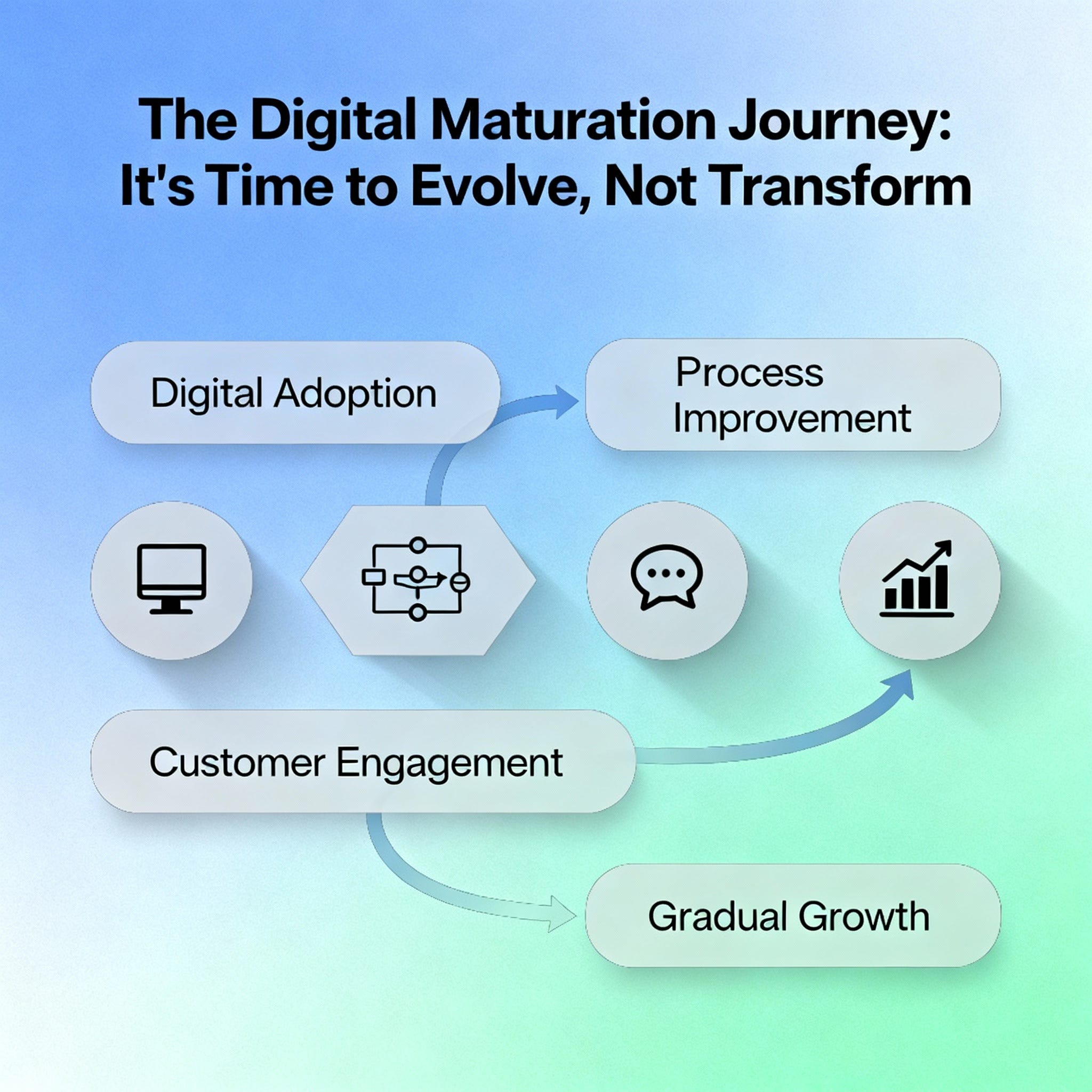
Embracing Digital Evolution
Digital evolution emphasizes incremental, adaptive change. Instead of discarding what works, companies build upon their existing digital foundations. They integrate new tools only when it makes sense for their operations, customers, and budgets. Most SMEs already have digital building blocks, think CRMs, accounting software, productivity suites, which become the launchpad for further, sustainable advancements.
Consider the journey from a basic CRM system to an integrated customer experience platform. The process is rarely linear or dramatic. Instead, it might be marked by modest upgrades, automation experiments, improved analytics, and, when you’re lucky, a few “aha!” moments when you realize your technology is actually starting to serve you, not the other way around.
The Wisdom of Digital Maturation
If digital evolution is the journey, digital maturation is the wisdom gathered along the way. This is not about lurching from one shiny tool to the next, but learning which technologies truly move the needle, and which are simply new wrappers on old problems. Over time, SMEs find themselves making more strategic, less reactive decisions about digital investments.
My own work with “CRM for Medium and Small Enterprises” (Routledge, 2022) drives this point home. The leap isn’t from “no system” to “system”, but rather from tracking contacts (in some way) to developing nuanced, data-driven approaches to customer relationship management.
You don’t buy maturity; you grow in it, sometimes painfully, but always with compounding dividends.
Talking of “evolution” or “maturation” shifts the expectation to something continuous, human, and, let’s be honest, relieved of such a drama: Leaders become gardeners, not demolition experts, cultivating talent, meta-competences, processes, and tech organically.
The “Digital Maturation Journey”: A Blueprint
So what does a realistic digital journey look like?
Assess capabilities: Understand what your systems and people already do well.
Build incrementally: Integrate new tools and refine workflows without breaking what works.
Experiment and learn: Give yourself permission for small failures and gradual wins.
Refine and repeat: Let experience inform your next steps as sophistication grows.
Enhance meta-competences: empowering people on their own most valuable contribution to the organization, be human.
Celebrate progress: Remember: digital wisdom is measured in lessons learned, not just pixels installed.
This incremental approach is not only more sustainable; it’s also more successful. Companies that mature digitally build resilience and competitive edge with every step, not just after the dust settles.
And if that weren’t enough, the narrative often skips over a crucial ingredient: the enhancement of meta-competences. It’s easy to focus on technical know-how instead of the usually called soft-skills. Yet, meta-competences like think adaptability, the ability to learn how to learn, strategic foresight, the application of Emotional Intelligence, and a creative problem-solving approach, are paramount to genuine digital evolution. These traits quietly empower organizations to navigate uncertainty, adopt new technologies judiciously, and continuously renew themselves. They are often understated, but in truth, they are the glue that holds together any successful journey through digital change.
Our Value Proposition: Managing Digital Evolution, Not Just Sudden Transformation
This is where I position my own offering to the market: managing digital evolution projects for SMEs. Not grandiose, one-size-fits-all transformations, but practical, tailored journeys that respect your starting point. My approach is grounded in CRM expertise -the core of a Customer Centric Culture-, but extends across the broader digital canvas. The advantage? Less disruption, more learning, and a stronger fit with your actual business realities.
Conclusion: Evolving, Maturing, Succeeding
In the end, most SMEs don’t need a digital revolution anymore, they need the confidence and guidance to evolve and mature. A successful digital journey is more about curiosity and discipline than drama and disruption. Here’s to all the gradualists: may your digital headaches slowly but surely morph into digital capabilities and, one day, wisdom.
“Digital evolution is about building capabilities, not just accumulating tools.”
“The only transformation most SMEs need is in their thinking about transformation.”
Thanks for reading! Subscribe for free to receive new posts and support my work.
Thank you for reading it, please consider reading my book: Customer Relationships Management for Medium and Small Business.
Comments
Nothing yet. Say the first thing.
Sign in to join the conversation.