
Biology will deliver most of the returns in the stock market in the coming two decades.
Now’s the time to get good at it.
In essence, Caris and Tempus AI do the same thing: take a tumour sample, sequence its DNA and RNA, subtract the background noise, match the profile against a large outcomes-linked database, run AI to pick the therapy or trial. It is the identical Ontology I described in my latest Hims piece: drug plus biomarkers implies updated biomarkers, which approximates a clinical delta. Both feed every result back as proprietary data that improves the next prediction.
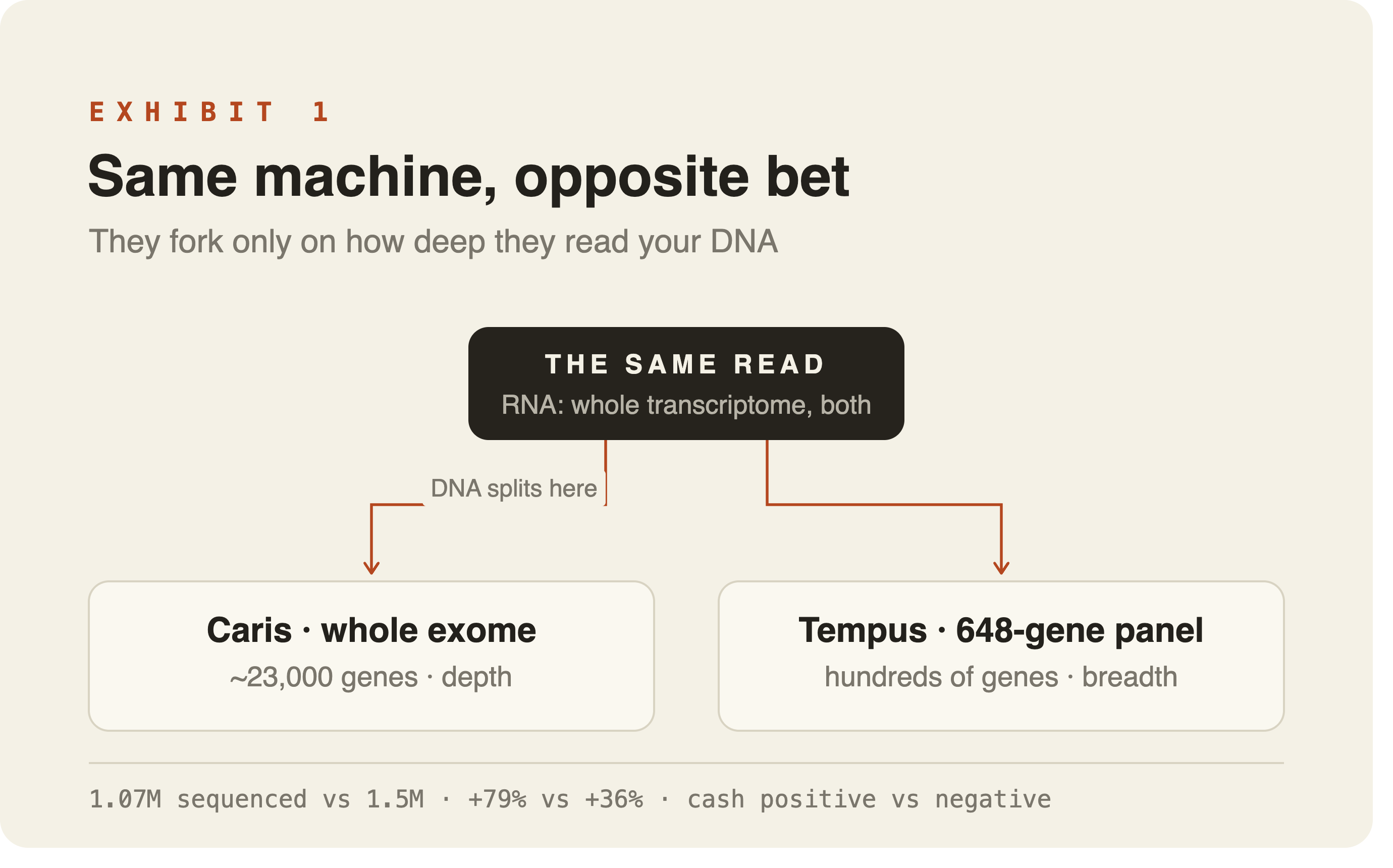
Caris and Tempus AI differ fundamentally in terms of how much of your genome they read.
Caris reads the whole exome, every protein-coding gene, hypothesis-free. Tempus reads a curated 648-gene panel. On RNA they converge: both run whole-transcriptome sequencing, because fusions and splicing cannot be captured by a fixed DNA list. So the disagreement is specifically about DNA, bringing forth the following tradeoff: depth per patient versus breadth across patients and modalities.
Caris has less scale. Tempus has more. On raw cumulative volume Tempus is ahead, not behind: ~1.5M patients with sequenced data versus Caris's ~1.07M profiled cases. On revenue Tempus is roughly 1.6x larger, $348M versus $216M in Q1 2026. The one axis where Caris leads is slope, 79% growth against 36%.
But Caris is already printing cash. This is the real separation. Positive adjusted EBITDA and positive free cash flow, multiple quarters running, while Tempus is still climbing to breakeven. The smaller company is self-funding; the larger one is not yet.
Caris does not win on scale on any axis except depth-per-patient. It wins on cash discipline and on the uniformity of its corpus. Everything that follows is a bet on whether those two edges out-compound Tempus's larger, broader, faster-growing book.
ASPs (average selling prices) are rising. Tissue ASP moved from ~$3,256 in Q2 2025 to ~$4,089 in Q3 to ~$4,300 with true-ups, on its way to a guided ~$4,200 for 2026. A large slice of 2025 was reimbursement catch-up: Q3 carried a $37.9M true-up (underlying gross margin 61% versus 68% reported), Q4 carried $33.6M of prior-year collections. Adjust for those and the base tissue ASP sits around $3,500 to $3,900. Still best-in-industry, and still climbing.
Management is explicit about the cause. The CFO, unprompted, credits the pricing edge to "the decision David Halbert made to go the whole exome and whole transcriptome." The President takes the direct shot at the panel model: the new AI signatures exist because "small panels of hundreds of genes are not sufficient to offer these types of insights."
Full exome at this scale is unique to Caris, and the decision dates to 2018. Halbert: "In 2018, I made the decision to move Caris to Whole Exome and Whole Transcriptome sequencing." Every profile since has been generated that way, which is why the corpus is uniformly comprehensive rather than a patchwork of panel versions. Tempus offers a whole-exome assay (xE) but reserves it for research; its clinical default stays the 648-gene panel. So the comprehensive-at-clinical-scale position is genuinely Caris's alone.
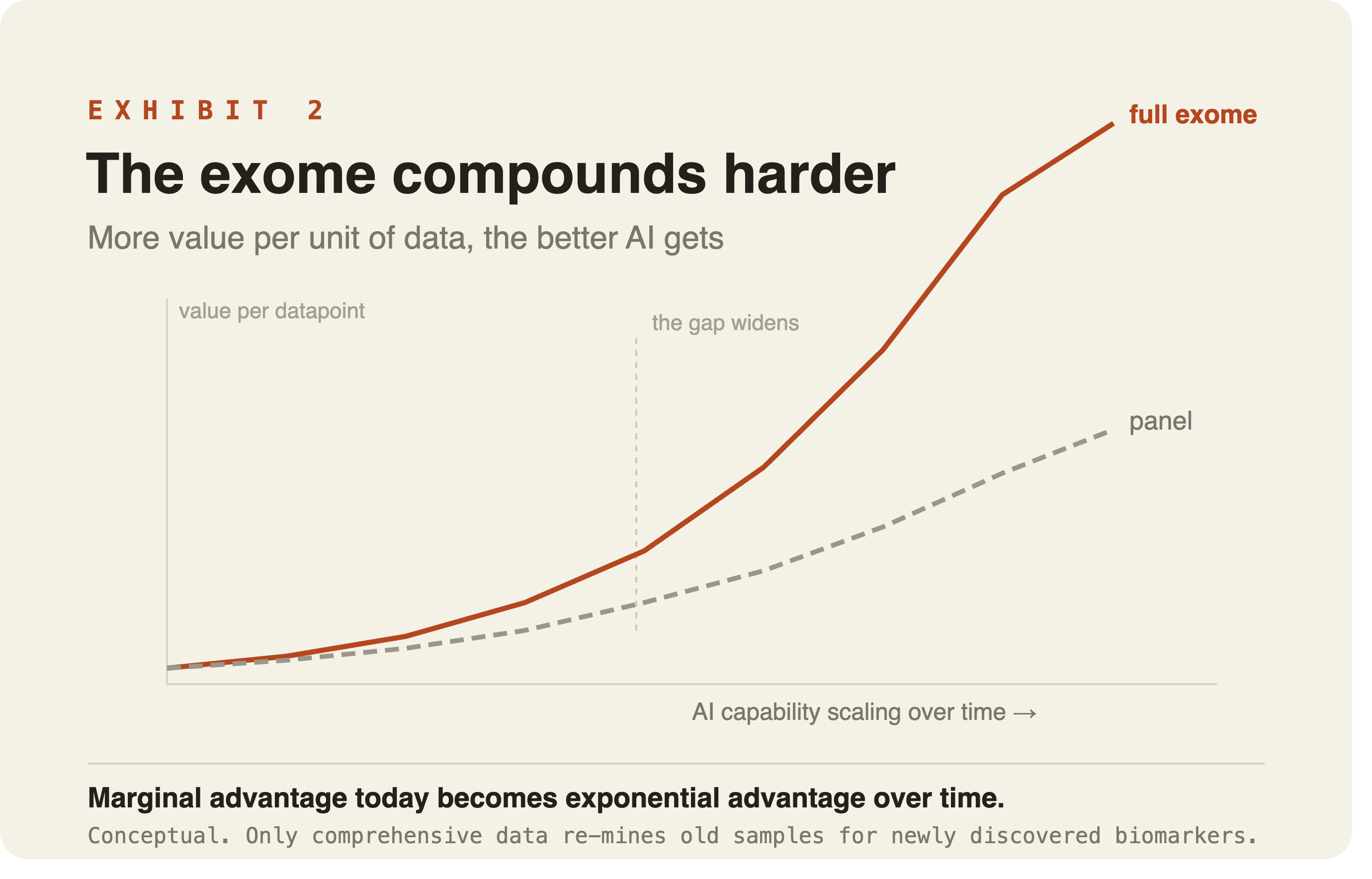
This is a Singularity Scaler. Comprehensive sequencing means the back catalogue is re-mineable: when a new biomarker is discovered, you already measured it, so you re-value 1M+ existing cases at zero re-collection cost. A panel cannot do that; to capture tomorrow's target it must redesign and re-sequence. And because the data is comprehensive, the value extracted per unit of proprietary data rises faster as AI scales, there is simply more substrate for a better model to find. In digital systems a marginal advantage compounds into an exponential one. That delta, small now, is where the long-run separation from Tempus could come from.
However, the pricing power transmits through FDA approval, PLA codes and payer contracting, not depth alone. A whole-exome assay without those would not command this ASP. The good news for the bull case is that this makes the moat harder to copy, not easier, and PAMA pins the Medicare rate with no expected downward adjustment through 2029.
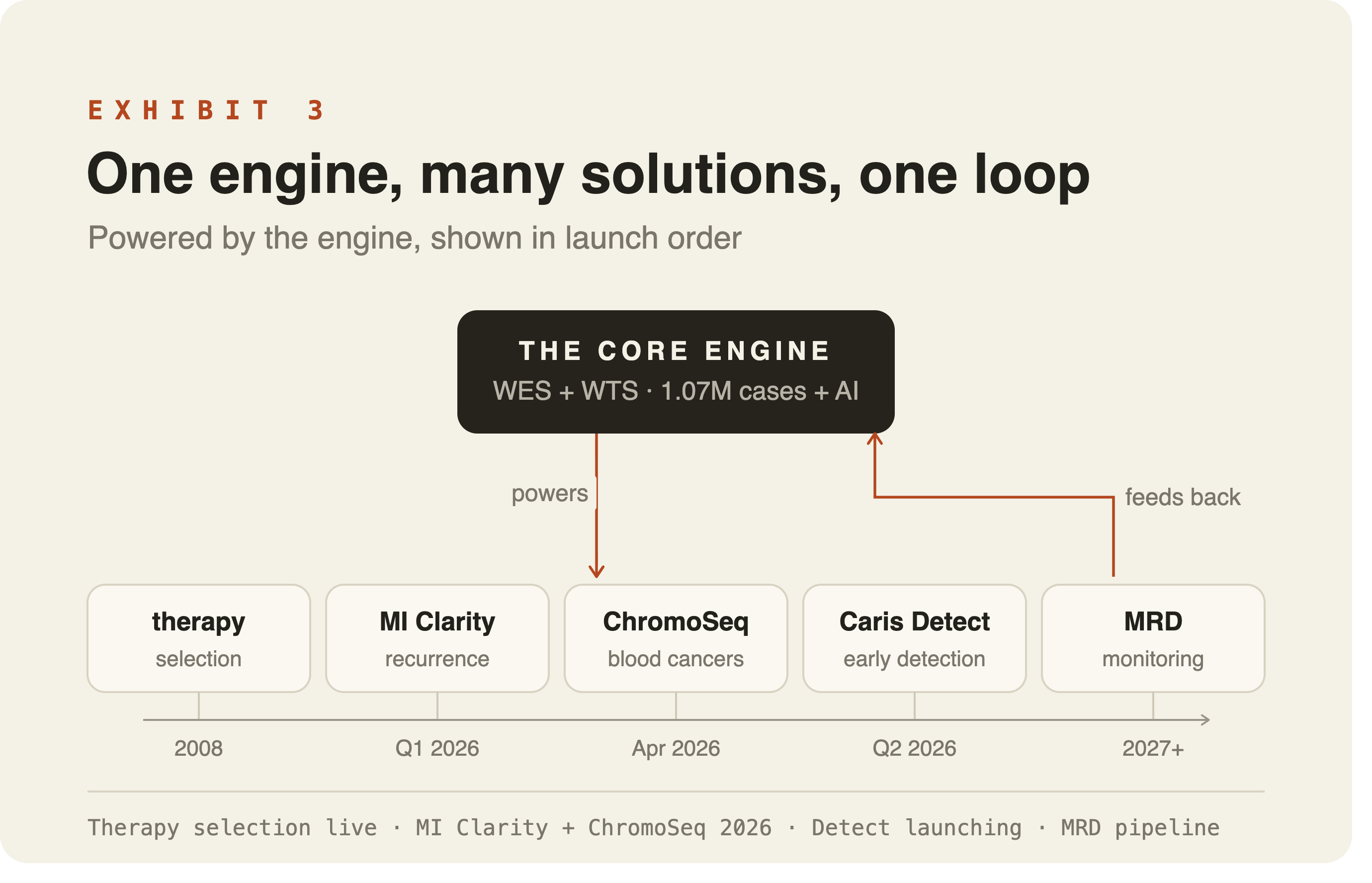
The platform is a flywheel. At the centre is the core engine: whole-exome and whole-transcriptome profiling on tissue and blood, which both is the original product (therapy selection) and generates the 1.07M-case database that powers everything else.
Around that engine, Caris launches new solutions that reuse the same data and the same channel: ChromoSeq for blood cancers, MI Clarity for breast-recurrence risk, Caris Detect for early detection, MRD for monitoring. Each is powered by the engine, and each new case feeds its data back in. Critically, the channel barely grows to support them, management ran roughly doubling volume on basically flat sales headcount for years, and new modalities ride the same oncologist relationships.
Revenue and operating cash flow both bend sharply upward between 2024 and 2025. Revenue: $258M, $306M, $412M, then $812M. Operating cash flow: roughly -$245M, -$276M, -$245M, then +$83M, and +$147M on an LTM basis. A company that burned a quarter-billion a year for three years flipped to cash generation.
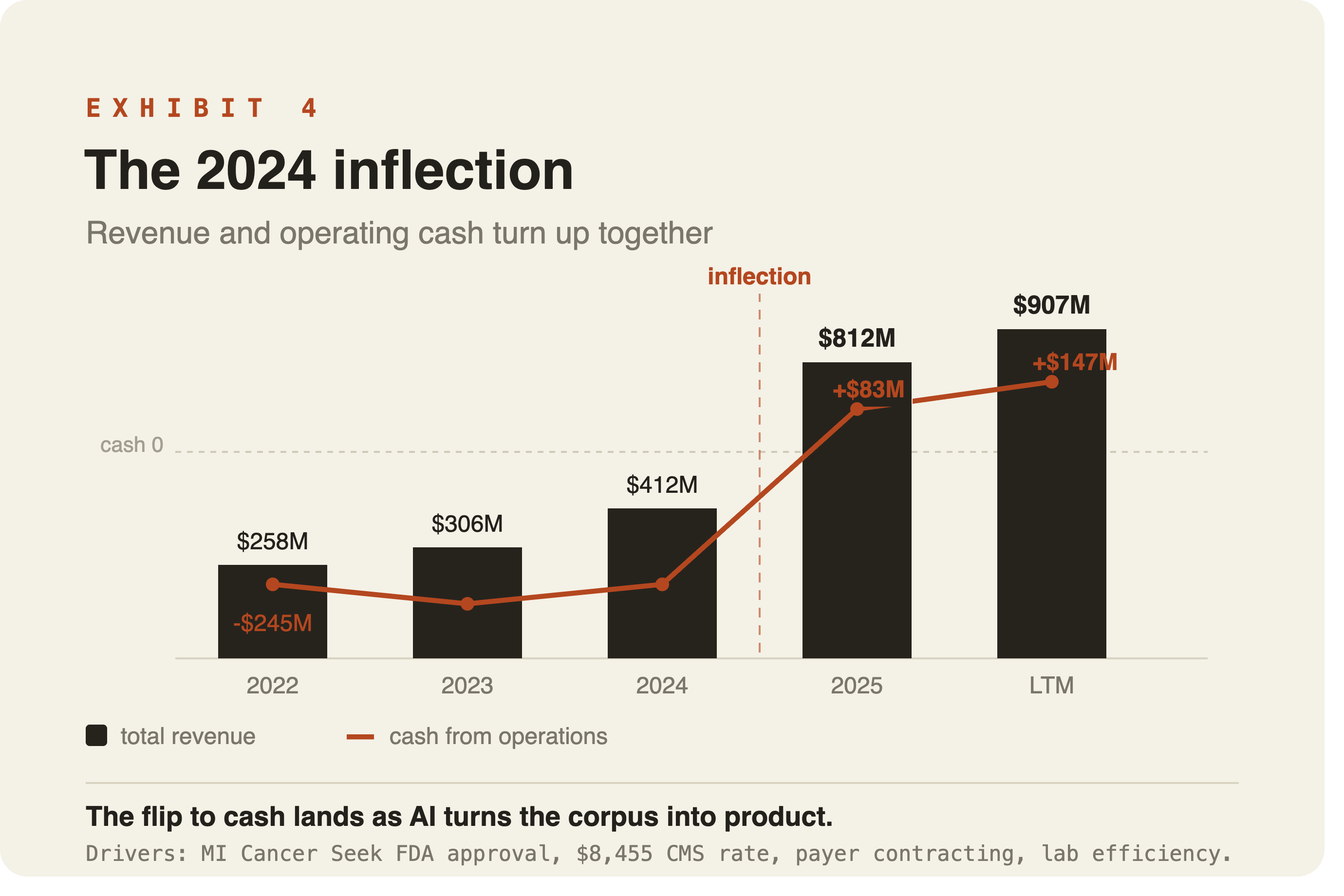
The proximate drivers are in the calls: MI Cancer Seek's FDA approval (January 2025) and the $8,455 CMS rate that followed retroactively to it, payer contracting past 225M covered lives, PLA codes, and lab efficiency. Turnaround, the time from sample received to result, was 8 days for tissue and 7 for blood by Q3 2025, quick for an assay that reads the whole exome and whole transcriptome. Caris never disclosed the earlier figure, so read that as a level, not a measured improvement.
But the deeper driver is that AI has become materially better at pulling signal out of biological data. The clearest signal is Caris Detect, the whole-genome early-detection test, built on the same data foundation. On the interim ACHIEVE-1 readout it posted an AUC of 0.90. AUC, the area under the ROC curve, is the chance the test scores a random cancer patient above a random healthy one, where 1.0 is perfect and 0.5 is a coin flip, so 0.90 is strong separation.
However, note that those interim figures softened on validation. Stage I/II sensitivity fell from 63.1% on the interim cohort to 60.3% once the blinded holdout was scored, the normal give-back when a model meets data it has not seen, and Caris has not restated the AUC on that blinded set, so quote 0.90 as interim. Caris also shipped five new AI-derived signatures on its tumour board and argued its profiling is "becoming more proprietary, not commoditised."
These are all visible manifestations of the same shift: models can now turn a comprehensive biological corpus into differentiated products. Reimbursement provided the mechanism to monetise that value, but AI is what made the corpus significantly more valuable in the first place.
This is the prize Hims, Tempus and Caris are chasing. Eventually everyone has a Biology Ontology running in the background 24/7. Hims builds it via D2C, with a relentless focus on patient outcomes. Caris and Tempus build it on traditional healthcare rails, and the only real difference between them is full exome versus not.
Caris and Tempus AI earnings calls consist primarily of analysts and management trading reimbursement minutiae for hours, ASPs, true-ups, PAMA cycles, covered lives, gross margin to the basis point. What you do not find, in any meaningful sense, is a conversation about actually keeping patients well.
That is not an accident. It is the same core issue I raised with Tempus: incentives, inherited from the rails.
Caris and Tempus draw their data through the traditional system, and that system is paid when you are sick. They earn per test, per diagnosis, and exactly $0 if you never get sick. Hims runs on the opposite reflex, longevity as a service, where the company makes more money the longer you stay well. Same Ontology, opposite reflexes. One is paid when the system acts on illness; the other when the customer avoids it.
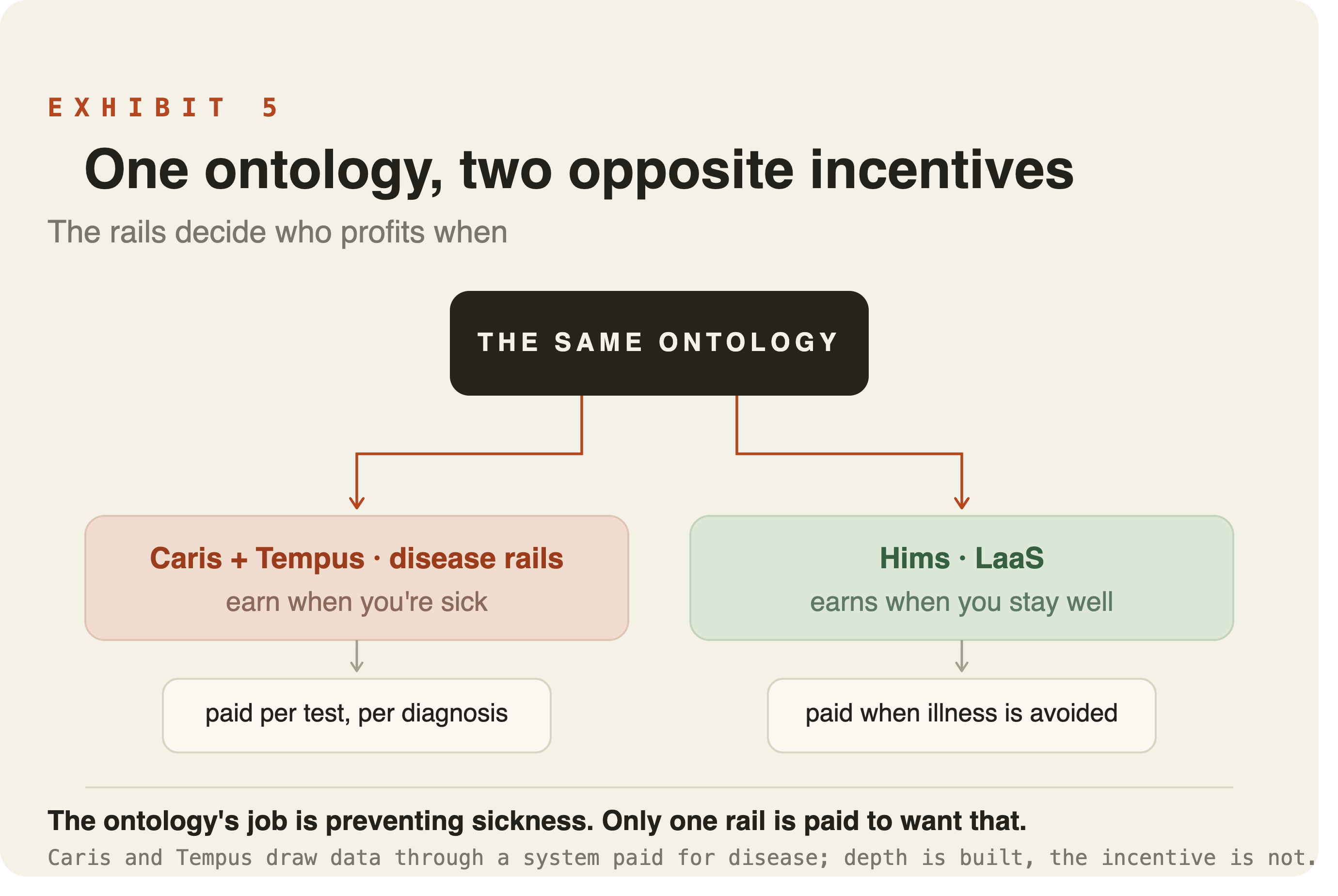
As the Ontology becomes maximally predictive, it stops describing disease and starts forecasting it years out. At that point prevention becomes the cheaper path, and systems eventually follow the cheaper path, though the reimbursement machinery resists, so this is a destination, not the present.
From there the tree splits, exactly as it did for Tempus. In the first branch, Caris builds its own D2C infrastructure and pivots toward prevention-as-a-service, at which point it stops being adjacent to Hims and becomes a competing Ontology fighting for the same patient. In the second, Caris does not build D2C, and becomes the depth engine distributed through D2C channels like Hims, the comprehensive-genome layer that breadth players license and pour through pipes they already own.
Caris's whole-exome corpus is arguably the better engine for that role precisely because it is comprehensive and re-mineable.
The bottom line is the one from the original Hims deep dive: the final application of a Biology Ontology is preventing sickness, and the monopsony economics of traditional health insurance are not built to reward that. Caris has built, on current evidence, the deepest per-patient corpus in oncology and the only self-funding model among the comparables. What it has not built, and on these calls does not yet seem oriented toward, is a rail whose incentives point at the thing the Ontology is ultimately for.
There is one number that cuts through everything else, and it runs against the depth thesis. A molecular ontology is only worth what someone pays to use it, and the buyer who matters right now is pharma. On that test, the deeper corpus is not the more valuable one. Tempus did roughly $316M in data and applications revenue in 2025, about a quarter of its $1.26B, growing 31% with the data-licensing line up 38%, against ~126% net revenue retention and a contracted book above $1.1B.
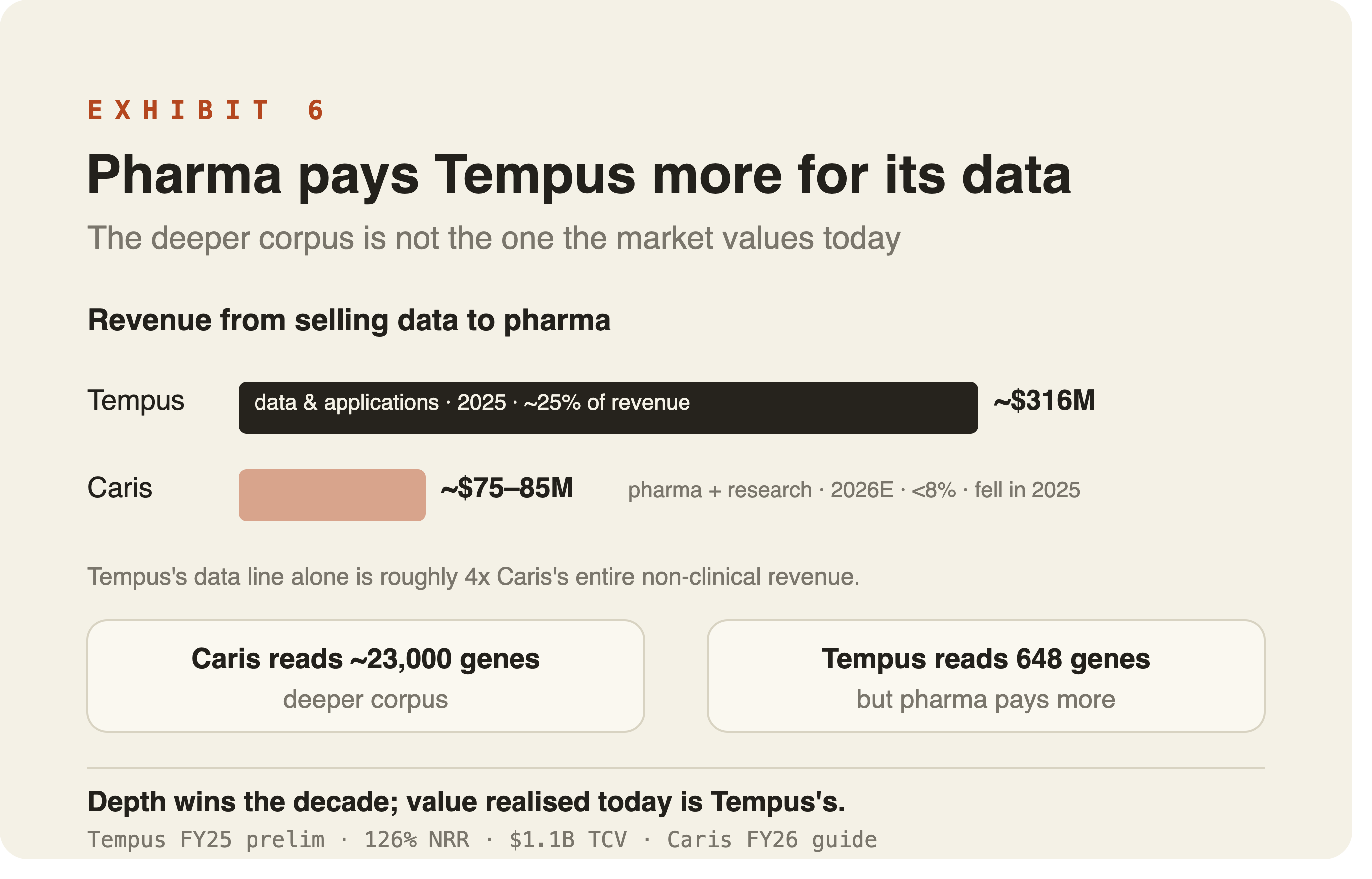
Caris, by contrast, guides its entire pharma and research line to $75–85M for 2026, under 8% of revenue, after that line actually shrank in 2025. Tempus's data business alone is roughly four times Caris's whole non-clinical revenue, and management at Caris won't even split out a data-licensing number until pharma crosses 10–20% of mix, which it is nowhere near.
Caris reads ~23,000 genes per patient; Tempus reads 648. Caris has the deeper data by construction. Yet the most sophisticated buyers in the world, the pharma R&D teams who could build this themselves, are paying Tempus multiples more for its maps. Either depth is not what pharma is buying, breadth across patients and modalities, the multimodal record wired to outcomes, is, or Tempus is simply years ahead at packaging and selling what it has. Both readings point the same way commercially.
And it may reframe Tempus as the more interesting bet right at an inflection: a contracted, retention-heavy data business already monetising the corpus, trading around 4x sales, just as generative AI starts spinning that corpus into predictive diagnostic products. The corpus depth argument still favours Caris on a ten-year horizon. The corpus value realised today favours Tempus.
Whichever way you read it now, Caris versus Tempus is a great experiment to see whether depth or breadth makes the faster-improving Ontology. One of them is wrong, and the data will say which.
⚡ If you enjoyed the post, please feel free to share with friends, drop a like and leave me a comment.
You can also reach me at:
Twitter: @alc2022
LinkedIn: antoniolinaresc
These are opinions only of the individual author. The contents of this piece do not contain investment and/or medical advice and the information provided is for educational purposes only and no discussions constitute an offer to sell or the solicitation of an offer to buy any securities of any company or any drug or medical treatment. All content is purely subjective and you should do your own due diligence.
Antonio Linares makes no representation, warranty or undertaking, express or implied, as to the accuracy, reliability, completeness or reasonableness of the information contained in the piece. Any assumptions, opinions and estimates expressed in the piece constitute judgments of the author as of the date thereof and are subject to change without notice. Any projections contained in the Information are based on a number of assumptions as to market conditions and there can be no guarantee that any projected outcomes will be achieved. Antonio Linares does not accept any liability for any direct, consequential or other loss arising from reliance on the contents of this presentation. Antonio Linares is not acting as your financial, legal, accounting, tax, medical or other adviser or in any fiduciary capacity.
No posts
Comments
Nothing yet. Say the first thing.
Sign in to join the conversation.