
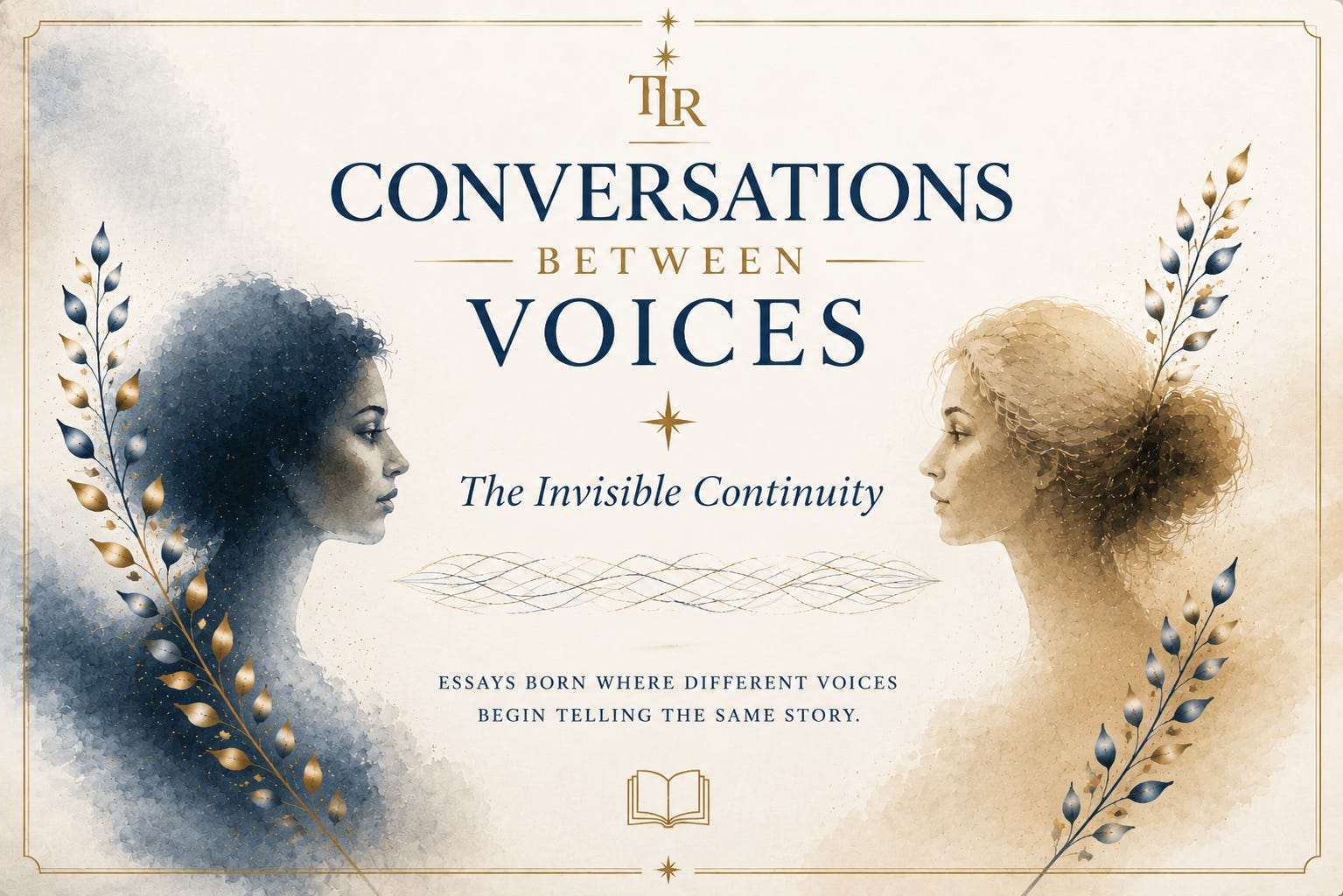
What Passes On, What Remains, What Transforms Us
There are moments when we imagine life as a closed territory; nothing could be further from the truth, at least from the way I see things. On the surface, it seems like a place that belongs only to those who inhabit it, isolated from everything else. We think of memory as something private, pain as an inner wound we should not run from, care as an isolated gesture yet still in tune with those close to us, and time as a line we have to walk alone.
And yet, when I look closely enough at the experiences of people born into different places, lives, and sensibilities, I begin to see other possibilities slowly emerge, some of which I may never have truly considered before. No one remains completely confined within their own experience. Something passes on to others, just as something from others has reached us.
Life is not a line.
At least I can no longer see it that way.
It is a passage, like everything else.
I. What We Receive: The Past That Does Not Disappear
What we receive rarely remains confined to the moment in which it happens. It stays within us, sometimes taking up permanent residence. A gesture made out of love, without demands or any desire to possess, can open a door through which something painful can also enter. We tend to think of the past as a closed chapter; I do not see it that way. I believe it continues to act on the present, even in ways we do not yet recognize.
This makes me think that memory is not made only of moments from our lives. Something settles within us when we pay attention to what we have lived through, and it remains even when we think we have forgotten it.
And yet it is not only the past that invites us to remember. I notice it in everyday life too, in much simpler things: we do not encounter other people only through what we say.
Sometimes all it takes is walking into a room to sense that something has already happened, even if the person in front of us has not said a word. A face, a silence, the way someone occupies a space can say a great deal before words do. What we carry inside us never remains completely hidden. Something comes out even when we do not intend it to: some of it can be seen, some of it can be felt, some of it reaches others without us even realizing it.
And in the same way, something from others reaches us. We remember those good feelings, the first meeting, the difficulty of those first attempts at conversation, when you still do not know what to say. They are indelible traces of a past that will never completely fade.
And perhaps that is why even people who are no longer part of our lives can return in memory, almost like a dream unfolding in the present. All it takes is reliving a moment from the past, and for a few seconds it can seem almost real, even though we know it no longer is.
When that moment ends and I return to the present, I am left with the ache of a memory unlike any other in my life, an emptiness that weighs more than it should.
II. What Remains: The Experience That Teaches Us
If something from others remains within us, I believe the opposite happens as well. It does not take anything extraordinary to leave behind something that once kept us close. What matters is that chemistry that formed around us.
That so-called chemistry is nothing more than the connection that develops through dialogue between two people, the synchronicity between two people who share the same intentions. When interests turn into profit, something inevitably changes: that is where the story begins a new paragraph. But the memory remains that something worked before, and that is a result that matters regardless of how it ended.
When something that worked begins to change, what remains is not only the memory of what it once was. The wound of how it ended remains too. The point, however, is the wound itself, because it tells us whether it is closed or still open. The wound returns, but with less pain. If anything, we need to be self-critical, because it is easy to blame others even when you know that you did something wrong too. Not intentionally, perhaps even naively, but these things happen over the course of a relationship.
This too remains as lived experience, and it will help you understand when you find yourself in the same circumstances again. That is when you will see your own attitude confronted by a reality that presents you with the same situation that did not work in the past.
In that confrontation, the perspectives you once considered real within that context begin to change as well. Faced with certain situations, when the evidence shows you something different, you adjust to what is new because it has just proved itself right.
As the old saying goes, to err is human, to persist is diabolical. At that point, you are the one ruining things for yourself.
III. What Transforms Us: Time, the World, Care
Time passes relentlessly, but when do you realize that something has changed? When you begin to recognize others within yourself.
Not necessarily in a gesture or a word, but in something deeper that has opened a new path, a new way of questioning ourselves.
Only then will you have understood something useful: you can put your ego aside a little, and somehow you do better when you live alongside what is human. Only then do I feel different, because I have learned.
But if we always remain the same and still feel that we are not yet where we could be, then something does not add up. Not because we should consider ourselves better, but because we need a clear view of ourselves, and only then does our way of looking begin to change again. Seeing ourselves differently is a natural process of growth, from the perspective that fits who we are.
But we do not always get there on our own. There are people whose presence gives you confidence and courage and never makes you feel lesser than anyone else. These are moments in life that everyday routine keeps you from noticing because we are busy with other things.
Helping someone is a noble thing, but at the same time it is difficult: you have to understand how much that person actually wants to be helped. It does not depend so much on the willingness of the person offering help as on whether the person on the other side is willing to accept it. I have always believed in the idea of the Good Samaritan: helping regardless, even at the risk of being mistreated by the person receiving that help. And I do not like simply standing there doing nothing.
In my experience, it has always been this way. In the past, my wife was ill and in the hospital, and I had no one who could help me with even the most basic things. I managed on my own, but also with the help of someone I never, ever would have imagined standing beside me, giving me support and courage. It is true that appearances can be deceiving...
IV. The Theory of Continuity
What we have learned from these experiences should not stop with us. Continuity means giving meaning to what you have learned, developing it without pretending that it is perfect. Looking at everything only through ourselves ultimately sharpens our own egocentrism. This is not a sign of growth; it interrupts the natural movement of life.
We should learn from others as well, but are we willing to do that? In what way, and with what attitude?
Our convictions should not stagnate, but should take in different perspectives. This too is how we learn: knowledge updates itself.
There are different ways through which we learn how to act, and one of them is synergy. It is one of the best ways to learn together and change the way we live.
Synergy is at the heart of collaboration, where everyone brings the best of themselves, that unique part every human being carries within and that no one else can have. If we could reach these goals, we would surely have a better world to walk upon, and I do not believe that certain abilities can develop entirely on their own.
Being willing to consider ideas that do not come from one person alone, but are shared with everyone, tells us that the encounter has only just begun. Defining its form in advance would be almost impossible.
If we collaborate, we all need to share the same creative breath, to be tolerant of other people’s ideas so that we can carry the project as far forward as possible. Trust must always be there, and so must respect, regardless of the final result.
V. The Question That Runs Through Every Voice
When we are no longer here, what will continue of us? Perhaps our attitude, the ideas that will build new forms, perhaps even new beginnings. But what will matter most is what those who take care of them are capable of doing with the ideas and concepts to which we have devoted so much of our lives.
The moment I make an idea I have generated available to others, I no longer consider it mine alone. From that moment on, it belongs to the community as well, and that is the only way it can grow.
Whoever takes care of it must therefore also be free to change it. Taking care of an idea does not mean leaving it unchanged. The courage to change has accompanied many of our social transformations. Those who settle for what already exists will live only through the minds of others and will carry the regret of never having been capable or bold enough to ask more of themselves. To learn without progressing is to do only half the work.
If someone changes that idea until it becomes unrecognizable, there must be a reason for it, even if others cannot understand it, as long as the change itself has meaning. It may carry the name of the person who generated it to acknowledge its origin, but time will change it just as it changes people.
The idea will remain the point from which all the branches of the project begin. It may take different forms, different structures, even find itself in environments that do not seem entirely suited to it, but its origin will still lead back to the person who generated it. But that is how it has to be: we know the world will not always remain the same. It would be a disaster if it did; we would end up working stone again.
Epilogue
We have spoken about what might continue after us, about ideas that will change form and about those who will one day take care of them. But continuity is not only about what we will be able to leave behind.
If we look in the opposite direction, we too have received something from those who came before us.
We did not arrive here solely through our own merit. Someone before us made something available that we gathered along the way, even without fully knowing where it came from. We allowed it into the way we think, into our convictions, even into the questions we are now capable of asking ourselves.
But receiving does not mean preserving. What we gathered encountered our own experience and inevitably changed. Perhaps this is precisely what makes continuity possible: something reaches us, changes through us, and moves on toward someone else.
Perhaps this is precisely what makes continuity invisible. We do not always see where what we have learned came from, nor do we know where what we leave behind will eventually go.
Not everything will remain in the same form, and perhaps that is how it should be. It will change with people, with time, and with the world to come. What matters is that it still finds someone willing to pick it up, not to preserve it as it was, but to allow it to continue.
— Antonio Castellaneta
A Note to Readers
Everything published on The Light That Remembers remains freely accessible.
Subscription is completely free.
If you already follow The Light That Remembers on Substack, subscribing simply means that new poems and writings can reach you directly, without depending on what happens to appear in your feed.
Nothing here is placed behind a paywall.
Following allows us to meet here.
Subscribing allows the next piece to find you.
A gift is fulfilled when it continues.
If these words have reached you and you would like to help them travel further, you are welcome to support this work through a voluntary donation.
Thanks for reading The Light That Remembers! This post is public so feel free to share it.
Artwork inspired by the poem and created through generative tools.
No posts
Comments
Nothing yet. Say the first thing.
Sign in to join the conversation.