
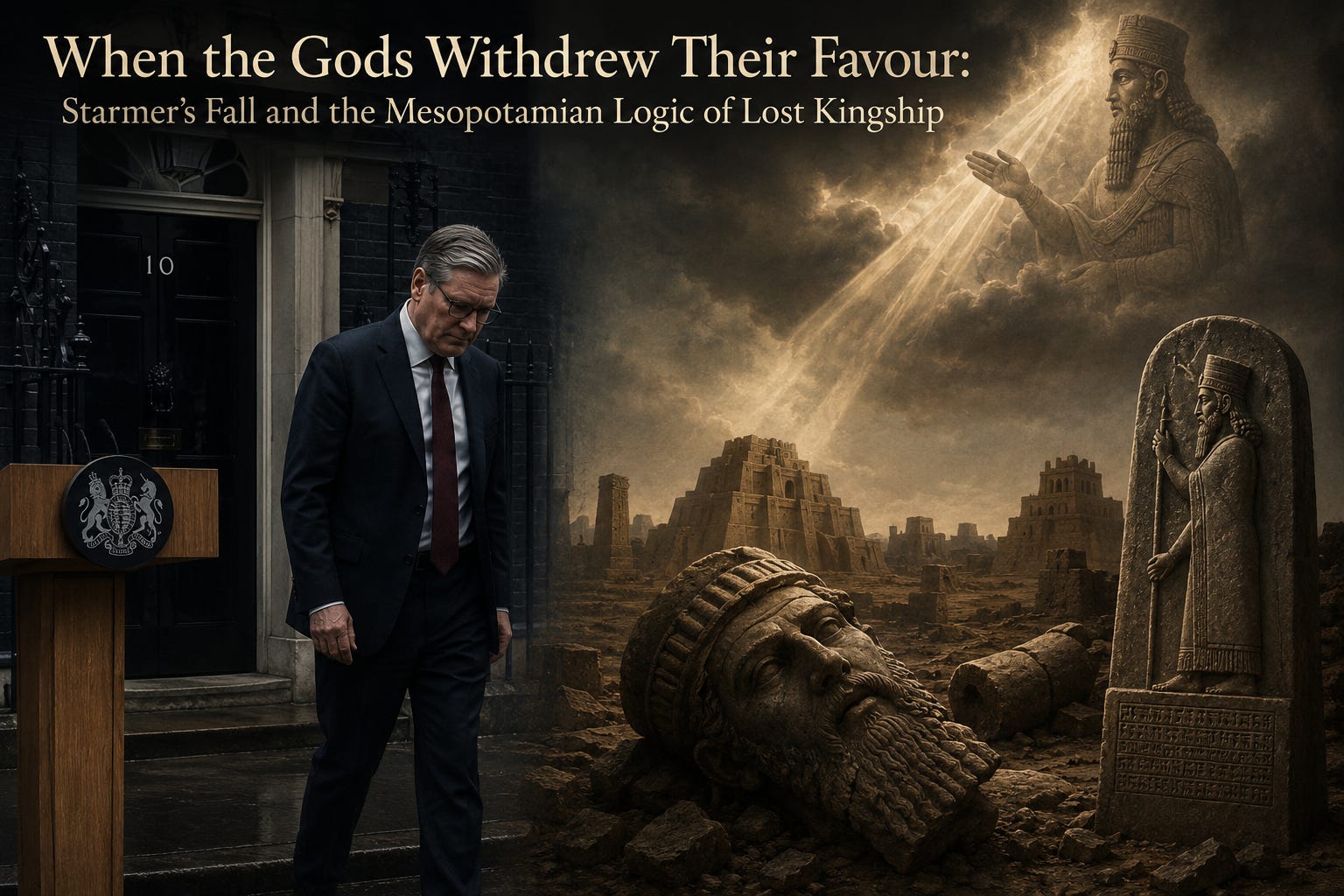
In light of the recent political events in the UK, I thought I would write this short piece….these hot, sleepless nights are good for something!
On 22 June 2026, Keir Starmer announced his resignation as Leader of the Labour Party and Prime Minister, four days after Andy Burnham won the Makerfield by-election and cleared his path to a leadership challenge (Institute for Government, 2026). The episode, on its surface a story of modern parliamentary arithmetic, dramatises a problem as old as organised government itself: how does a ruler lose legitimacy before they lose office, and how is power transferred without rupturing the state?
Four thousand years earlier, the city-states of Mesopotamia wrestled with the same problem in starker terms, often through divine sanction, military force, or dynastic collapse rather than ballots and nominations.
The mechanics of 2026
Starmer's authority eroded gradually rather than collapsing in a single vote of no confidence. Poor results in the May 2025 and 2026 local elections, paired with resignations from Wes Streeting, Defence Secretary John Healey, and Armed Forces Minister Al Carns, signalled a cabinet no longer willing to defend him (Institute for Government, 2026). Crucially, Burnham could not challenge Starmer while outside Parliament; Josh Simons' resignation created the vacancy that let Burnham re-enter the Commons and become eligible to stand (Institute for Government, 2026). Starmer's resignation came not from a formal defeat but from the recognition that he could no longer command his own party's confidence - precisely the mechanism by which, as the Institute for Government notes, prime ministers between general elections are usually removed: through resignation as party leader rather than through dissolution (Institute for Government, 2026). As political scientist Nicholas Allen observes, takeover premierships of this kind are common in British history, Starmer's predecessor Rishi Sunak was himself a ‘takeover’ prime minister following the rapid removal of Boris Johnson and Liz Truss in 2022 (Allen, 2026).
The Mesopotamian parallel: legitimacy without elections
Sumerian and Babylonian kingship rested on a different but structurally comparable logic: a king's authority depended on continuous proof that the gods still favoured him. As Brisch (2013) argues, Mesopotamian rulers maintained ‘close proximity to the divine to legitimize and bolster their power,’ and losing that proximit, through famine, defeat, or plague, was read as the gods withdrawing their mandate. The Larsa dynasty's collapse after King Sin-iddinam died of plague in 1843 BCE shows this instability: his successor Sin-iribam was not his son, and the throne passed rapidly through short reigns (Sin-iqišam, then Ṣilli-Adad, who held it only months in 1835 BCE) before Kudur-Mabuk, a dignitary of Elamite descent, manoeuvred his sons Warad-Sin and Rim-Sin onto the throne (Fiette, 2020). Kudur-Mabuk never took the crown himself; he ruled while remaining formally a ‘father’ figure’ (titled abi Amurrim, later abi Emutbal) building power from a regional base at Maškan-šapir before his sons could be accepted as legitimate (Fiette, 2020; Steinkeller, 2004). Like Burnham needing a parliamentary seat before mounting a challenge, Warad-Sin and Rim-Sin needed a credible base of support; their father's regional power, reinforced by a probable marriage tie into the previous dynasty, before they could be accepted as rulers (Fiette, 2020).
Loss of confidence as ancient and modern currency.
What the Institute for Government's constitutional commentators describe in Starmer's case (the convention that ‘the Government must be able to command the confidence of the House of Commons’) (Commons Library, 2019), finds a distant echo in sources Assyriologist Gebhard Selz has studied closely: early curse formulas on royal monuments and a school-based tradition of Sumerian proverbs, both revealing ‘traces of discontent and opposition’ toward kings and shedding light on the ‘criteria involving the loss of the legitimacy of power’ (Selz, 2010).
Selz shows Mesopotamian subjects judged rulers on competence as much as bloodline: proverbs voicing scepticism toward ‘the palace’ circulated in scribal schools, and at least one royal inscription records a city's population rising up and killing an incompetent ruler outright (Selz, 2010).
Visual representation reinforced this constantly renewed legitimacy: kings were depicted as ‘touched by the gods’ in steles throughout the Mesopotamia, a public, repeated assertion of divine backing rather than a one-off coronation (Winter, 2008). Neither system required a popular vote to remove a ruler; both required a visible, cumulative collapse of support among those who mattered: MPs in 2026, priests and city populations in antiquity.
Succession mechanics.
The Sacred Marriage rites described in Sumerian temple literature symbolically renewed the king’s mandate each year, much as a Labour leadership contest (opening nominations on 9 July, concluding by early September (Institute for Government, 2026)), formally renews a party’s mandate in its leader. Both are institutionalised rituals for managing a transfer of power that custom and convention require to appear orderly, even when the underlying contest is anything but.
The comparison should not be overstated however, Mesopotamian succession often involved violence, divine kingship ideology, and dynastic bloodlines wholly absent from the UK’s unwritten constitution, where, as Dane Luo (2025) notes, even prime ministerial ‘advice’ to the monarch on a successor is contested and non-binding. Yet both systems share a deeper structural truth:
that institutional power, whether sanctioned by gods or by parliamentary confidence, is never simply held. It is continuously re-earned, and its loss, however gradual, eventually demands a name.
Further Reading
Allen, N. (2026) ‘Why the UK shouldn’t expect a general election, even with a new prime minister in place’, The Conversation, 22 June. Available at: https://theconversation.com/why-the-uk-shouldnt-expect-a-general-election-even-with-a-new-prime-minister-in-place-285956
Brisch, N. (2013) ‘Of Gods and Kings: Divine Kingship in Ancient Mesopotamia’, Religion Compass, 7(2), pp. 37–46.
Fiette, B. (2020) ‘’King’ Kudur-Mabuk. A Study on the Identity of a Mesopotamian Ruler Without a Crown’, Die Welt des Orients, 50(2), pp. 275–294.
House of Commons Library (2019) No confidence motions and early general elections. Available at: https://commonslibrary.parliament.uk/no-confidence-motions-and-early-general-elections/
Institute for Government (2026) How do Labour Party leadership contests work? Available at: https://www.instituteforgovernment.org.uk/explainer/labour-party-leadership-contests (Accessed: 23 June 2026).
Luo, D. (2025) ‘There is ‘Advice’ and then there is ‘advice’: The Constitutional Conventions on the Appointment of the Prime Minister’, UK Constitutional Law Association Blog, 28 May. Available at: https://ukconstitutionallaw.org/2025/05/29/dane-luo-there-is-advice-and-then-there-is-advice-the-constitutional-conventions-on-the-appointment-of-the-prime-minister/
Selz, G.J. (2010) ‘The Poor Are the Silent Ones in the Country’: On the Loss of Legitimacy; Challenging Power in Early Mesopotamia’, in Charvát, P. and Maříková Vlčková, P. (eds.) Who Was King? Who Was Not King? The Rulers and the Ruled in the Ancient Near East. Prague: Institute of Archaeology of the Academy of Sciences of the Czech Republic, pp. 1-15.
Steinkeller, P. (2004) ‘A History of Mashkan-shapir and Its Role in the Kingdom of Larsa’, in Stone, E.C. and Zimansky, P. (eds.) The Anatomy of a Mesopotamian City: Survey and Soundings at Mashkan-shapir. Winona Lake: Eisenbrauns, pp. 26–42.
Winter, I. (2008) ‘Touched by the Gods: Visual Evidence for the Divine Status of Rulers’, in Brisch, N. (ed.) Religion and Power: Divine Kingship in the Ancient World and Beyond. Oriental Institute Seminars, 4. Chicago: The Oriental Institute Press, pp. 75–101.
Comments
Nothing yet. Say the first thing.
Sign in to join the conversation.