
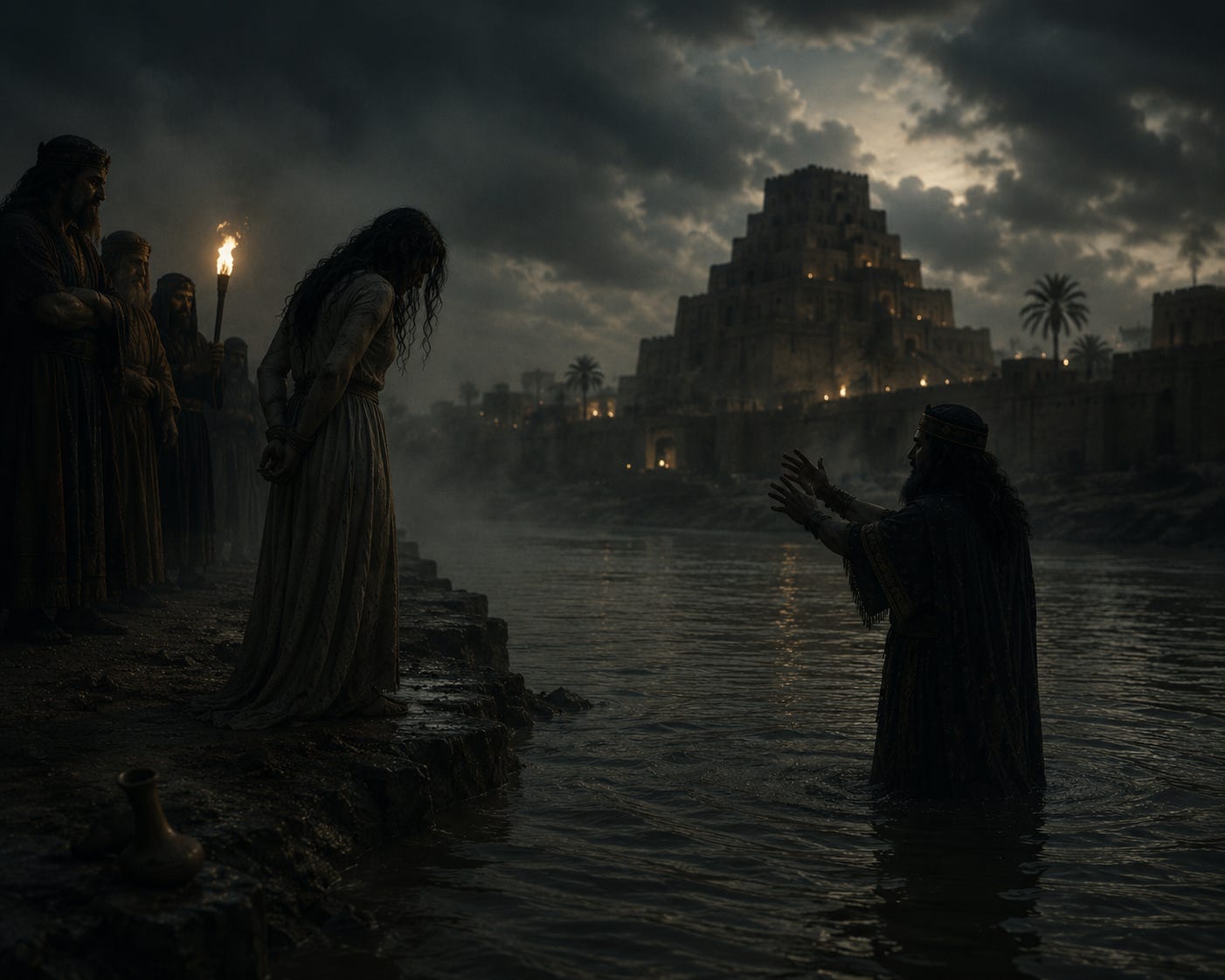
Somewhere in Babylon, around 1750 BCE, a man stood accused of casting a spell on his neighbour. There were no witnesses willing to testify, no confession, no proof either way. So the court did the only thing it could: it sent him to the river. He had to throw himself in. If the water swallowed him, he was guilty, and his accuser inherited everything he owned. If he surfaced alive, his accuser would be executed in his place, and the dead man's estate would pass to him instead. This is not myth or later legend … it is the second law in the Code of Hammurabi, carved into a 2.25-metre diorite stele unearthed at Susa in 1901–1902 and now housed in the Louvre. In the standard modern scholarly translation: ‘If a man charged another man with practicing witchcraft but has not proved it, the one charged with witchcraft shall undergo river ordeal; he shall indeed submit to the river ordeal, and if the river ordeal should overwhelm him, his accuser shall take full legal possession of his estate’ (Roth, 1995, p. 81). Long before any European witch trial, Mesopotamia had already decided that accusing someone of sorcery was dangerous enough to warrant trial by water…
If you enjoy thoughtful essays on history, archaeology, and the stories hidden beneath the surface, please consider becoming a paid subscriber to support my work and gain access to exclusive posts!
Comments
Nothing yet. Say the first thing.
Sign in to join the conversation.