
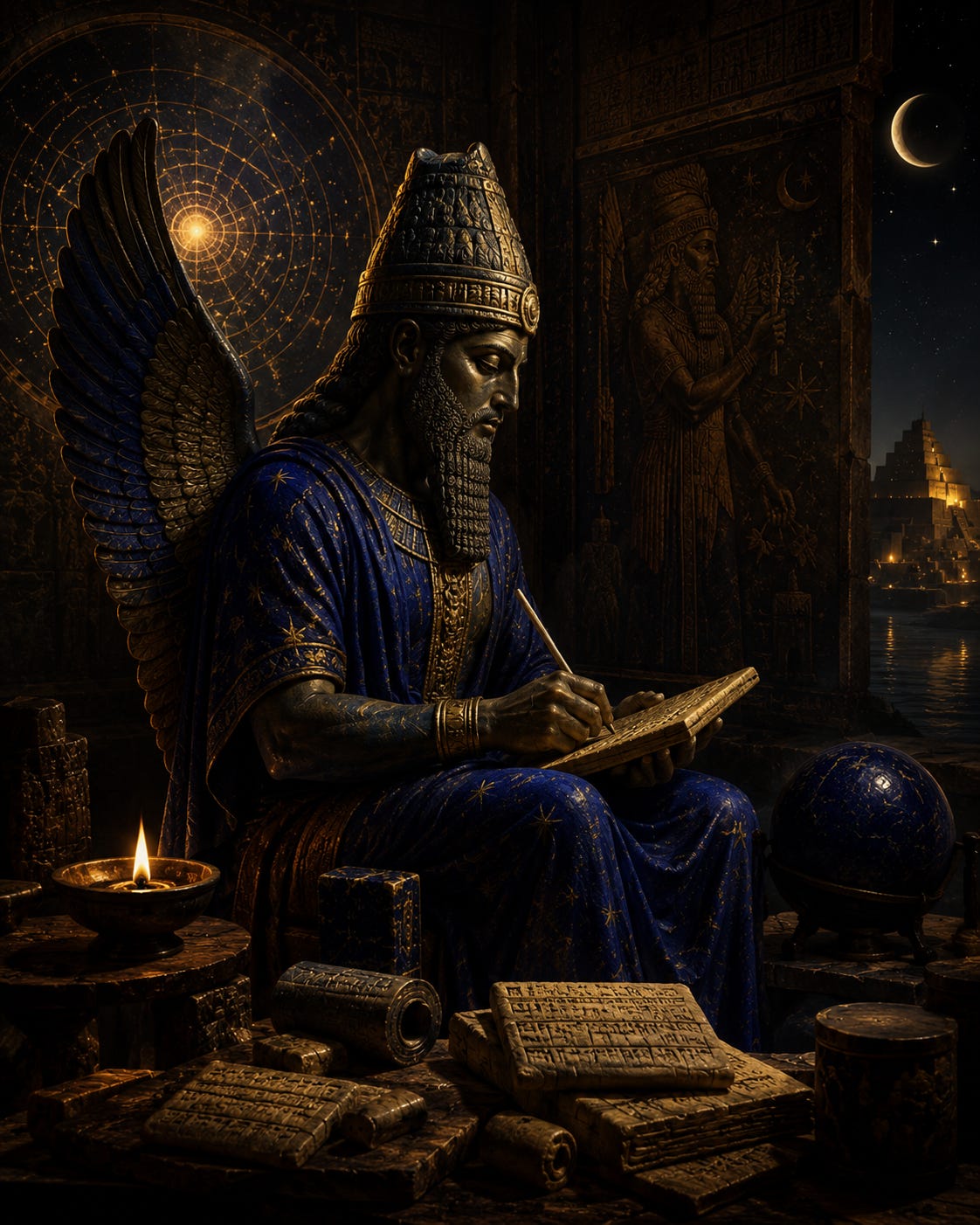
Long before the written word was an everyday tool, it was viewed as a form of deep, volatile magic. To the ancient peoples of Mesopotamia, a single stroke of a reed stylus on a wet clay tablet could alter the course of empires, extend a human life, or seal a soul’s destiny. At the centre of this sacred, silent power stood one deity: Nabu (also known in the Hebrew Bible as Nebo).
He was not a god of thunder, war, or chaotic oceans. He was the ‘Announcer’, the quiet keeper of the cosmic ledger, the master of wisdom, and the patron of all scribes. To understand Nabu is to step into a world of ancient libraries, massive ziggurats, and a divine influence so profound that it echoed across the pages of biblical prophecy.
Nabu's story began modestly. During the Old Babylonian Period (around 2000–1600 BCE), he was considered a minor administrative deity, often serving as a mere assistant to Nisaba, the Sumerian goddess of writing. Yet, as the centuries rolled forward and the power of the written word became central to ruling vast territories, Nabu’s influence quietly eclipsed his predecessor. By the Middle Assyrian period, his status had migrated northward, gaining massive prominence in the royal courts of Assyria alongside heavyweights like Marduk and Nergal (Neumann, 2018).
By the first millennium BCE, during the height of the Neo-Babylonian and Neo-Assyrian empires, Nabu was no longer a servant. He was elevated to the status of the firstborn son of Marduk, the supreme King of the Gods. Together, father and son ruled the Mesopotamian cosmos.
In classic representations, Nabu is depicted as a bearded figure wearing a horned cap (the traditional crown of Mesopotamian divinity). He stands with his hands clasped in an eternal posture of priesthood and meditation, frequently riding atop the Mušḫuššu (the scaled, dragon-like hybrid creature inherited from his father). His symbols were simple but held immense authority: the clay tablet and the stylus.
While Marduk reigned from the majestic city of Babylon, Nabu’s true home was the nearby sister-city of Borsippa, located just southwest of Babylon. There stood the Ezida Temple (The True House), Nabu’s primary sanctuary, crowned by a towering ziggurat (Neumann, 2018). The temple itself was a sensory masterclass, designed to project the exclusive, highly specialized knowledge of the scribal elite who served him.
Every spring, during the momentous Akitu (New Year) Festival, Nabu’s cult statue was carefully escorted from Borsippa to Babylon. This was not merely a ceremonial parade; to the Babylonians, it was a cosmic necessity. At the height of the festival, Nabu was believed to take up his stylus and write the fates of humanity for the coming year upon the legendary Tablet of Destinies. He had the terrifying power to shorten or prolong human lives, to decide which kingdoms would rise, and which would crumble into the desert sands.
During the late Babylonian Empire, Nabu’s popularity grew so immense that many commoners and kings revered him even more than his father, Marduk. Even centuries later, during the Hellenistic period, Seleucid rulers like Antiochus I felt compelled to present themselves as the ‘caretaker of Esagila’ (Marduk’s temple) and Ezida (Nabu’s temple) to legitimise their rule over the local population (Weitzman, 2004).
Because of Nabu’s central role in the Babylonian Empire, he inevitably crossed paths with the writers of the Hebrew Bible, where his name is transliterated as Nebo. When Jewish exiles were carried away to Babylon in the 6th century BCE, they witnessed the opulence of the Akitu festival firsthand. The transport of these grand, gilded idols was a stark contrast to their own unseen God; a contrast that biblical writers used to symbolise Babylon’s eventual fall.
The prophet Isaiah, writing of the impending doom of Babylon, directly targets Nabu and his father:
‘Bel bows down, Nebo stoops; their idols are on beasts and cattle...’
— Isaiah 46:1
Here, ‘Bel’ represents Marduk, and ‘Nebo’ is Nabu. Isaiah mocks the statues that once demanded grand processions, pointing out that during Babylon’s collapse, these heavy, powerless idols had to be packed onto the backs of tired pack animals to escape the invading Persian army.
Similarly, the prophet Jeremiah mentions Nebo in his oracle concerning Moab, a region with deep geopolitical ties to the Babylonian campaigns:
‘Woe to Nebo, for it is laid waste!’
— Jeremiah 48:1
The name ‘Nebo’ also famously attaches itself to Mount Nebo in modern-day Jordan; the ridge from which Moses gazed upon the Promised Land before his death. Scholars believe this mountain was named after the deity due to the spread of Nabu’s cult westward through Aramaic and Canaanite communities.
When Babylon fell to Cyrus the Great in 539 BCE, many of its gods faded into obscurity. Yet Nabu, the master of communication, proved incredibly resilient. Because his identity was rooted in literacy, astrology, and wisdom rather than political borders, his worship survived the fall of empires.
Nabu’s cult migrated to Syria, Anatolia, and Egypt. Centuries later, when the Greeks and Romans conquered the Near East, they recognised Nabu’s characteristics in their own pantheons. They equated him with Apollo (as a giver of prophecies) and Hermes/ Mercury (the swift, winged messenger and god of communication).
His worship only truly waned in the 2nd century CE, when the cuneiform script itself was finally forgotten. Nabu, who had lived by the pen, finally slipped into history when the last scribe put down their stylus. Yet, through biblical texts and archaeological ruins, his quiet, mysterious legacy as the divine author of destiny still whispers to us from the clay.
Neumann, K. (2018). READING THE TEMPLE OF NABU AS A CODED SENSORY EXPERIENCE. Iraq, 80, 181–211
Weitzman, S. (2004). Plotting Antiochus's Persecution. Journal of Biblical Literature, 123(2), 219–234.
No posts
Comments
Nothing yet. Say the first thing.
Sign in to join the conversation.