
Most of what gets written about ancient Mesopotamia falls into one of two camps: either it treats every museum label as settled fact, or it drowns you in academic hedging until nothing feels worth knowing at all. This series is an attempt to do neither. Each instalment takes a single artefact, site, or discovery and walks through it in four steps: what archaeologists actually found, what the leading interpretations argue it means, what actually remains unresolved even among specialists, and finally, a fair, evidence-based attempt at answering the question in the title. No invented certainty, no exaggerated mystery for its own sake, just the real state of the evidence, presented plainly enough to follow and honestly enough to trust. Some of these stories will end in a satisfying answer. Others will end, correctly, in a shrug backed by very good reasons. Both outcomes are the point. Enjoy!
In the winter of 1927–28, the British archaeologist Leonard Woolley was excavating the Royal Cemetery at Ur, in what is now southern Iraq, when his workmen uncovered a corner of mosaic inlay in one of the largest graves in the cemetery, designated PG 779. As the soil was cleared, Woolley recognised the fragments of a hollow wooden box, its frame long since rotted away, its two main panels crushed flat by millennia of compacted earth. The wood was gone, but the decoration survived: a mosaic of shell, red limestone, and lapis lazuli, set in bitumen, arranged across two long panels and two shorter end panels, each divided into three horizontal registers.
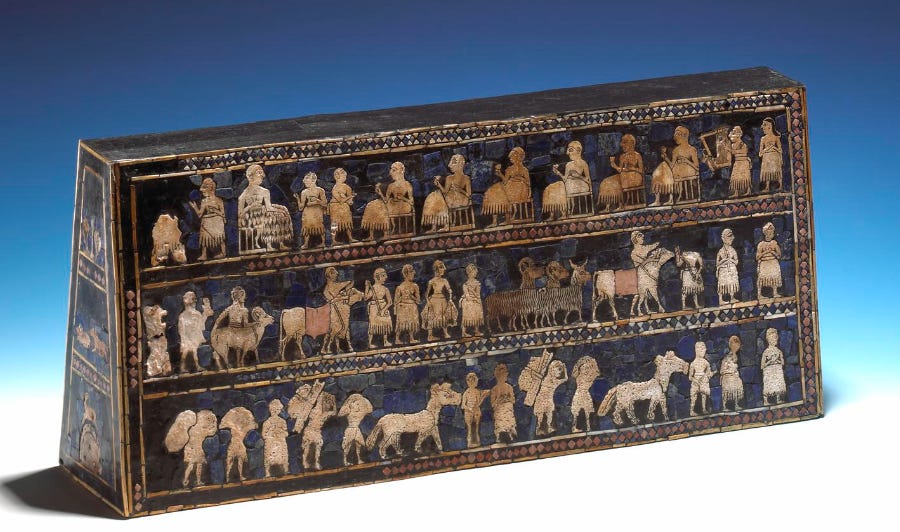
(Image source: British Museum- ‘peace panel’)
One long side depicts what has come to be called the ‘war’ panel: chariots trampling enemies, infantry marching captives before a larger, central figure of a king. The other, the ‘peace’ panel, shows a banquet, seated figures drinking, animals and goods brought as tribute, and, in the upper register, a lyre player and a singer. The object lay close to the shoulder of a man’s skeleton, himself found dressed in what Woolley described as a cap covered in thousands of minute lapis lazuli beads, alongside a cylinder seal inscribed with the name ‘é-zi.’ Woolley concluded the man had carried the object aloft, on a pole, and gave it the name it still carries: the Standard of Ur. It is now dated to the Early Dynastic III period, roughly 2600 to 2400 BC, and has been on display in the British Museum since Woolley’s finds were divided between London, Philadelphia, and Baghdad.
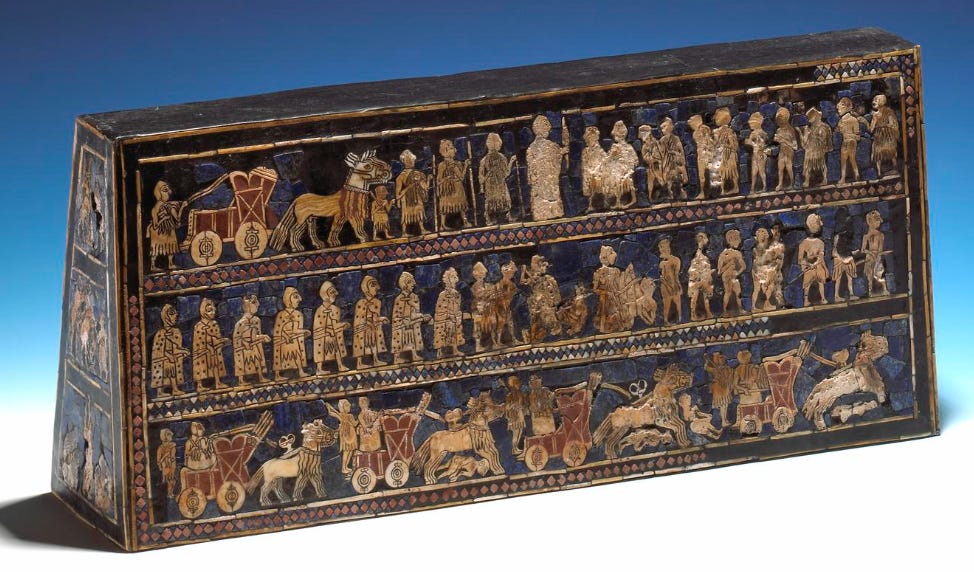
(‘War’ panel, British Museum)
Woolley’s own interpretation, laid out in his original excavation report, was that this was a military and royal standard, carried in procession or into battle to signal the king’s presence, its two faces depicting the same regime from opposite angles: conquest on one side, the feast that followed on the other (Woolley, 1934). That reading fits neatly with where it lay in the grave, and with the martial content of one whole panel.
The alternative interpretation, favoured by the British Museum’s own current display description, treats the object instead as the soundbox of a musical instrument, drawing a comparison with the lyres and harps recovered from several other graves in the same cemetery, richly decorated instruments buried alongside their presumed players. The catalogue prepared by Richard Zettler and Lee Horne for the Royal Tombs of Ur exhibition situates the object within this wider context of elaborately inlaid musical and ceremonial furniture from the cemetery, noting how closely its craftsmanship and materials echo the lyres found nearby, without resolving definitively which category it belongs to (Zettler and Horne, 1998).
Neither reading is without a serious problem. If it was a military standard, it is unusually delicate for the purpose: a thin wooden box coated in inlay glued on with bitumen is not an obvious candidate for something carried into the physical chaos of a battlefield or a procession, and no comparable “standard” of this exact form survives from any other Mesopotamian site to confirm the type existed more broadly. If it was a soundbox, the physics are equally awkward: an instrument’s resonating chamber generally needs thin, flexible walls that can vibrate to project sound, whereas this object’s sides are thickened considerably by dense inlay work, which would tend to deaden vibration rather than amplify it. P.R.S. Moorey’s study of the Royal Cemetery’s burial population, prepared for the University of Pennsylvania Museum’s Expedition magazine, underlines a broader problem sitting behind this specific puzzle: the cemetery’s finds were recovered under time and resource pressures typical of 1920s fieldwork, and many objects, this one included, survived only as compacted impressions in the soil, reconstructed from plaster casts taken during excavation rather than examined intact (Moorey, 1977). What we have, in other words, is a faithful record of the object’s decorated surface and a far less certain record of its original three-dimensional structure, which is precisely the detail that would settle the debate.
No later Mesopotamian text refers back to this object by name or function, and no closely comparable artefact has surfaced elsewhere to arbitrate between the two readings. The debate has, if anything, calmed rather than resolved, with most recent literature content to describe the object’s possible function in the plural rather than commit to either camp.
An object was buried in the mid-third millennium BC beside a man who may have carried it, in some capacity, for a king whose military victories and courtly feasts it depicts on opposite faces. Its name describes what one excavator, working from where it lay and how it was decorated, believed it to be. Its current museum label describes what a later generation of specialists, working from comparison rather than certainty, now think slightly more likely. Both readings rest on carefully argued evidence, and neither has managed to eliminate the other. What survives, ultimately, is the clearest visual narrative we have of Early Dynastic Sumerian life, attached to an object whose own working life, the thing it was actually for, was buried along with its owner and has not yet been recovered.
Moorey, P.R.S. (1977) ‘What Do We Know about the People Buried in the Royal Cemetery?’, Expedition, 20(1), pp. 24–40.
Woolley, C.L. (1934) Ur Excavations II: The Royal Cemetery. London: British Museum; Philadelphia: University of Pennsylvania Museum.
Zettler, R.L. and Horne, L. (eds.) (1998) Treasures from the Royal Tombs of Ur. Philadelphia: University of Pennsylvania Museum of Archaeology and Anthropology.
No posts
Comments
Nothing yet. Say the first thing.
Sign in to join the conversation.