
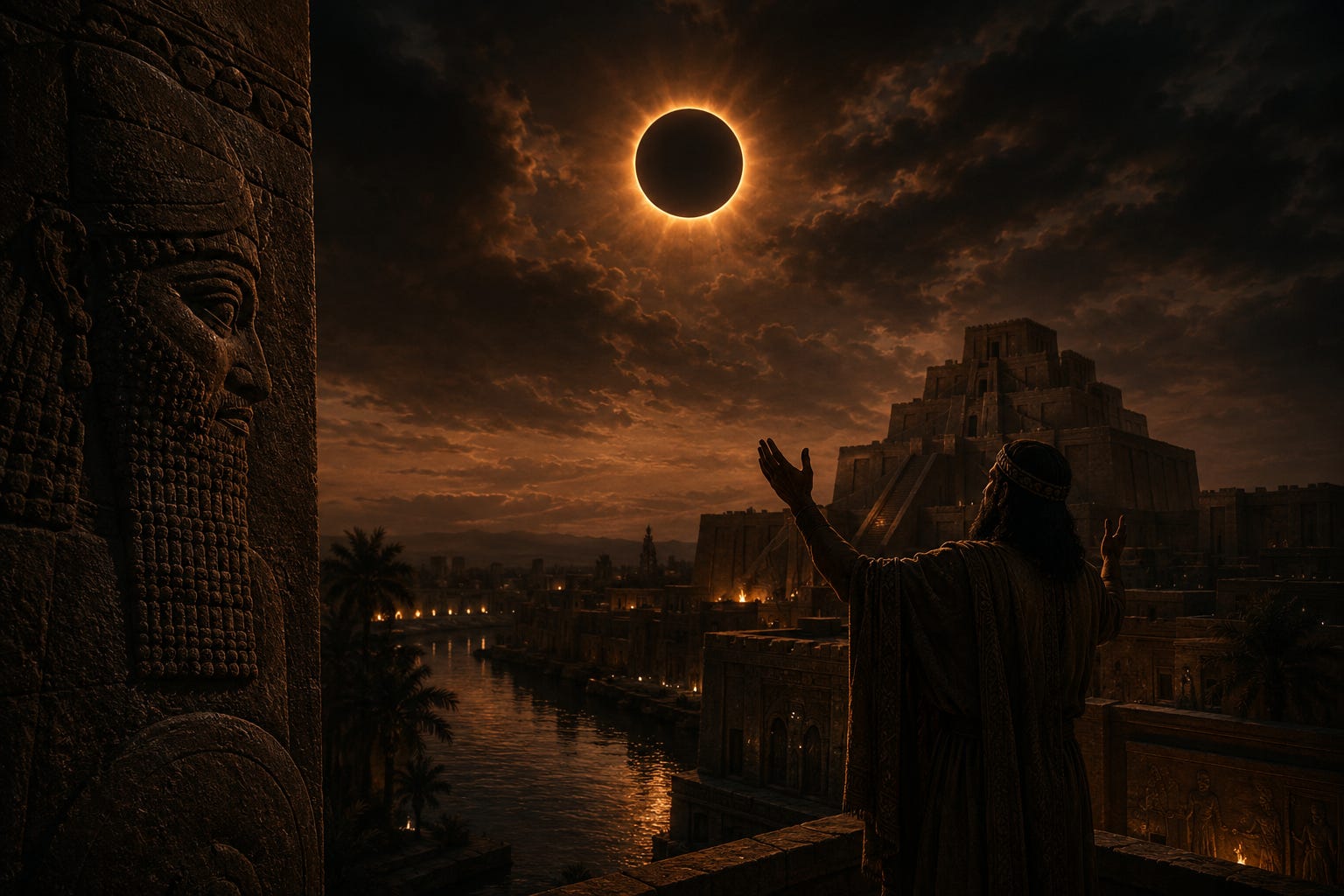
Mesopotamia possesses one of the longest continuous records of celestial observation in human history, preserved on the cuneiform clay tablets of Sumerian, Babylonian and Assyrian scribes. Among the astronomical phenomena they recorded, solar eclipses held particular significance, being interpreted as portents affecting the fate of kings and states. below examines the principal archaeological and textual evidence for solar eclipse observation in the ancient Near East, situating it within the wider tradition of Mesopotamian celestial divination, and considers how modern scholars have verified and, in some cases, revised the dating of these records.
The most contested candidate for the earliest written solar eclipse record is a small clay tablet, catalogued as KTU 1.78 (also known as PRU 2.162 or RS 12.061), excavated in 1948 from the ruins of Ugarit, a Late Bronze Age city on the Syrian coast. The brief Ugaritic inscription describes the sun being ‘put to shame’ and ‘going down’ on the day of the new moon in the month of Hiyaru, in the presence of the god Rashap, commonly associated with the planet Mars. Sawyer and Stephenson first proposed that this described a total solar eclipse visible over Ugarit on 3 May 1375 BC based on the identification of the astronomical event as a description of a total solar eclipse dated to that day (Sawyer and Stephenson, 1970; Stephenson, 1970). Nearly two decades later, de Jong and van Soldt reanalysed the tablet, drawing on a revised Ugaritic calendar and the mention of Mars near the sun, and argued for a substantially later date: a new historical dating of the tablet, together with the visibility of Mars during the eclipse and the month in which it occurred, indicated that the eclipse actually took place on 5 March 1223 BC (de Jong and van Soldt, 1989). This re-dating is now favoured by most specialists, though the identification of the tablet as an eclipse record at all remains disputed by some scholars, who note that not every darkening of the sun described in ancient texts necessarily denotes an eclipse rather than a meteorological event.
Far less ambiguous is the solar eclipse recorded in the Assyrian Eponym Canon, a chronographic list of limmu officials used to date each year of the Neo-Assyrian state. The entry for the eponymy of Bur-Saggilê, governor of Guzana, states that a revolt occurred in the city of Ashur and that ‘in the month of Simanu, an eclipse of the sun took place.’ Nineteenth-century Assyriologist Henry Rawlinson matched this to a solar eclipse of 15 June 763 BC, and this identification, since confirmed through modern retro-calculation, has become an anchor point for the whole of Assyrian chronology between roughly 911 and 648 BC. The eclipse would have appeared partial over the Assyrian capital of Nineveh but total a short distance to the north, with totality lasting only a few minutes. Because the eponym canon is otherwise a bare administrative list, this single celestial notice allows historians to assign absolute BC dates to more than a century and a half of Assyrian eponyms, a point emphasised in recent chronological studies of the period (see the discussion of eponym anchoring in relation to the Bur-Sagale eclipse, dated to 15 June 763 BC).
From the mid-eighth century BC onward, Babylonian scribes maintained systematic ‘Astronomical Diaries,’ recording nightly observations of the moon, planets, weather and eclipses, a practice that continued into the first century BC. These cuneiform texts from Assyria and Babylonia offer direct evidence for systematic astronomical observation across two widely separated periods, extending from the middle of the eighth century BC to the middle of the first century BC in the form of extensive daily observational diaries (Steele, 2000). This tradition sat alongside an older genre of omen literature. A 2024 study by George and Taniguchi of four Old Babylonian tablets held in the British Museum, thought to originate from Sippar and dating to roughly 1894–1595 BC, demonstrates that Mesopotamian scholars were systematising eclipse omens (in this case lunar rather than solar) by time of night, shadow movement, duration and date many centuries earlier than previously documented (George and Taniguchi, 2024). This body of divinatory scholarship, discussed extensively by Rochberg (2010) in her study of Babylonian celestial divination, forms the intellectual background against which solar eclipse reports must be read.
Because a solar eclipse was believed to threaten the reigning monarch directly, Neo-Assyrian courts of the seventh century BC, particularly under Esarhaddon and Ashurbanipal, practised the šar pūḫi or ‘substitute king’ ritual: a temporary stand-in, often a person of low social standing, was enthroned to absorb the predicted misfortune before being ritually killed, while the true king withdrew from public life for the duration of the danger (Metropolitan Museum of Art, 2017; Frahm, discussed in Brewminate, 2026). This practice, attested in royal correspondence to Esarhaddon, illustrates how astronomical observation and state religion were inseparably linked in Mesopotamian governance.
Taken together, the Ugarit tablet, the Assyrian Eponym Canon, the Babylonian Astronomical Diaries and the substitute king ritual constitute a layered body of evidence for how ancient Mesopotamians observed, recorded and responded to solar eclipses across some two millennia, from the Late Bronze Age to the Neo-Assyrian period. Modern verification of these records depends on the interplay between philological reinterpretation and astronomical retro-calculation, as the repeated redating of the Ugarit tablet demonstrates. This ongoing dialogue between cuneiform scholarship and celestial mechanics continues to refine our understanding of one of antiquity's most sophisticated observational traditions.
de Jong, T. and van Soldt, W.H. (1989) ‘The earliest known solar eclipse record redated’, Nature, 338, pp. 238–240.
George, A.R. and Taniguchi, J. (2024) ‘Old Babylonian lunar-eclipse omen tablets in the British Museum’, Journal of Cuneiform Studies, 76, pp. 127–161.
Rochberg, F. (2010) In the Path of the Moon: Babylonian Celestial Divination and its Legacy. Leiden: Brill.
Sawyer, J.F.A. and Stephenson, F.R. (1970) ‘Literary and astronomical evidence for a total eclipse of the sun observed in ancient Ugarit on 3 May 1375 BC’, Bulletin of the School of Oriental and African Studies, 33(3), pp. 467–489.
Steele, J.M. (2000) ‘Eclipse prediction in Mesopotamia’, Archive for History of Exact Sciences, 54, pp. 421–454.
Stephenson, F.R. (1970) ‘The earliest known record of a solar eclipse’, Nature, 228, pp. 651–652.
No posts
Comments
Nothing yet. Say the first thing.
Sign in to join the conversation.