
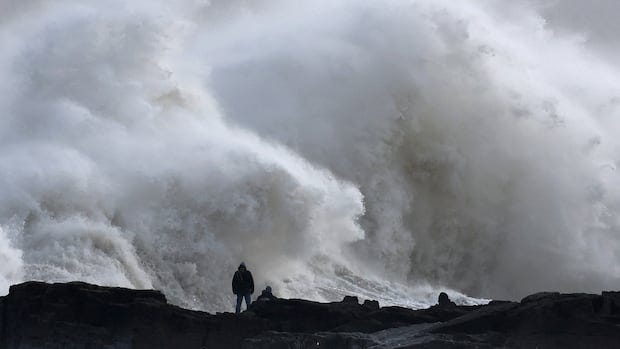
Suddenly, I don’t want to be this guy, hoping he doesn’t get swamped by a North Atlantic storm.
At least, that is how I feel after I spent the weekend on Laughing Gull, babysitting her through a southwesterly blow. It turns out that Castlepark Marina is not the safe haven I hoped it was…if you are tied up on the outside, the riverside, of the marina. There, you are vulnerable to strong southwesterlies—not uncommon around here— because there is about a mile of fetch up the Bandon River in that direction. And when you stack up a flood tide that pushes straight into the teeth of a pumped up southwesterly you get some pretty nasty conditions that press any boat on the outside pontoon hard against the dock, with wave action. No bueno.
Last winter, Storm Eowyn, which brought near-hurricane force winds (depicted in the photo above), tore up the docks and damaged a lot of boats on the outside of the pontoon at Castlepark. The SW winds forecast for this weekend were not nearly as strong, but gusts were predicted to get into the 40s. Stephen, the thoughtful Castlepark Marina manager Whatsapped me early in the week and suggested I consider moving somewhere else. Having just moved LG to Castlepark for safety, I wasn’t sure where else to go. We decided to see how the forecast evolved.
Thanks for reading Sailing Into The Anthropocene! Subscribe for free to receive new posts and support my work.
As the weekend approached, the forecast settled into steady SW winds in the mid-20s, with gusts into the high 30s. Stephen found me a slip at the better protected Kinsale Yacht Club for Saturday night. But he also offered to tie off LG’s bow to a groundline Castlepark had set up after Storm Eowyn to better anchor the pontoons. I opted to stay put with the assistance of the groundline (which would hold LG’s bow off the pontoon), and to babysit LG through the blow so I could adjust lines and fenders as needed.
This is the sort of frequent dilemma that comes with a sailboat. Nature is capable of forces that go far beyond our puny abilities to protect. That requires a healthy degree of humility, which is a useful counterweight to human arrogance and the destructive belief that we can (and should) try to dominate the natural world. It also requires a certain degree of fatalism. Sometimes, given our vulnerabilities, our only option is to make the best choices we can, and hope for the best.
I felt this vulnerability acutely when I arrived at Castlepark early Saturday morning, as the leading edge of winds (with rain) started to whistle through Kinsale harbor. When I had left LG at Castlepark the week before, the outside of the pontoon had been festooned with boats. Now it was empty, save for one catamaran which didn’t have the benefit of a groundline tie-off and departed hastily for Kinsale Yacht Club. LG was left all on her lonesome on the outside. I adjusted dock lines and fenders as best I could, tightened up the groundline, and settled in to see what the wind gods would bring. It felt a bit forlorn and exposed out there, I have to admit. But it was too late to second-guess my choices. Or at least there was no point to it.
Around mid-day the wind and rain started to build and veer from the safe south into the dangerous southwest. I heard a knock on the hull. Mark, a neighbor with a Beneteau in a nearby inside slip, had come to check on me. He had seen what Storm Eowyn’s southwesterlies had done to boats on the outside of the pontoon, and seemed a bit nervous about my prospects. He offered me some extra fenders (it was only now that I noted how many fenders even boats on the inside of the pontoons at Castlepark deployed, which told me all I needed to know). I gladly accepted. One of the reasons boats on the outside had been damaged in previous blows, I had been told, was that wave action throwing boats against the pontoon either displaced or popped fenders. So it was definitely a more is better situation. I went from six fenders to nine. Mark still seemed worried. I felt a bit more sanguine.
The strong winds came with the afternoon, at times blowing 30, and gusting near 40. The flood tide pushed up against them and produced a decent washing machine action. LG was pressed hard against the pontoon and the Maginot Line of fenders (which unlike the Maginot Line, thankfully held up). I stayed nervous and mildly stressed through the day, but the setup seemed to be doing the job. By evening I was feeling LG would survive relatively unscathed, and cooked up a hot dinner, supplemented by a portion of perfectly cooked fries from the fish and chips food truck operated as a side gig by marina-manager Stephen. Mark stuck around on his boat and occasionally wandered over to check on LG and add another fender. Overnight, I slept surprisingly well.
The wind was still blowing hard when I woke up Sunday but by then I was reasonably confident in the lines and fenders, as they were set. Another bullet dodged. So it goes with life with a sailboat. I drank a vivifying mug of hot coffee in the cockpit, with a windy, sunny day, ahead, and considered: knowing what I had learned about how Castlepark sets up in a southwesterly blow, would I move to Kinsale Yacht Club if I had to do it all over again? Probably.
More important, I realized, the best solution would be to avoid playing Marina Frogger, dodging Fall storms. It is time, I decided, to get LG to the UK and hauled for the winter. My hopes of a late summer cruise seem unlikely as the parade of Atlantic storms looks set to continue for the next week or two. So instead of worrying about protecting a sailboat that isn’t cruising and is instead collecting weed in a marina or on a mooring, perhaps it is time to jump into the first decent weather window and get said boat to winter storage on land.
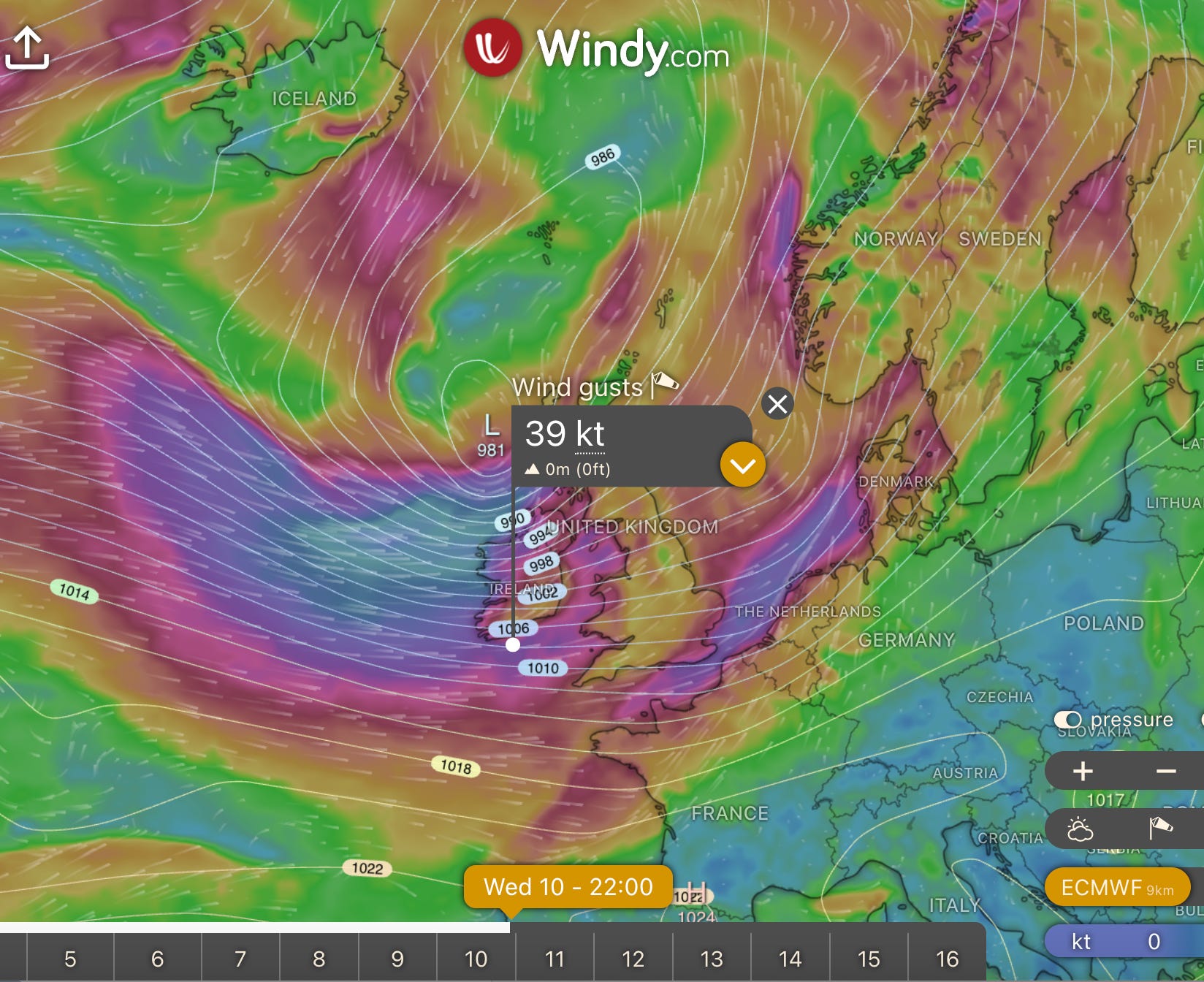
For the moment, LG will stay at Castlepark, set up as she was for this last blow. But I am starting to scan the long-range forecasts for any moderate weather system with westerly component winds to whisk LG toward Plymouth, a quick voyage of just 200 miles. Once there, I can cruise the UK south coast a bit, if the late-September weather comes good. Or I can live aboard in Plymouth for a few weeks and get LG ready to be lifted out for the winter. Either way, I will get some much-needed LG time, and I won’t be playing defense against the north Atlantic. Time to haul towards the haul. LG has been sailing hard for almost a year now, and has covered thousands of miles in all sorts of conditions. She is due for some yard TLC. That feels like the right choice now.
Anthropocene Notes:
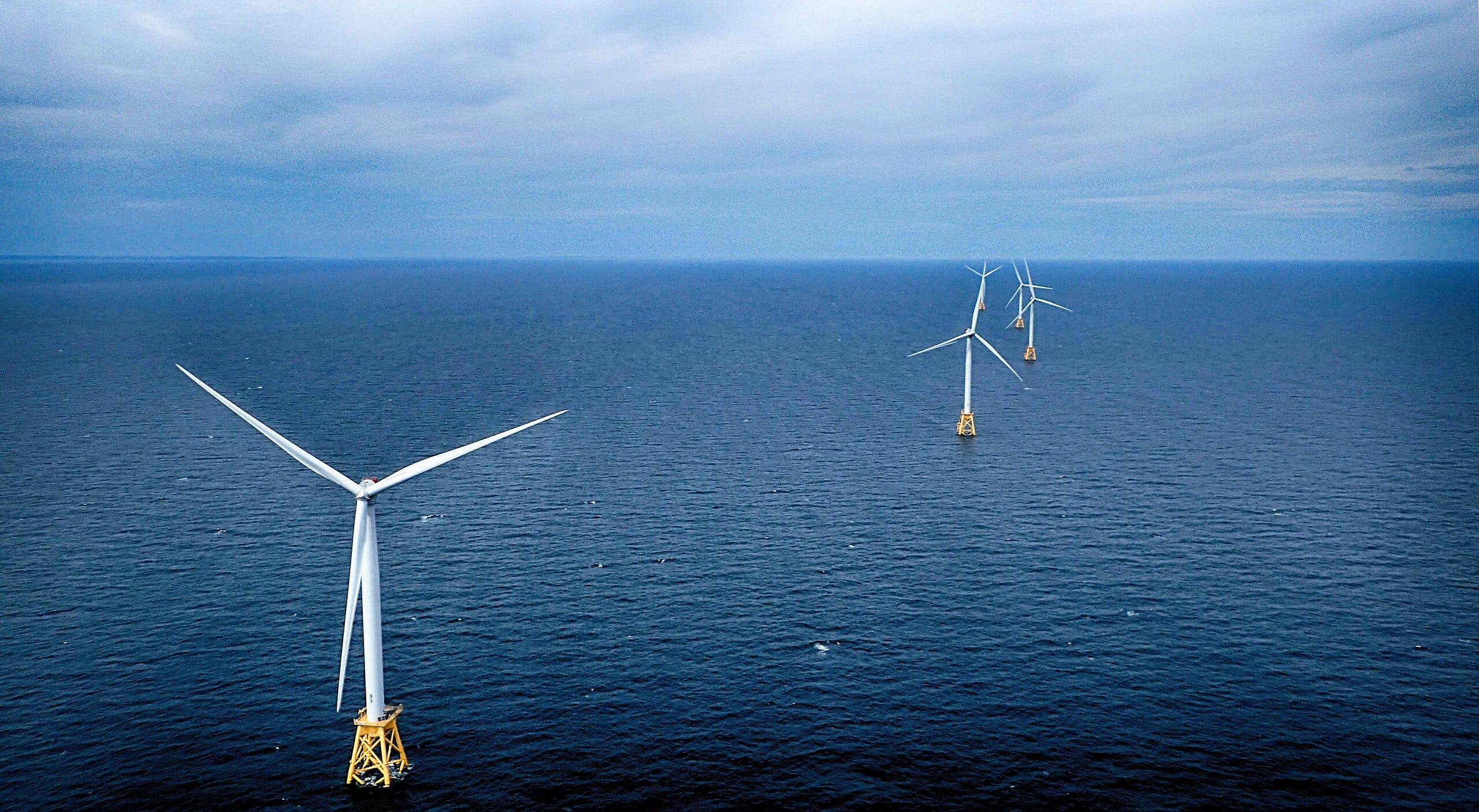
Beyond dumb. Beyond stupid. Beyond logic. The Mad King has a thing about wind power, and his jihad against wind turbines, which includes wind farms that are essentially completed, elevates his nutty whims above the future well-being of America and the planet:
The Transportation Department on Friday canceled $679 million in federal funding for a dozen offshore wind projects, the latest attack by the Trump administration on the reeling U.S. offshore wind industry.
Funding for projects in 11 states was rescinded, including $435 million for a floating wind farm in Northern California and $47 million to boost an offshore wind project in Maryland that the Interior Department has pledged to cancel…
Last week, with U.S. electricity prices rising at more than twice the rate of inflation, Trump lashed out, falsely blaming renewable power for skyrocketing energy costs. He called wind and solar energy “THE SCAM OF THE CENTURY!” in a social media post and vowed not to approve any wind or solar projects.
“We’re not allowing any windmills to go up unless there’s a legal situation where somebody committed to it a long time ago,” Trump said at a Cabinet meeting on Tuesday.
Energy analysts say renewable sources have little to do with recent price hikes, which are based on increased demand from artificial intelligence and energy-hungry data centers, along with aging infrastructure and increasingly extreme weather events such as wildfires that are exacerbated by climate change.
Worries Running AMOC: new research reinforces potential for Gulf Stream to shut down as planet continues to warm:
The collapse of a critical Atlantic current can no longer be considered a low-likelihood event, a study has concluded, making deep cuts to fossil fuel emissions even more urgent to avoid the catastrophic impact.
The Atlantic meridional overturning circulation (Amoc) is a major part of the global climate system. It brings sun-warmed tropical water to Europe and the Arctic, where it cools and sinks to form a deep return current. The Amoc was already known to be at its weakest in 1,600 years as a result of the climate crisis.
Climate models recently indicated that a collapse before 2100 was unlikely but the new analysis examined models that were run for longer, to 2300 and 2500. These show the tipping point that makes an Amoc shutdown inevitable is likely to be passed within a few decades, but that the collapse itself may not happen until 50 to 100 years later.
The research found that if carbon emissions continued to rise, 70% of the model runs led to collapse, while an intermediate level of emissions resulted in collapse in 37% of the models. Even in the case of low future emissions, an Amoc shutdown happened in 25% of the models.
Gulp.
Your semi-regular reminder that factory farming (in this case industrial hog farms in the Yucatan) is an environmental abomination:
If you liked this post from Sailing Into The Anthropocene, why not subscribe here (free!), and/or hit the share button below? You can also find me on Instagram and BlueSky. (You can find me, but I have discovered life is better without social media).
Comments
Nothing yet. Say the first thing.
Sign in to join the conversation.