
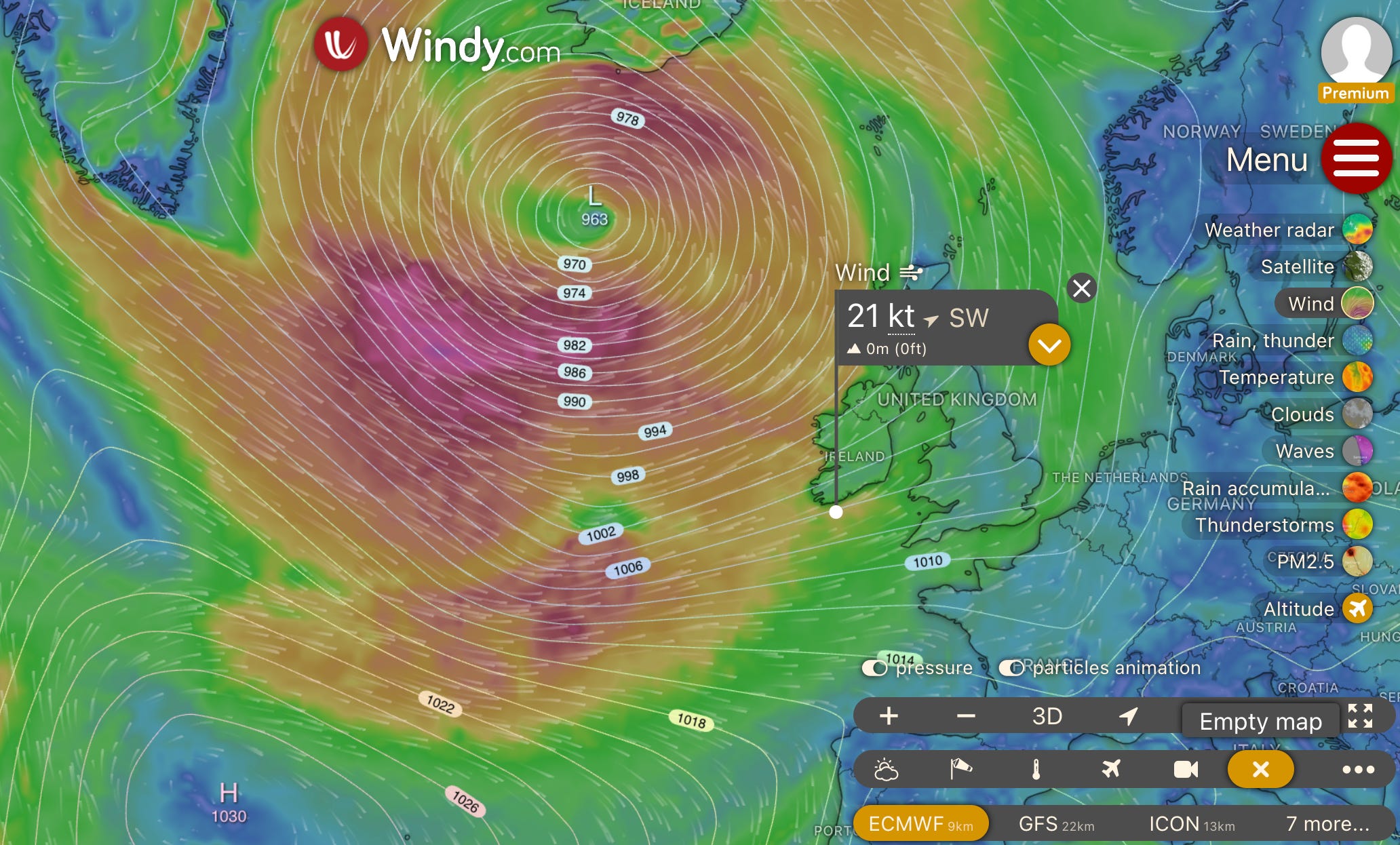
It has been an (unusually?) fine summer here in Glandore, and if it hadn’t been for my surprise COVID I would have enjoyed the tail end of it on a west coast of Ireland mini-cruise. But that was then. The Atlantic Ocean in an era of climate-warming is not always so benign, and the change has arrived. Former Hurricane Erin, still a massive storm, is now ambling along to the northwest and will blast Ireland with wind and rain for the rest of the week. Thanks to the magic of modern super-computer forecasting, I can see a series of lows will follow Erin, keeping things nice and spicy into September.
That meant Laughing Gull needed to be on the move. Glandore harbor is a good harbor, and generally well-protected…except in a southerly blow. There will be plenty of strong southerlies in the coming weeks, so it was time to stash LG in Kinsale, which has 360-degree protection, and a decent marina. I rallied a crew (never hard to do around here, which is one of the many reasons I like it so much), and made the delivery last Friday, in fine weather. Well, maybe a bit too fine. There was lots of sun and little wind, so we motored. Still, any day on the water…Especially in contrast to what is coming.
It felt good to have water moving under the hull again. Things have been busy since LG carried us into Glandore from the Azores on July 10. And apart from one daysail, poor LG has been somewhat neglected. I’d row out every few days and check on her. But as Admiral Nelson allegedly observed “men and ships rot in port.” Indeed, LG now carries a nascent rainforest of algae and bushy growth on her underside. It is possible that I also experienced some rot in port, as well, as the opportunities to drink and eat are many and frequent (not to mention the presence of the odd virus).
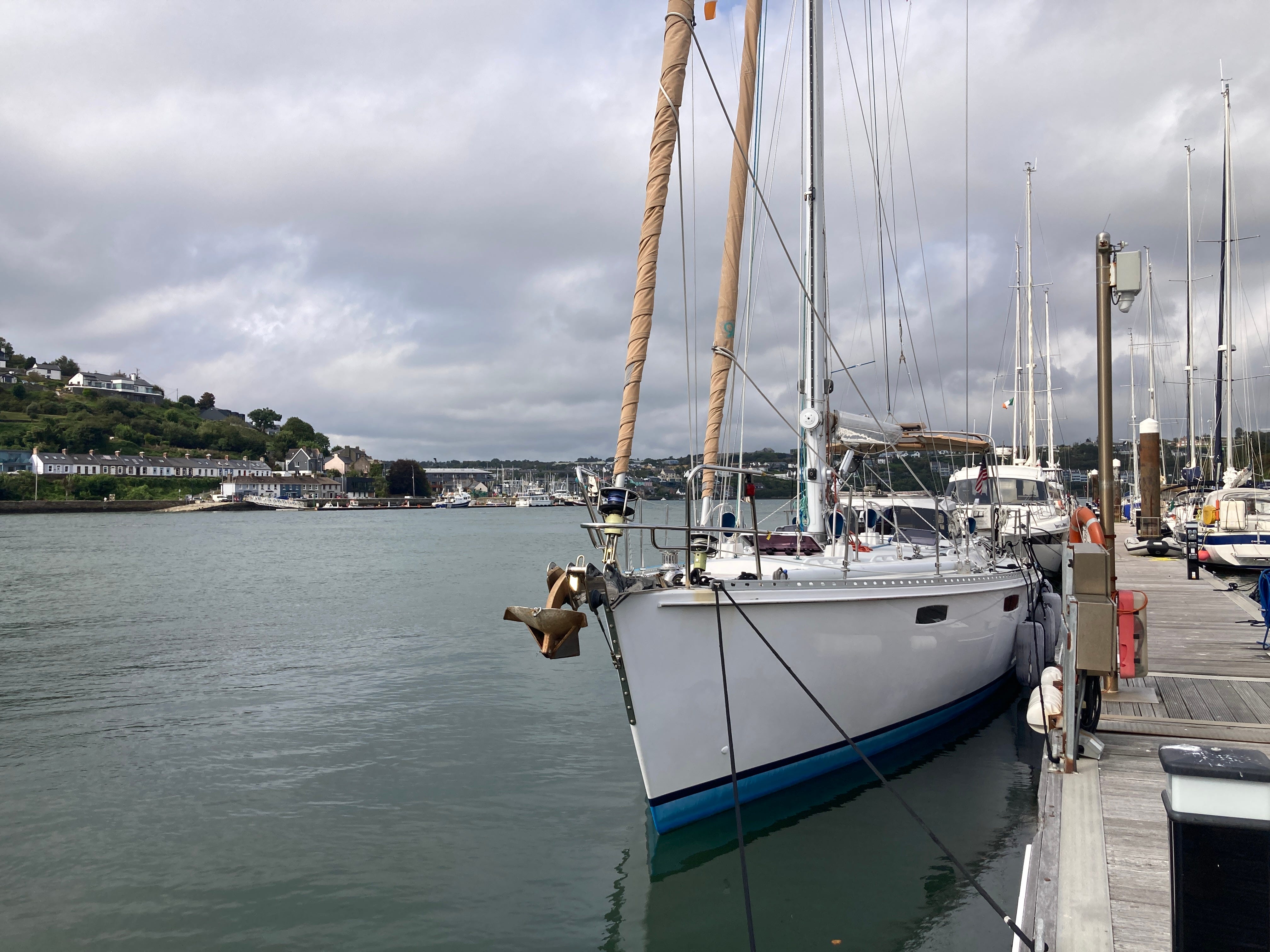
I arrived aboard for the delivery with some guilt for my temporary abandonment of LG. LG seemed slightly forlorn and lonely, but did not punish me by refusing to start or pitching some other mechanical fit. The passage to Kinsale was pleasant and uneventful, as the spectacular and rocky Irish coast slid past. We rounded the Old Head of Kinsale in the later afternoon, and were snug and secure in Castlepark Marina by 5 pm. The only unexpected event was a request to board by a joint Irish, UK and French customs brigade—who no doubt hoped we had just arrived from across the sea and could be subjected to all the tedious formalities of a full clear-in.
This was ironic, as I had been trying to clear myself and LG into Ireland—unsuccessfully—for about a month. When this enthusiastic team of paper-pushers realized we weren’t newly arrived, and had no passports or other documents with us to flyspeck, there was a palpable deflation of the bureaucratic energy. Despite the disappointment, they managed to ask some questions and fill out some forms. They also asked if they could take pictures of LG, which makes me think there is a nautical version of facial recognition in development for coastal border control.
The climax of this unexpected Customs inspection was a “light rummage” (that is the technical term, they said) down below. Said rummage turned up some rotting cheese deep in an unused fridge, so at least the administrative might of three European nations in alliance produced tangible and positive results.
In any case, Castlepark Marina is in a pretty nice spot. And I enjoyed being back on LG so much I returned yesterday and spent last night aboard. That gave me a chance to secure everything, make sure all the necessary docklines were in place, and ready LG for a few weeks of wind and rain. I miss living aboard, and life afloat, I realize. Which is something to think about through the winter.
As someone who finds Chat GPT incredibly useful, I pay attention to the alarmism about AI’s climate footprint. Thankfully, Hannah Ritchie, from Our World In Data and a very good Substack called “Sustainability By The Numbers,” does a very good job of keeping it all in perspective:
My main conclusion is no different from my initial post: individual usage of ChatGPT and other LLMs for most people is a small part of their carbon and energy footprint.
The energy use “per query” is possibly 10 times lower than estimated in the previous article. Google estimates that its median text query uses around 33-times less energy than 12 months ago. So, this kind of stacks up.
Google says that its median text query uses around 0.24 Wh of electricity. That’s a tiny amount: equivalent to microwaving for one second, or running a fridge for 6 seconds.
Another key point is that text queries are way less carbon intensive than using AI to generate images and video. So I’ll keep using it to help me figure out how to rewild a field and deploy more solar panels.
If you liked this post from Sailing Into The Anthropocene, why not subscribe here (free!), and/or hit the share button below? You can also find me on Instagram and BlueSky. (You can find me, but I have discovered life is better without social media).
No posts
Comments
Nothing yet. Say the first thing.
Sign in to join the conversation.