
It may be the weirdest time for the so-called “documentary film” since the form’s nascent days a hundred years ago when such disparate movies as “Nanook of the North,” “Man with a Movie Camera,” “Drifters, and “Berlin: Symphony of a Great City” were all vying to lead the way for the emerging art.
Today, “documentary” films—at least in the eyes of the viewing public—aren’t really documentaries as they’ve been known for a century, but something else entirely. Perhaps the title of this post should actually read “The Most Popular Forms of Docutainment of 2026”? Or maybe “Top Ten Docspoitation Titles of 2026”? These words seem to better describe what the majority of the world’s consumers are now watching as “documentary.”
Last week, Netflix released its semi-annual report of its most watched content from January to June 2026. As has been the case for the last few years, the Top 10 most-watched documentary feature films are a fairly consistent, cookie-cutter grouping of familiar stories of murder, pregnant-woman murder, child murder, pop-culture phenomena (i.e. the manosphere), and coming in at #10, one anomalous independent documentary film, last year’s hit “The Perfect Neighbor.”
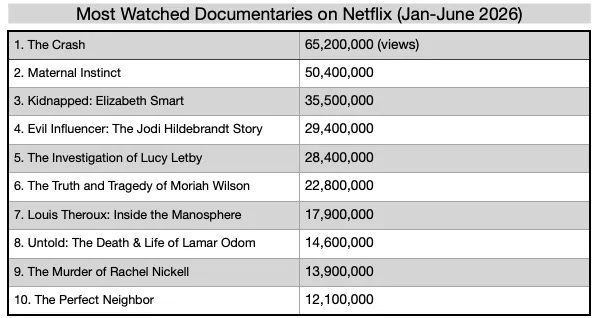
Of course, Netflix isn’t the only place where people are watching long-form docutainment, but it is likely the biggest (probably slightly under YouTube and slightly above Amazon Prime), and it’s also the only streaming company to provide such data. Over 65 million views for “The Crash”—dubbed by Slate as “utter nightmare fuel for parents”—is a lot of eyeballs, placing the movie as the 8th most watched film (fiction or doc) on Netflix for the first six months of the year, just below shark attack thriller “Thrash” and the rom-com “People We Meet on Vacation.”
I used to think the the preponderance of streamer docu-slop was kind of its own thing. Like Brett Ratner’s shiny, vomitous propaganda piece “Melania,” which is Amazon’s most watched documentary of 2026 due to its massive marketing budget, these things, as I’ve argued before, are not really documentaries.
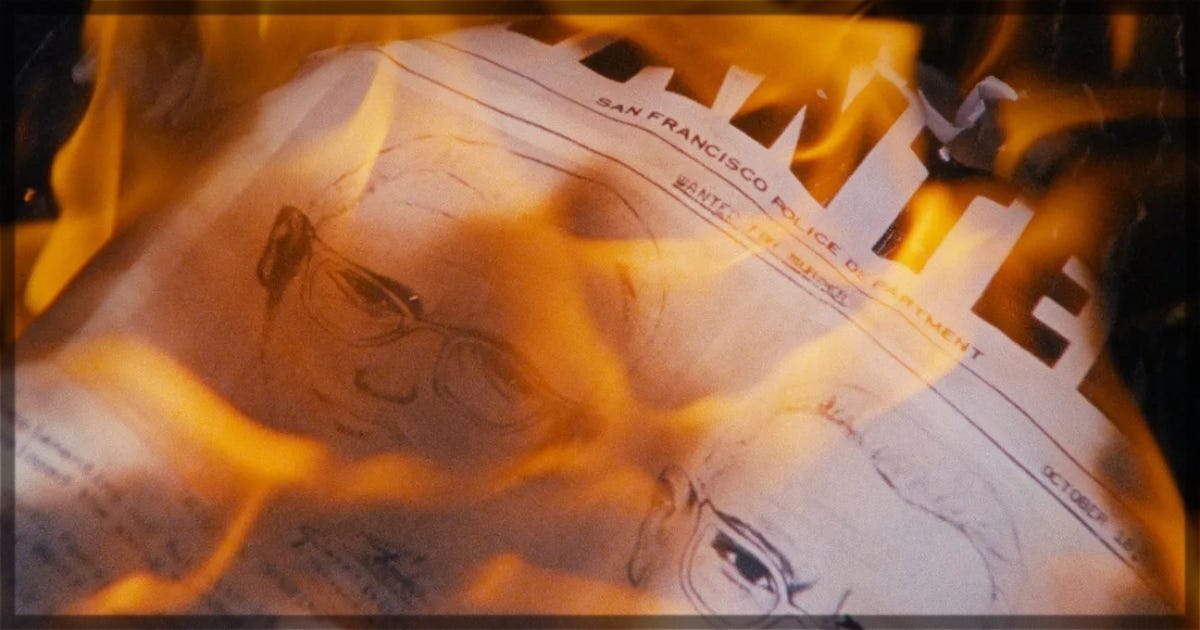
I know it might sound snobby (that phrase gets repeated a lot around here), but this content is clearly a different type of beast than the award-winning independent documentary films that circulate at film festivals and art-houses. I leave it for another post (or some intrepid film critic) to dig deeper into why this is the case, but suffice it to say that their algorithmic-driven structures and sensationalism are operating in a very different way than most indie docs. (See Charlie Shackleton’s 2025 doc “The Zodiac Killer Project” for a clever satirical deconstruction of Netflix true-crime not-exactly-nonfiction formulae.)
The new streamer-driven, streamer-built construction is made to order for our short-attention-span multi-screen moment. And honestly, that could be fine, as long as these things existed separately.
But the problem now is that the one (docutainment) is so much more dominant over the other (documentary), in terms of resources, marketing, platforming, etc, that it continues to push the latter towards cultural extinction.
For the record, I believe that the documentary form is extraordinarily pliable, and it’s one of the reasons I love it. Unlike fiction films, there are fewer conventions to abide by; they can have fictionalized reenactments (or not); they can be a series of static shots where very little happens except for clouds passing in the sky; they can be composed of all archival footage, personal home movies, or just talking heads; they can be music-driven observational essays, or something else entirely different; they can be… almost anything.
But these days, that diversity of documentary storytelling is dwindling. Documentaries are not anything anymore; on the contrary, the industry has defined them, with just a few exceptions, as just one thing: It’s like the entire form—at least what companies are producing and people are watching—has been consumed by the evil stepchild of “Unsolved Mysteries” and Jerry Springer.
Of the top 50 most-watched documentaries on Netflix, according to Flixpatrol, which has filtered the Netflix data, I recognized only three or four documentaries that have played film festivals and were produced without algorithmic intentions: In addition to “The Perfect Neighbor,” there’s Ben Feldman’s “The Rise of the Red Hot Chili Peppers: Our Brother” (#15, 17.1 million views); “Secret Mall Apartment” (#24, 5.5 million views; and “The Greatest Night in Pop” (#40, 3.3 million views).
Perhaps an interesting comparison outside of the Netflix universe is FRONTLINE’s most watched documentary this year on YouTube, “Remaking the Middle East: The U.S., Israel & Iran,” which currently also has a relatively impressive 3.3 million views. This is obviously another very different kind of documentary—informational, diligently-sourced, and journalistic. There’s room for all kinds of docs, and I’m happy to see there’s a place for it, but it still pales in comparison to the level of views of the streamers’ top docutainment.
Then again, the marketplace always surprises. On Monday, July 13, just a couple weeks after it premiered on HBO Max, Penny Lane’s acclaimed and hilarious 2019 documentary film “Hail Satan?” hit #8 on HBO Max (just below “The Meg”) and appeared in the Top 10 for three days, climbing to #6 last Wednesday—and this is having already been available on dozens of platforms for years. I don’t know how often independent docs pop briefly into mainstream docutainment culture, but it’s nice to know that it can still happen.
One last statistic that might alarm you. According to Flixpatrol, their list of Most Watched Documentary Movies on Netflix in 2026 (January - June) had 509 results, with 1,027,800,000 viewing hours recorded, which makes it 1.08% of all hours Netflix published in this period. If I’m reading that correctly, then, even docutainment makes up the tiniest fraction of Netflix viewership. Although maybe that’s a good thing?
(I’m eager to discuss more things documentary this week at the International Documentary Association’s 2026 Getting Real Conference. Hit me up if you’ve got a tip, or suggestions for a post, or just want to say hello.)
Comments
Nothing yet. Say the first thing.
Sign in to join the conversation.