
If your son is not interested in attending your church’s youth ministry, he’s probably not the problem. I posted the video above of youth pastor on X the other day and said this about it:
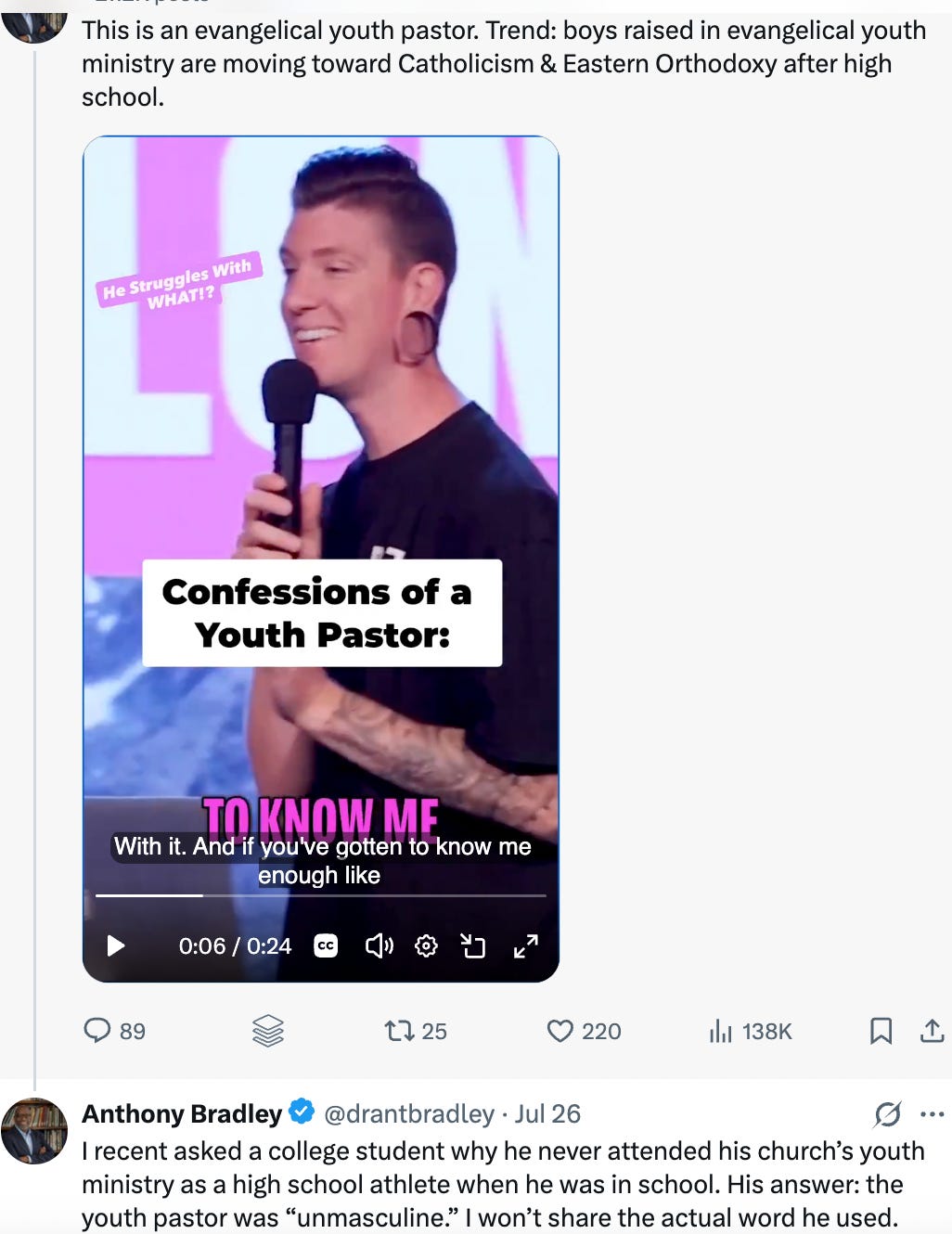
Middle-school and high-school boys are drawn to impressive men. They are drawn to men who represent the kind of men they aspire to become. They want to be around aspirational men: men who are smart, serious, intense, rigorous, and articulate; men who will challenge them intellectually and call them to greatness in mind, body, and soul. They want to be around men who are awe-inspiring and exceptional.
Most youth ministries are structured for girls, not boys. Too often, the male leaders lack the masculine gravitas, competence, and strength that adolescent boys admire. This is why the games are silly rather than demanding. The kids receive a list of dos and don’ts, which amounts to behavior modification, from a charismatic leader who is considered “cool.” Then they are placed in circles where they “share their hearts” in small groups, often called “D-groups.” This generally appeals more to girls than to boys.
When I spoke with that college student and asked him why he had avoided his church’s youth ministry as high school athlete, the bottom line was that the youth pastor was incredibly unmanly. The youth-group culture was infantile and silly. They played childish games. He wanted something intense and deep, as he should have. He did not want fun. He wanted intense growth. He wanted a bootcamp, he got elementary level VBS instead.
Middle-school boys and young men want to be around men who embody at least four masculine archetypes (King, Warrior, Sage, and Lover) and who are remarkable to them in some combination or variation of these archetypes as explained in Atlas of Soul:
The King Archetype
Authoritative • Steady • Protective
The King represents order, responsibility, and dependable leadership. He offers direction in chaos, protects those entrusted to him, and uses authority with integrity; in his negative form, however, leadership can become rigidity, control, or tyranny.
The Warrior Archetype
Courageous • Determined • Resilient
The Warrior embodies disciplined action, perseverance, and the courage to defend what matters. At his best, he channels strength toward justice and service, but without restraint, his determination can become aggression, anger, or emotional hardness.
The Sage Archetype
Self-aware • Discerning • Analytical
The Sage represents wisdom, insight, and the ability to see beneath the surface of things. He transforms knowledge into guidance and personal growth, though his intelligence can become manipulative, secretive, or detached when separated from empathy and service.
The Lover Archetype
Passionate • Empathetic • Magnetic
The Lover embraces beauty, emotion, intimacy, and the fullness of human experience. His openness creates deep connection and joy, but his pursuit of pleasure and intensity can become indulgence, dependency, or a lack of self-control.
Fathers, here is the bottom line: if you are not awe-inspired by the men leading your son’s youth ministry, and your son shows no interest in attending, do not force him to go. You are making it worse for everyone. And please do not bribe him with something manipulative like, “If you attend 75 percent of the youth-group meetings this year, we’ll buy you a car.”
Your sons want to be around Kings, Warriors, Sages, and Lovers. The best resources for middle-school and high-school boys in the church are the other men in the church. Every church has men who have been tested in these areas and have thrived.
Fathers, do not believe the lie that you and the other men in the church are not equipped to form your own sons, or something ridiculous like, “You’re not cool enough.” Oh, please. Your sons do not need “cool” men in their lives. They need men they find impressive, men who will care for them, set them straight, love them, and build them up.
A Better Idea

If your son is too masculine for your church’s youth-group culture, gather a group of fathers and have them meet with some of the more dominant, self-confident, and masculine middle-school boys and high-school young men. You do not need anyone’s permission for a group of fathers to work together, for example, to guide their sons through high school. You can do this yourselves.
I know a father in Oklahoma who did exactly this because his football-playing son was likely losing interest in church, and understandably so. So, he and a group of fathers looked at the youth leader and said, “Heck no.” They said, “Hold our beers,” pulled their sons out of the youth ministry, and took responsibility for spiritually forming them themselves. This is the way. . .
Once a week, they met with their sons and engaged them in intense, serious, challenging, and aspirational spiritual and masculine formation led by sage figures who impressively embodied some combination of the King, Warrior, Sage, and Lover. These were men the boys respected and wanted to become like.
What could one of these meetings look like?
Food. And, not children’s food (pizza, chips, cookies, doughnuts, food coated in sugar). School-age boys need “grown man” food. It should be one of the best meals they have all week.
Overcome a challenging obstacle or learn a skill together. The more difficult and demanding, the better. It should not be silly or immature. Here’s one of the dumbest youth group videos I’ve even seen for youth group activities. The title is “Fun & Easy Youth Group Games: Minimal Prep, Maximum Fun!”1 One of the games, “Cheeto Face,” involves putting shaving cream on your face while other people throw Cheetos at you. No middle-school boy or high-school young man with an ounce of masculinity or self-confidence will be drawn to something so infantile and lame.
Men connect best after conquering something together. Therefore, a Socratic conversation should follow about something from the Bible, theology, or culture. It needs to be serious, intense, and not sugar-coated. Don’t baby them. If they’re in high school, talk to them they way you’d talk to a 25-year-old. They want intensity. Give it to them. Use adult themes and language, just like the Bible does.
How it’s framed and structured is wide open and it needs to fit your cultural content. When it’s fathers and sons doing their won thing you all have the flexibility to work arounds sports schedules, etc.? Does the group need to include only the biological sons of the men in attendance? No. In fact, the ideal man to organize it might even be an empty nester. Also, this is exactly the kind of environment in which you want boys from dad-deprived homes to be formed. They need to be introduced to and habituated within a community of elders and spiritual fathers. Boys from broken homes need a multi-generational brotherhood exponentially more than they need to play “Cheeto Face.”
Fathers, do not waste your sons’ middle-school and high-school years by subjecting them to men who do not impress you. If you do, do not blame your son if he drifts into nominalism after high school. Do not waste those formative years subjecting him to mediocrity and infantilization.
Boys are turning to online influencers because many of those men project strength, competence, seriousness, and aspiration. Do not blame the “manosphere” without asking why church leaders have failed to offer a more compelling model of manhood. Your sons want to grow. They do not want to be treated like children by men they do not admire.
You Don’t Have Time, You Say?
“We’re too busy. That’s why we let the mediocre guy form our son at church.” Then get less busy. This is an eternal issue, and it matters more than your son’s college applications and his resume. You don’t have time to get together four times a month to help form your son’s soul in brotherhood of other fathers, working together, playing off of each other’s strengths?
If you are unwilling to invest in your son’s formation alongside other men in the church, then do not complain when the results of his life make it clear that you outsourced his formation to someone who failed to inspire greatness in him. Don’t complain. This is your “hold my beer” moment.
Church is not supposed to be fun. If your son says his youth group is “boring,” he is not necessarily saying that it lacks entertainment or activities. What he is likely saying is that it feels unmanly and is not demanding enough. It’s too soft. It does not challenge him or appeal to his desire to become a King, Warrior, Sage, or Lover.
And yes, the youth group may even offer sound Christian teaching. But parents are naive to believe that this teaching will truly stick and become integrated into the spiritual DNA of school-age boys if their formation is not led primarily by the fathers of the church.
NOTE: And, yes, all four of these archetypes are patterned in the Bible. Lastly, you can save your “Well, not my youth group” comments and replies. Yeah, we get it. Yours is an outlier. Congratulations.
If this matters, don’t keep it to yourself. Share it with a man or leader who needs to read it. Subscribe for more writing on fatherhood. Also, if you want to go deeper on what dad-deprived culture is doing to the formation of children, my new book The Fatherhood Effect ($15.99) makes the case in full. The book is $19.98 on Amazon.
By the way, that video has 50,000+ views, which means thousands of churches are likely playing these silly games. The idea that youth ministry needs to be “fun” is nowhere in the Bible. When Jesus sent out his disciples and they returned to him, he never asked, “Was it fun?” Boys hear that question from their mothers about youth activities all the time.
Comments
Nothing yet. Say the first thing.
Sign in to join the conversation.