
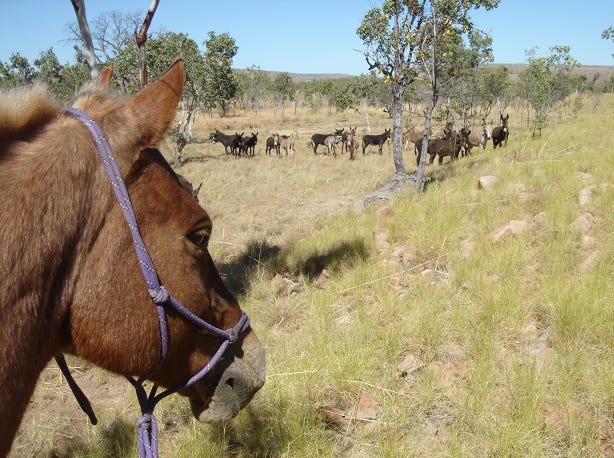
Days to Save Donkeys on Death Row. That headed my column here yesterday. Over night, yet more support and interest has come in for the proposal brought together for the Western Australian government; a proposal that would avert the donkey cull and open the way to further investigate the significant potential of Kachana Station’s regenerative innovation in the northern Kimberley region of the state.
That proposal has since landed with the WA Minister for Agriculture and Food, Jackie Jarvis MLC, Director General of the Department of Primary Industries and Regional Development (DPIRD), Heather Brayford, and the Commissioner of Soil and Land Conservation, Dr Melanie Strawbridge.
Meanwhile, the invitation from the group of credentialed people in the field, that was included in my piece yesterday, remains open for anyone to sign an open letter and/or express further interest in the proposal.
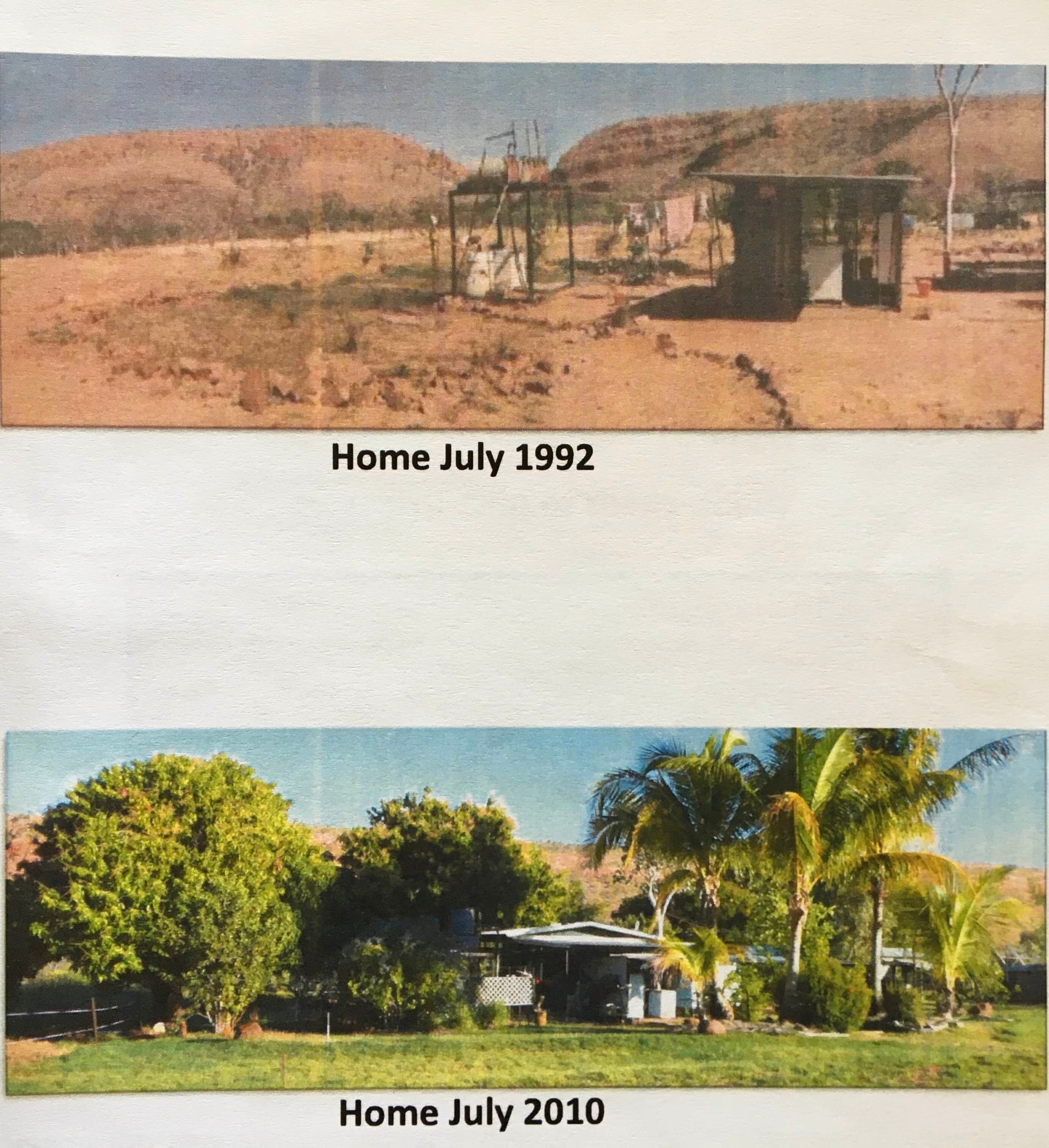
Jardine Macdonald is a hydro-geologist and landscape ecologist based in Broome, a far north-west coastal town in the Kimberley. He’s a Kimberley Landcare representative, former DPIRD employee, and convenor of several research interests concerning Kachana Station in the East Kimberley. On that basis, he submitted the proposal to the above decision makers.
It leads off:
Foremost is compliance. Kachana Pastoral Company has accepted the SAT outcome [upholding DPIRD’s cull order] and requested KRBA’s [offered] assistance to implement the Pest Control Notice [PCN].
The KRBA is the Kimberley Rangelands Biosecurity Association. Dick Pasfield is its Executive Director. Robert Henggeler, co-director of Kachana Pastoral Company, and son of Chris Henggeler, made that request directly to Mr Pasfield last Saturday, ‘Should the upholding of the PCN still be deemed necessary and reasonable by the DPIRD’. He added:
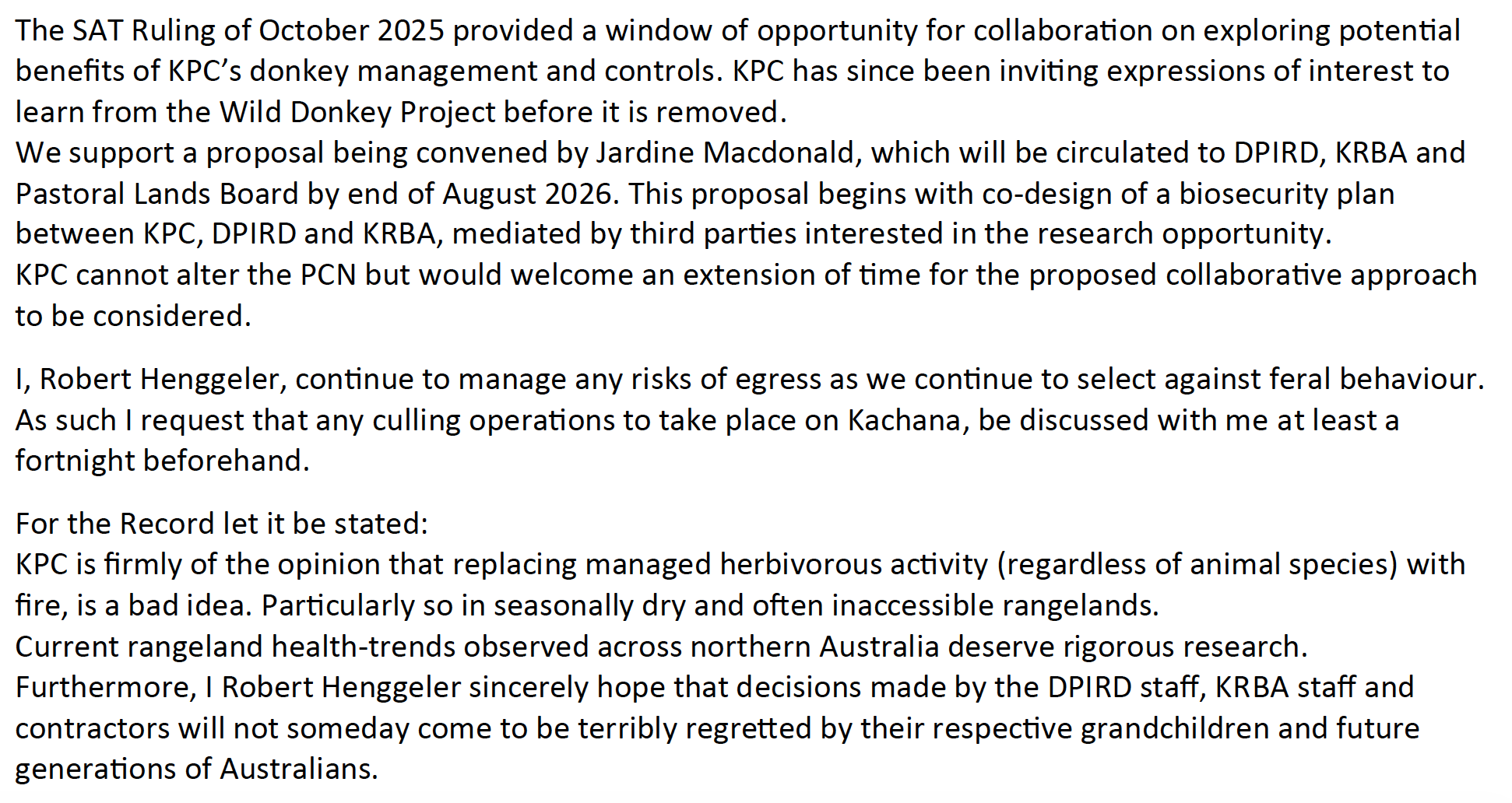
Jardine’s submission to the Minister et al continued:
KRBA has advised [in its reply to Kachana] that … it is not available to undertake the [culling] work until May 2027 … This is not a request to excuse non-compliance. It does, however, create a window in which we ask DPIRD to discuss a lawful pathway forward … We see an opportunity to turn a long-running conflict into a transparent, evidence-led resolution that protects biosecurity, preserves public value and allows all parties to move forward constructively.
I therefore implore you to consider the attached proposal. Kachana’s long-term field history has attracted substantial interest in regenerative land management, stewardship of Country and the integrated management of grazing, fire and biosecurity. These rare, multi-decade treatments could provide valuable and timely insights for the Kimberley, pastoral industry and wider public—but only if sufficient time is preserved to assess them, and under acceptable controls.
The proposal in essence is to take up the opportunity for collaboration expressed by the SAT, and ‘Preserve Kachana's managed field condition for an initial 12 months while strengthened biosecurity controls and independent assessment are implemented.’
As mentioned yesterday, this would ‘enable a global consortium of researchers to further the existing independent research already happening at the Station. To indeed ‘consider and investigate’ the enormous potential on offer here, before the opportunity is lost.
I asked KRBA’s Dick Pasfield his views on this possibility back in November last year, soon after the SAT decision. He had been quoted in an ABC article saying:
Despite the many positive things you can find online about the [donkey] project, there was actually no formal or scientific research ever carried out over its lifetime.
So I put to him:
My information from QUT [Dr Arian Wallach] is that there is actually ‘an ongoing research project on the ecological effects of donkeys on Kachana for the past several years, which includes a PhD project and international collaborators. This project falls within the scope of my Australian Research Council funded Future Fellowship. DPIRD is aware of my research activities at Kachana, and Ben’s highly popular Australian Story episode features it as well.’
Do you know of this? And if so, do you have any thoughts on it?
He replied that he was packing up his files on the case now, but ‘That said, your reference about QUT did pique my interest to some extent.’ He mentioned being aware that researchers including Dr Wallach ‘had an interest in the donkeys around 2018–19, but as far as I’m aware, nothing came of that.’
It became clear there are still sizeable gaps in understanding what’s actually happening on the ground at Kachana. So I wrote back:
My interest is piqued, in turn, by that passage you cited from SAT's decision. Is that something you're still up for in principle, 'to consider closely, and perhaps even partner with, the Applicant in exploring what has been the effect of allowing donkeys to graze in the rangelands'?
He said no, ‘given the regulatory constraints around our funding it would not be possible for us to provide support for this type of research. We would have to find a completely different funding stream to enable any participation.’
What if this proposal could be an avenue to do just that?
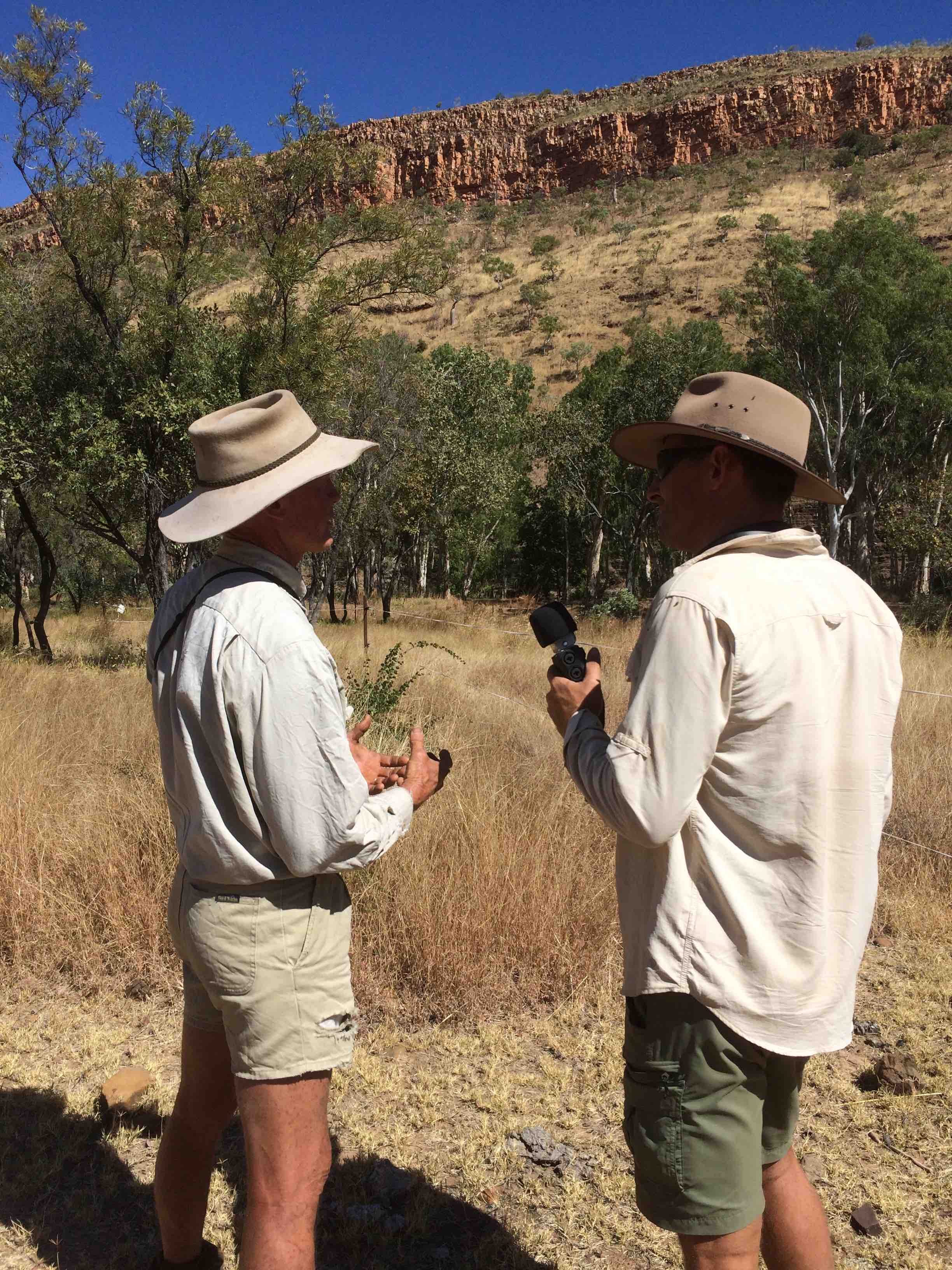
The main signatories to the request made of the Minister, Director-General and Commissioner today, are Jardine Macdonald of Soil Watershed, Lead support Rebecca Gorman, of the Regenerative Food and Farming Alliance (which launched at Parliament House in Canberra earlier this year), and Research Coordinator Cindy Eiritz, of Regenerate Earth.
Multiple letters and statements of support were also submitted, from notable folk including:
Professor Anne Poelina, Traditional Custodian from the Martuwarra Fitzroy River Council (Kachana came up in this live conversation with Anne, in Derby in the West Kimberley, back in 2021)
Dr Terry McCosker OAM, founder of RCS Australia and CarbonLink (the man described as being behind the greatest regenerative agriculture movement in Australia)
Dr Arian Wallach, ARC Future Fellow, Queensland University of Technology (and supervisor of the current PhD at Kachana)
John D. Liu, globally prominent filmmaker, founder of Ecosystem Restoration Communities, and Commonland Ecosystem Ambassador (here in conversation with Chris on the podcast earlier this year as he helped the global collaboration grow)
Wildlife Habitat Improvement of Nevada Board (supporting postponement, evidence-based management and comparative Australia–Nevada research into equid ecology, fire and dryland restoration)
Dr Magnus Sylven, Global Rewilding Alliance (supporting postponement and development of Kachana as a long-term Living Laboratory and international learning node)
Sonja and Martin Stuchtey, The Landbanking Group (inviting DPIRD collaboration on Kachana’s natural-capital project and an evidence-based framework integrating biosecurity, regeneration and investment).
The possibilities are building. While many more continue to take up the invitation to complete the register, sign the open letter within, and express interest in contributing.
With just days on the clock now, communications continue and all await an official response.
Thanks for reading! This post is public so feel free to share it.
Comments
Nothing yet. Say the first thing.
Sign in to join the conversation.