
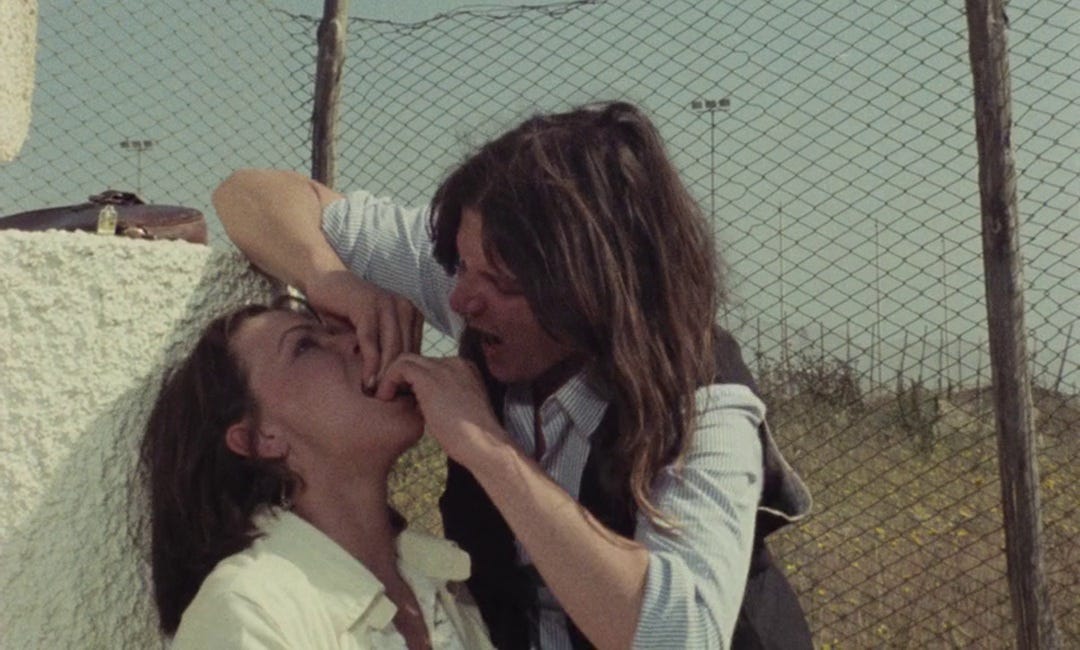
Filmmakers can sometimes fall into cracks, even when they come from relatively well explored film zones. Such is the cruelty of film exhibition and criticism. I’m very fond of the work of Claudio Caligari, and it says something about their marginalization that I ended up watching his features in reverse order. Caligari did a few documentaries in the 1970s and then followed them with three feature films in the final three decades of his life. The first one, Toxic Love, came out in 1983 and won him an award in Venice as a new filmmaker. The last one, Don’t Be Bad, premiered at the same festival in 2015, four months after he passed away. The Scent of the Night came out more or less midway through that in 1998, as one can tell Caligari didn’t have an easier time getting financing. His Italian Wikipedia page has a whole section for unproduced screenplays that is longer than the films made, even counting the earlier non-fiction. I can’t claim to know that much about the internal politics of current Italian cinema, but I’ve always gotten the sense that he is locally a well-liked underground figure, but outside of it he never seems to get much attention.
The three movies all deal with lives outside society, almost proudly so. His characters are less forgotten than people who seem to steadfastly refuse to take part in a productive society. Small-time criminals that move around like ghosts. An idea stated directly in The Scent of the Night, whose main character is a cop turned criminal who stages big robberies at wealthy houses. The Scent of the Night is the least of Caligari’s movies, partly because of the more recognizable genre trappings (complete with constant Scorsese allusions) and partly for its didacticism, but it articulates its revolt and malaise in a way that his other movies don’t quite.
What stands out first in Caligari’s work is how good he is at mapping those marginal types lives and how they move through his Rome. He knows how to keep his movies very close to them, add a sense of intimate veracity, while not giving in to any objectivity. All three movies have a doomed structure that sees death as an inevitable destination, but they don’t beat the characters with it because the filmmaker can’t help but see them with admiration. One might say he makes movies about characters who would be seen as losers and makes the most to turn his film tools to push them past such description. Caligari plays fair about the limits of those lives, but there is a romantic side to his cinema, and his attempt to find a balance between his honest and idealized sides is part of what is so appealing about them.
His appreciation of Scorsese is intriguing in this context because it is very much a European cinephile’s mythized love that zeroes in on their more abrasive and realistic qualities while looking past the Hollywood gloss. The Scent of the Night makes me think a bit of La Cecilia, a film former Cahiers editor Jean-Louis Comolli made about an Italian anarchist collective in late 19th century Brazil that is directed as a Howard Hawks movie, and how the idea of the aristocratic American filmmaker principles getting reimagined for much more radical means always amuses me. Caligari’s film isn’t as good, but it is fascinating to observe him find a political bite in the Scorsesian tics that exist far outside the compromises involved in being a successful Hollywood filmmaker.
Thinking about the three movies together, it is notable that the progression between them is one of filmmaking muscle. Toxic Love and Don’t Be Bad are in many ways similar films, observing a group of marginalized figures as they dance with death with plenty of affection. The similarities of milieu and gaze are clear as an almost documentary desire to install the audience into the characters environment, but the latter film has a narrative fluidity and urgency that the earlier one couldn’t come close to suggesting. There is a desire to grab the audience and push the fiction forward in Don’t Be Bad. Every scene is imagined as a seductive event that justifies the character’s worldview. Caligari’s ideas about realism and his poetics of losing are indebted to Pier Paolo Pasolini, but Don’t Be Bad also has the drive of an American gangster film. It is also economical and precise; its 102 minutes are packed with events, a whole life inevitable trajectory of doom.
Toxic Love is a movie about a group of heroin addicts. There is an actual romance that slowly becomes quite affecting, but the toxic love the title promises is also between the addict and the needle. The first hour is remarkably aimless. The movie is full of dead time but also faithful to the idea that the characters never lack urgency; their next fix is always there to organize their lives. Those are very focused people, even if they refuse to do anything else. Those scenes are uncomfortably close and have their own form of joy, until Caligari raises the desperation in the later section. He is too affectionate to be punitive, but too in love with the idea of losing and doom not to ask their price. The movie is quite good at filming the city and the way it seems to keep going on while its characters remain forgotten ghosts. Rome comes off very lively in all these films.
The achievement has to do with how much life Caligari injects in those little moments that at first seem to go nowhere. Former non-fiction filmmaker Caligari cast his movie with former addicts and gets plenty of their presence without ever feeling exploitative. There is also a lot of drug consumption in Don’t Be Bad, although the characters seem intoxicated with their self-images. These are people in revolt, staging their own subversive lives, even if they probably couldn’t put it in words outside of a desire to run away. Caligari is always good with actors, but the later movies get a lot out of stars and trust them to sink their teeth into their more elaborate dramaturgy. Valerio Mastandrea, who gives The Scent of the Night such a strong center, even served as producer in Don’t Be Bad, trying to help his friend to get one final movie. The two friends in the latter movie are played by Luca Marinelli and Alessandro Borghi, both of whom are quite good. Marinelli, as the more doomed friend whose every decision seems to warrant the worst outcome, gives the movie a constant jolt of energy. It is a sorrowful movie, but never a depressed one. Caligari films beat up people who are very aware of their position (“we were born on the wrong planet,” one of them claims to his lover in one of the movie’s better scenes) but seem very driven to reach their exit on their own terms.
What I take from Caligari’s three movies is how full of love they are, regardless of how the audience feels about their characters. These movies are constant dances, with their marginal lives, an idea of Italian realism, even death itself, but they are so lively and passionate. There is a tenderness to the filmmaker’s approach that is very moving. Characters seem to constantly refuse to do what they are supposed to, but they are embraced by the images. It is a radical form of love between the filmmaker and their marginalized world.
No posts
Comments
Nothing yet. Say the first thing.
Sign in to join the conversation.