
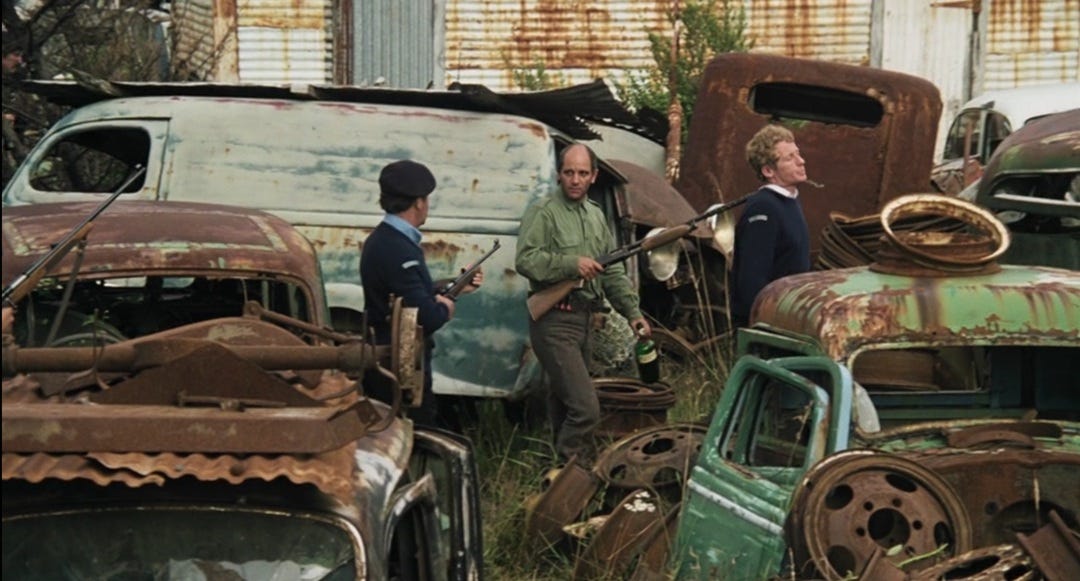
When Sam Neill passed away last week, the first movie that I thought about wasn’t his more popular or prestigious work, but his debut, Sleeping Dogs (1977), made in his New Zealand. It is not exactly a forgotten film, but it is certainly a marginal one, another dystopic science fiction from a period full of them, if a very grounded one, a paranoid road movie about a guy falling into a police state. He gets asked to react physically a lot, one of those movies that put the burden on its lead actor, without offering him much in the way of conventional dramatic scenes to express himself. That is probably why it came to my mind. Sleeping Dogs was the debut feature of Roger Donaldson, who I’ve always liked, and that makes me think about his even better follow-up, Smash Palace (1981), with Bruno Lawrence as a very divorced man who finds a way to get himself into increasingly more trouble. I do think Smash Palace is one of the great forgotten movies of the 1980s; it got great reviews back in 1981/1982, but it lacks the star power in front or behind the camera to get much in the way of a revival.
Anotações de um Cinefilo is a reader-supported publication. To receive new posts and support my work, consider becoming a free or paid subscriber.
Part of the issue is, of course, Donaldson himself. After those early home triumphs, Sleeping Dogs has the distinction of being the first New Zealand movie to get Western distribution; he went to Hollywood and stayed there for three decades, mostly cranking out a variety of anonymous if competent genre fare. He is the definition of an amiable journeyman; if one is used to watching American movies from the late 80s to the early 00s, stumbling in a Donaldson movie or two feels inevitable. His Hollywood work is uneven, and it probably doesn’t help that his most popular movie, Tom Cruise’s “let’s remake Top Gun in a bar” vehicle Cocktail (1988), is terrible. There are quite a few Donaldson Hollywood movies I really like (No Way Out, White Sands, The Bank Job, even Thirteen Days), but I know I saw 2003’s The Recruit in a theater but have barely a memory of it. When I mentioned Sleeping Dogs the other day, a Brazilian critic said he was always surprised that Donaldson didn’t get hired to direct a James Bond film, and “guy who should’ve helmed a Bond movie” seems like the right epitaph for his Hollywood career. For what it’s worth, his last Western movie, The November Man, was a Pierce Brosnan vehicle aimed at people who still missed his Bond days in 2014 (solid film).
There is a large dissonance between his early work and these movies, even though it is easy to gasp why someone saw them and decided this guy should do Hollywood action movies. Adrian Martin back in the mid-90s put it in perspective: “Who would have guessed, watching his New Zealand hit Smash Palace (a gritty family melodrama) back in 1981, that Donaldson would have proved himself such a proficient craftsman of genres like the horror movie, the thriller, and comedy?” I like Donaldson more than most, but he was indeed seen as a promising new voice back in the day; his first movie in the West, a version of Mutiny on the Bounty called just The Bounty, was in Cannes competition in 1984, so he was a respectable enough up-and-comer for the honor even if I’m sure the all-star cast helped (Mel Gibson, Anthony Hopkins, Edward Fox, one of the last Laurence Olivier’s performances, and very early work from Daniel Day-Lewis and Liam Neeson; that one really had every Brit actor that Dino DeLaurentiis 80s money could buy). The movement towards more anonymous work does pique my imagination and make these two movies worth revisiting beyond their qualities.
They are very similar superficially: paranoid fantasies of a slighted man on the run with a very subjective framework, a lot of forward momentum, and, despite their artier trappings, approached by Donaldson like action movies. They are so deep into their main characters’ point of view, they almost seem like they are conjuring their obstacles on their heads. The two guys are big malcontents from their first shot; their environment seems to attract and repel them. Sam Neill abandons his family in Sleeping Dogs’ opening scene and tries to run from society but gets embroiled in political intrigue instead. Bruno Lawrence in Smash Palace seems to love his family, and he recently moved back home. He is a former racing car driver with a French wife (Anna Maria Monticelli, good in one of those parts that are more symbol than properly written) who can’t stand him anymore; she leaves with their 8-year-old daughter, and he quickly turns violent. The two movies have a similar structure towards a major apocalyptic confrontation with memorable endings. The last half hour of Sleeping Dogs turns into a near abstracted chase movie, while Smash Palace becomes an exercise in action absurdism as the ex-driver kidnaps his daughter. It is easy to watch Neill’s good looks and charm and imagine how he will go on to be a movie star; the bald, constantly pricky Lawrence holds the attention, but there is little that is easily likable about him. The movie fills in the blanks of what motivates him but never lets his actions go smoothly.
They exist in that strange world cinema zone that plays into local feelings while hoping for an international career. Warren Oates is around in Sleeping Dogs as an American operative that remains at the margins of the action, and he often comes off as a Hollywood bogeyman, one of those presences that seem to allegorically allude to the complicated relationship between a local cinema and the ubiquitous American one. It is quite funny given Donaldson’s future, also because Oates is simultaneously likely the most famous actor a moderately budgeted New Zealand movie could afford and the exact opposite of a Hollywood movie star. The French wife and the suggestion of a glorious past function similarly in Smash Palace.
The two movies put a lot of emphasis on the environment and landscape. There is a large unease to them. Nothing about the political reality in Sleeping Dogs quite tracks with 1970s New Zealand, but if the plot is not allegorical, Donaldson seems to constantly negotiate a lot of complicated feelings about the movie terrain. Neill wants to escape a home that seems to engulf and suffocate him. Lawrence, by his part, wants to embrace it but seems even more crushed. Smash Palace starts with a wonderful opening scene staging a car accident that sets the upsetting, violent mood. It gets a lot out of the junkyard that gives the movie its title and serves as its main setting. The two movies seem to exist at a purgatory that increasingly approaches hell, although the earlier movie seems to ascend towards clarity while the later gets lost in a maze of threatened masculinity. Women are incidental in Sleeping Dogs and a trophy in Smash Palace. One of the scariest parts of the latter film is that one never doubts Lawrence loves his daughter, but also that he sees her as someone he can claim as his.
Donaldson directs these movies like an action filmmaker, even if neither of them quite naturally fits the genre. There is a practical quality to them and a desire for constant motion. That the main character is a former driver becomes a central aesthetical motif in Smash Palace. These are movies that keep moving forward, and they have an engrossing action and reaction logic and a kinetic eye for movement. There is a physical dimension to these movies even during Smash Palace’s more domestic scenes. My friend Eric Marsh pointed out how Sleeping Dogs feel indebted to Joseph Losey’s art chase movie Figures in a Landscape (1971), and the last section of the movie Neill and Ian Mune on the run does stick close to it. Losey’s film is an essential and very concrete film; two prisoners in a vague political scenario lost in the landscape chased by a metaphysical state, the title is quite literal. Those final scenes do play like a miniature, not quite as formally precise variation on the earlier movie. Losey’s influence does hang over both movies, and one can sense how his example was useful to Donaldson early in his career. Smash Palace doesn’t have as many direct nods, but feels even more Loseyan, even if the drama suggests New Hollywood movies about threatened masculinity (Peckinpah’s Straw Dogs isn’t far from it, and Donaldson eventually did remake The Getaway). There is a symbolical dimension to the action, but everything remains very matter-of-fact.
I don’t think there is anything quite as good in Donaldson’s career as the scenes between Lawrence and his daughter. There is an openness there that doesn’t dispel the threat of violence of the rest of the movie. He is quite tender, but his desire for control remains. His unease with his position in the world comes because outside the car, he has to submit to others. Eventually he decides his only option is to kidnap her (this man does not make wise decisions), and they end up living away in the woods. Smash Palace is honest about how the girl is in awe of her dad and aware he can be dangerous. She seems to grasp that he is not likely to hurt her, but that the same isn’t true of her mom and others. At this point, the movie remains grounded in character behavior and increasingly absurd in action. Those few scenes do have a privileged quality to them. Two years ago, Donaldson’s daughter India directed a very good feature called Good One that had a successful festival run. It was about a 17-year-old girl on a weekend trip with her dad and her subjective observation and distance from his masculine world and how she has to negotiate with it, and while her main influence seems to be Kelly Reichardt, it did feel like another perspective of some of what Smash Palace was trying to accomplish.
The two movies do share a similar malevolence and paranoia. Neill wants to escape the world to achieve some idea of freedom, while Lawrence wants it to give him what he believes is owed. There is a mythic quality to the terrain; this place is a tomb to those men, and the movie’s final movement is towards an idea of self-annihilation. One movie ends with a man accepting freedom in death, and the other staging a mock suicide. They also do conclude with the men seeking an understanding in violence with the guys their wives are sleeping with. The final scenes in Sleeping Dogs are quite good, but they aren’t on the level of Smash Palace. The first movie does have a certain vagueness to its scenario, while the latter one is very precise in how it maps the former driver’s desire to fight the world. The script (written by Donaldson, who only has one other writing credit) is quite strong and good at filling every detail of its portrait. Nothing Lawrence does makes any sense to those around him, but every dumb decision does seem fully justified in his head.
Donaldson does have a great feeling to how to present the idea of a man cornered. Everything is very claustrophobic and inevitable. A trap with every good option taken away. The promise of confrontation seems to be as big as they are hollow. That man wants to make a gesture, give the world the finger one last time for all his perceived slights, but he also doesn’t have the stomach to call his own threat. When the wife comes to retrieve the daughter, there is a wonderful couple intimacy, but also a resignation, an understanding between the parties that exists beyond the movie’s bigger action. The denouement is tense and full of ingenious absurdity.
There is an off putting and mysterious quality to these movies that are mostly absent from his later work. They are precise and efficient like his Hollywood movies, but not beholden to them. There is a value in a talented journeyman, arguably more than critics often are interested in. Mainstream movies can suffer from too many small talents who think they are major, so skilled modesty can be welcome. I do wonder about Donaldson’s career arc and the fascinating tension between initiating movies in a marginal industry and negotiating through a larger one. There is more resources, while something is lost. The open roads of Sleeping Dogs and Smash Palace do suggest a desperate need for an escape, and in some way Donaldson’s Hollywood career seems like the destination, uneven and compromised perhaps, but possible.
Comments
Nothing yet. Say the first thing.
Sign in to join the conversation.