
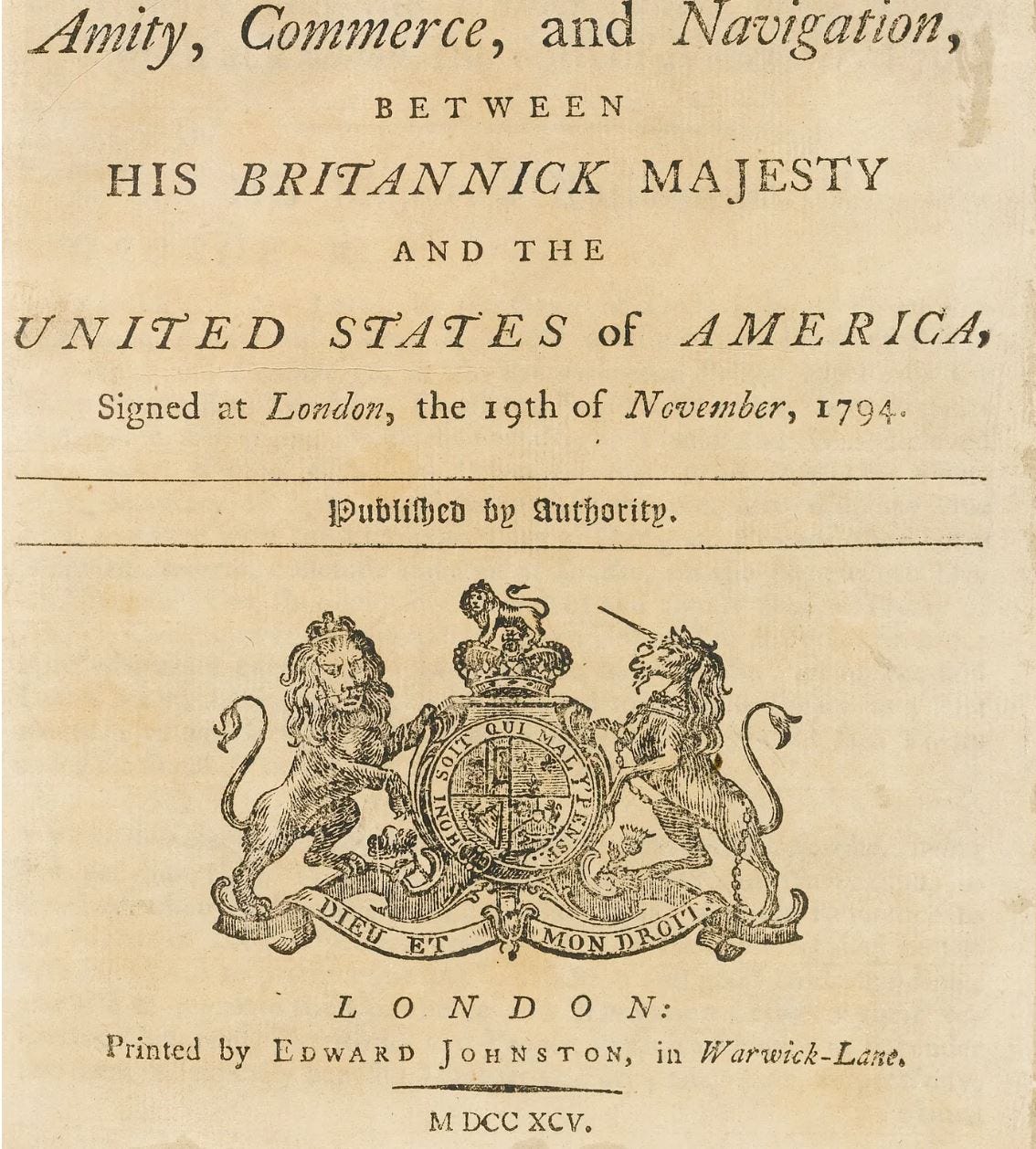
Image Source: https://bonniekgoodman.medium.com/otd-in-history-june-24-1795-the-senate-ratifies-jays-treaty-establishing-trade-between-america-c9015c3011d8
The Jay Treaty – which Canada does not recognize but the United States does – allows First Nations people born in Canada to freely enter the United States for employment, study, retirement, investment and immigration. This differential treatment is cause for concern amongst many First Nations people, particularly those whose traditional lands straddle both sides of the border.
The problem exists because of the nature of the Jay Treaty itself. Named after John Jay, Chief Justice of the United States, the treaty also known as A Treaty of Amity, Commerce and Navigation between His Britannic Majesty and the United States of America was settled in November of 1794, and ratified October 28, 1795. The intent was to resolve several grievances between the two countries that remained outstanding from the Treaty of Paris (1783).
Tensions between the United States and Britain remained high after the Revolutionary War as a result of three key issues: British exports continued to flood U.S. markets, while American exports were blocked by British trade restrictions and tariffs; the British continued occupation of northern forts that the British Government had agreed to vacate in the Treaty of Paris (1783); and Britain’s impressments1 of American sailors and seizure of naval and military supplies bound to enemy ports. These issues brought the two nations to the brink of war in the late 1700s.
The British were involved in the French Revolutionary Wars in the midst of the French Revolutionary Wars, which had begun in 1792 and wanted to avoid becoming engaged in another conflict. The Jay Treaty provided them with 10 years of guaranteed peace with the Americans. Therein lies one of the problems with the Treaty, it had an expiry date.
The Americans were actually somewhat divided with respect to wanting the treaty. Many Americans still harboured significant resentment against the British, while others recognized that the future of the fledgling nation rested on developing good relations with Britain. President George Washington, supported by Secretary of the Treasury Alexander Hamilton, was eager to resolve the outstanding issues with Britain as they saw peaceful relationships as an important step in assuring US independence. It is interesting to note that in forming the first government Washington was opposed to the idea of political parties. However, the issue of settling a treaty with Britain so divided the nation that it saw the beginning of the formation of two distinct political parties: the pro-Treaty Federalists and the anti-Treaty Democratic-Republicans.
The treaty ultimately helped the Americans achieve many of their goals including British withdrawal from forts that were on what had become American territory. Debts owed to Britain by the U.S. and issues related to where boundaries between the U.S. and British North America should be drawn were both referred to arbitration for resolution marking one of the first times in international affairs where parties conceded to the arbitration process for settlement. The treaty also contained provisions with respect to expanded trade for the Americans.
The important part of the treaty for Indigenous people was Article III which states:
“It is agreed, that it shall at all times be free to His Majesty’s subjects, and to the citizens of the United States, and also to the Indians dwelling on either side of the said boundary line, freely to pass and repass, by land or inland navigation into the respective territories and countries of the two parties on the continent of America, (the country within the limits of the Hudson’s Bay Company only excepted) ... and freely carry on trade and commerce with each other.”
Some argue that despite the expiration of the treaty this provision was intended to live on indefinitely. This argument however has not been accepted by the Canadian government or Canadian courts despite the notion having been supported by both U.S. and British courts.
When the Jay Treaty expired negotiations took place on a renewal agreement that is now referred to as the Monroe-Pinkney Treaty (1806). However, by this time relations between the two countries had once again worsened and despite being accepted in London was vetoed by then President Thomas Jefferson. In 1812, Jefferson’s replacement James Madison, concerned with the continuing issues over regarding trade, impressment, and national sovereignty, and fueled by a desire to annex British North America (i.e. Canada) as part of the United States, declared war against Britain.
So, while it is clear that the Jay Treaty had expired and was not replaced one can add to the argument that the declaration of war nullified all treaty understandings between Britain and the U.S. The war of 1812 ended somewhat in a draw resulting in the Treaty of Ghent (1815). During peace talks, the American delegates decided not to present President Madison’s demands for Britain to turn Canada over to the United States. This created an opportunity for the British to press for one of their key demands which was for the formation of an indigenous state (in what today is the land stretching from Ohio to Wisconsin) as a buffer to contain American imperialism. The Americans flatly refused to consider a buffer state or to include Indigenous nations directly in the treaty in any fashion. One of the British negotiators, Henry Goulburn noted:
“I had, till I came here, had no idea of the fixed determination which prevails in the breast of every American to extirpate the Indians and appropriate their territory.”
The Americans were particularly concerned that including Indigenous people in the discussions or even considering their rights in the discussions would potentially mean the United States was abandoning its sovereign claims over Indigenous territories. It was then and remains the position of the U.S. that it retains sovereignty over all peoples living within the boundaries of the United States. The resulting impasse brought negotiations to the brink of breakdown. In the end, the British government backed down and accepted Article IX, in which both governments promised to make peace with their indigenous foes and to restore Indigenous nations to “all possessions, rights and privileges which they may have enjoyed, or been entitled to in 1811.”
Some argue that this provision results in Indigenous rights with respect to crossing the border for trade as written in the Jay Treaty were restored. However, again one notes that the Jay Treaty had expired in 1805 and its replacement had never been ratified by the U.S. So, despite the fact that American courts have upheld the Indigenous rights under the Jay Treaty, Canadian courts have not.
For example, in the 1956 case Francis v. The Queen, the Supreme Court of Canada determined that the Jay Treaty was not legally binding in Canada and could not be enforced by Canadian courts because it was never formally implemented through legislation. The ruling concluded that Indigenous rights to duty-free goods and free border crossing under the treaty are not recognized in Canadian law, distinguishing the Canadian stance from U.S. recognition.
In fact, the United States has codified Indigenous cross border rights in the provisions of Section 289 of the Immigration and Nationality Act (1952) stipulating that Native Indians born in Canada are therefore entitled to enter the United States for the purpose of employment, study, retirement, investing, and/or immigration if they can prove that they have at least 50% blood quantum, and cannot be deported for any reason. Given some of the current policies of the American government the Canadian government has advised Indigenous people to take precautions to ensure they have the proper identification that demonstrates they are in fact “native Indians” and therefore ought to be immune from deportation at the hands of the Immigration and Customs Enforcement (ICE) agents.
While well intentioned the issuance of this advisory has raised concerns about Canada’s refusal to recognize Indigenous rights in a reciprocal way. More than 50 Indigenous nations have traditional lands that straddle the U.S.-Canada border, separating families and communities. Key nations include the Mohawk (Akwesasne), Ojibway, Blackfoot, Vunut Gwitchibn and White River FN, Tlingit, Haida, and Sinixt2. These communities often face challenges in maintaining cultural, familial, and economic ties.
Pinckney, the American ambassador in London who assisted in negotiating the Jay Treaty and its replacement (though not ratified), in a letter to the Secretary of State wrote an explanatory note that essentially set out the intent for Indigenous cross border rights to continue to exist regardless of the status of the Jay Treaty or any other treaty:
“No stipulations in any treaty subsequently concluded by either of the contracting parties with any other state or nation, or with any Indian tribe, can be understood to derogate in any manner from the rights of free intercourse and commerce secured by the aforesaid third article of the Treaty of Amity, Commerce and Navigation to the subjects of His Majesty and to the citizens of the United States and to the Indians dwelling on either side of the boundary line aforesaid but that all the said persons shall remain at full liberty freely to pass and repass, by land or inland navigation into the respective territories and countries of the contracting parties, on either side of the said boundary line, and freely to carry on trade and commerce with each other according to the stipulations of the said third article of the Treaty of Amity, Commerce and Navigation.”
It is in this spirit that the rights so enumerated back in 1795 ought to be restored and recognized. Today Canada has implemented some temporary measures to ease travel rights for Indigenous people born in the U.S. to enter and stay in Canada to visit relatives. Notwithstanding, it is important to understand that the border is an artifact that exists by agreement between Canada and the U.S. and does not have the same implications for sovereign First Nations. The resulting differential treatment remains an issue that Canada has to address and rectify.
Thanks for reading Canadian Indigenous Facts, Stories and Learnings. This post is public so feel free to share it.
Share Canadian Indigenous Facts, Stories and Learnings
The Sinixt Nation is actively working to reassert their rights in their traditional territory in British Columbia, despite being declared “extinct” by Canada in 1956.
Comments
Nothing yet. Say the first thing.
Sign in to join the conversation.