
Image source: https://www.canadashistory.ca/
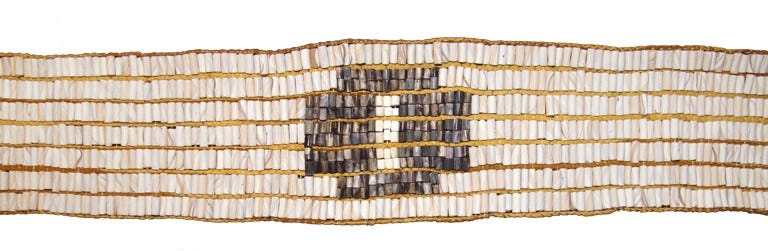
This image is a reproduction of the orginal Dish With One Spoon wampum belt. The dish and spoon image is constructed with authentic wampum from circa 1650, collected from Seneca territory in Western New York. Acrylic beads were used to complete the belt.
IMAGE COURTESY OF RICHARD HAMELL, WITH PERMISSION FROM ANSLEY JEMISON
Georg Wilhelm Friedrich Hegel, the famous German philosopher observed in his 1837 work Lectures on the Philosophy of History that “We learn from history that we do not learn from history.” While history offers us lessons we too often ignore them and the potential application to the present. Thus, dooming us to repeat past failures or to prolong a past wrong. In the case of Canadian history and in particular the history of the relationship between the Indigenous people and settler society, the lessons that might have been learned were further complicated by certain dogma that suggested European principles and concepts were superior to the beliefs and customs of the Indigenous people they encountered and dealt with.
In particular, French and British colonialists came to believe that the First Nations people held primitive beliefs because they did not conceive of land ownership in the same way that Europeans did. Many of our readers know, the European notions of private property rights did not exist in indigenous societies. This was seen by the settlers as a serious flaw that led to the conclusion that this was proof of the primitive nature of indigenous society. Moreover, the notion of land being considered as “commons” to be shared was seen as a notion held in communists societies and anathema to mercantile and capitalist pursuits.
In today’s current world we continue to tend to view concepts in extremes and as a result are unable to reconcile different principles and find overlapping value. In other words, we prefer viewing differentiated ideas as being somehow mutually exclusive. Thus, we cannot conceive of a way in which the notion of private property rights coexisting in a world where land might also be seen as a common resource. The difficulty we have in reconciling different concepts such as this is at the root of many treaty misunderstandings. It also has created a barrier to our collective ability to learn from history and specifically to learn from the successes of many indigenous societies in creating foundations for peaceful coexistence.
Throughout virtually the entire seventeenth century the French colonialists (i.e. New France) and their Iroquois allies in North America were engaged in continuous and prolonged conflict with other Indigenous groups, primarily the Anishinaabe, Mississauga, and Haudenosaunee Nations. These are sometimes referred to as The Beaver Wars (or the Iroquois Wars) as control of the fur trade was a central factor in the intense conflicts that plagued the parties. Ultimately in 1700 Governor Louis-Hector de Callière initiated negotiations aiming to end the conflict and establish a lasting peace. These efforts were mediated by an influential Huron-Wendat chief, Kondiaronk, whose pivotal contributions convinced the various First Nations to work towards reaching an agreement. The result was The Great Peace of Montreal, a Treaty agreed to in 1701. In August 1701, over 1,300 delegates from 39 different First Nations gathered in Montreal to sign the treaty with the French. The treaty ensured free access to hunting grounds and established neutrality for the Iroquois in future conflicts between the French and English. This agreement is said to have created a stable, long-lasting peace in the region and reshaped relationships among the First Nations and European settlers.
Characteristic of First Nations’ treaty makers, the group gathered in Montreal, developed their approach around foundational principles designed to provide a basis for a long-term agreement that would last for seven generations or more. In this case those fundamentals were built around the metaphor of dish with one spoon. For the settlers, their principles, if we can call them that, were built on the notion of private property and the ephemeral approach of resource extraction as quickly as possible to capitalize on the then current demand for the resource of beaver pelts in order to generate large profits over the short-term. While the parties were able to arrive at an agreement it was one based on different views of how the commons (the lands) would actually be shared.
For the settlers, New France, the agreement was intended to acquire private property rights in order to have exclusive access to a needed resource. As well, the French wanted to neutralize the Indigenous groups allied with the British in order to level the playing field in their ongoing conflicts with their rival European. Again, this New France perspective was short-term focused as were many of the so-called Peace and Friendship treaties that predated Confederation. The problem with the two divergent approaches was, and remains, the fact that neither the Indigenous groups nor the French entering into The Great Peace of Montreal treaty had a true appreciation for just how fundamental the different understanding of property rights were and what the ultimate consequences would be emerging from the resultant misunderstandings.
Dish with One Spoon is an Indigenous philosophy predating European contact applicable to treaty formation which signifies a binding agreement to share, protect, and sustainably manage regional resources (the “dish”). Parties to an agreement understood the concept of only one spoon, meaning we all eat from the same dish and one spoon signifies everyone takes only what they need and, therefore leaves enough for future generations.
In the metaphor the “dish” represents the land (in this case specifically the Great Lakes region, Southern Ontario and Southern Quebec) and the resources found in the region. The “spoon” represents the needs of both individuals and nations living there. It represents a shared responsibility wherein the land is not to be divided or owned, but rather shared collectively, with all parties responsible for its care. The use of a single spoon implies taking only what is needed, avoiding waste, and ensuring resources are never completely depleted. This creates sustainability and respect for the fragility of the resources being extracted. Interestingly the metaphor is also powerful for what it does not include. By considering the spoon but not knives the metaphor symbolizes a commitment to non-violent conflict resolution and peaceful cooperation.
Wampum belts, elaborately decorated with intricate beadwork were typically used to signify core commitments embodied in the treaties as long-lasting relationships and to ensure that yhe memory of the agreement would be preserved. The Dish with One Spoon belt produced to symbolize the Great Peace of Montreal has become one of the best-known examples. It was developed through the 1701 negotiations which culminated in a two-week event was marked with feasting, the smoking of pipes, the exchange of wampum belts and speeches by Indigenous leaders. It was serious stuff.
However, it is clear the French (and in fact all European powers) had an entrenched belief in the sanctity of private property and could not, or would not, try to understand the notions behind a dish with one spoon. So, there was not a true meeting of the minds. The French thought they were acquiring ownership the Indigenous nations thought they were entering a sharing agreement. They believed that land was to be shared by all, not simply the possession of one group or people forever.
We can learn a lot from the metaphor and how it is actually applicable today. Belief in the concept of the Dish with One Spoon raises awareness of ecological and environmental sustainability. One of the core values within the idea of a dish with one spoon is that those who use the land should not abuse the land. In other words, individuals and groups should only take what they need from the land so that there will be a healthy, long-term, sustainable environment. It is a concept we see applied by many Indigenous groups across Canada today in consultations when Companies are attempting to seek Free, Prior and Informed Consent (FPIC). It is not that these groups oppose extraction industries but rather they want to be assured that methods will not result in the abuse of the land.
An interesting parallel is the different approaches taken by the U.K. and Norway in the development of North Sea oil reserves. The U.K. took an expedient approach to maximize short-term goals and the result was quick boosts to GDP, high corporate profits and very little lasting public benefits. Norway, on the other hand adopted a longer-term approach focused on sustainable benefits that ensured maximum public benefit and minimum environmental impact. The result was there is zero continuous value for the U.K. in oil extraction from the North Sea while Norway is still producging but now reducing the amount of oil production because they have been able to establish a national sovereignty fund of over $2 trillion that can perpetually fund all of its peoples’ health and welfare needs for many coming generations.
Another important point to raise is that the One Dish One Spoon concept was meant to emphasize that while land was being shared between the Indigenous groups and the settlers (the French in the case of the Great Peace of Montreal) it was also an agreement amongst a diverse group of Indigenous nations too who maintained their individual sovereignty while also sharing the land. Too often settlers failed to see the diversity of Indigenous interests being represented in these agreements. Moreover, while the Dish with One Spoon is a metaphor unique to nations in central Canada (i.e. Ontario and Quebec) the concept of sharing the land is a common theme across most of not all Indigenous Nations.
Some observers deliberately dismiss any acknowledgement of the value of the Dish with One Spoon metaphor because they see it as a rejection of the notion of private property and is embracing a culture that smacks of communism. In truth, the Indigenous groups that lived by the metaphor in fact managed dual goals. It was the approach to be taken with respect to the “commons” while also acknowledging that individuals had private rights to own material, tools and improvements they themselves had produced. Viewing Indigenous philosophies through the lens of settler ideologies is a mistake that leads to misunderstandings. One really needs to think of context and indigenous culture to understand the nuances of these beliefs and practices. Understanding these gaps helps us appreciate why there continues to be difficulty in reaching agreements about land entitlements.
Until recently, the Dish with One Spoon was little known outside of Indigenous communities. Starting in the 2010’s, more Canadians have become aware of it. In many instances the metaphor is acknowledged as part of the articulation of a land acknowledgement. Perhaps as we improve the understanding of this type of foundational concept we will be able to move forward together.
It is notable that these ideas, significantly contributed to the longevity of another famous agreement the “Great League of Peace” — the Iroquois Confederacy made up of the Seneca, Cayuga, Oneida, Onondaga and Mohawk nations. This Confederacy has existed for more than four hundred years. Its longevity is a testament to its success. It is referred to amongst the Anishinaabeg “Gdoo – naaganinaa.” Which translates to our dish and is used to refer to the One Dish One Spoon commitments. . Its message is uplifting and important to consider at this current time in our history.
We can learn a lot from history if we are willing to view history and consider the wisdom and perspectives of all people involved.
Let’s keep Our Dish full.
Share Canadian Indigenous Facts, Stories and Learnings
Thanks for reading Canadian Indigenous Facts, Stories and Learnings! This post is public so feel free to share it.
Comments
Nothing yet. Say the first thing.
Sign in to join the conversation.