
The topic of birth control inspires a lot of strong opinions. Today I’m going to surprise no one by taking a moderate stance: I will argue that birth control is neither the holy grail of women’s rights and freedom, nor the frivolous, selfish choice of sexually licentious women trying to cut themselves off from their embodied, natural fertility.
While making people mad is not my intention, I understand that this post may offend people on both sides of the political spectrum—the religious and the non-religious. Sorry! I know that some hold deeply rooted religious beliefs that artificial contraception is morally wrong, and I completely support them in living their lives accordingly. But from this crowd, I often get the impression that they think a woman not wanting to spend a couple decades pregnant, breastfeeding, and stay-at-home momming is a betrayal of femininity.
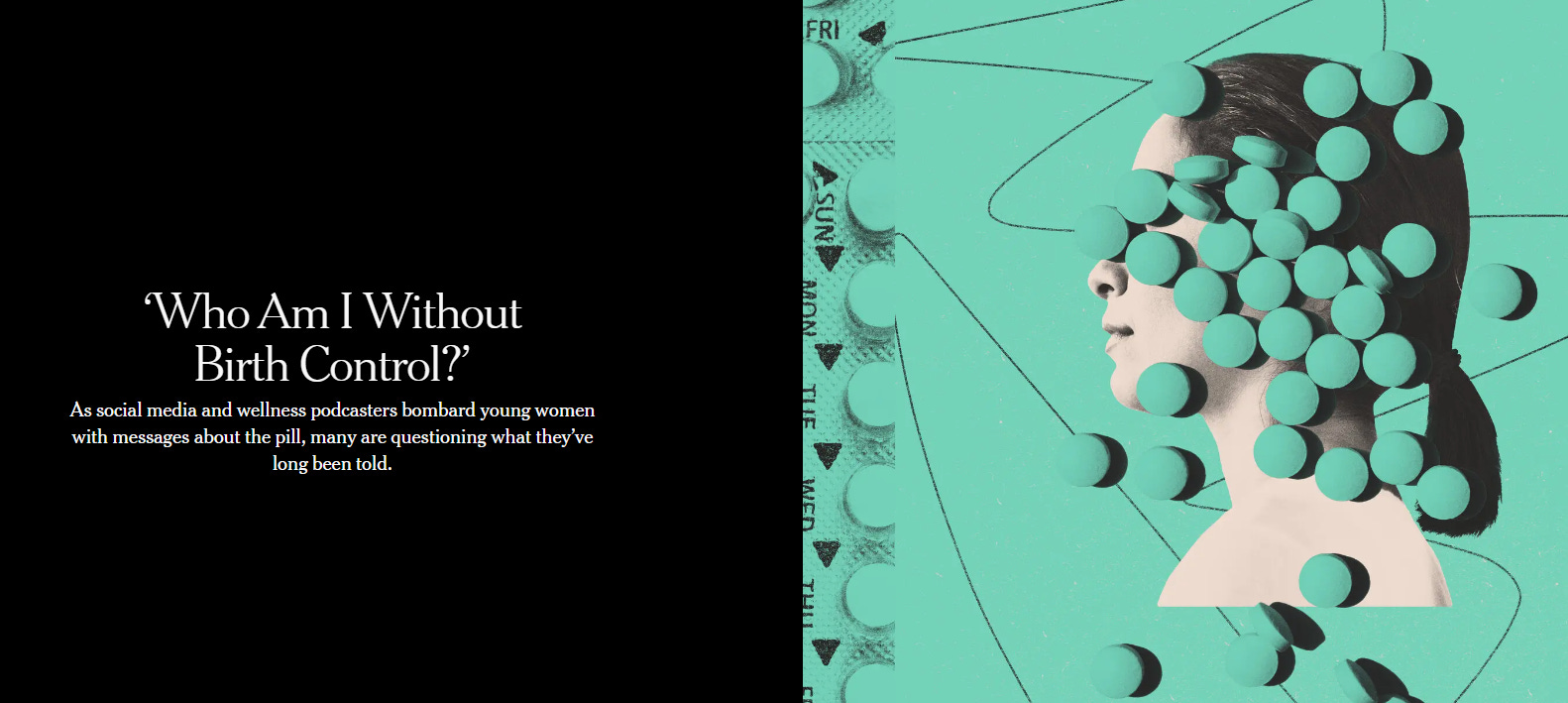
On the other side, majorities of people seem to view birth control as a tool of liberation and assume its benefits to women are obvious and universal. They have trouble understanding the crazy people who don’t want to be on birth control constantly, especially if it means risking—gasp!—pregnancy. Such was the tenor of this New York Times article, “Who Am I Without Birth Control?” which blames right-wing anti-birth control influencers for a rash of unwanted pregnancies.
I found it condescending, painting women as dupes rather than adults capable of making their own decisions. It tells horrible stories of women who decided to go off birth control and had babies. They are now miserable, depressed and overwhelmed all because TikTok influencers led them astray. There is no control group (are mothers with planned pregnancies also overwhelmed sometimes?) and no check back in two years to see if these moms regret their pregnancies (odds are, they don’t!)
The thing is, after twenty years caring for women across their reproductive lives, I think the truth about birth control is incredibly nuanced. Contraception can be really helpful, really harmful, and everything in between.
My job requires me to help people navigating these decisions at every stage of life—from teenagers in their first relationships to perimenopausal women hoping to avoid the “oops” baby. Many of the patients I counsel are already mothers trying to decide how many children to have and how much space to put between them. These are tough decisions that have a huge impact on the trajectory of their lives and their children’s lives.
Over the years I’ve educated myself about the full range of options. But beyond that, I’ve had a lot of intimate conversations with the people making these decisions and experiencing the risks and benefits of different methods. This essay is mostly trying to speak from that perspective. Birth control can be really beneficial. It can also be pretty disruptive to a woman’s health, moods, and relationships.
I honestly have no agenda here. My greatest wish for families is that they have the children they want, when they want them. I don’t want women pressured into pregnancies they aren’t ready for. But I also feel a deep sadness for women who are unable to conceive the babies they desperately want. Sometimes delayed childbearing—often made possible by contraception—plays a role in that story too. We should be honest about that.
But First, What Do I Even Mean By “Birth Control?”
I want to be clear that when I talk about birth control in this essay, what I really mean is any method intended to avoid conception.
There are hormonal methods and non-hormonal methods. There are methods with high efficacy and low efficacy. There are permanent sterilization methods and reversible ones. There are fertility awareness approaches like natural family planning (NFP) and lactational amenorrhea (LAM). But for the purposes of this essay, anyone who is having penis-in-vagina sex and doing something to avoid pregnancy is using a birth control method.
Granted, depending on the method chosen, the risk/benefit profile is very different. I’ll try to distinguish between the methods I’m talking about along the way, but I am not going to be able to cover every birth control method in detail. Use the section subheadings to navigate to the sections that interest you most!
Now, A Nod to The Oldest Birth Control Method
When I was a midwifery student, I remember being sent into a postpartum room alone without my preceptor to talk to a patient. She had just given birth to her fourth or fifth child. She was an older, confident, buxom, Spanish-speaking woman—the kind of seasoned mom who probably did not need advice from the likes of me. At the time, I was a naïve, pollyannaish type who had grown up Catholic and had still never had a serious boyfriend in my early twenties. On my checklist of required questions was: “Do you want anything for birth control?”
So I asked her, in Spanish.
Her response: “Él me cuida.” He takes care of me.
I was confused. He takes care of her? Was my Spanish failing me? So I asked again whether she wanted us to prescribe a birth control method.
“No,” she said firmly. “Él me cuida.”
Same answer, and now she’s seeming a little annoyed. Oh well, I’ll ask one more time.
“Ya te lo dije. Él me cuida.” I already told you. He takes care of me.
Sensing her growing frustration, I finally gave up and left the room to talk to my preceptor about the interaction. She was an experienced midwife who had worked with this immigrant population for years.
Completely unfazed, she explained:
“He pulls out.”
“What?” I asked.
“Withdrawal,” she said. “It’s very common in this population.”
Seeing the blank expression on my face, she rolled her eyes and practically shouted:
“HE DOES NOT COME INSIDE OF HER. HE EJACULATES OUTSIDE HER BODY.”
Well, gosh golly. That was embarrassing! This mom’s birth control method was literally the oldest trick in the book, and somehow I did not see it coming.
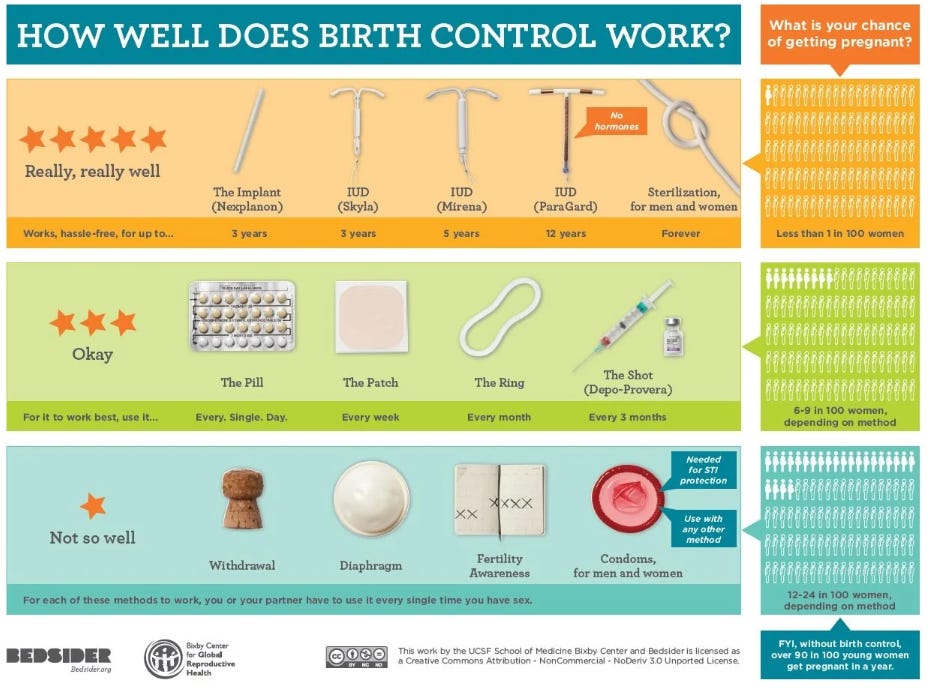
Since that interaction, I’ve talked to many more women who use this method successfully. Sometimes I share a few statistics with them about its effectiveness as a caution—it’s relatively low. About 1 in 5 couples relying on withdrawal will experience a pregnancy each year. Yet, I’ve had women tell me they’ve used it their whole lives and only gotten pregnant when they wanted to. And indeed, I have known patients who used this method with committed partners (who must have really good self-control, by the way!) to space pregnancies four or five years apart, all the while avoiding the side effects of hormonal birth control. So before we move on, let’s acknowledge what was probably the most commonly used birth control method for all of human history: withdrawal.
Next Up—The Method Approved by the Vatican: Natural Family Planning (NFP)
While we’re on the topic of “natural”—that is, non-hormonal, non-surgical, non-device-based—methods, I want to talk about another one we hear a lot about: Natural Family Planning (NFP). Or maybe it’s just me and the Substackers I engage with—I’m not sure!
As a former Catholic (I’m Lutheran now, but still respectful of the tradition) and someone who attended Catholic universities for both undergrad and graduate school, I had plenty of opportunities to learn about NFP. I understand that some people don’t like describing NFP as “birth control,” but anyway, I googled it and the world wide web agrees with me:
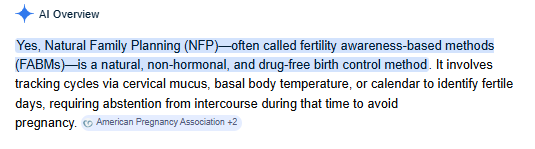
An important difference with NFP, of course, is that it also helps couples understand fertility in a way that can help them achieve pregnancy, not just avoid it. While I don’t consider myself an expert on NFP, I’ve read books and articles on the topic and attended conferences where it was taught.
I once even dragged my unsuspecting Protestant fiancé to an NFP workshop during a pre-marriage retreat. The class was taught by two men: one a father of five, and the other a scientist living a celibate religious life. In retrospect, they may not have been the world’s foremost experts on avoiding pregnancy and I’m not going to lie—it was a little cringy listening to them mansplain the different kinds of cervical mucus I should watch for that signal fertility: “raw egg whites” rather than “tacky,” etc.
Still, I don’t want to jest too much. Many people—including people I love and respect—have deeply held religious beliefs that artificial contraception is morally problematic. I don’t share that belief. But I also think there is something worth taking seriously in the broader ethos that often accompanies NFP: the idea that sex is actually a big deal. It’s an act with real psychological, social, and physical consequences (partner bonding! babies! STDs!) and one that I believe is best undertaken within a relationship where two people are genuinely committed to each other. And there are certainly benefits to avoiding the risks and side effects of hormonal contraception—which I’ll talk about later.
Why Some People Aren’t Great Candidates for “Natural” Approaches
So what’s my overall take? Honestly: everyone should learn the basics of fertility awareness. Understanding when you’re fertile can be incredibly helpful, and I’ve taught those fundamentals to many patients trying to conceive. As a birth control method, though, NFP is less reliable than other methods—about 76-88% effective with typical use. In practice, it also limits “safe” sex to just a handful of days each month. That can be a real drag for couples who actually like each other—especially women, whose libido peaks right around ovulation (not to overlook men, whose libido is pretty high whenever!) It’s also hard to use during times of irregular, unpredictable ovulation, like lactation and perimenopause.
So I get a little annoyed when NFP is presented as a one-size-fits-all solution, or when its effectiveness is portrayed as higher than it realistically is for most people. Over the years I’ve cared for women living in all kinds of difficult circumstances, and many of those circumstances make NFP a poor fit. I’ve had mothers drag their teenage daughters in for birth control because they didn’t want them to repeat their own experience of teen motherhood. I’ve met women who genuinely feared rape, and who did not have much say in when or whether sex happened in their relationships. I’ve had patients ask me to secretly place IUDs and cut the strings very short so their partner wouldn’t notice because they were being pressured to have more kids than they wanted.
Beyond these difficult social circumstances, I’ve also helped women choose a birth control method because pregnancy itself posed serious health risks. Some had uncontrolled hypertension, diabetes, kidney disease, autoimmune disorders, severe depression, or opioid use disorder—all conditions that can make pregnancy far more dangerous for both mother and baby. I serve on my state’s Maternal Mortality Review Team, and we regularly review cases where women entered pregnancy with complex medical or psychological conditions like these, and, tragically, did not survive the experience.
A birth control method that requires careful tracking, predictable cycles, and a partner willing to cooperate with periods of abstinence assumes a level of health, stability and autonomy that many women simply don’t have. For a lot of patients, the question isn’t “Which birth control method will most lead to human flourishing?” but “Which method will actually protect me from becoming pregnant in my current circumstances?”
I’ll share one example from early in my career. I cared for a patient during pregnancy who went on to have her fifth child—and her third C-section. She shared with me that she wanted it to be her last, but she delivered at a Catholic hospital, which meant she did not have access to tubal sterilization at the time of surgery.
Afterwards she developed a horrible flesh eating bacteria at the incision site, requiring repeat surgery to remove giant chunks of infected flesh and save her life. She survived the ordeal by the skin of her teeth, and even her Catholic OB/GYN surgeon did not think it would be safe for her to become pregnant again. But when I read the discharge plan, the recommendation was that she be counseled on NFP for birth control.
Now, to be fair, I have worked with Catholic physicians over the years who were deeply committed to pro-life principles and opposed to contraception. Many of them were extraordinarily generous people. These were the doctors volunteering at my community health center, donating diapers and baby supplies to pregnancy resource centers, and performing procedures for uninsured patients through charity care.
However, I just have to say that even if you think birth control is sinful, advising a woman who does not necessarily share your religious beliefs and almost died giving birth that the best method of birth control for her is NFP feels disingenuous. It’s is a fine method for people who are basically willing and able to accept a somewhat ill-timed or unplanned pregnancy. It’s not a great birth control method for someone who could literally die if she becomes pregnant again.
Moving on to Hormonal Birth Control
If I sound annoyed with the “NFP is the only acceptable method; everything else is sinful” crowd, don’t worry—I’m also annoyed with people who gloss over the downsides of hormonal contraception. I’m talking about progesterone IUDs and implants, Depo-Provera, and combined estrogen-progesterone methods like oral contraceptive pills, the vaginal ring, and the patch.
If anything, the “Birth control: what could go wrong?” perspective is even more prominent in the broader cultural conversation. In modern Western societies there’s a strong assumption that women of childbearing age should be on some form of hormonal birth control more or less continuously unless they are actively seeking pregnancy.
This is what led my friend’s boyfriend to say “I thought all girls were on the pill,” when she told him she did not want to have sex due to fear of pregnancy. 🙄
The cultural narrative goes something like this: a woman starts birth control in her late teens and stays on it throughout her twenties and early thirties. During those years she enjoys great, consequence-free sex and experiences minimal side effects. Then, the moment she decides she wants a baby, she simply stops her chosen method and promptly gets pregnant. Voilà!
I’m not saying this plan never works out, but I do want to point out that inside this story are a few big assumptions:
Hormonal birth control has minimal risks or side effects.
It doesn’t affect mood, libido, or relationship quality.
Pregnancy is easy to achieve, and we have control over when it occurs
Let’s unpack some of those.
Hormonal Birth Control is Essentially “Faux Pregnancy”
Let’s start with the first assumption: that hormonal birth control has minimal side effects or risks. In reality, these medications work by significantly altering the body’s hormonal environment. One way I explain it to patients is that hormonal birth control creates a kind of controlled, reversible imitation of pregnancy.
Most hormonal contraceptives supply synthetic progesterone, sometimes combined with estrogen. High progesterone levels suppress ovulation and change the uterine lining so pregnancy cannot occur. In other words, the body receives the signal that ovulation is unnecessary because a pregnancy is already underway.
During pregnancy, high progesterone levels prevent you from ovulating (obviously—what would be the point?!) After birth, progesterone drops so milk can come in, but frequent breastfeeding keeps prolactin levels high. This high prolactin acts as a natural 'off switch' for the hormones that trigger ovulation, which is why many exclusively breastfeeding women don't have a period for months. This is known as lactational amenorrhea (LAM) which is another “natural” birth control method. It creates a high-prolactin, low-estrogen state—physiologically similar to menopause. This is the culprit behind the low libido during breastfeeding, a little-discussed downside to lactation—or upside, from the perspective of the baby who is not yet ready for a younger sibling!
Anyway, to summarize, hormonal contraception places the body in a pregnancy-like hormonal state for months or years at a time. This isn’t necessarily bad: after all, it may have been the normal state for many women for most of our human history!
Historically, Women Spent Far Less of Their Lives Cycling
For most of human history, women spent much more of their reproductive years pregnant or breastfeeding. Today a woman may experience around 400 menstrual cycles in her lifetime, whereas women in traditional high-fertility societies may have experienced closer to 100–150, largely because pregnancy and prolonged breastfeeding suppressed ovulation for much of their reproductive years.
This difference may help explain some of the health effects associated with both pregnancy and hormonal contraception. Fewer ovulatory cycles appear to reduce the risk of ovarian and endometrial cancers.
I thought it was interesting when compared the benefits of lactation to the benefits of the pill, saying in a note:
I think it’s true that breastfeeding has health benefits, but I disagree that they are significant enough to make breastfeeding obligatory or even a normative choice. There are lots of decisions in life that can positively impact health that people can reasonably forego if they have an otherwise healthy life and have other reasons for not wanting to engage with them.
Oral contraceptives (“the pill”) reduce ovarian and endometrial cancer risk by around 30-50%, and may reduce overall risk of cancer from 3-12%. If you like being on the pill, you should feel good about that too! But similarly, I just don’t think these benefits are significant enough that women should feel obligated to get on the pill at some point in their lives.
She’s not wrong to point out that OCPs have some benefits—but I would also point out that OCPs are linked to higher breast cancer rates, whereas breastfeeding is linked to lower ones. Anyway, it’s interesting to think about how birth control methods have become a way to imitate our ancestral hormonal history.
Probably for this reason, hormonal birth control can have important medical uses. It can treat heavy or painful periods, acne, irregular cycles, and conditions like endometriosis. But precisely because they change the body’s hormonal environment in significant ways that imitate pregnancy, it shouldn’t be surprising that they also come with serious downsides.
Hormonal Contraceptives Have Real Risks
Combined hormonal contraceptives (estrogen and progesterone) are associated with an increased risk of venous thromboembolism—blood clots that in severe cases can lead to pulmonary embolism—compared to non-use. They are also associated with small increases in stroke and heart attack risk, particularly in women with other risk factors. They can raise blood pressure as well—on average about 8 mm Hg systolic and 6 mm Hg diastolic compared with women using non-hormonal methods like the copper IUD. This may not seem like a big increase, but in a world where so many people are already struggling with stress, obesity, diabetes, alcohol and tobacco dependence, we don’t need one more thing raising our blood pressure. This is why I often find myself dissuading women in their 40s and those with any kind of comorbid conditions from using these methods.
For most healthy young women these risks remain small. But they are not imaginary, and must be balanced against the risks that pregnancy poses (both physically and psychologically) for that individual woman. Interestingly, women are also at increased risk of venous thromboembolism while pregnant or postpartum.
And even if combined estrogen/progesterone methods aren’t an option for some women, that still leaves behind some important progesterone-only options, right?
Which brings us to another assumption in the cultural narrative: Hormonal birth control has minimal effects on libido, moods, or relationships.
How Good Is The Sex on Hormonal Birth Control?
For some women, hormonal birth control makes very little difference in sexual desire or satisfaction. Some even report improvements—especially if contraception reduces anxiety about pregnancy or improves painful menstrual symptoms.
But for others, the change is noticeable. I meet these women in my office all the time. They describe feeling more prone to depression, less interested in sex, or somehow “not quite themselves.” Granted, I am seeing the women who come back to clinic because they are unhappy with their methods quite a bit more than the ones who are satisfied. But I have conversations with women who notice weight gain, mood changes, and decreased libido all the time. Because I have access to their records, I can look at their weight on the date the birth control method was started and compare it to their current weight. I often see a 5, 10, or 15 lb weight gain even in just a few months, especially with methods like Nexplanon (progesterone implant) or the Depo-Provera injection, so I don’t think this is just a matter of perception.
Yet when I try to confirm these findings in the literature, the evidence is mixed. There is, however, a pretty good study linking Depo-Provera use over five years to greater weight gain (13.7 lb) than other methods or non-use. After seeing everything from weight loss to excessive weight gain, I conclude that hormonal birth control side effects vary among women the same way pregnancy does. Some women love pregnancy and feel great; others hate it and feel miserable and more prone to depression. Some gain a lot of weight while others do not. While it’s hard to make generalizations, it seems unlikely that our hormonal milieu has no effect on mood, libido, or relationships.
Research on libido shows a similar pattern. The evidence is mixed, but some studies suggest hormonal contraceptive methods can reduce sexual desire for a subset of women, particularly progesterone-dominant methods. For example, users of Depo-Provera and Nexplanon (implant) have reported lower sexual interest compared with women using non-hormonal methods like the copper IUD.
As we discussed earlier, hormonal birth control creates a hormonal environment resembling pregnancy or breastfeeding—states in which libido is often naturally lower and ovulation (a woman’s horniest time of the month!) is not occurring. From an evolutionary perspective that makes sense: a woman who is already pregnant or breastfeeding a newborn infant does not benefit biologically from becoming pregnant again. Reduced sexual interest during a high-progesterone state may therefore be part of the body’s normal design.
Does Hormonal Birth Control Affect Mate Choice?
There’s another wrinkle that researchers have explored which I find fascinating: hormonal contraception may subtly influence attraction and partner preference. Some studies suggest that women on hormonal birth control may show different patterns of attraction than women cycling naturally—for instance, OCP users showed a decreased preference for more masculine features and a decreased sense of sexually relevant odors. Naturally cycling women in the periovulatory phase are significantly more sensitive to androstenone, androsterone, and musk than women taking oral contraceptives.
The research here is still evolving and has been disputed, but personally, I find it plausible that altering our chemical makeup through exogenous hormones could shape who we’re drawn to. Hormones influence many aspects of behavior across the animal kingdom, including mating preferences. For many mammals, scent plays a powerful role in attraction and partner selection. While we like to think humans have evolved beyond that kind of instinct, we may still be more influenced by subtle sensory cues than we realize.
I’ve always had a very developed sense of smell. I can’t really explain it, but I’m certain I could sniff any member of my family out of a crowd even if I were blindfolded. Experiences like that make me suspect that scent may play a larger role in human relationships than we usually acknowledge.
This idea reminds me of a story one of my anthropology professors told in college. He had spent time living among a hunter-gatherer society on a Pacific island. When he mentioned that women in his culture often shave their armpits, the people he was speaking with were shocked and appalled. One of them asked, “But then, how do you smell the woman?” For them, scent was obviously part of how people recognized and evaluated potential partners.
None of this means hormonal birth control is “bad” or that women shouldn’t use it. For many couples, the benefits—especially reliable pregnancy prevention—far outweigh any drawbacks. But the idea that these medications are completely neutral with respect to sexuality and relationships probably isn’t quite right either.
How Easy Is It To Turn Fertility Back On?
The last part of the cultural narrative I want to examine is the assumption that pregnancy is easy to achieve and that we can control when it happens.
Imagine a woman who spends her twenties carefully avoiding pregnancy using hormonal contraception. Then, sometime in her early thirties, she stops birth control and expects things to happen quickly.
As describes it:
I get it. We all want ‘NO FERTILITY! NO FERTILITY! NO FERTILITY!’ until the point where we want ‘ALL FERTILITY! ALL FERTILITY! ALL FERTILITY!.’ ‘No fertility!’ we’re getting pretty good at.
She’s right about that. We’ve become extremely good at preventing pregnancy. Hormonal options like Nexplanon (the implant) are so effective that in my entire career, the only person I’ve seen get pregnant on it left it in for thirteen years (it’s designed to last five!) IUDs are also about 99% effective, and many women are choosing these long-acting reversible contraceptives (LARCs) because they work so reliably. In other words, we’ve gotten very good at turning fertility off.
Turning it back on, however, is less predictable.
People often assume that getting pregnant is easy, but even at a very fertile age—around twenty-five—the chance of conceiving in any given month is only about 25%, and that’s if intercourse happens during the fertile window. As women age, the odds each month gradually decline.
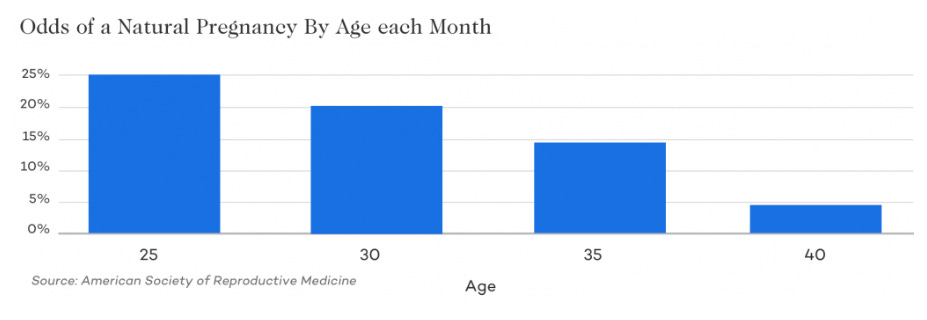
Over time, of course, the cumulative odds of pregnancy are high if couples consistently have unprotected sex. And to be clear, reversible contraceptive methods are indeed reversible. I’m not blaming contraception for the difficulties some women experience when they try to conceive later. While certain methods (Depo-Provera, for example) can take some time for fertility to return, the effects are temporary.
What isn’t reversible is age-related fertility decline. As women are encouraged to spend their most fertile years avoiding pregnancy, many reach their thirties and discover that conception is not as easy as they expected. In clinic, I sometimes hear comments that reveal how much control people think they have over the timing of pregnancy. For example:
“I want my baby to be born in October, so I’m going off birth control this month. If I don’t get pregnant right away, I’ll just go back on birth control and try again next year.”
Or:
“I want another baby, but I think I’ll wait five years before trying again.” (said by someone who was 35!)
These plans sound reasonable—but they assume that fertility behaves like a switch that can be turned on and off exactly when we want it to. Unfortunately, biology doesn’t really work that way, especially as we age.
See the post below for more on that topic!⬇️⬇️⬇️
Final Thoughts
I hope you have found this essay thought-provoking, whether or not you agree with it! Personally, I don’t feel that contraception is the best or the worst thing to happen to womankind. That doesn’t mean it’s not life-changingly wonderful for some women, or extremely detrimental for others. Most people will experience a mix of risks and benefits—and it’s up to each woman to weigh those for herself.
One last thought I want to leave you with: no one should feel obliged to use birth control because of a societal expectation to have sex. I’ve had this conversation with many women over the years: if the idea of having a baby with your partner horrifies you, that’s a pretty strong signal they might not be the right one—birth control or no birth control! And there are plenty of fun things you can do that don’t risk STIs or an unplanned pregnancy while feeling out the situation—like making out! Loved ’s take on this (see below).
A Moderate Midwife is a reader-supported publication. To receive new posts and support my work, consider becoming a free or paid subscriber.
If you’ve made it this far, thank you! I hope you enjoyed my take. Now I’m more than happy to hear yours! Any pros or cons I forgot to mention?
Comments
Nothing yet. Say the first thing.
Sign in to join the conversation.