
On a recent visit to El Salvador with my ELCA church—we’ve had a partnership there for fifteen years, and I’ve visited four times—I spoke with a Salvadoran friend who had recently welcomed a second child with his wife. With their first baby, his wife was informed by doctors that she was too estrecha—too narrow—to deliver vaginally.1 A C-section would be done instead without waiting for labor. During her second pregnancy, she was told she would need another cesarean because it was unsafe to give birth vaginally after a prior C-section.2
What saddened him most, he told me, was that they had always imagined having a larger family. Three or four children. But now the doctors were warning them against it. “Apparently it’s not really safe to have more than two C-sections. They told us three máximo,” he said, making a slashing gesture across his abdomen with his hands. “After that they’ll tie her tubes.” It was not presented as a choice.
This was not the first time I’d heard of the “three cesareans only” rule. Patients from Mexico and Nicaragua have told me the same thing, often coming to me 5 to 10 years after their repeat C-section and sterilization procedure, asking if there is any way to have another baby.3 In one case, a Puerto Rican woman in her 30s explained she was sterilized after her third C-section at age 17. A Mexican woman told me she didn’t want the sterilization but “her husband signed the papers anyway.” He was now her ex-husband, and she badly wanted a baby with a new partner. Another Mexican woman, struggling to get pregnant for 6 years, told me she thinks a sterilization was done with her C-section, but she doesn’t know for sure. “Is there any way to find out?” she asked.4
I felt a familiar rage rising in me as I heard my friend sadly lament the children he’d probably never have. But his wife was having a hard go of it, he explained. Recovering from this C-section was painful and difficult, and he didn’t know if it would be safe for her to go through it again. He’s not wrong to worry about his wife’s health, and it is reasonable that these concerns will change the trajectory of their childbearing future.
Maternal morbidity and mortality rises substantially with each subsequent cesarean.5 In under-resourced areas of Latin America, healthcare systems are understandably wary of the risk of an individual woman having too many C-sections. And even without coerced sterilization, many women who give birth by C-section will choose to avoid these risks by having fewer children.

If C-section Is Such A Big Reason For Fertility Decline, Why Doesn’t It Make The News?
Fertility decline in Latin America is obviously multi-factoral, but whenever economists and demographers talk about birth rates, they seem to focus on childlessness. Women are now more educated, empowered and “feminist,” causing them to forgo marriage and childbearing. Housing costs and a lack of good jobs make it hard to afford a family. Young people spend too much time on their smartphones—gambling or watching pornography—and are simply choosing this hedonistic lifestyle rather than marriage and family.
Perhaps these are the major factors in Western, wealthy nations. But based on my experiences in Latin America, and caring for immigrant patients from the region, the causes of their birth rate decline are quite different. This culture still values motherhood quite a bit: most women strongly desire and intend to be mothers, and many mothers want more than two children.
A larger portion of birth rate decline in this area is due to “child-fewer” rather than “childless” people. This was shown by Tyler Cowen in a recent paper about the sharp decline in fertility across Latin America (bolded parts, emphasis mine):
We show that the decline in period fertility between 2000 and 2022 is driven primarily by reductions in within-group birth rates rather than by changes in population composition, with the largest contributions coming from younger and less-educated women. Comparing the cohort born in the mid 1950s and the one born in the mid 1970s, we find that the decline in completed fertility reflects not only delayed childbearing but also substantial reductions in the average number of children per woman. This is driven primarily by lower fertility among mothers rather than by rising childlessness.
Demographer Lyman Stone acknowledged the effect of elective C-sections on completed fertility as well, showing that C-section prevalence had one of the strongest associations with fertility rates—larger than the effect of contraception use, wives’ control of their own health, or the country’s child mortality rate.
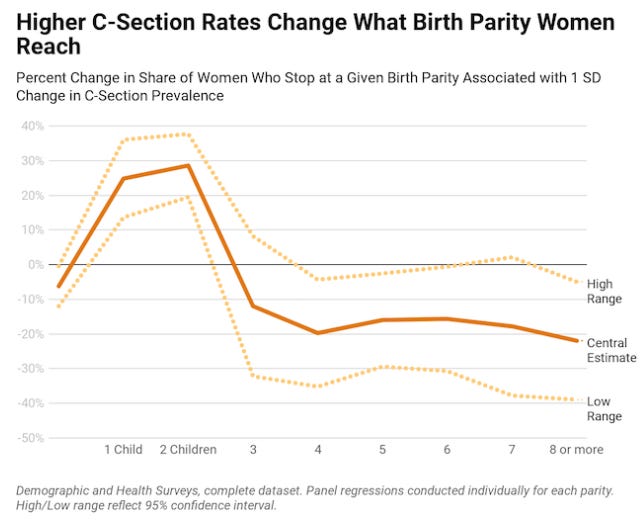
He summarized the above graph, saying:
As can be seen, higher rates of C-sections are associated with more women stopping at just 1 or 2 children, and fewer women having 3 or more births. This is, again, precisely in line with what we would expect if in fact C-sections cause women to avoid higher-parity births.
It simply must be the case that C-section overuse is shaping Latin America’s fertility in a way that many economists and demographers don’t seem to widely acknowledge—at least not to the point that they are advocating to address the injustice of non-medically indicated cesarean being forced upon Latina women.
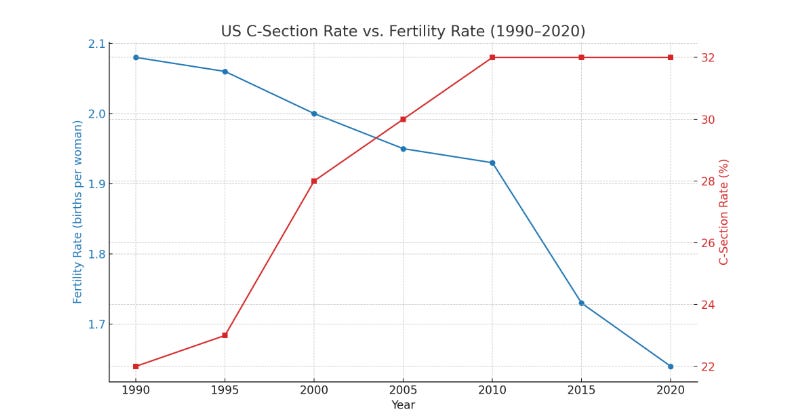
I strongly believe this factor is affecting the birth rate in the U.S. as well6 and there is obstetric data showing it.7 But if paternalistic attitudes in medicine and cesarean overuse are a problem in the U.S., they are far more deeply entrenched in Latin America.
Documenting The Rise in C-section Prevalence in Latin America
When I listened to Derek Thompson and demographer Jesús Fernández-Villaverde talk about fertility in Latin America, I kept waiting for this factor to come up—but it didn’t.
Thompson: Where is the most surprising fertility collapse in the world?
Fernandez-Villaverde: Latin America. If you ask which is the main continent right now undergoing an amazing demographic revolution in terms of fertility collapse that is not covered in the mainstream media, it’s Latin America.
Let me give my favorite example: Guatemala. I love Guatemala. I have many good friends from Guatemala. But Guatemala was not really a shining example of development in Central America. Around 2006 or 2007, I’m quoting from memory, Guatemala had a fertility rate of 3.9, basically the fertility rate of a Sub-Saharan African country. Last year, it was probably around 1.9, 1.8. The fact that in 20 years Guatemala has cut in half its total fertility rate is mind-blowing. At the current speed, Guatemala will have a lower fertility rate than non-Hispanic whites in five years.
But there is another major change unfolding in Guatemala: a rapid shift toward cesarean birth, which has risen dramatically over the last two decades. While elective cesarean delivery has long been common in private hospitals across Latin America, the trend is now extending into rural Indigenous communities as well.
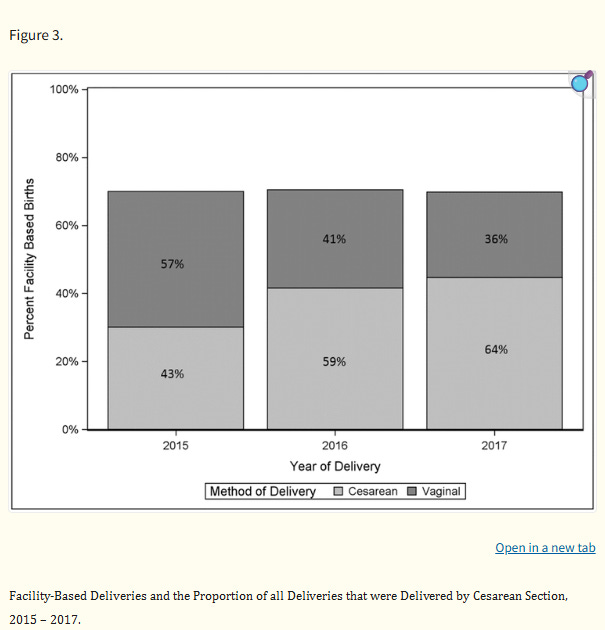
Nationally, Guatemala’s C-section rate was 11.9% in 2002 and had risen to 26% by 2015. More recent national statistics are difficult to find, but newer studies suggest the trend has spread to some rural populations. One recent journal article reported that 83 of 98 births (85%) at a hospital serving Indigenous Maya women in occurred by C-section. Larger regional datasets point in the same direction. A graph published in the journal article Trends in the mode of delivery of pregnant women in rural Guatemala from a Quality Improvement Database shows that from 2015 to 2017, the C-section rate went up substantially, starting at an already high 43% and increasing to 64% in just two years.
Obviously, if these additional C-section rates were substantially improving maternal or neonatal outcomes across the region, they might be easier to defend. But good evidence suggests otherwise. A analysis of global C-section rates which included 194 countries that belong to the World Health Organization (WHO) found no additional improvement in maternal or neonatal outcomes once C-section rates rise above 19%. And a separate study of severe maternal morbidity (hemorrhage, sepsis, blood transfusion, hysterectomy, etc.) in Latin America found that about 70% of cases involved a cesarean birth.
In spite of this, cesarean rates have climbed dramatically throughout the region over the last two decades, with several countries now reporting that more than half of all births occur by C-section. In Mexico, the national C-section rate rose from roughly 45% in 2010 to 55% in 2023. Brazil and the Dominican Republic have reported some of the highest rates in the world, both exceeding 55% nationally. In parts of the private healthcare system, the numbers are even more extreme: studies from Brazil have documented C-section rates above 80% in private hospitals.
In fact, the region has experienced the largest increase in cesarean use worldwide, increasing from 22.8% to 42.2% as of 2014. The WHO projects Latin America’s C-section rate will be 54% by 2030.
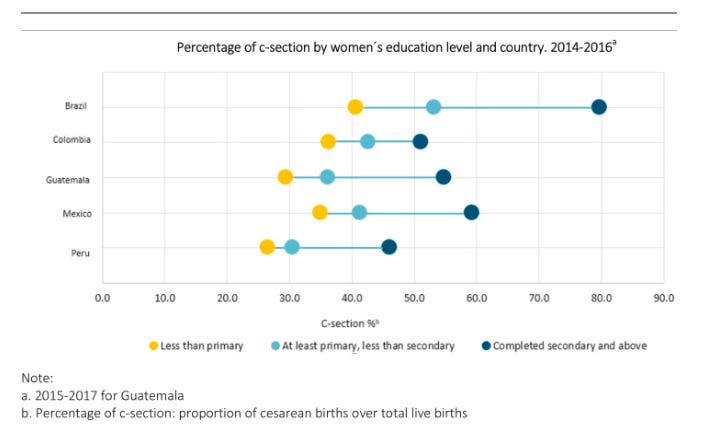
While C-section rates have always been higher among wealthier, more educated women in Latin America, who also tend to choose to have fewer children, the trend of elective C-section has spread to poorer women as well. Take a look at these stats from Cesarean sections and social inequalities in 305 cities of Latin America
But is this just what women in Latin America want?
Some might object to the idea that C-sections are contributing to low birth rates, arguing instead that the causation runs the other way: women who already want fewer children are more likely to choose a C-section, and perhaps a tubal sterilization after their first or second baby. There is some truth to this, and it may explain a small portion of the rise in cesareans, especially among higher-income women.
But through my work as a certified nurse-midwife (CNM) at a community health center (FQHC) in the U.S. serving many immigrants from Latin America, I see something quite different. The vast majority of the mothers I care for are simply grateful for the care they receive, both here and in their home countries. It does not occur to them to question what a trained doctor or midwife recommends. Their healthcare choices are limited to the local clinics and hospitals, and when those systems are nudging them toward a C-section, it becomes very difficult to say no.
And when women tell me the reasons they were given for cesareans—reasons that, frankly, would never be considered legitimate indications in the hospital setting where I attend births—they do so with a kind of acceptance:
“They only do births on Wednesdays.”
“The cord was around the baby’s neck on ultrasound.”
“I am too short.”
“I went past my due date.”
“My water was low.”
“My water broke.”
Furthermore, almost none of these women have access to epidural anesthesia while in labor in their home countries, meaning that they were often choosing between a C-section and an hours long, painful labor.
Do mothers know that they are sometimes being coerced into unnecessary surgeries? I suspect that some do. When asked the reason for her prior C-section, one woman rolled her eyes and told me, “Siempre hacen cesáreas en México. Pagan más.” (They always do C-sections in Mexico. They pay more.) Another women told me about leaving for a different hospital in the middle of her labor because the doctor, who wanted to go home, was trying to force her into a C-section. Another told me she crossed the border from Peru into Ecuador to give birth because she was being denied a chance at a vaginal birth after cesarean (VBAC).
Another reason I do not believe Latina women broadly “prefer” C-sections for cultural reasons is that, when offered the option, the majority of my patients who have had a C-section in another country choose to attempt a VBAC. This choice is highly associated with wanting future children, and with having them.8
One mother who had undergone a C-section in Mexico after being told she was “too narrow” to give birth, and her baby “too big,” gave birth to a second, 9-pound baby by VBAC. Afterward, she sighed and said to me, “I knew there was nothing wrong with me.”
Why Do I Care?
None of this means cesareans aren’t sometimes necessary. But C-section is a big deal—major surgery that can be both life-saving and life-threatening. It is also fertility-limiting. So when doctors, hospitals, or entire Latin American countries perform a large percentage of births by cesarean, it raises serious ethical questions about the normalization of a non-medically indicated procedure—and the impact that may have, intentionally or unintentionally, on a family’s ability to have the number of children they want.
The reasons for fertility decline that should concern us most are the ones causing people to have fewer children than they want. Over my career, I have known many women who ended up having fewer children because of cesareans, and some of these cesareans weren’t medically necessary. And frankly, even if fertility rates fall, I am far less troubled when that comes from free choice than from what I see among my patients: women whose backs are against the wall, unable or unwilling to risk another pregnancy because of the dangers another cesarean may pose.
We owe it to moms all over the world to care about this problem.
If you’re a regular “A Moderate Midwife” reader, you already know how I feel about telling someone prior to labor that their body is inadequate to give birth. It is complete B.S.
Attempting to have a vaginal birth after cesarean (VBAC) does have some risks, particularly uterine rupture during labor, which happens in 0.4-0.8% of labors after cesarean. It can be catastrophic, risking the life of mother and baby, so it is reasonable that an under-resourced hospital might not want to support it. At the same time, when VBAC occurs, it decreases maternal and neonatal morbidity and increases the chance of future births. Repeat C-section is associated with increased maternal morbidity and mortality compared to a VBAC attempt. Wrote about it for Emily Oster’s newsletter, Parent Data, here.
There is a way to get pregnant after you’ve had your tubes tied (egg extraction, IVF) but it is usually prohibitively expensive for my patients, the majority of whom are uninsured or on Medicaid (which does not cover fertility treatments). IVF is also less likely to result in successful live birth when someone has had a history of prior cesarean. On one occasion, a mom wanted it enough that she came up with the $30-60K needed and came back to see me pregnant!
It’s crazy to me that someone might “not know” if a sterilization procedure was done or not, but this reinforces the idea that these are likely being done through a dubious consent process. To answer this patient’s question, a hysterosalpingogram could identify if tubes were indeed removed or cut, but this is an elective procedure not covered by insurance, and is quite expensive for the uninsured, which most of my patients are.
I wrote this article for Scientific American addressing the need to hold doctors and hospitals accountable for non-evidence based cesarean.
I also wrote about the way I think C-section rates are affecting the birth rate in the U.S. several months ago:
C-section Overuse Is Suppressing the Birth Rate
·
June 27, 2025
Cultural and economic factors dominate the conversation about falling birth rates, and the potential solutions. I read a lot of fascinating, well-written, well-researched articles on this topic here on Substack by authors like Elissa Strauss, Lyman Stone
A recent AJOG article concluded the following:
First birth by cesarean delivery was associated with an 11% reduced likelihood of a second live birth within the 12-year study period and a 28% increase in the use of assisted reproductive technologies to achieve a second birth.
One large American population study called First birth Caesarean section and subsequent fertility: a population-based study in the USA, 2000–2008 reached a similar conclusion. Researchers followed more than 52,000 Pennsylvania women for nearly a decade after their first birth and found that women who delivered their first baby by C-section were significantly less likely to have another child than women who delivered vaginally, even after controlling for demographic factors and health conditions that would have made cesarean more likely.
Over an average of 8.5 years of follow-up, 40.2% of women with a Caesarean first birth did not have a subsequent live birth, compared with 33.1% of women with a vaginal first birth
No posts
Comments
Nothing yet. Say the first thing.
Sign in to join the conversation.