
Last spring, a mom walked into my clinic nine centimeters dilated and had a baby.
She’d had a few prenatal appointments with us but was new to the area and didn’t know where the hospital was. My medical assistant called 911 in an attempt to get her there, but the ambulance took too long. So she paced around an exam room until finally announcing “I have to push!” Then, she climbed up on the exam table and gave birth. It was really peaceful and uncomplicated—that is until the firefighters showed up in full gear and started excitedly throwing clamps and scissors at me and trying to separate the baby from the mom.
Apparently their one-hour training about how to attend births did not emphasize the importance of delayed cord clamping and skin-to-skin contact! From my perspective it was a perfect birth—she was very calm and intuitive about pushing, the baby came out breathing and crying, and the placenta delivered easily with no excess bleeding. It was funny to see that even a textbook normal birth can feel like a big, scary emergency to people who don’t see birth very often.
So, Are Humans Bad At Birth?
Well, clearly, the human described above was not. In fact, if everyone were as good at birth as her, I probably wouldn’t have a job.
But it would be disingenuous of me as a midwife to try to present this case as typical. I’ve watched humans give birth for twenty years, and over that time I’ve seen a mix of births, from “Whoops, I sneezed and gave birth in the toilet” to “It’s been three days of contractions! How can I only be 1 centimeter dilated?” There are really easy, uncomplicated births and really difficult, traumatic births—with most falling somewhere in between.
And over the years, I’ve asked myself questions like “Why is birth really easy for some people and really hard for other people?” and “Why did this person who I predicted would have a hard birth have an easy one?” and, alternatively, “Why did this person who should have had a really easy birth have a difficult one?”
On my worst shifts—when it’s 3 a.m., we’ve been pushing for 3 hours in every position other than standing on her head, and all I see is a tiny tuft of baby hair—I have even found myself asking “How could a birth canal this bad have been selected for over several thousand years of human evolution?”
Don’t worry—I never say these things out loud. That would be super discouraging.
The mystery of it all is honestly what I love about my job: it’s never boring and always keeps you on your toes. You try to recognize patterns, consider data, keep your biases in check, consider an individual mom’s priorities, and make the best recommendation possible with the information you have—while knowing full well that the person in front of you may surprise you and completely defy the statistics.
I may never have the answers I seek about why birth is so variable—but I do have a lot of guesses! I’ve been meaning to write a post exploring the evolution of human birth for a while, but it was going to require far more biological anthropology research than I realistically had time or brain power for given that I have a full-time job and am armed only with a BA in anthropology. Fortunately, Elena Bridgers did me a huge solid by researching and writing about it herself!
To summarize Elena’s article very briefly: she explores the evolutionary theories for why human birth is often difficult, painful, and dangerous. Of great interest to me, she critiques the famous “Obstetrical Dilemma” hypothesis—the idea that humans evolved a narrow pelvis for efficient upright walking while simultaneously evolving giant baby brains, leaving modern women tragically trying to squeeze enormous infants through inadequately sized holes.
This theory has absolutely permeated popular culture. I remember learning it in college anthropology classes, and it made its way into the obstetric textbooks we read in midwifery school as well. I’ve heard it mentioned in podcasts and science writing aimed at the general public, and a lot of people accept it as fact. As Elena points out, the field of medicine “seized on it with considerable enthusiasm.” In her words:
If the human birth canal is a structural compromise baked into our evolutionary architecture, the logic goes, then obstetric intervention is not an intrusion on a natural process but a brilliant correction to an evolutionary design flaw. The Obstetric Dilemma (OD) became, in other words, a justification — for inductions, for C-sections, for the entire apparatus of managed, medicalized birth.
Personally, the OD is one of my least favorite hypotheses because I see how badly it has hurt women. You have no idea how many moms I’ve met who had unnecessary C-sections because some doctor looked at them, decided they were too estrecho (narrow) to give birth vaginally, and coerced them into a C-section without even waiting for labor. This practice is absolutely common throughout Latin America, and I’ve known doctors in the U.S. who do it as well.
Women are told they are too short to give birth, too small, too old, too fat, too narrow. Their bodies are treated as inadequate before labor has even begun. Let me just say once and for all: this is BS. Before labor, you cannot reliably predict who is going to struggle to give birth.
Let me tell a story to try to bring this point home. I recently had a first-time mom ask me to check her cervix at a 40-wk prenatal visit. As I was doing it, I noticed something weird about her pelvis. The pubic symphysis felt like it was encroaching on the vaginal opening. The sitz bones seemed to jut inward, blocking the path of my fingers. It felt super crowded and narrow—alarmingly so. Not knowing what to say, I finished the exam, told her she was 1 centimeter dilated, and kept my mouth shut. But privately I was thinking: “Oh boy. How in the world is this person going to give birth vaginally?”
A week later I followed up and saw that one of my midwife coworkers had caught her baby: eight pounds, uncomplicated birth, pushed for one hour. I was shocked—and incredibly glad I’d kept my concerns to myself instead of saying something hurtful or discouraging about her ability to give birth.
Because despite twenty years of watching births, I cannot reliably predict who will give birth easily based on pelvic exams, body type, or height. So my guiding principle as a midwife is pretty simple: I assume that all moms are capable of giving birth vaginally. I cannot predict ahead of time what clinical circumstances may arise during labor, or whether a vaginal birth will ultimately be the safest option for her or her baby. But I do not assume there is some inherent flaw in her body before labor has even begun.
That doesn’t mean there aren’t trends! For example, tall women supposedly have an easier time giving birth than short women. But I have cared for tiny people who effortlessly delivered large babies, and tall, athletic people who still struggled through days of labor. Birth surprises me time and time again, and I’ve learned it doesn’t pay to stereotype moms or count them out.
This is why I’ve always had trouble accepting the Obstetrical Dilemma hypothesis. It relies heavily on skeletal measurements and interpretation of ancient fossils (sometimes not even accurately identifying male vs. female skeletons!)—as though birth outcomes can be predicted primarily by pelvic dimensions.
Obstetrics spent a long time thinking this way too. For decades, physicians performed pelvimetry: measuring women’s pelvises in an attempt to predict whether they could give birth vaginally. They even used to X-ray women in the middle of difficult labors! The problem is that it doesn’t work! The practice was abandoned because evidence suggests pelvimetry poorly predicts labor outcomes and may mostly increase cesarean rates without improving outcomes for babies.
Birth turns out to be far more dynamic and adaptable than a static set of bone measurements suggests. Pelvic diameters change with movement and position. The fetal head descends. Hormones loosen connective tissue late in pregnancy. The cervix softens, ripens, thins out, dilates over time (sometimes, a lot of time). The fetal skull molds during labor. Factors like psychological support in labor (aka “the doula effect”) also make a huge difference in the end outcome.
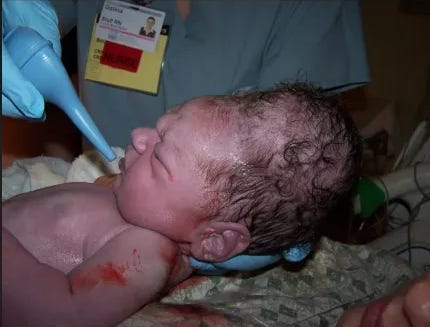
And then there’s the underappreciated factor that, in my experience, matters most of all: whether someone has given birth before. Human birth is often dramatically harder the first time, and I honestly do not think this fact gets enough attention.
I also think this has serious evolutionary implications. Let’s talk about that!
Human birth is harder the first time
I love birth stories, and because I’m a midwife, I’ve found that even complete strangers like to share them with me!
When it comes to describing their births, I hear a lot of people tell some version of this story: “My first birth was awful—long, painful, traumatic—because of X (hospital birth, epidural, bad nurse, not moving enough, etc.). Then my second birth was magical—short, uncomplicated, empowering—because of Y (birth center, midwife, doula, different positions, no epidural, etc.).”
And I’m not saying those factors didn’t matter! Environment, support, labor management, and birth setting can absolutely influence both the psychological experience of birth and the end outcome.
But (forgive me for being Captain Obvious): your second birth was also easier because it was your second birth!
These facts are well established. Labor is longer the first time and C-section rates are markedly higher for those who’ve never given birth vaginally before compared to those who have. Vacuum or forceps assisted birth is about 3 times more common and the chance of a 3rd or 4th degree perineal laceration is about 10 times higher for first time moms. Epidural use is more common because—duh—labor is a lot longer. Another fun fact: first time moms have longer gestations on average than women who have given birth before (40w5d vs. 40w0d) and are therefore more likely to have a postterm pregnancy and be induced.
Unsurprisingly then, serious complications for both moms and babies are also more common in first births. First-time moms are more likely to experience things like severe tearing, infection, hemorrhage, blood clots, or emergency interventions, and their babies are more likely to struggle during or immediately after birth. First babies have worse Apgar scores, are more likely to need resuscitation, to have a seizure, to suffer neurological or respiratory problems, and to experience birth injury or death.
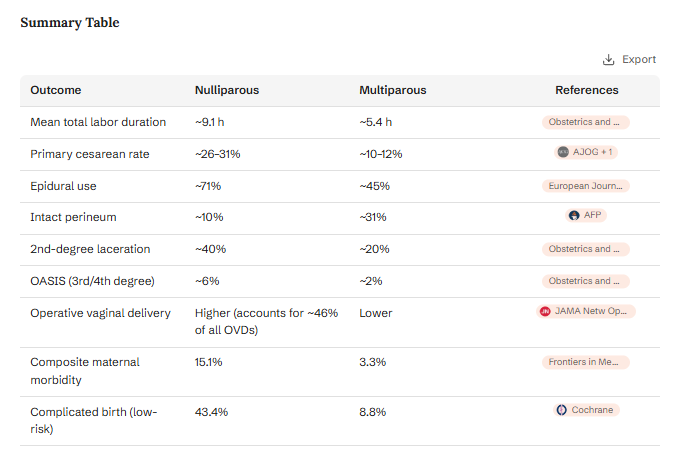
Why am I telling you all this? It’s not to scare you into never having a first baby. It’s to reinforce my previous point: birth difficulty cannot simply be explained by the size or shape of the bony pelvis. If it could, second and third births would not so consistently become easier. Clearly, something profound changes after the body has already given birth once: it’s the elasticity and tone of the pelvic floor muscles and the soft connective tissue of the cervix and vaginal canal. And this is great news!
So the caveat I would add to Elena’s title—”Your Body Didn’t Evolve To Give Birth Easily” is your body didn’t evolve to give birth easily the first time.
In my experience, almost every “easy” birth I’ve seen—the person who accidentally gives birth at home on the way to the hospital, the one who arrives in triage complete and ready to push, and yes, the mom from the opening story who gave birth at my clinic—has been a multip (someone who has given birth before).
This is so commonly understood in my field that we have a joking phrase for it when the board fills up with first-time moms: “death by primip.” It’s not that we don’t love these moms just as much, but we know their labors are going to last longer, and there’s a higher chance they’ll end up needing interventions (like Pitocin, epidurals, C-sections, vacuum or forceps). And before you accuse us hospital birth attendants of unnecessary intervention, I want to point out that this is true even for first-time moms who are committed to non-interventive births. Transfer rates to the hospital during home or birth center birth are markedly higher (30% vs 4%!) for first time moms, as shown by this study.
First births are harder, and this is a fact of nature that we just can’t wish or birth plan our way out of. Take it from me—I really wanted a nice, low intervention birth for my first. Here’s what I got instead:
Water broke at 40w2d. Labor didn’t start. “Natural” methods of inducing labor—pumping, castor oil—didn’t work (Zero stars. Do not recommend). Finally consented to Pitocin after 24 hours. Then had another 24 hours of contractions. Got stuck at 6 cm for 12 hours. Finally got an unplanned epidural. Dilated to 10 cm. Pushed for 3 hours. Begged for a vacuum. Had a vacuum assisted vaginal birth (40w4d, 48 h later). Got a 3rd-degree laceration. Baby weighed 9 lb 6 oz.
But don’t worry, it got easier!
Second birth: went into labor on my own at 41w1d. Woke up at 1 a.m. Went to the hospital at 6:30 a.m. Gave birth at 8 a.m. Did not use an epidural. Did not tear. Baby weighed 9 lb 6 oz.
Third birth: 41w2d, woke up with mild contractions at 5:30 a.m. Walked around my house for a while. Worst labor pain of my life at 11:50 a.m.. Had my husband drive me to the hospital. Begged him to run red lights. He said “but I don’t want to hit the pedestrians.” Begged him to run red lights anyway. Arrived at hospital. Told my midwife I needed to push. Had baby 16 minutes after arrival at 12:52 p.m. Baby weighed 10 lb 14 oz. Did not tear.
Do you see the point I’m trying to make? It’s not that the human female pelvis is somehow inherently “bad at birth.” If there were something fundamentally wrong with my anatomy, why would my second and third births have been so dramatically easier—even with a baby that was 1.5 lb bigger than my first?
Some people talk about difficult human births as if we’re the only species dealing with an evolutionary compromise. But humans aren’t alone: throughout the animal kingdom, many mammals experience higher rates of difficulty, stillbirth, or neonatal loss with first offspring—including cattle, horses, and some marine mammals such as dolphins.
When I was a high school student in rural Iowa, our anatomy teacher (who was also a farmer’s wife) took us out to watch one of their cows give birth. We stood there gawking at the poor animal for what felt like forever, only to see a small orb protruding the entire time. (In retrospect, maybe a crowd of awkward teenagers staring at her crotch was not especially conducive to physiologic labor.) We eventually gave up and left, only to learn the next day that the calf had been stillborn after a 24 hr labor.
And honestly, that memory stuck with me because it raises an uncomfortable possibility: maybe evolution never particularly cared whether first births were easy, as long as they worked often enough to allow future reproductive success.
From an evolutionary perspective, a human female’s first birth did not necessarily need to be smooth, fast, or empowering. It just needed to work often enough that most women survived to reproduce again, even if their first babies died or were injured during the process. For most of human history, losing a significant portion of your children was simply a fact of life. In many premodern populations, 30–50% of children died before age five. Maternal death was tragic but far less common by comparison; even estimates as high as a 1-in-150 lifetime risk mean the vast majority of women survived childbirth long enough to conceive again.
Maybe this theory is already out there, but if not, I hope some PhD student picks it up, figures out a way to test it, and names it after me.
Here’s the encouraging part: once someone has given birth vaginally, future births are much more likely to succeed. And that, more than pelvic measurements or fossilized hip bones, may tell us something important about how human reproduction actually evolved.
What We Misunderstand About Human Evolution
I am not an evolutionary biologist, and I don’t want to overstate my expertise here. But one thing I appreciated about Elena Bridgers’s essay is that she pushes back against the common tendency to think about evolution as some kind of refining process that has our best interest at heart, gradually producing perfectly optimized organisms.
Um, no—it produces a species that survives and reproduces well enough in a given environment, while giving little care about collateral damage. And because environments constantly change, what worked reasonably well for Homo sapiens thousands of years ago may not be perfectly suited to modern life.
So when people ask whether humans are “bad at birth,” I think they are often imagining that evolution should have produced a system where labor is always safe, efficient, and uncomplicated. In the promoters of physiologic labor camp (of which I consider myself part!) you’ll often hear statements like:
“You’ll never grow a baby too big for your body.”
“Your body won’t give you pain you can’t handle.”
“Your body is not a lemon.”
That last quote, famously said by the midwife Ina May Gaskin, is one I mostly agree with. As I stated above, women have been deeply harmed (and coerced into unnecessary interventions) by being told their bodies are defective, inadequate, or incapable of giving birth.
But I also think people sometimes swing too far in the opposite direction and start imagining that nature—or God, depending on your worldview—must have created a perfectly functioning birth process for mothers and babies where nothing ever goes wrong naturally—and anything bad that happens is somehow the “fault” of too much medical intervention. I already explored this, so I won’t go into it too much:
Hospital Birth Doesn't Have To Be Horrible
·
December 11, 2025
Hi friends! Before we begin, I want to confess something. This essay has been a work in progress since late last year, and my New Year’s resolution was to get it published in a mainstream media outlet. But here we are in December, and after pitching it in various forms to several places throughout the year, I still haven’t found home for it.
But, in fact, I have seen a baby grow too big for someone’s body. It’s called gestational diabetes, and it happens all the time. Turns out this much sugar was not available in our ancestral environment, is not particularly good for us, and increased rates of obesity and infant macrosomia are making childbirth harder. As the mother of three macrosomic infants (no, I did not have GDM), I can attest that it’s not the best way to get yourself an easy first birth.
Here’s another example. In a recent Substack note I said the following:
I was not trying to poke the bear, but many of the comments pushed back on this recommendation on the grounds that if vitamin K were really so important, surely babies would naturally have enough of it. After all, why would evolution—or God—design imperfect babies?
But newborn vitamin K deficiency is actually a pretty good example of how evolution works. Without vitamin K prophylaxis, a small percentage of babies will experience serious bleeding, including intracranial hemorrhage (about 1 in 59). Some of those babies will die or suffer permanent neurological injury. And yet apparently this problem was never severe or consistent enough to create strong evolutionary pressure for dramatically improved placental vitamin K transfer to the baby. There may even have been tradeoffs that selected against higher fetal vitamin K levels. Pregnancy is already a relatively hypercoagulable state, and vitamin K plays a central role in clotting. Perhaps substantially increasing transfer raised the risk of dangerous clots for the mother, fetus, or placenta. We do not really know.
What we do know is that natural selection has never meant “optimized for zero risk,” and evolution tolerates far more suffering, dysfunction, infant loss, and maternal injury than modern people are comfortable with. And when there’s a simple intervention to prevent suffering or death, most people are pretty comfortable saying “screw evolution.” They will give their baby the vitamin K shot, the vaccines, the antibiotics. They will accept the C-section, the blood transfusion, the magnesium sulfate. Very few people will willingly sign up to be the victim of natural selection when the bad outcome is staring them in the face.
But some of these bad outcomes—like intracranial bleeding due to inborn vitamin K deficiency—are relatively rare. Which means most people will never personally witness them. You can make the “wrong” decision and get away with it nearly all the time. And as humans, we are notoriously bad at intuitively weighing low-probability, high-consequence risks. We tend to reason from anecdotes, personal experience, ideology, or what feels emotionally salient to us—not from population-level probabilities.
As I see it, the challenge for modern humans is not deciding whether to trust nature or reject it. It is figuring out which aspects of our biology we can use to our advantage, which risks we are willing to tolerate, and which interventions meaningfully improve health and survival without creating larger harms in return. That requires humility about the strengths and weaknesses of our bodies, and the value of medical intervention.
What is my takeaway?
Long, difficult, exhausting (and usually first) labors may have always been part of normal human reproduction, but that doesn’t mean that women are “flawed.” Even difficult first births likely resulted in maternal survival and future reproduction, and that was enough for selection. Women are, afterall, tough. 💪

Human birth has always been a system shaped by tradeoffs rather than optimization, which is honestly what we’re left with today. Some risks are avoidable, some are rare, and some are newly relevant in modern (sugar-filled!) environments.
We have evolved highly sophisticated immune systems and reproductive systems. But we also live in a world where we can amplify those systems (think: vaccines), correct for their blind spots (think: vitamin K), and sometimes bypass their limits entirely (think: safe cesarean). Personally, I don’t see any conflict in appreciating that design while also choosing reasonable interventions. If anything, it feels like using what evolution—and God, if you’re a person of faith—gave us at its highest level. As humans we can use our ingenuity and prosocial nature to improve the world for ourselves, our children and our neighbors.
So the question isn’t whether we should accept or reject “the natural” but rather, how to make decisions in a system where neither nature nor intervention is perfectly safe, and where the best outcomes usually come from knowing how and when to take advantage of both.
I am curious how others navigate this question. How do you decide when to trust your body and when to trust intervention in making decisions for yourself or your children?
No posts
Comments
Nothing yet. Say the first thing.
Sign in to join the conversation.