
An Otherwise Beautiful Birth
At a recent birth, the nurses and I called for NICU staff to be present due to meconium fluid, as is our policy. It’s not an uncommon occurrence for a baby to poop prior to being born—it happens in about 1 in 7 births and is more common with longer gestations (>40 weeks pregnancy). However, in rare cases (~5% of infants with meconium fluid) it can be very dangerous, leading to meconium aspiration syndrome (MAS), which is life-threatening. I’ve seen it two or three times in my career, and it was scary enough to be fully on board with the plan to have extra personnel present to resuscitate and intubate a newborn baby if necessary.
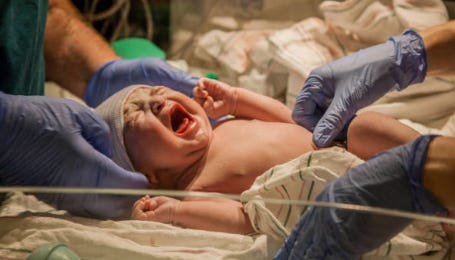
But in the vast majority of cases, babies born with meconium fluid are just fine. They come out breathing, crying, and reaching for their mothers like any other baby—which is exactly what happens in this birth:
As soon as I see that this baby is vigorous and transitioning well, I glance at the NICU team waiting by the warmer.
“Can we do a few minutes of delayed cord clamping?” I ask.
Delayed cord clamping improves newborn iron stores, lowers rates of infant anemia, and supports smoother cardiovascular transition. It should be an easy yes. Instead, I see eye rolls and impatient shifting. In their defense, they probably have a million other things to do right now, and my insistence on delayed cord clamping is putting them behind schedule.
“Ok fine. One minute,” someone says.
I place the baby on mom’s chest, skin-to-skin, and she immediately wraps her arms around him. This is my favorite moment in a birth. She needs this moment to process—to explore her baby’s tiny body and gorgeous face, to see the fruits of her labor.
“A MINUTE HAS PASSED,” someone calls out, interrupting the tranquil moment.
I sigh, clamp the cord, and hand the scissors to dad, who cuts. I explain to mom that the team wants to check the baby’s breathing just in case. Even though this assessment could almost always be done with the baby on her chest, that’s not how our NICU team works. And this mom, like 99% of moms, would agree to anything that medical staff presents as necessary for the good of her baby.
So she agrees and I pick up baby—totally fine-looking, pink, breathing and now crying because he’s been separated from his mom—and bring him to the warmer, where the NICU staff swoops in, and three sets of hands start poking and prodding.
I return to my tasks: delivering the placenta, making sure the bleeding is controlled, checking for tears. Ten minutes pass, and I noticed mom craning her neck, looking over at her baby longingly.
“Are you guys done?” I ask.
No response.
“Do you think she could get her baby back now?” I say louder.
“In a minute — we just want to weigh him,” someone replies.
I watch the nurses quickly trying to take care of their tasks—and they have many. In the 90–120 minutes between birth and transfer to the postpartum unit, they’re responsible for a long checklist: repeated vitals, measurements, medications, documentation. With so many tasks and limited time, the temptation to keep the baby at the warmer and finish everything at once is enormous.
In this case, I get frustrated when I see one nurse pull out a measuring tape to check the baby’s head circumference — a completely non-urgent activity — so I loudly interrupt, “HEY, CAN SHE PLEASE HAVE HER BABY BACK NOW!?” The nurse shoots me an annoyed look, sets the tape measure down, and reluctantly returns the baby to his mom.
Welcome to an American hospital birth, where even though the benefits of skin-to-skin and breastfeeding within the first hour of life are well known, systems are designed to make it difficult.
Why I’m Writing This Essay
Despite how bossy I sound in that story, confrontation doesn’t come naturally to me. I’m a people-pleaser by nature, and there are other times I stay quiet and go along with routines that I know make early breastfeeding less likely simply to keep the peace. But that’s the problem. A baby getting to spend the first hour(s) of life in his mother’s arms shouldn’t depend on me choosing to pick a fight.
Recently I read aelle’s practically fairytale account of giving birth in Germany, where she described “the systems that made breastfeeding an easy and soft choice.” In contrast, I want to walk you through the systems that make initiating and sustaining breastfeeding genuinely difficult in the setting of American maternity care!
I’ve been reading a lot of breastfeeding discourse lately, with takes from Elizabeth Grace Matthew, Elena Bridgers, Stephanie H. Murray, Emily A. Hancock and Kristin Lawless that I found fascinating and well-argued. And while I find points of agreement and disagreement across the spectrum, this essay isn’t about convincing anyone that breastfeeding is the “right” choice. Despite being a big fan of breastfeeding and a breastfeeder myself, I can accept without judgment a woman’s decision not to breastfeed for any number of reasons.
What I cannot stand is how often American maternity care undermines the efforts of women who really want to breastfeed.
So going along with Darby Saxbe’s recommendation in a recent post…
After twenty years working in four different hospitals — as a postpartum RN, labor and delivery RN, and now a midwife — I still see systems that separate mothers and babies without clear medical need, prioritize low-value tasks over breastfeeding support, lack meaningful lactation infrastructure and staff education, and promote policies that are not aligned with physiologic breastfeeding or the best available evidence.
Worst of all, when moms struggle with breastfeeding in part because of these policies, we frame their bottle feeding as a personal choice rather than the result of policies and procedures that actively undermine breastfeeding. Too many moms who really wanted to breastfeed leave the hospital already on the wrong path—without breastfeeding well established—and are therefore less likely to meet their breastfeeding goals.
So the purpose of this essay is to name the things I see getting in the way of early breastfeeding, but also to help parents understand the way hospital systems work, and what they can do to advocate for a better breastfeeding experience. In this essay, I will:
Name a common maternity care practice that makes breastfeeding difficult
Explain how and why it influences breastfeeding success, and what the alternatives are
Offer moms practical ideas to avoid letting these practices derail their breastfeeding experience
Let’s get started!
Common hospital practice: Maternal/infant separation at birth
I opened with this story because incidents like this are incredibly common. In an ideal world, a baby is born and placed directly on the mother’s chest for skin-to-skin contact. This should last at least the first hour of life, preferably two hours. I’ve worked at hospitals that were excellent at respecting this “golden hour” and others that were not.
Even in the case of cesarean birth, immediate skin-to-skin contact can sometimes be facilitated, though it does not appear to be routine practice in many settings. One online convenience sample—composed largely of white respondents—reported that 29.7% experienced skin-to-skin contact during cesarean, a figure I found surprisingly high. Because convenience samples often reflect the experiences of patients who feel more empowered to seek information, advocate for their preferences, or share their stories online, these findings probably don’t represent the broader population.
In my career, I recall one physician who was very on board with skin-to-skin during C-section. He ordered a special drape with a little window that allowed for easy passage of the baby between the surgical field and the mother. It was such a big deal that it made the news!
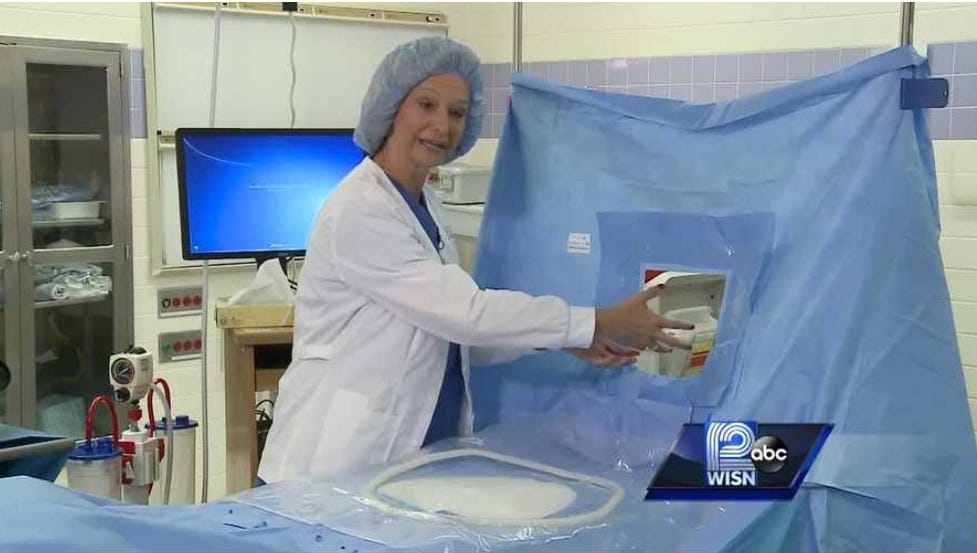
Given that lactogenesis II—when a woman’s body shifts from producing colostrum to larger volumes of mature milk—happens about 12-24 hours later on average when a baby is born by C-section, options like this seem really important!
Why does this matter? Right after birth, babies are biologically alert and highly responsive. They instinctively root, crawl toward the breast, and are often very good at latching on their own. But this alert period is fleeting — babies quickly become sleepy in the hours after birth. They go into a deep sleep about 2-3 hours of life and sometimes do not feed well until around 24 hours later. If separation occurs during the first two hours of life, the chance to establish a strong latch and robust early milk supply can be significantly reduced.
A recent Cochrane review called “Strong evidence supports skin-to-skin contact after birth as standard care” confirms this:
The findings show that mothers who have skin-to-skin contact with their babies in the first hour after birth are more likely to exclusively breastfeed for the first six months of the baby’s life. Exclusive breastfeeding brings many health benefits for mothers, babies and health systems.
The review found that about 75% of babies receiving early skin-to-skin contact were breast feeding exclusively at 1 month compared with 55% of babies in the groups that did not receive skin-to-skin contact. Newborns also benefit from more optimal sugar levels, body temperature, breathing and heart rate.
Despite guideline recommendations to initiate immediate, uninterrupted skin-to-skin contact until after the first breastfeeding, many health systems still separate mothers and infants during this period.
Sometimes babies do need special care or advanced resuscitation. Approximately 5% to 10% of newborn infants need help to begin breathing at birth, and of those, 1% need advanced resuscitative measures (like intubation). Babies that are born prematurely or low birth weight are the most likely to need extra help. But for the vast majority of babies that don’t fall into these categories, staying with mom is nearly always the best choice. Given this strong evidence, why are babies being separated?
The reasons are often complex. Hospital routines, staffing patterns, training traditions, and concerns about safety or liability can all shape how care is delivered in the first hour after birth. Assessments are frequently performed at a warmer because that is the longstanding workflow, even when many evaluations could safely be done on the mother’s chest during skin-to-skin and delayed cord clamping. While there are times when separation is medically necessary, for many healthy newborns it may happen more out of habit and system design than true clinical need.
What moms can do
If you want immediate skin-to-skin contact and delayed cord clamping, make your wishes clear early and often. While these practices are increasingly recognized as best standard of care for healthy newborns, stating that they matter to you helps your team understand your priorities and opens the door for shared decision-making if concerns arise.
If you are the birth plan writing type, make sure your desire for skin-to-skin and delayed cord clamping is well-documented. If you don’t have a birth plan, tell your nurse that this is important to you when you are first admitted to L&D. If you are told at any point in the labor or birth that complications have arisen (such as meconium fluid or concerning heart tones) tell your nurse that skin to skin is still important to you, and that you would like your baby to be evaluated on your abdomen for the first minute of life before a decision is made to take the baby to the warmer. This is reasonable in 90% of cases, and if staff feels strongly that it’s not a good idea, ask them to explain why.
Many newborn evaluations — listening to the heart and lungs, drying, stimulation, and observing tone and color — can be done while your baby remains with you.
In my experience, many babies who are taken to the warmer are healthy and don’t actually need separation. Being firm about your wishes — especially in borderline cases — can make a real difference. Having a doula or birth advocate present, such as a partner who understands your wishes, can help, too. Unfortunately, moms without advocates or with limited hospital knowledge are much more likely to be separated from their babies by default. I do my best to advocate for these families, but even experienced staff can struggle against systemic routines.
Common hospital practice: NICU admission
In the United States, about 1 in 10 newborns is admitted to the NICU. This care is often life-saving, allowing premature or critically ill infants to survive and later thrive — don’t get me wrong. But some of the statistics give me pause. For instance, admission rates for full-term infants vary five-fold depending on the hospital, according to the Dartmouth Atlas of Neonatal Intensive Care. Two babies with very similar health profiles might receive dramatically different levels of care solely based on where they are born. NICU admission rates, imaging practices, and intensive treatments differ widely across hospitals, and much of this variation cannot be explained by differences in newborn illness.
Nearly half of NICU admissions are for babies of normal birth weight, highlighting how expanded NICU capacity and hospital practices have shifted care patterns. While the NICU is critical for babies who truly need it, these statistics suggest that use of intensive care is not always driven by medical necessity. Hospitals now have more NICU beds and more low-risk babies are likely to be admitted, meaning that many otherwise healthy newborns experience separation from their mothers, exposure to highly medicalized routines, and, as research shows, a greater risk of interrupted breastfeeding.
In the case of premature or low birth weight infants, while necessary NICU care can be life-saving, unnecessary or prolonged NICU stays can be disruptive to the breastfeeding relationship. These are often the babies who could most benefit from breast milk, yet separation from the mother interferes with early breastfeeding establishment and the hormonal signals that drive milk production.
Research supports this concern. For example, a study in Colorado looked at late-preterm infants (34–36 weeks) and adjusted for maternal and infant characteristics to compare those who went to NICU versus stayed with their mothers. The researchers found that breastfeeding initiation was roughly the same between groups, but continuation at 10 weeks was significantly lower for the NICU group. Specifically, infants admitted to the NICU were 14% less likely to still be breastfeeding. This suggests that even when medical need is similar, the experience of being in the NICU can directly impact breastfeeding duration.
I find these results really unsurprising. While technically parents have 24-hour access to their babies in the NICU, I’ve seen firsthand that the rooms are small, not very private, and don’t have a bed for a parent to stay in overnight. In many cases, a mom is literally forced to be separated from her baby unless she chooses to spend the night in a chair, away from her partner or other children. After a difficult birth — or especially a C-section — this is not a real choice. I don’t mean to diminish the dedication of NICU staff, many of whom are compassionate and supportive, but it is clear that the medical team largely controls the decisions surrounding the baby, leaving parents with limited agency over early feeding and bonding.
These findings align with broader evidence showing that breastfeeding success is closely tied to early, frequent, and direct contact with the mother. When babies are separated or receive care that prioritizes medical routine over feeding cues, the breastfeeding relationship can be disrupted. In other words, the decision to admit a baby to the NICU has ripple effects on feeding, bonding, and long-term health outcomes.
Unfortunately some of this may come down to money. I don’t consider myself an expert on this topic, but I would encourage you to read Neel Shah, MD’s post called “Stuck in the NICU.“ To quote:
The NICU is among the most profitable units in the hospital. In contrast to labor and delivery, which is often treated as a loss leader, the NICU is widely regarded as a money machine. A single day can cost more than a weeklong stay at a luxury hotel, and it is not uncommon for premature infants to remain hospitalized for months, accruing medical bills that reach into the millions of dollars. Since 1995, the number of NICU beds in the United States has surged by more than 65 percent, even as birth rates have fallen and the share of premature births declined. Today, more babies are admitted to the NICU than ever before…Admission rates to the NICU for full term infants vary five-fold, and the criteria for getting to leave the NICU is highly subjective…
What moms can do
This is a tough one, and I want to be very clear: I am not advocating for ignoring medical recommendations. NICU care can be absolutely necessary, and sometimes hospitalization is critical for a baby’s safety. But in borderline cases, advocating for yourself and asking questions can make a meaningful difference.
In my own experience, my first child was born with a vacuum assist, so NICU staff were present. Years later, I learned that my L&D nurse—a friend and coworker—actually prevented my daughter from being taken to the NICU! They were concerned about a bruise on her head from the vacuum and recommended “observation.” But my friend firmly told them, “No, you cannot take Ann’s baby.”
I find this story funny now, but it illustrates how subjective some NICU decisions can be. There are plenty of borderline cases, and the more parents and their advocates ask for explanations, alternatives, and reasoning, the less likely they are to be pulled into unnecessary separation simply because of routine or convenience. In my daughter’s case, it was medically important to watch for any signs of intracranial hemorrhage due to the vacuum delivery, but she showed no signs of illness, and postpartum nurses were fully capable of monitoring her safely.
Beyond individual stories, there are proactive steps parents can take to maximize contact and support breastfeeding:
Rooming-in or kangaroo care (skin-to-skin) whenever medically feasible helps stabilize the baby and supports early milk production.
Ask early and often about feeding options, such as direct breastfeeding or expressing milk, instead of defaulting to formula.
Work with a lactation consultant — they can help set routines, monitor supply, and coach parents on overcoming challenges.
Communicate proactively with the care team about discharge goals. You may be told, “We don’t know yet,” but asking frequently signals that you are paying attention and motivated to reduce unnecessary separation.
In short, while NICU care is sometimes essential, knowledge, advocacy, and presence give parents more control over borderline situations and increase the chances of bonding and successful breastfeeding.
Oops: Once again, I have written a way longer post than I intended to
My New Year’s resolution was to keep my posts at ~1000 words to make them more reader friendly. HA! I am failing miserably. Even though I wanted to cover the additional practices below, I’m going to leave them for another day. Please comment on which of these you’d like to hear more about!
Common hospital practice: Strict warnings against co-sleeping and lack of accommodation to co-sleeping on hospital units (TBH I’ve already written about this here)
Common hospital practice: Under-resourced nursing and lactation departments, particularly understaffed on nights and weekends
Common hospital practice: Routine formula supplementation without medical need
Common hospital practice: Encouraging scheduled feedings rather than cue-based feeding
Or, if you have other questions or ideas about how healthcare professionals and parents can work to make maternity care better, please share in the comments!
No posts
Comments
Nothing yet. Say the first thing.
Sign in to join the conversation.