
Hi friends! Before we begin, I want to confess something. This essay has been a work in progress since late last year, and my New Year’s resolution was to get it published in a mainstream media outlet. But here we are in December, and after pitching it in various forms to several places throughout the year, I still haven’t found home for it.
It’s all good, though—now I have a Substack, so I can publish whatever I want and leave it un-paywalled just for you! If you want to thank me, please subscribe to A Moderate Midwife:
I have a day (and night!) job so you don’t have to get a paid subscription unless you want to.
I’m a little sad about all the rejections, though—because IMHO birth is a really important topic! It has been around through all presidential administrations, and even if media outlets need to prioritize other healthcare-related stories right now (as one editor told me), birth is not going away anytime soon. It affects a lot of people. We were all born. A good portion of the half of us who are female will give birth at some point. And nearly all of us care about someone who has, or will have a baby. Also, those babies matter, and the circumstances of their births have implications for the rest of their lives.
And for better or worse, 98% of births in the U.S. occur in the hospital. Let’s talk about that.
Hospital Birth Isn’t Perfect, But It Saves a Lot of Lives
As a birth junkie who follows a lot of home birth and birth center content, I think those settings can be wonderful for the right people, and I wish they were available to more families. At the same time, I’ve attended hundreds of beautiful births in the hospital, given birth to my own three kids there, and witnessed many moments when skilled teams literally saved the lives of moms and babies. I think some people are too quick to dismiss the value of hospital birth, wanting to throw the proverbial baby out with the bath water.
Natural birth advocates may also overestimate the percent of women who are truly good candidates for out-of-hospital birth—more on that later!
A common counter-argument to the idea that hospital birth saves lives is that hospitals themselves create the medical problems they claim to treat—that unnecessary interventions pile up, triggering what is often called the “cascade of interventions.” I don’t always disagree with that critique; I’ve made it myself more times than I can count, and there are plenty of things about hospital birth that frustrate me and absolutely need to change. Given some of my prior posts, you might think me an unlikely defender of hospital birth. Afterall, I’ve written that The C-section Rate Doesn’t Have To Be This High and suggested that You May Want To Give Birth Without An Epidural.
But I strongly believe that, when it comes to birth, there is something in between intervening too much and intervening too little. It is called: intervening the right amount.
That doesn’t mean it is always easy. There is gray area in maternity care decision making. Did inducing a 41 week pregnant mom prevent a stillbirth and save a baby’s life? Or did trying to force birth before the body was ready lead to prolonged labor, chorioamnionitis, compromised fetal heart tones, and an unnecessary C-section? We can never know for certain how any action—or inaction—would have changed the outcome. Birth isn’t a “choose your own adventure” book where we can go back and try again. None of us has a crystal ball; we’re all working with imperfect data and doing the best we can.
Still, the assumption held by some natural birth advocates—that any intervention in childbirth is inherently harmful, and that left to nature all would be fine except for in rare cases—is obviously wrong. Pregnancy and birth carry real, inherent risks, many of which can be mitigated through skilled midwifery and modern medicine. Helping one another through childbirth is a practice as old as humanity itself, and is probably one of the reasons our species has been so reproductively successful. In fact, UNESCO recognized midwifery on the Representative List of the Intangible Cultural Heritage of Humanity, noting that it is a global, universal tradition, present in every society throughout human history.
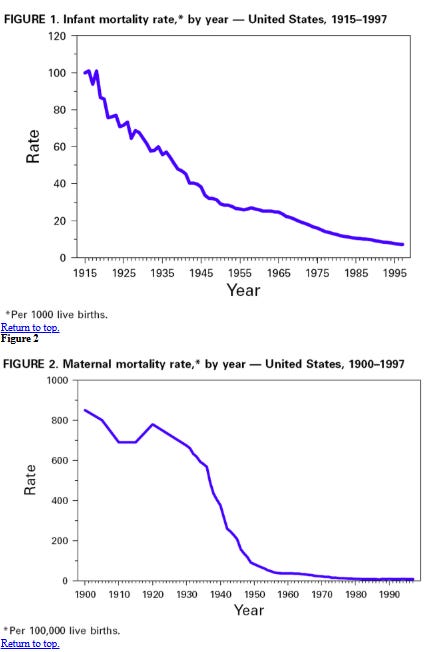
And medical advances during the 20th century, like antibiotics to treat infection, blood transfusion to treat hemorrhage, magnesium sulfate for preeclampsia (before it turns into seizures and strokes, aka eclampsia), and safer cesarean section have caused death rates for moms and babies to plummet even further. For proof, see below:
Let’s Talk About Medical Over-Intervention
Looking at Figure 2, are you wondering why maternal mortality went up instead of down in the 1920’s? The increase during that time was primarily due to inappropriate and excessive medical interventions as physicians moved childbirth out of the home and into the hospital. The problem wasn’t hospitals in themselves, but practices that were adopted by obstetricians without proper evidence—twilight sleep (scopolamine and morphine), routine use of episiotomy and forceps, manipulating the cervix, uterus or fetus during labor and poor hygiene. Doctors weren’t washing their hands and were going directly from dissecting cadavers during autopsy to attending births, causing high rates of sepsis.
At the same time, traditional midwives of the era were put out of business due to lobbying from physicians. Wanting to do away with the competition, these doctors argued to remove midwifery training programs and advocated for laws that took away midwives’ licenses to practice. This marks a big difference between U.S. medical culture—where midwives were shunned—and other places like the U.K. where they were embraced and integrated, a la “Call the Midwife.” To me, this is an important point: the best maternity care systems in the world have an intimate, respectful collaboration between midwives and physicians. Even in the U.S., states with the best outcomes have higher levels of midwifery integration.
While some births require a high level of intervention, most don’t—and being experts on normal birth, skilled midwives are well-equipped to recognize the difference.
Let’s Talk About Free Birth
In case you need further proof that intervention in childbirth isn’t always bad, recent reporting on free birth—childbirth without trained attendants—makes this painfully clear. An investigation by The Guardian looked at the Free Birth Society, a network that made millions of dollars promoting unassisted home birth, reporting on numerous cases in which women experienced stillbirths, neonatal deaths and severe maternal injuries.
For me, the most heartbreaking part of the article was the account of a 17-minute shoulder dystocia that left the baby with permanent brain damage. Three friends the mother had met through the Free Birth Society were present at the birth, but repeatedly told her, ‘the baby is safe,’ even as she asked for help, knowing her baby was stuck.
As a midwife, I’ve managed several shoulder dystocias and my longest was around 3 minutes, so the idea of watching one unfold for 17 minutes without acting is almost incomprehensible. Shoulder dystocia is a terrifying emergency that occurs in 1.4% of births and needs to be addressed immediately. Even with the best management possible, babies can sometimes be injured—broken clavicles, brachial plexus injuries—but the worst risk is brain damage from prolonged oxygen deprivation. That’s exactly what happened to the little boy in the article, who is now severely disabled, fed through a tube, and cannot walk at age 3.
Reading that part of the story made me physically ill, especially as I recalled the shoulder dystocia I experienced with my own third birth, which my midwife skillfully resolved in less than a minute. I feel awful for that mother. She asked for help and was ignored; the people present weren’t trained in anything other than an ideology of “baby is safe” even when the exact opposite was true.
Just yesterday, the Huffington Post shared more tragic news. A 30-year-old wellness influencer in Australia died of a postpartum hemorrhage after a free birth with only her husband and a doula present. By the time she was taken to the hospital, her blood supply was completely exhausted. When her husband announced the death on Instagram, he told his wife’s followers that she died of “unforeseen and extremely rare” complications. My heart goes out to this man for this terrible loss.
This tragedy also highlights an important fact: postpartum hemorrhage isn’t as rare as some people believe. It affects 3-4% of births and is the leading cause of death in childbirth worldwide. It is also very treatable with medications, hemorrhage control devices (Bakri balloon, Jada), blood transfusions and, in a worst case scenario, surgery such as hysterectomy.
Over my career, I’ve helped countless families give birth, and I can count on one hand the people who would truly reject medical intervention if it meant preventing avoidable tragedy for themselves or their babies. Every day, incidents like the ones mentioned above are prevented during hospital birth, and also during home birth or birth center birth with a skilled attendant.
Why Does Hospital Birth Get a Bad Rap?
Now that I’ve waxed poetic about hospital birth, let’s take a step back. Because there is some pretty good evidence that people are not happy with the state of hospital birth. For this essay, I’m mostly going to focus on the U.S., but I’m well aware that medical hierarchies, dehumanizing practices, and non-evidence-based maternity care exists all over the world.
A recent CDC report found that 1 in 5 mothers reports mistreatment during childbirth, a number that rises to 1 in 3 for people of color. Their most common complaints were:
Receiving no response to requests for help.
Being shouted at or scolded.
Not having their physical privacy protected.
Being threatened with withholding treatment or made to accept unwanted treatment.
Black mothers, in particular, face bleak statistics: they are more likely to be subjected to unnecessary cesareans, and many report racism within the medical system. It’s no surprise that Black moms are increasingly turning to midwifery care and out-of-hospital birth in search of more respect and better outcomes.
The idea that hospital birth is disempowering and traumatic is so widespread that it even became the punchline of a comedy sketch. On The Daily Show, after joking that she chose home birth because “I wanted to ruin my couch,” unpacks what women hate about hospital birth, stating “Whenever I talk to a woman who has given birth in a hospital, it’s almost always a horror story.”
She goes on to highlight the most common complaints about hospital birth: the loss of autonomy, profit-driven hospital policies, the prioritization of physician convenience over patient wishes, and the unjustifiably high C-section rates of many hospitals. Then she concludes that integrating midwifery care would be a great solution. Obviously, I agree! In fact, I wrote about it in You May Want To Give Birth With A Midwife!
But many medical professionals dismiss mothers’ dissatisfaction as naïve or unrealistic. On platforms like X, doctors mock birth plans, widening the gap between the care people want and what they receive. This dismissive attitude can contribute to situations of obstetric violence, where women’s autonomy is violated and their experiences become traumatic.
What some healthcare professionals fail to see is that the most essential intervention in pregnancy and childbirth isn’t a technology or procedure, but rather the presence of attentive, supportive caregivers. When this basic support is missing, it’s no wonder that mothers start looking for out-of-hospital alternatives. Modern medicine has introduced valuable interventions, but its reliance on technology, often at the expense of human connection, may be its biggest blind spot.
Faced with hospital bans on options like vaginal birth after cesarean (VBAC) and vaginal breech birth, which were once widely available in American hospitals, some people attempt these births at home despite the elevated risks, driven by a desire to avoid major surgery. Pregnant people wanting to avoid cesarean correctly assume that their chances are much better with home birth. Despite wide recognition that the C-section rate is too high, very little is done to hold the healthcare system accountable for unnecessary cesarean.
Even in our modern day, the evidence in favor of continuous labor support for improving birth outcomes is overwhelming. Yet this kind of support is shockingly rare during hospital birth.
Midwives, offering a lower-tech, higher-touch version of care, face barriers in U.S. hospitals due to discriminatory laws and policies. While midwives attend the majority of births in other countries, they assist in only 12% of U.S. births. Doulas, whose presence improves numerous birth outcomes, are used in only 6% of labors, mostly by those who can afford them. In some hospitals, staff view doulas as adversaries, undermining their support or even kicking them out of delivery rooms.
In theory, labor and delivery nurses are the ones providing support during hospital birth. In practice, hospital culture and policies prioritize unproven technology and efficiency over one-on-one care, as shown by recent New York Times reporting. The technologies involved with birth seem designed to help staff be anywhere but the patient’s room. Continuous electronic fetal monitors broadcast heart tones to the nurses’ station, and blood pressure cuffs can be programmed to go off automatically. Epidural anesthesia, while an incredibly useful tool for some laboring moms, can be pushed by overworked staff who know that people laboring with anesthesia require less in person support.
When I worked as a labor and delivery nurse, I often felt buried under tasks like tracking fetal heart tones, completing documentation, and making phone calls to doctors who were not present on the unit but expected to be called at exactly the right moment to attend the birth. These demands distracted from the person who mattered most—the laboring mother—and forced me to be less present to her.
In short, you do not have to work very hard to convince me that our current system of hospital birth is flawed. The question is, what should we do about it?
Is Home Birth a Way Out of the Horribleness of Hospital Birth?
The connection between dissatisfaction with hospital birth and the rise in home birth is rarely discussed, but it’s undeniable. For example, a Washington Post article profiling the deaths of several infants under the care of a certified professional midwife showed evidence that many mothers who were not good candidates for home birth chose it anyway due to their distrust of the medical system, or religious beliefs that kept them from accessing care. Similarly, Court TV’s coverage of the “Midwife Delivery Death Trial” revealed that a couple whose baby died of asphyxiation during a home birth chose this option with a non-credentialed midwife after being denied the option of a vaginal birth after cesarean (VBAC) at their local hospital.
If we want to reduce the risks of unsafe home births, we need to address the real problems driving people away from hospitals in the first place.
First off: I am not opposed to people who are good candidates choosing home birth or freestanding birth center birth (this is a facility apart from a hospital designed for low-risk birth, usually run by midwives). I hear a lot of great things! My sister-in-law had a very nice home birth, as did one of my best friends. Despite some of the horror stories published in the media, the home birth stories I hear are overwhelmingly positive. Beyond this, data shows that planned out-of-hospital birth with a skilled attendant is actually pretty safe. In fact, one could argue it’s safer for the mom by way of lower intervention rates, and perhaps a little bit less safe for the baby (depending what studies you chose to look at).
One of my favorite researchers, Elizabeth Nethery, did a fairly large study of home and birth center birth in Washington, a midwifery-friendly state where, in her words “midwifery practice and integration mirrors international settings.” Here were their outcomes:
Results: The study population included 10,609 births: 40.9% planned home and 59.1% planned birth center births. Intrapartum transfers to hospital were more frequent among nulliparous individuals (30.5%; 95% CI 29.2-31.9) than multiparous individuals (4.2%; 95% CI 3.6-4.6). The cesarean delivery rate was 11.4% (95% CI 10.2-12.3) in nulliparous individuals and 0.87% (95% CI 0.7-1.1) in multiparous individuals. The perinatal mortality rate after the onset of labor (intrapartum and neonatal deaths through 7 days) was 0.57 (95% CI 0.19-1.04) per 1,000 births. Rates for other adverse outcomes were also low. Compared with planned birth center births, planned home births had similar risks in crude and adjusted analyses.
Emphasis on C-section rates is mine. Can you believe how low they are? But when you look at who was included in the study, it kind of makes sense.
They excluded the following risk factors from their analysis. For reference, I researched the frequency of each thing in the general maternal population:
Pre-pregnancy diabetes (frequency: 0.5-2%)
Pre-pregnancy hypertension (frequency: 3-5%)
Twins (frequency: 3%)
Amniotic fluid abnormality—too much or too little (frequency: 10-15%)
Previous cesarean (frequency: 14.7%)
Gestational hypertension or preeclampsia (frequency: 8-16%)
Breech (frequency: 3-4%)
Labor at <37 wk (frequency: 10.5%)
Labor at >42 wk (frequency: 5-10% *higher rate found with older data, as routine induction at or before 41 wk has reduced the incidence of >42 week pregnancy)
I guess my point is, there are plenty of people who just aren’t great candidates for out-of-hospital birth! It’s also worth noting the transfer rate—30.5% of first-time mothers planning an out-of-hospital birth were transferred to the hospital. Some might see this as a ‘failed’ home birth, but I see it as evidence that the midwives involved were making safe, appropriate decisions—recognizing risk, staying within their scope, and transferring when necessary. Kudos to them. ✌️
While I support expanding options like home and birth-center births, we also need to be realistic about how many people they can safely serve. When you consider the risk-factor data, the high transfer rates for first time moms, and the fact that most laboring mothers choose epidural anesthesia (71%), it becomes clear that only about 20–30% of pregnant people are truly candidates for out-of-hospital birth.
Why Don’t Women Have More Options During Hospital Birth?
When my sister was pregnant with her first child, she specifically chose a hospital-based midwifery practice that offered water birth. At 38 weeks, her midwife gave her the disappointing news that the hospital had a new head obstetrician who had unilaterally banned water birth, going so far as to lock the portable tubs away in his office.
At the time I was a midwifery student, and it was one of my first glimpses into how power and policy—rather than evidence or patient preferences—often shape hospital birth. Since then, I’ve seen many more examples, such as an anesthesiologist blocking our unit’s efforts to introduce nitrous oxide, and patients who were decent candidates for breech vaginal birth or a VBAC being required to have a C-section.
The deeper issue is that healthcare is built on hierarchy, liability fears, and profit-driven motives. Many physicians practice the way they were taught, even when evidence shifts. Hospitals often adopt policies based on risk management rather than patient autonomy. And because physicians sit at the top of the hierarchy, their preferences—sometimes even personal biases—can override the options available to patients. Hospitals rely on physicians to generate revenue, and replacing a doctor is not always feasible—especially in areas already struggling with provider shortages. All of this makes meaningful change slow, even when everyone agrees patients deserve better options.
To complete the story, my sister went on to have two hospital water births later on with a group of certified nurse-midwives (CNMs) at a New Jersey hospital. I was there for the second one, and it was the first water birth I’ve ever witnessed. It was calm, intimate, and nothing like the impersonal experiences that drive some people away from the hospital. Two years later I was present in the same hospital when a medically necessary induction of labor probably saved my nephew’s life. During both births, my sister’s midwives and nurses never left her side, and obstetricians stood ready to intervene if needed.
At its best, this is what hospital birth can be: an experience that honors the incredible power of mothers while giving them access to life-saving modern medical care when needed.
Is Low Intervention Birth Possible in the Hospital?
The other day I was on call when a low-risk mom came into the hospital in labor. She didn’t have an IV, didn’t get an epidural, and I only checked her cervix once. Her water broke spontaneously, and she paced around the room until it was time to push. She pushed standing up, leaning over the bed. Once the baby was born, I passed her to the mom for immediate skin-to-skin contact and breastfeeding, and we waited several minutes before dad cut the cord. I recommended 10 milliunits of Pitocin injection to help prevent postpartum hemorrhage, and she agreed. The placenta delivered normally, and she did not tear or bleed heavily. Other than that single dose of Pitocin, she experienced no medications or interventions during her birth.
So, yes! This is possible. Why is it so rare? As discussed above, it’s complicated: it has to do with hospital policies, provider training and culture, patient preferences (like epidural), and legal/liability concerns.
How To Have The Most Beautiful Hospital Birth Possible
No one becomes a nurse, midwife, or doctor because they want to ruin your birth. The vast majority of maternity care workers are good people who want the best for moms and babies, but we’re still working within a flawed system.
I know everything I’ve written here might feel like whiplash: “So is this midwife saying hospital birth is good or bad?” Well, yes, I am! To make up for being totally confusing, I’m going to leave you with some ideas for how to work with the system to make your (hospital) birth as good as possible.
Research your hospital ahead of time: Not everyone can choose where they give birth, but if you can, it’s worth looking into which hospitals follow evidence-based practices. Hospitals are required to report their NTSV (nulliparous, term, singleton, vertex) C-section rates. Rates above 23.6% exceed the national benchmark, which may indicate higher-than-average intervention rates. Use this website to research your hospital
Birth plans vs. birth wishes: Please communicate what matters most to you during birth. Some providers may roll their eyes at a detailed birth plan—after all, birth is unpredictable, and you can’t control everything. That’s why I prefer thinking in terms of birth wishes. Share your priorities with your healthcare team: a calm atmosphere with dim lighting, minimal cervical checks, freedom to move during labor, and the ability to eat and drink are all reasonable in most circumstances. Honestly, I wish more parents would speak up, so I wouldn’t be alone in advocating for these preferences to the nurses!
Consider midwifery care, or at least giving birth in a hospital that has midwives: Midwives often focus on low-intervention, patient-centered care so having a midwife on your team can help you access evidence-based practices and advocate for your birth wishes. Even if you’re too high risk for midwifery care, studies show midwives influence the culture of a hospital, so giving birth at a hospital open to midwifery can still positively influence your birth.
Hire a doula: A trained labor support person can provide continuous emotional and physical support, help you communicate your preferences, and act as an extra advocate with hospital staff. Research shows doula support is associated with lower rates of interventions and higher satisfaction with the birth experience.
Thank you so much for sticking with me this far! I know this topic brings up a lot of strong opinions, and I’m happy to hear your thoughts and answer any questions in the comments.✌️💌👶
Comments
Nothing yet. Say the first thing.
Sign in to join the conversation.