
I was hoping to offer you an updated profile of artist Susan English this week, but we couldn’t quite coordinate in time. So instead I’m reposting a little esssay I wrote for a new online magazine, which asked me to ruminate on a favorite painting—in this case, Henri Matisse’s The Piano Lesson from 1916. It was such a fun exercise I may do this again in the future. I’ve been so miserably housebound since the onset of long Covid in 2023 that it’s a pleasure to revisit works I’ve loved, even if I can’t see them in person.
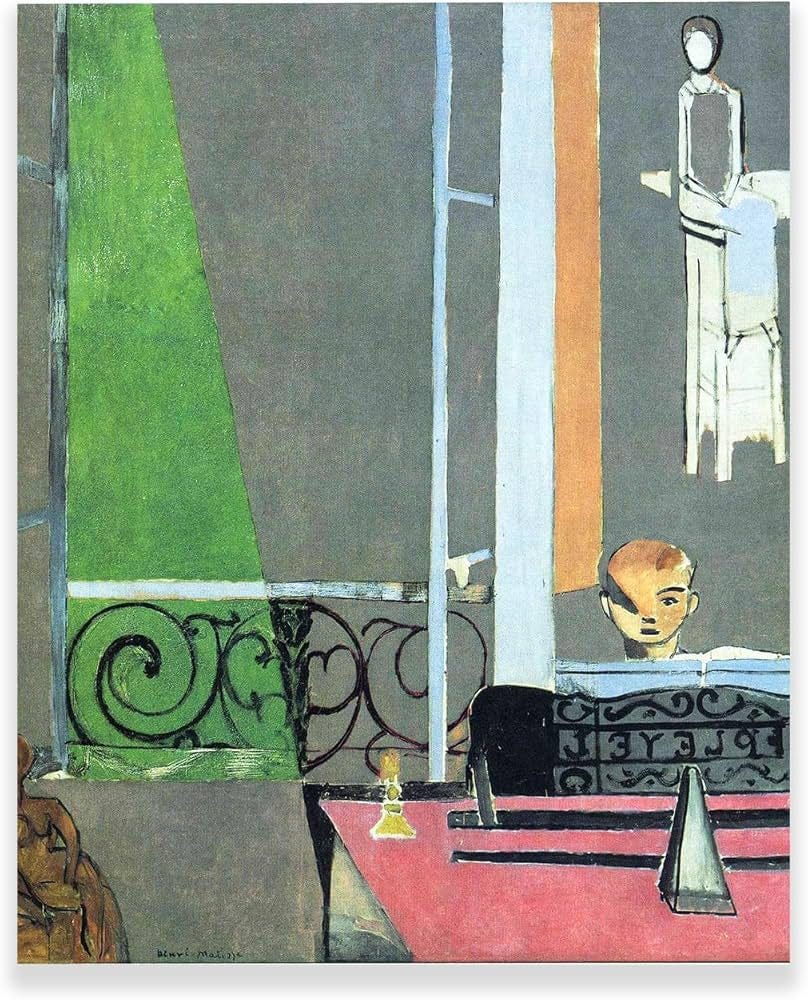
I first encountered Henri Matisse’s magisterial canvas The Piano Lesson in New York’s Museum of Modern Art when I was about 13 years old, a recent transplant to the city from suburbia and eager to soak up its cultural treasures. More obvious choices for a young teenager were Pavel Tchelitchew’s Hide and Seek, with its bloody tangle of children’s heads and hands, and Andrew Wyeth’s corny but haunting Christina’s World. But it’s the Matisse that has stayed with me over the years, and I revisit the work whenever I have the chance to hang out at MoMA.
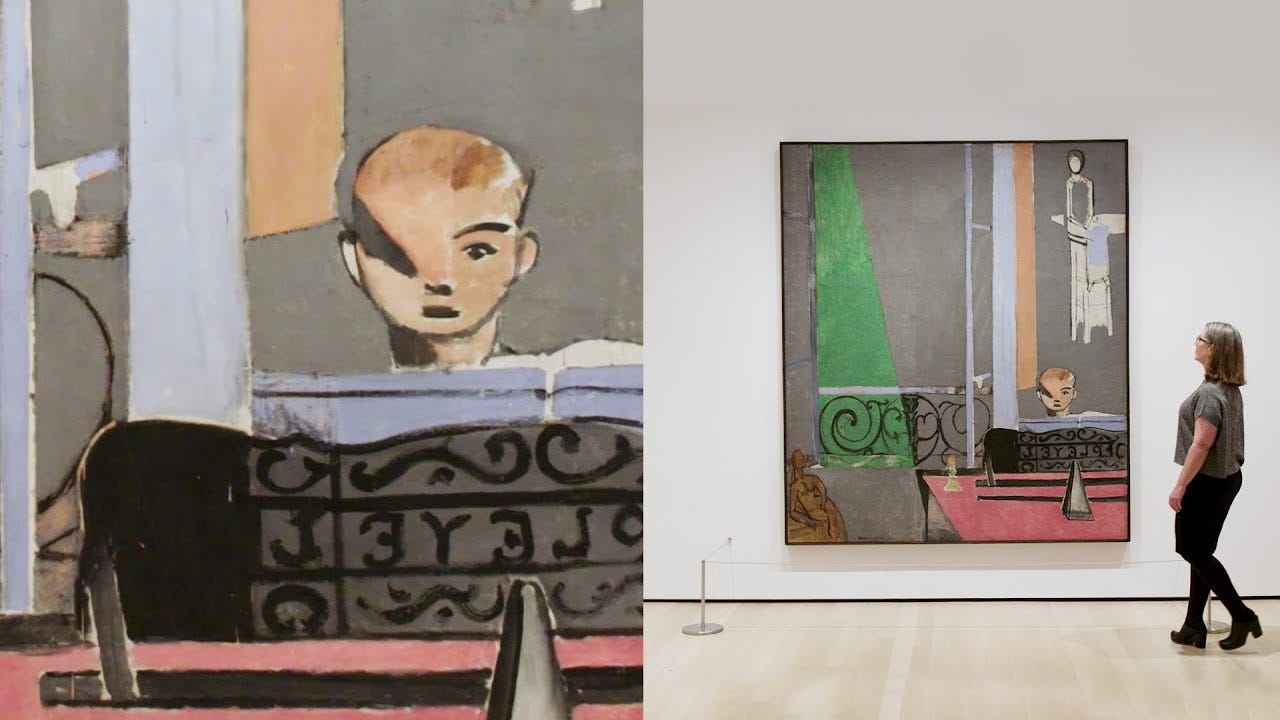
It’s a big painting, about eight by seven feet, and the composition is disarmingly simple. In the lower right quadrant, a boy practices his scales at a Pleyel piano (a popular accoutrement of bourgeois French life). His face is partially blocked by a trapezoidal shape that echoes the metronome on the piano and the huge swath of green that fills the left of the canvas. In the upper right is a ghostly female figure, based on one of Matisse’s earlier paintings, Woman on a High Stool. The lower left contains a replica of his sculpture Decorative Figure of 1908, “arguably the most sexual of his sculptures,” according to John Elderfield, a former curator at MoMA. So it’s easy to see the small boy as trapped between the forces of eros and the oversight of schoolmarmish figure behind him.
There’s a lot of backstory and critical discourse surrounding this work, which is so unlike the outpourings of joy generally associated with the artist. The model for the boy is a younger version of Matisse’s son Pierre, who was 16 at the time The Piano Lesson was painted. A musician himself, the artist “instituted a routine that began with his son rising daily at six to practice scales for two hours alone in the salon,” according to biographer Hilary Spurling in Matisse the Master. “Whenever the piano fell silent, as the child dozed off, he would be woken by thunderous knocking on the ceiling from his father upstairs in bed.”
At the time he painted The Piano Lesson, in the late summer of 1916, Matisse was 44 years old and secure in his reputation. As a leader of the Fauve movement in the early 1900s, he jumped to the forefront of modernist painting, supported by generous collectors and well-connected dealers. In The Piano Lesson, according to British critic Jonathan Jones, “Matisse paints the death of his own art. Soon afterwards he left Paris, settling in the south and not really making a comeback until the end of the 1920s.”
The predominant color in the painting is a scarcely inflected military gray, perhaps a reflection of the melancholy of a time when France was besieged by Germany in the First World War, when more than half a million were dead in 1916. Jones adds that the work was painted in the living room of the artist’s home, “a suburb of Paris that had transformed itself into a center for the military aviation industry, producing fighter planes; and the household was impoverished by the war, whose guns could actually be heard from the garden on quiet days.”
But the beauty of the painting for me is that what was really on Matisse’s mind—war, a farewell to Cubism, the pull between duty and pleasure—is still guesswork. It’s the extraordinary composition with its bold patches of raw color, knit together by the arabesques of the music stand and window grille, so much suggested rather than spelled out—that keeps me coming back time and again. The Piano Lesson just never gets old.
No posts
Comments
Nothing yet. Say the first thing.
Sign in to join the conversation.