
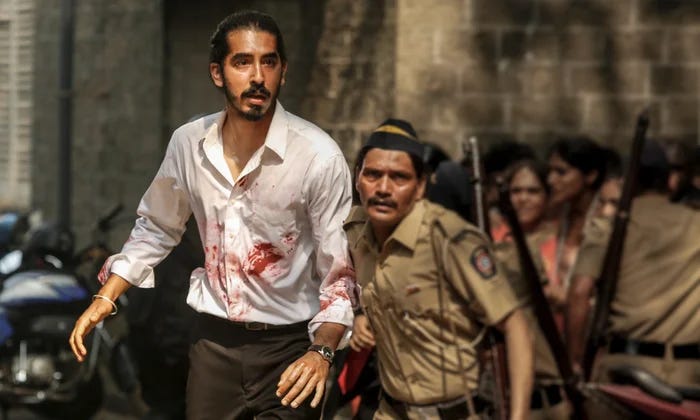
Like many people who live alone—or perhaps like many people, period—I am always looking for good movies and series in the vast sea of streaming slop on an unstoppable tsunami of platforms. So when Netflix flushed Hotel Mumbai into my panel of suggested viewing, I dived in, knowing upfront from the blurb that it was based on the real-life 2008 invasion by terrorists of a luxury hotel in India. I wish I hadn’t gone there. It was relentless pounding violence with enough cliff hangers to house a passel of big-horn sheep. But sucked in I was to the final white-knuckle scenes, not knowing who was going to emerge alive from the cliché-studded cast (beautiful Indian heiress, bigoted rich white lady, adorable fresh-faced nanny, jaded Russian mogul).
The plot is simply this: Terrorists from a group of militants known Lashkar-e-Taib mow down members of the hotel staff, mostly using machine guns, and then move on to a select group of guests, who are led to safety by noble self-sacrificing personnel, like the chef and a hapless kitchen worker who turns out to be a bumbling hero with a picture-perfect young wife and baby. Some make it out alive; some don’t. There was blood all over. I didn’t sleep well.
But I did start thinking the next day: Why is this movie so familiar? And I realized it reminded me of another film about a hotel under siege, Hotel Rwanda, released in 2004, in which the self-sacrificing staff, mainly the manager played by Don Cheadle, leads about 1500 people to safety within the precincts of an upscale resort. There was not as much blood, even though more people were murdered, and the film evinced considerably more pathos as it was about a senseless act of genocide that went largely unchecked by other countries. The plot was further enhanced by a noble US military commander and a heroic Red Cross worker. But it’s still a formula about a hotel as safe haven and people saved by resourceful, often underappreciated staff.
This example led me to consider other formulas. I have occasionally watched the much-acclaimed emergency-room drama The Pitt on HBO, but not a steady stream of it because there is so much gore. In fact, the story often seems like snippets about evolving characters and plot wedged between suppurating boils, amputated legs, deep head wounds, and the stereotypical life-saving tracheotomy—all of this accomplished with much poking of gloved fingers inside wounds and orifices that ooze bodily fluids. Yeah, yeah—I get the timeliness of themes that spike the series: the problems of health insurance, a mass shooting at a popular local event, the ICE incursion into a medical facility. And the characters have an admirable degree of angst-ridden complexity that sets them apart from most hospital dramas.

But still… the formula goes back to the original ER on television, which ran from 1994 to 2009, starring a young and jaw-droppingly handsome George Clooney. There are many of the same clichés: drugs filched by hospital staff, heart patients who require repeated CPR or shocking with paddles, the no-nonsense head nurse, little glimmers of romance among the staff but nothing too major. And it’s interesting to note that actor Noah Wyle, the edgy and imperious Dr. Robby of The Pitt, “played Dr. John Carter starting with the 1994 pilot episode of ER and became one of the show’s central stars for many seasons. In fact, he appeared in more episodes than any other major cast member,” says my ever-trusty ChatGPT.
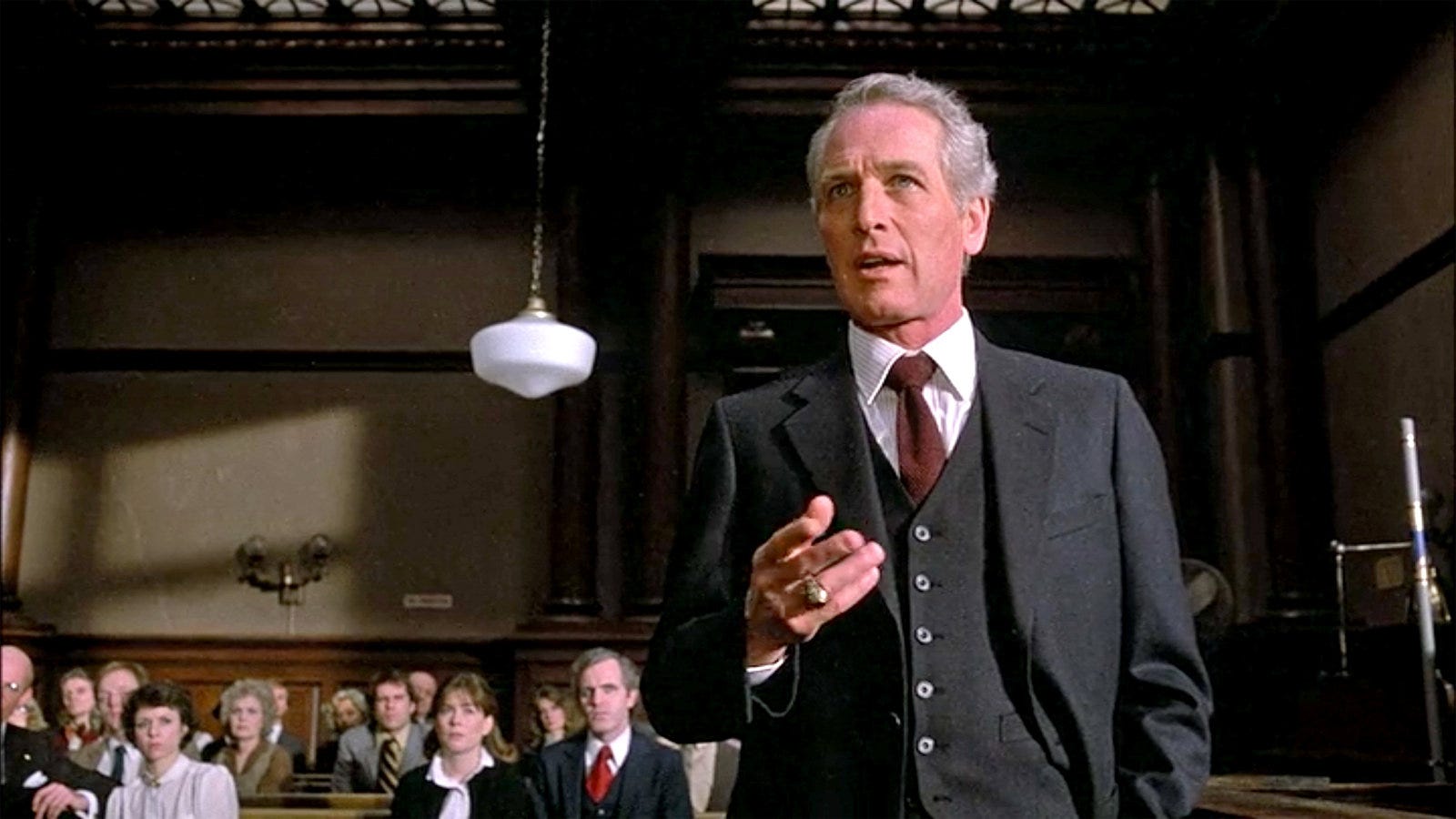
I was going to move on to talk about formulas in courtroom dramas beginning with The Verdict (1982), written by David Mamet and starring Paul Newman and James Mason. It’s still a truly gripping film and sets up many of the tropes for legal suspense films of the future: the down-and-out nearly washed-up hero (Newman) who goes up against the smug successful establishment figure (Mason). The blue-collar victims pitted against a secretive, uncaring medical establishment. A surprise twist at the end and a huge monetary award for the plaintiffs. There is much gavel pounding, useless expert witnesses, and, again, a little bit of romance, but only enough to grease the plot.
You get the idea, and once you spot the template, you’ll start taking notes as I did. There are rom-com formulas, Jane Austen period-drama formulas, the beleaguered rich white-lady formula, so ably sent up in a recent New Yorker “Shouts and Murmurs.” And formulas that evolve in virus-like ways, as HBO’s “White Lotus” gets channeled into the new Netflix “Beef” series.
We need formulas. They offer what one of my many shrinks called “the comfort of the familiar” to explain how people from abusive homes often get stuck in abusive relationships in adult life. Streaming networks like them because one good formula might spawn subsequent hits; viewers like them because we have a small inkling of what might happen but not enough to spoil our trip through known narrative terrain. And occasionally the formula is tweaked so brilliantly to reflect the zeitgeist—as in The Pitt—that it wins multiple awards and gets praised for its huge originality (which turns out not to be so original, but rather a matter of smart, enlightened updating, snazzy detailing on an old chassis).
If I had a literary background, I could write essays devoted to formula in fiction, but I am not that well-read, and this is a newsletter primarily for artists. The point I am making, in a chatty and roundabout way, is that formula is ubiquitous, but it’s a phenomenon that doesn’t work for inspired and dedicated visual artists.
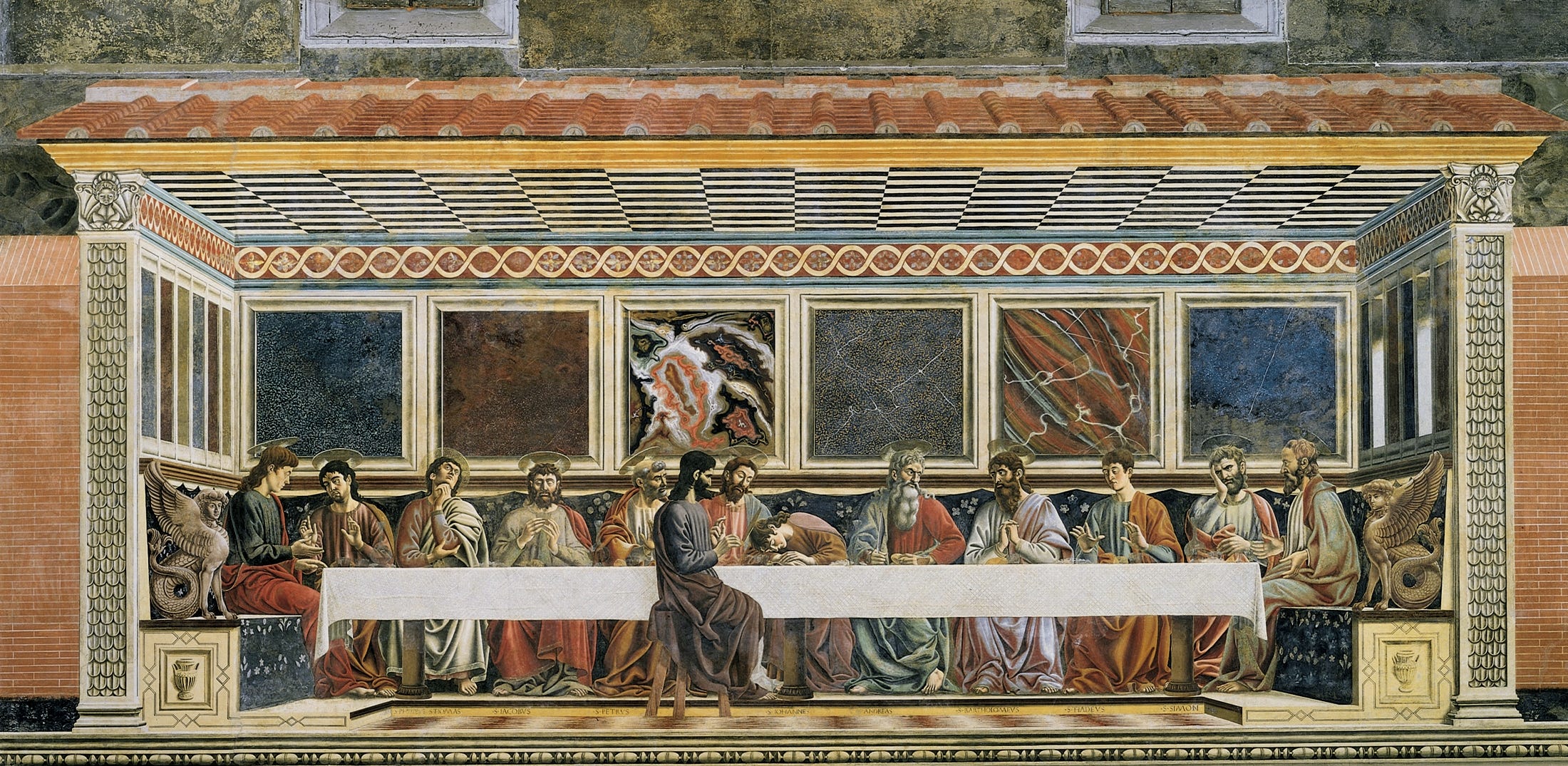
Yet for a long time in art history, this was not the case. Think of classical Greek sculpture—all those nearly identical Venuses, Athenas, Poseidons, et al. Or the scenes that evolved from the early through high Renaissance to promote the dogma of the Christian church: Madonnas with babies, sacra conversazione, the Nativity, the Crucifixion, the Annunciation, the Last Supper. Formulas repeated over and over, sometimes to a level of breathtaking genius in the hands of the great masters. This is what both patrons and audiences wanted in art for their palaces and churches. Even secular art was affected: consider the many reclining nudes, portraits, or mythological scenes commissioned by the nobility and wealthy classes. Mona Lisa, for instance, was a common type of three-quarter-length portrait, often framed against a landscape backdrop. And portraiture as a whole has formulas that repeat down through the ages: power portraits with armor and rearing steeds, court portraiture in formal dress (I’m thinking particularly of Holbein), family portraits with dogs and kids.
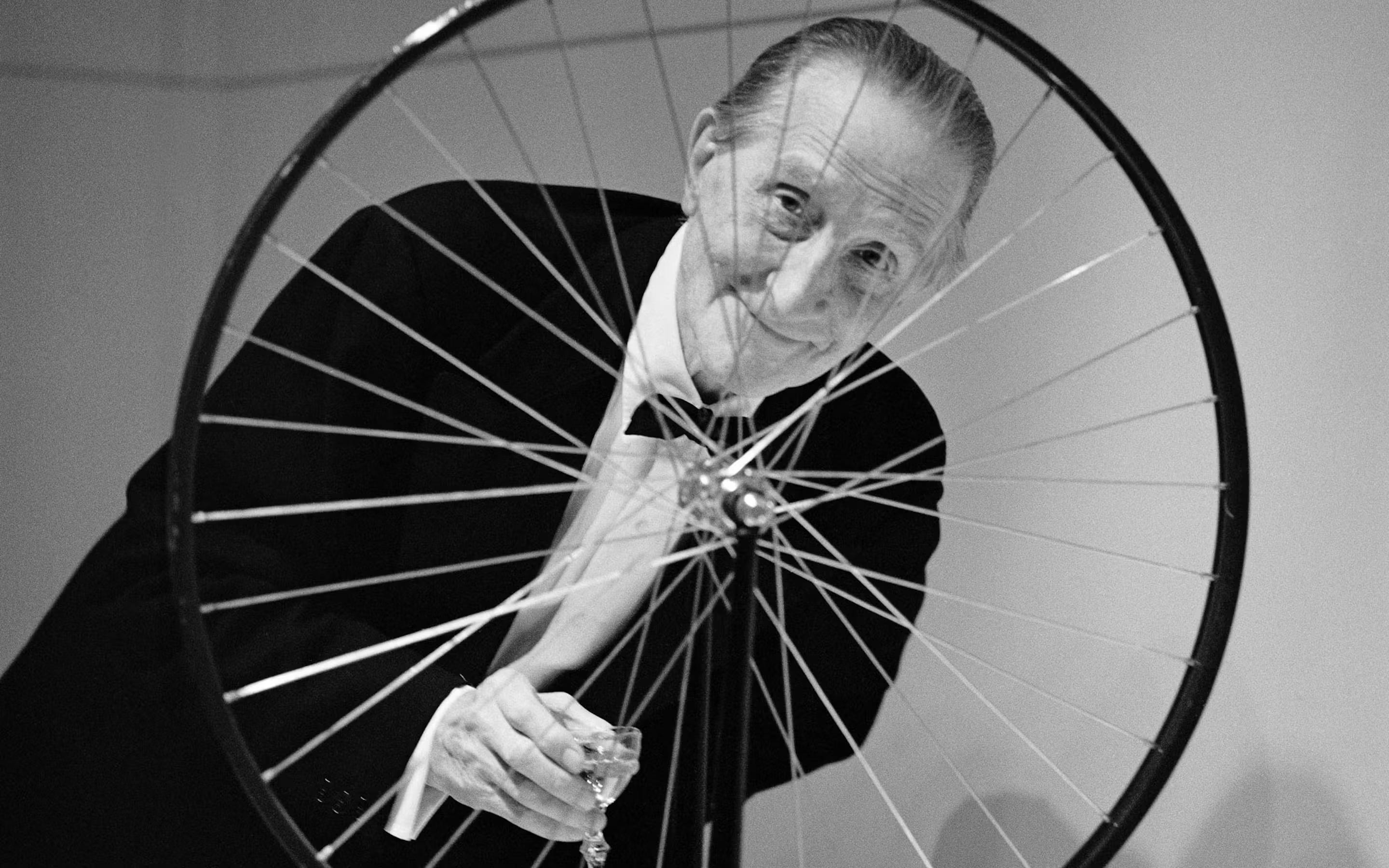
But formulas in art started to go all to hell when an avant-garde took root early in the 20th century. The Cubists tore up, sometimes literally, the notion of one-point perspective. The Fauves and Expressionists liberated color from reality. Kandinsky, Malevich, and Mondrian introduced total abstraction. And Duchamp thumbed his nose at just about every convention he could find. Originality, not formula, was what made for great art. But it’s very hard to overthrow the old order completely.
I have heard artist friends dismiss colleagues’ work with “Oh, she’s too derivative.” To which I often respond: Almost all art is derivative. It does not emerge out of a vacuum but carries hints of its forebears and builds new vocabularies on top of earlier traditions. Look around the examples of the American Abstract Artists show covered by Laurie Fendrich last week and you will see the shades of Mondrian, Vasarely, Agnes Martin, Stuart Davis, and on and on. There is nothing wrong with this, as long as it does not tip over into feeble imitation (I often see on Instagram, for instance, pastiches reminiscent of mid-century American artists—Joan Mitchell and Robert Motherwell are especially popular.)
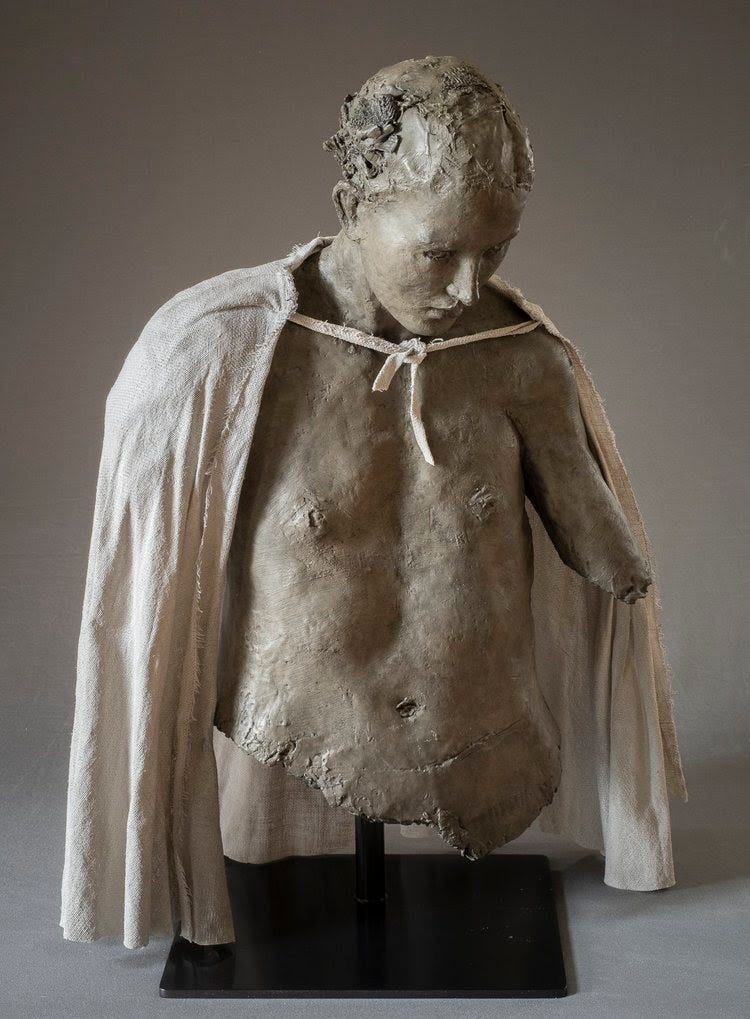
On Thursday April 23, three days before shipping out this newsletter, I happened to open a gallery invitation to a show of works by Nicolas Africano, and immediately thought of Rodin’s Age of Iron and Degas’ little ballerina with the fabric tutu. These are antecedents, not direct sources, and the work is affecting on its own and in no way screams piracy.
That said, it’s the most radical rule breakers who will probably go down as “great” in art history—Picasso, Rauschenberg, de Kooning, Nauman, Martin, Bourgeois, et al. At the end of his recent review of the Marcel Duchamp retrospective at MoMA, through August 22, Holland Cotter of The New York Times remarked: “he shook the foundations of culture in a way no other Western artist of his era did. I can’t remember a more conservative moment in our culture than the one we’re in now, in which ‘classical values’ [e.g. Trump’s aesthetic agenda] are, blatantly or obliquely, being so relentlessly asserted. We need foundation-shaking badly. ‘Marcel Duchamp’ is a timely reminder of what that can mean.”
Amen to that!
No posts
Comments
Nothing yet. Say the first thing.
Sign in to join the conversation.