
DPS chief moves to homeland security post after Senate leaves nomination unconfirmed for more than seven months
By Annie Dance | Cops & Congress | Reporting from Rutherfordton, NC
Gov. Josh Stein withdrew Jeffrey Smythe’s nomination to serve as secretary of the North Carolina Department of Public Safety on Monday, ending a seven-month confirmation standoff and moving Smythe into a new position as the governor’s senior adviser for homeland security.
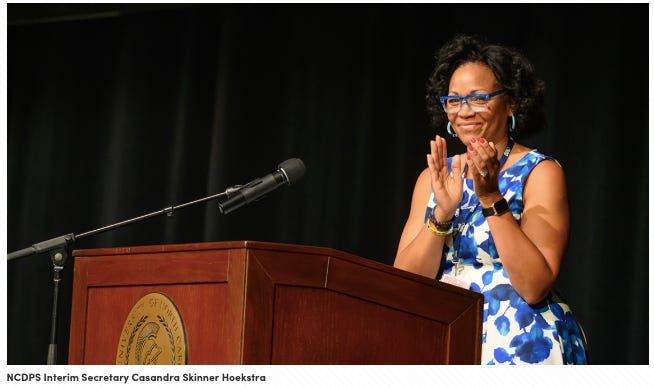
Stein also appointed DPS Chief of Staff Casandra Hoekstra to serve as interim secretary while he searches for a permanent replacement.
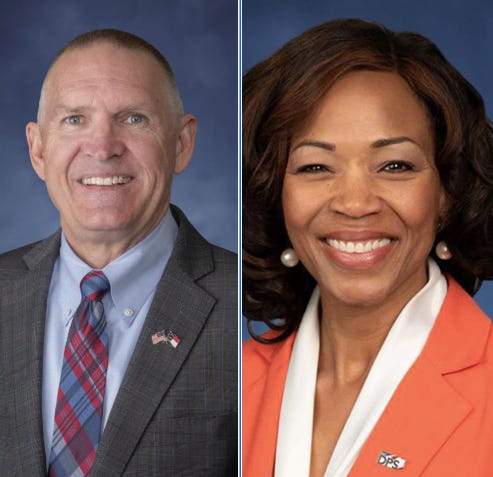
The announcement comes less than three weeks after a state audit found $97.3 million in financial-reporting errors and weaknesses in internal controls at DPS during Smythe’s tenure as secretary. Smythe said that the department was developing new procedures in response to the findings.
Smythe became secretary in January after Stein appointed him to replace retiring Secretary Eddie Buffaloe, who is now Deputy Chief for the Administrative Services Division at the Raleigh Police Department. Before taking over DPS, Smythe served as director of the North Carolina Criminal Justice Education and Training Standards Division and previously spent years as a police chief, including eight years leading the Burlington Police Department.
But his nomination quickly became politically contentious.
Senate scrutiny
Cops & Congress reported in June that lawmakers were scrutinizing Smythe over ethics questions, concerns about holding elected office while serving in state government and other issues surrounding his nomination.
Smythe was elected to the Burlington City Council in December 2025 while serving as director of the state’s Criminal Justice Standards Division. Burlington’s official biography identifies him as both a city council member and the state’s Criminal Justice Standards director.
The Senate never held a public confirmation hearing on Smythe’s nomination.
Stein sharply criticized that decision Monday.
“Yet by failing to consider his nomination or even hold a single public hearing, the Senate abdicated its responsibility, disrespected Jeff and law enforcement, and undermined the safety of the people of North Carolina,” Stein said. “Their failure to do their jobs is unacceptable.”
Rather than continue waiting for the Senate, Stein moved Smythe into the governor’s office.
“The people of North Carolina are safer when proven and talented public servants like Jeff are empowered to lead,” Stein said.
State Senate Judiciary Committee chairs, who are Republicans, Sen. Danny Britt, Sen. Warren Daniel and Sen. Buck Newton, said in a statement that it is their duty to advise and consent on nominations.
“When law enforcement officers across the state raised serious concerns about the nomination of Jeff Smythe, we advised Gov. Stein his choice didn’t have the votes. He chose to withdraw the nomination. It is our hope that Gov. Stein nominates someone who puts the safety of all North Carolinians first,” the Judiciary chairs reportedly wrote.
A different model of policing
Smythe’s record also made his nomination significant for North Carolina’s law enforcement community.
As Burlington police chief, Smythe promoted a policing model centered on de-escalation, reductions in use of force, officer intervention, implicit-bias initiatives and behavioral-health resources.
The state Department of Public Safety describes those initiatives as part of Smythe’s record as Burlington chief. The North Carolina Department of Justice likewise said Smythe implemented policies involving de-escalation, use-of-force reduction, duty to intervene, implicit bias and mental health and addiction support.
Burlington’s own police reform materials show Smythe’s department actively participated in the national debate over policing following the death of George Floyd in 2020. The department published responses to proposals including the “8 Can’t Wait” police reform campaign and other community demands for changes in policing.
That history is relevant to the political debate over Smythe because his approach has not been universally embraced by conservatives or law enforcement critics who favor a more traditional emphasis on enforcement.
His professional record, however, is also extensive. Smythe spent 35 years in law enforcement, including service with the Arizona State University and Scottsdale police departments, five years as chief in Show Low, Arizona, and eight years as Burlington’s police chief.
DPS under Smythe
Smythe’s brief tenure as secretary also coincided with significant operational challenges.
In July, Cops & Congress reported on a state auditor’s findings involving $97.3 million in financial-reporting errors at DPS. The audit identified weaknesses in the department’s internal controls, prompting Smythe to say the agency was developing new procedures.
The department also faces broader public-safety pressures involving recruitment and retention, jail overcrowding, mental-health crises and juvenile violence.
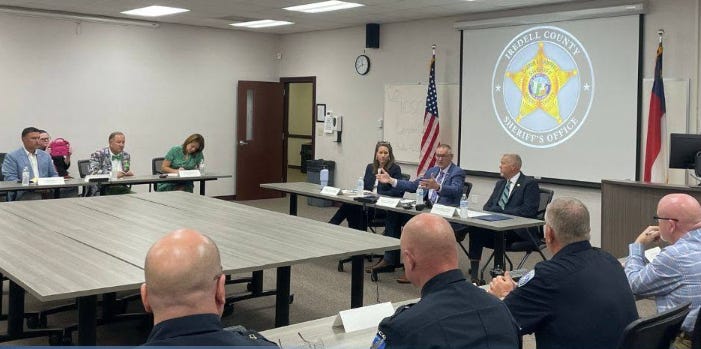
At an Aug. 6 public safety roundtable in Iredell County, Smythe and Department of Adult Correction Secretary Leslie Dismukes met with sheriffs, police chiefs, lawmakers and criminal-justice officials to discuss those issues.
Iredell County Sheriff Darren Campbell said agencies were struggling to compete with state departments for officers because of higher pay scales.
Jail capacity was another concern. Campbell said Iredell County’s detention population was averaging more than 550 inmates, while Dismukes said the state’s prison population was about 1,000 inmates higher than the same point the previous year.
The roundtable illustrated the type of statewide policy work Smythe will now continue from the governor’s office.
Hoekstra takes interim control
Hoekstra, an Asheville High School alumna who has served as DPS chief of staff since January 2025, will oversee the department during the search for a permanent secretary.
Her previous DPS experience includes serving as chief deputy secretary for eight years and as interim secretary and homeland security adviser in 2021.
She is an attorney who previously served as DPS general counsel and as legislative counsel for the North Carolina Association of County Commissioners.
Hoekstra has also been active in law enforcement training initiatives. Her recent work includes the department’s Helping Enhance Autism Response Training program, which trains officers and other first responders on interactions with people with autism.
The appointment gives Hoekstra responsibility for a department that oversees emergency management, adult corrections, juvenile justice and other major public-safety functions.
Smythe stays in the Stein administration
Smythe’s departure from the secretary’s position does not mean his departure from state government.
Instead, he will become Stein’s senior adviser for homeland security, giving the governor a way to retain Smythe’s law-enforcement and public-safety experience without requiring Senate confirmation to the cabinet post.
The move also removes an increasingly contentious confirmation fight from the Senate.
Stein said politics should not interfere with public safety.
“Politics should never get in the way of our work to create a safer, stronger North Carolina,” Stein said. “I certainly won’t let it.”
For North Carolina’s law enforcement community, the immediate question is no longer whether the Senate will confirm Smythe.
It is who Stein will select to permanently lead DPS — and whether the next nominee will face the same scrutiny over policing philosophy, ethics, management and the direction of the state’s largest public safety agency.
—
This newsletter is supported by readers like you. Paid subscribers have access to the full archive.
—
🏛️ All those mentioned are presumed innocent until proven guilty.
Learn more about this newsletter, ethics policy, how you can help shape this work, and support it. Follow on X and Facebook. Send constructive criticism, fan mail, and tips with public documents for future stories: CopsandCongress@gmail.com
Comments
Nothing yet. Say the first thing.
Sign in to join the conversation.