
We were in the middle of a lengthy stay in the Pacific Northwest. The Olympic Peninsula had been a long-time wished-for experience. Neither my husband nor myself are the type to check off boxes of NP visits (Mark likes to quote the adage about “making God laugh by making plans”), but we wanted to spend time among our nation’s most vast treasures. Thus, I started thinking about the long wait times for entry, fading paint on parks’ facilities, and of course the primary preservation of our country’s beauty many spent a lifetime protecting, as well as the jobs that protect and support those who protect and support.
Only two weeks ago, two US Forest Rangers were kidnapped and held hostage for nearly 15 hours in Shasta-Trinity National Forest in Northern California, by a deranged father and son, men known to the authorities. The rangers were eventually released. What might cause people to do such things?
I didn’t see that episode as vastly different from a president and administration that would choose to carve apart our national treasures, and yet spend $37.5 billion to bomb Iran. If there is one thing to be learned from the early literature of the United States, our national parks and wildlife refuges are worth saving, promoting, and investing in.
Many years ago, progress may have been framed in the shape of territorial grabs, but others saw how citizens would benefit from experiencing our great (public) lands and seas.
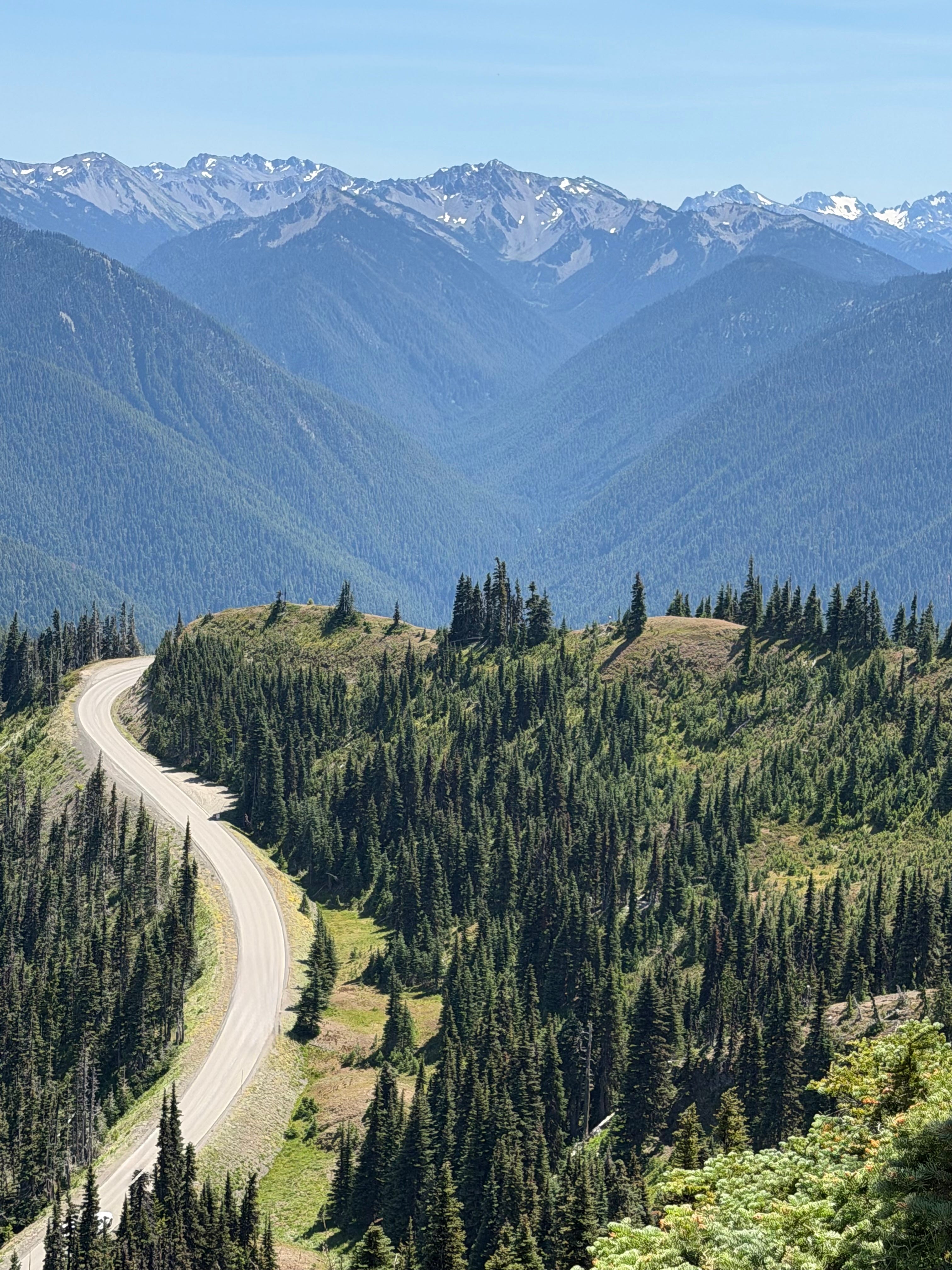
A country abounding in majestic mountains, deep, untrodden swamps, boundless prairies, and vast cataracts.” Washington Irving.
“The Air is delightfully temperate, and the Soil as rich as the Flood of Nile could make it... The River... forms a natural Cascade, which is a very agreeable Object to the Eye.” – William Byrd II.
“There is a delight in the hardy life of the open. There are no words that can tell the hidden spirit of the wilderness that can reveal its mystery, its melancholy and its charm. The nation behaves well if it treats the natural resources as assets which it must turn over to the next generation increased and not impaired in value. Conservation means development as much as it does protection.” - Teddy Roosevelt.
Early July, the president visited the new Theodore Roosevelt library in Medora, North Dakota, named thus for the formative years Roosevelt spent in the Badlands. I doubt any of the above quotes crossed the current president’s mind (“not impaired in value.”) Then he took a cringe-worthy railway ride, which his administration was all too happy to exploit for photo ops, but refused money for state or entities to build out trains if the states focus on the need for rail to mitigate climate change.
Ironically, the president was quick to embrace the cowboy mentality of a predecessor and quick to dismiss his environmental legacy. In conversing with a digital Roosevelt, the president remarked, “I had a conversation with Theodore Roosevelt: ‘What did you think about the Panama canal? Is that your greatest achievement? How do you feel about the fact that the Democrats gave the Panama canal away for one dollar to Panama?’” He moved on to mention his library in Miami someday.
I’m certain Roosevelt answered back with a question of his own. How do you feel about ripping apart my true legacy of our National Parklands? Oh, and let’s not even go there about the Endangered Species Act.
What kind of legacy might the current president have built should he have planned to refurbish our national parks and their reputation, instead of tearing them apart or bolstering his own pocketbook? Instead of spending on a war that has no purpose—nor end.
Roosevelt eventually took the advice of naturalist William Finley and created national wildlife refuges along the Oregon coast (the first west of the Mississippi), known as the Oregon Coast Islands National Wildlife Refuge, thereby protecting one particular corner of my world in Oceanside, Oregon, the Three Arch Rocks, and the numerous sea birds that make themselves at home.
We learn so much about ourselves by witnessing sea animals, their way of life, but also, by patience. Bird watching is a lot like orca watching as we experienced later in the week. Each task required a fair amount of patience to not only spot what you’re looking for, or not looking for, but also learning what is required of you, as a person, to not trample in order to observe. This is how we learn to care for one another too. This is how we stand, in all our endings.
Only thirty states contain one of sixty-three specifically designated National Parks (which makes it easy for those who are ticking off boxes on their list). Combined, there are 400+ national properties of monuments and refuges, etc. What kind of legacy could one leave for a state like Alabama or Iowa, to forge a national wonder from of their land? Wouldn’t that lead to less overcrowding and more “pursuit of happiness” for all? And wouldn’t that have been the kind of legacy one might have built for America’s 250th?
In previous budget cuts, the administration enacted reorganizations, terminations and hiring freezes, leading to a 25% reduction of the National Park’s permanent workforce. So many jobs were lost in service. So many trails now overgrown. When the people that are looked upon as leaders eviscerate National Parks with their contempt for the law, for others, for our precious land, or for something that doesn’t make them money (because money doesn’t grow on trees), others are soon to follow.
Thankfully, many of the National Wildlife Refuges along the Oregon Coast exist among a caring community that will preserve these vestiges of another time.
And speaking of caring for one another….
*
I love the concept of nurse logs—fallen, decomposing trees that become little mini nurseries for other plants and trees. Moss and fungi grow on this decay, and in turn, provide a cozy mattress for any new seeds to take root. As these root into, and around, the rotting log, lengthy trunks develop along the horizontal bed into a lineup that resembles the von Trapp children proudly singing in Salzburg.
I never knew nurse log was the term scientists and nature lovers and even regular human beings utilize to describe these phenomena
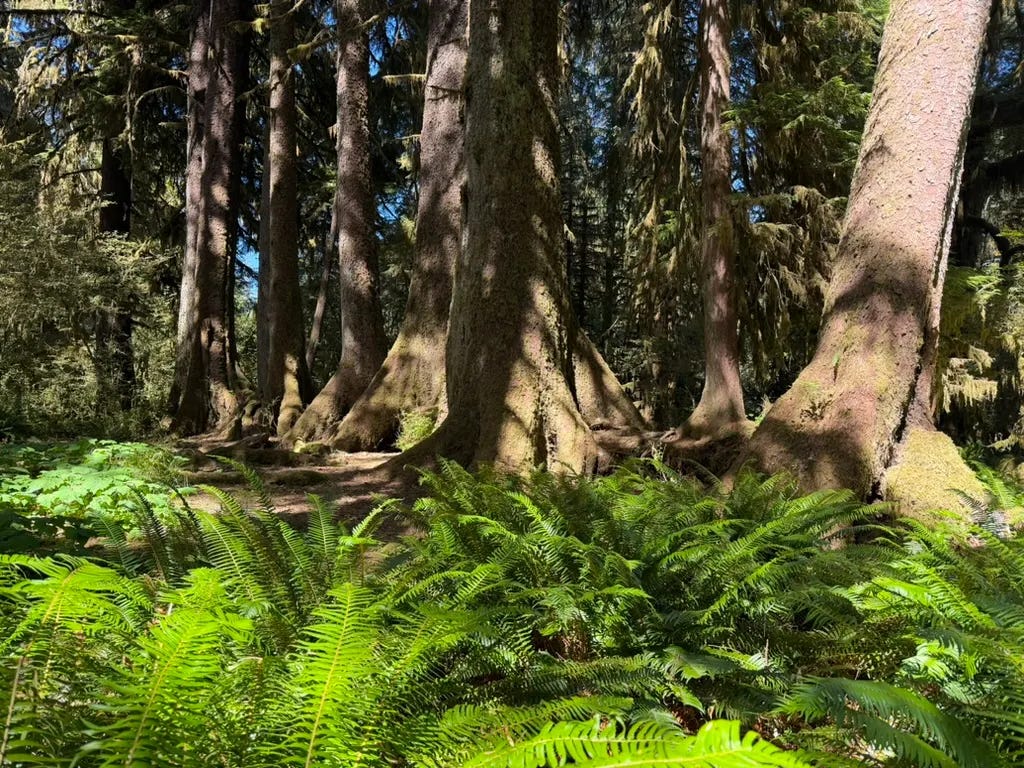
.At one point in our Olympic Peninsula hike in the Hoh Rainforest, we discovered five trees in a row, grown up from a nurse log. An entire family of them. They are awe-inspiring. My husband, the more artistic of the two of us (my focus is food and words), conjured a few new art projects for himself based on the nurse log and his knowledge of bonsai and terrariums. Turns out, nurse logs not only support life in the forest, but life inside each of us too.
For the remainder of our hikes, I never stopped gazing at a decaying tree in the same respectful way.
*
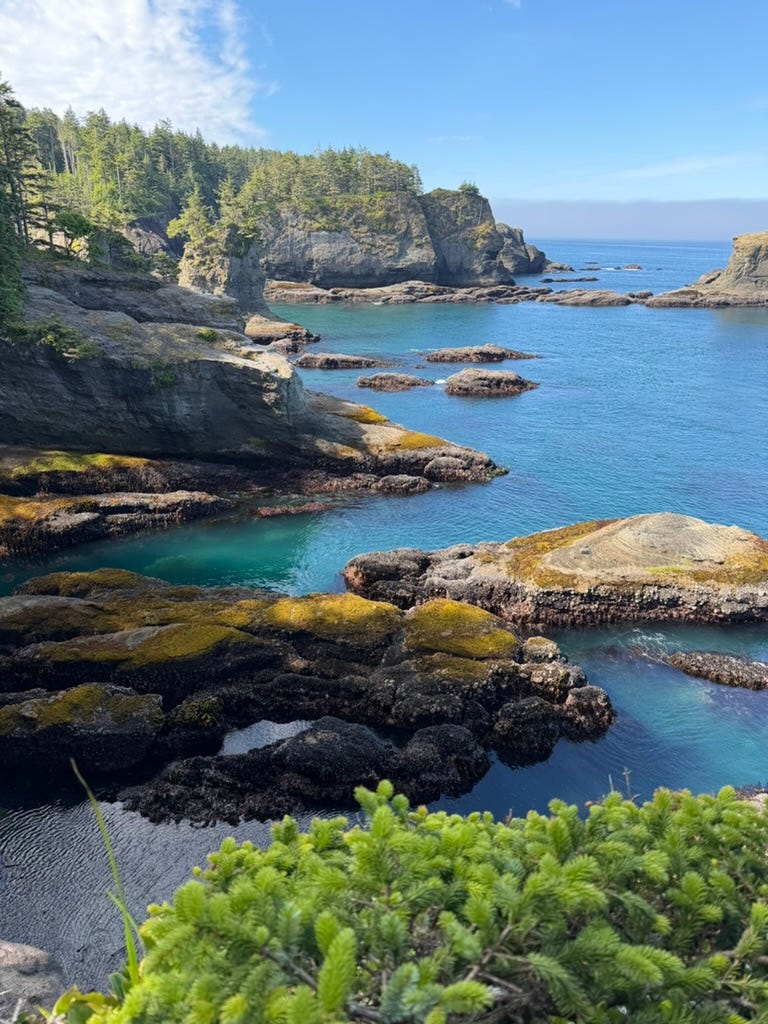
There really wasn’t a moment of time (other than inland Portland to see our granddaughter) when we weren’t within reach of water. Hiking around mountain-fed streams and lakes, kayaking on Lake Quinault (the lodge needs some work, Feds), discovering the most northwestern point of the U.S., Cape Flattery (“flattery” will get you only so far in the PNW), to physically see the angles of water, to sense the boundary not created by land. Where does the separateness lie between the known and unknown?
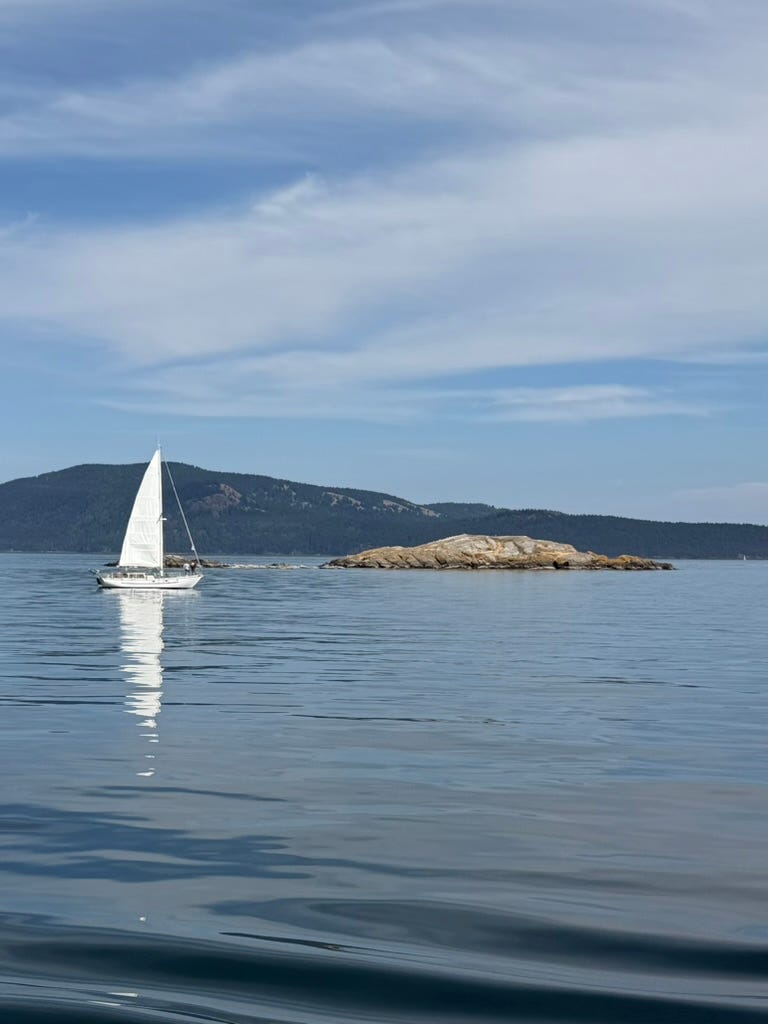
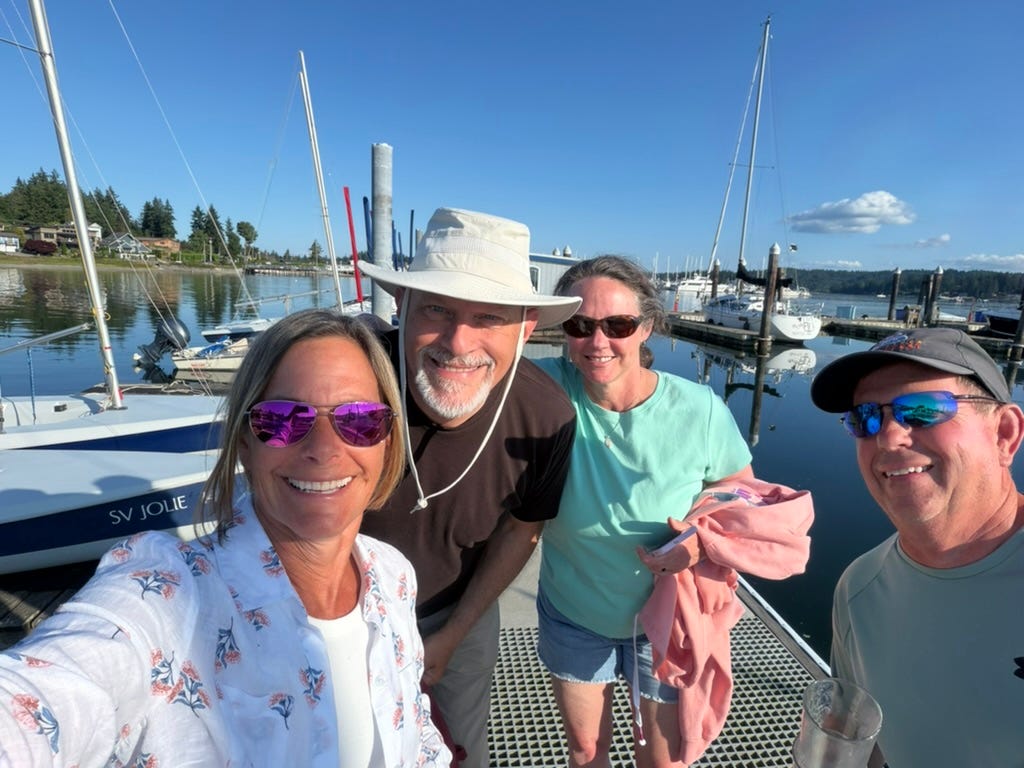
The Salish Sea, which hugs within its arms, the sounds, bays, and inlets around Seattle, Vancouver, and the San Juan Islands, whale watching, a dinner with friends from Over-the-Rhine who coincidentally were on Orca Island at the same time, a pivot from sailing with a former schoolmate (He says we were six when we met. I have to believe him) but we boated along the water, and somehow, surrounded by all that beauty, time slipped away. We were back in high school AND talking about aging (and deceased parents) after not seeing each for thirty years. Both of us on our second marriages, we understood a bit more about life. What it means to chase, what it means to choose. What it means to cherish. (Thanks, Frank!)
These are the places water always flows within me.
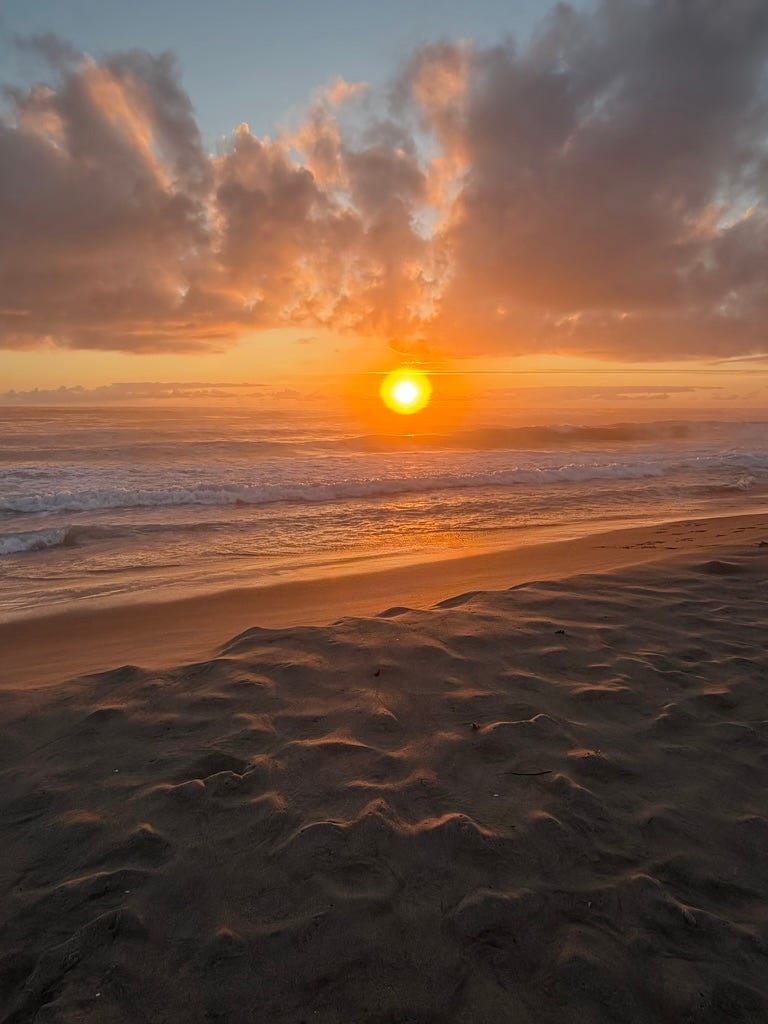
In our mornings, we were presented sunrises of faint life across soft ripples of waves and sand. And each night, we bedded down with sunsets spread across islands, oceans, boats, and ferries. Yet nothing captured the essence of sea—that kind of water we can touch with our feet, our hands, our hearts—more than our last night/morning along the Oregon coast.
The advantage of living on Eastern Standard Time is that, while on the West Coast, one can wake to the proliferation of light available at nearly all hours of the day during this high time of summer. Only a week past the solstice, we were on the Oregon coast during two sets of early, early morning negative tides, meaning by 5 a.m. And every evening, we didn’t need TV, let alone books to entertain us.
We had the sea.
*
In the end, I lost a little patience gained from bird observing, whale watching, and tide pooling and time away from social media. Atop Hurricane Ridge, where one can view the Olympic Mountains in 360°, phones ringing and loud conversations invaded the skyline (was it really important to know what time Uncle Leo was coming to dinner tomorrow?) When I sat near the muddy mires of a bay early morning on a ferry wait, a mother screamed at her three children to “come here, and don’t wade in that water and don’t you dare step on those rocks,” and knifed through my peace. Then there’s always a know-it-all on every tour, such that even our expert tour guide visibly lost their train of thought. Please, sir, I wanted to say, there’s no need for you to take this tour if you are so informed about the red alders and the native woman who occupied the land on Cascade Head.
“People ruin places.” I said often to Mark on our stay.
But they couldn’t ruin a sunset torched with colors flaming more brilliant than fireworks, and tinged with a sadness that this was our last evening. Nor could they take away the surprises of beadlet anemones, sculpins, harbor seals, porpoises, murres, how Guillot pigeons are unable to land on water, more or less waterski barefoot, and suddenly dive for food, and the tufted puffins, how they socialize and yet stand alone.
And the long walks with another soul who truly understands how my proclamation of “people ruin places” is my way of trying to save something in this world that is insistently being taken away. I will never forgive those who will have led to the disappearance of our majestic landscapes, to the obvious “omission of care,” as its known called in the caregiving field, i.e., neglect. Perhaps the sea will forgive, yet what I know of it, I’m not inclined to believe so.
The best we can do for each other? Support our national parks. Love one another like a nurse log hosting the seeds of the next generation, remembering we all decay. And give unto the forests and the oceans that which belongs to them. For future generations of every species of animal, including man, their livelihoods, liveliness, and aliveness will depend on it.
Upcoming Appearances -
August 30 - Italian American Museum - An afternoon of Something Italian appearance. 3 p.m. www.IAMCLE.org.
September 1 - West Virginia Italian American Festival, Author’s Forum - 5:30 p.m. Clarksburg Public Library. Virtual. Link here for more information.
Tuesday, Oct 13th - I’ll be chatting with author, food writer, and chef Amy Tobin on the intersectionality of my memoirs, and how food played in a role in each. Podcast link available at a later date.
Oct 15th & Oct 29th 6:30 - 8:30 - Literary Cleveland - Writing Our Heritage. Sign up for LitCleveland or follow link to sign up for class. Virtual.
October 21 - Lloyd Library and Museum in partnership with Fotofocus, Presentation - Chestnuts: The New Comeback Kids. More details to follow.
November 10 - United Italian Society - Writing Our Heritage - 6:30 p.m.
November 14 - Mark your calendars. Books by the Banks presented by the Public Library of Cincinnati and Hamilton County is back! Visit the website for more details.
*
Upcoming for 2027
Caring for the Caregiver experiences will return in 2027. Look for dates coming soon in February and August. Visit givingvoice.org to be added to their mailing list.
Creative Writing Project will begin again in October, February, and April. Look for February dates from me. But sign up for all the sessions when you can! Follow the CAC CWP here.
No posts
Comments
Nothing yet. Say the first thing.
Sign in to join the conversation.