
We’re not that deep into the Squaxin Forest, a state park in Olympia Washington. Formerly called Priest Point Park, perhaps that name is part of my spiritual quest. But also, Squaxin has other meanings - “in between” or a “place to cross over to another bay.” The Squaxin considered themselves “People of the Water” and here, on the southern end of Puget Sound, I take another cue this is where I’m supposed to land today.
The random stop on our PNW tour is another of my whims my husband, Mark, is prone to roll his eyes at, then roll along with however my west wind blows. We follow the blue dots of our trudging feet on AllTrails until we lose the markings on the app, looking for a telephone line, a connection to the past.
Every step we take includes our inside joke. How each local plant or flower I attempt to identify is given a moniker related to the area: alpine, sea, Pacific, ocean, western or wild. Creambush, known as ocean spray, or as Mark calls it the cloud smoke plant where its cream-colored buds burst forth in little clouds, connected to one another through a thin stem. The western thimbleberry, a semblance to the raspberry we’re not supposed to eat right now. And bear’s britches known as sea dock, its long towering stems with white flowers that, when appearing in bunches, soar like skyscrapers in Gotham City.
We pass Douglas firs, such towering ancient pines. Everything feels ancient here, precious, spiritual, grounding, and yet uplifting, as if there truly is a stairway to my own personal heaven in the Pacific Northwest, or at least a crossing over to another kind of bay. There are new shoots at the end of the fir branches, despite the fact we are deep in summer. Immersed in green, the sun won’t hit here until much later in its seasonal arc. I pinch the shoots, pop them in my mouth and relish. Italians call our berry fruit frutti di bosco. I wonder if Italians eat pine or fir shoots and call them the same, that’s how sweet they are on my tongue.
Finally, we arrive at the small sign. Telephone this way. In the heart of a forest. The Japanese began this tradition of placing wind phones or telephones of the wind, on a post. The setup is situated—in most cases—somewhere out of the way. The idea is for individuals to call their loved ones who have died. And speak freely to them. Let their words be carried on the truth of the wind.
That ritual exists here, in front of us. And across the world.
I encourage Mark to use the phone first (something I never would have done when sharing a phone with three sisters and a brother). He’ll want to speak to his recently deceased father. I wander off to the side, pee behind a looming alder tree. Give him some privacy to share.
It’s my turn. The telephone nailed to a board and post is surrounded by little love notes on rock and paper (users are encouraged to only leave that which is natural in its eventual state) that remind me of all the loved ones I want to contact.
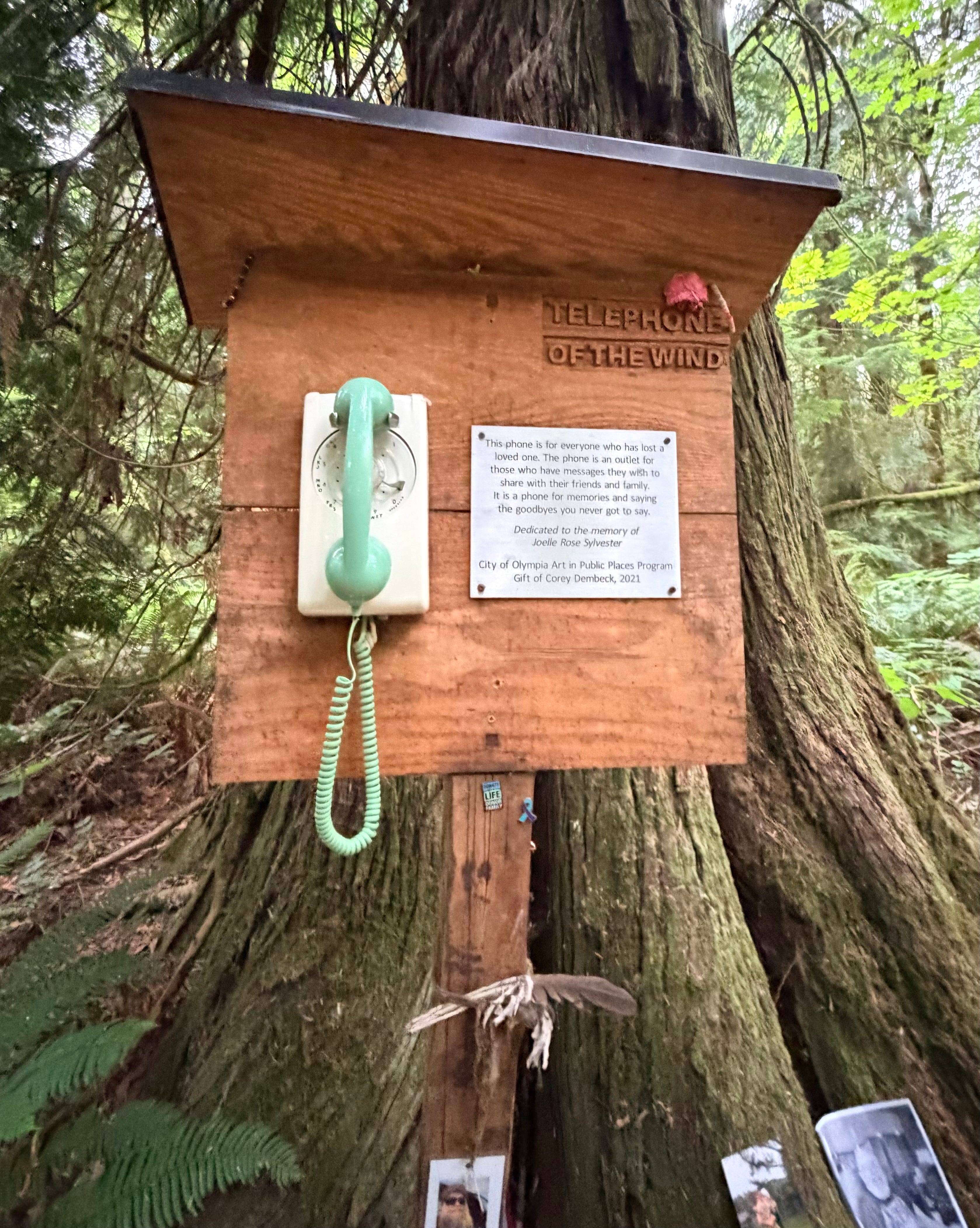
Stepping forward, I pick up the cream, cool-to-touch rotary dial phone with a green headset and long green cord for twirling fingers when waiting for a voice to answer. The last time I used a rotary phone? Probably in the family home of the Lincoln Street’s basement, where privacy could be had by stepping into my father’s work clothes closet which smelled of earth and him. Or randomly picking up the kitchen phone in the same home, assuming it’s a pinochle club member for my mother calling out “stir the sauce for me would you?” Who says no to that?
But my lasting image of a rotary phone? Speaking to my parents from afar. Oregon to Ohio, not a cheap call then. Impossible today since they are dead.
I see them now, the forest through trees, my parents, reaching for the handle of their phones at it rings. Mom in the kitchen seated at her Formica desk, pink eyeglasses on, Bic pen in hand. Dad in his office, seated at his glass topped cherry desk, the adding machine clicking. Both with windows facing the backyard of the home. Summertime, cherries and pears poking through in bloom. The tomatoes ripening with each western red sky that watches over Lake Erie.
“I knew it was you, Net” my mother says on the wind. “Yeah , Net Marie,” my father echoes in the whoosh of air.
I tell them, “I’m in the Pacific Northwest.” As if they didn’t already sense or know.
Next, I apologize. “I’m sorry for that move away,” the first to Oregon made in 1996, but wanted them to know I was happy then. I am happy now, here. “It’s where I’m most at home.” Not physically, but my insides. Did they know that about me, when I was ten? When I was 30? Now that I’m 60?
I thank them for the years they trekked to Oregon and Seattle, gave up pieces of their lives to be with my young family in those long months of sickness and those short years of our happy health. “I miss you.”
“I love you.”
I wonder how to close when a garbled whisper rises from my throat. “I’ll see you again soon,” I say, with a hope that a dead wire, come alive, nailed to a tree might offer.
Did I hear them in that moment? You bet your last rustling branch on a Douglas fir I did.
Later, Mark and I merge our rental car onto highway life, racing toward our new granddaughter two hours away. I begin a new conversation, “When I talked to Mom and Dad…”
Mark laughs. I do too. At the absurdity of it, the reality of it. And at the possibility that everyone is only a phone call away, their voices and their heartbeats reverberating on the wind.
*
To learn more about wind phones near you, visit My Wind Phone or The Telephone of the Wind directories.
Stay tuned for an updated schedule of programming - workshops, book events, and speaking appearances.
Here’s a quick snapshot for your calendar.

No posts
Comments
Nothing yet. Say the first thing.
Sign in to join the conversation.