
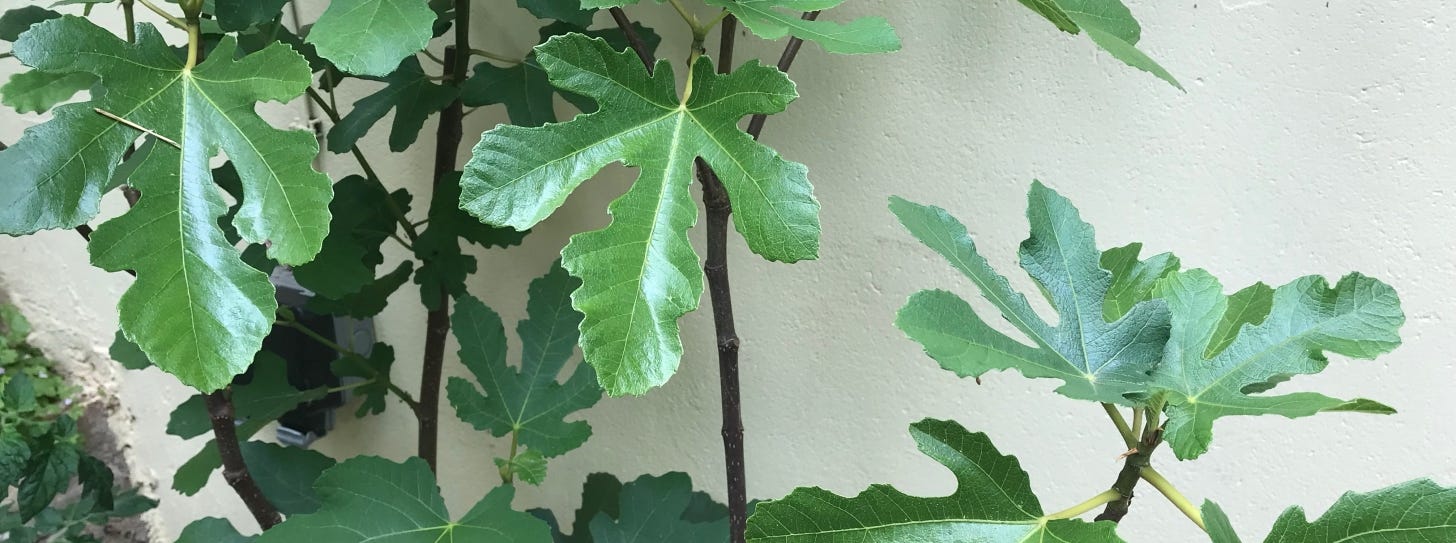
The common fig (Ficus carica) is a generous fruiting tree, considered sacred in many ancient traditions. From a health perspective there are many benefits. Not only does the fig give tasty and nutritious fruits to keep us well-regulated but it also provides leaves for a delightful tea and a powerful milky sap or latex to deal with warts and other skin growths. Here I explain some of the medicinal effects, offer suggestions on cultivation, propagation, uses and a tea recipe. Research evidence for uses of the fruits, latex and leaves for health benefits is limited but increasingly positive. This small tree thrives in a warm climate and can resist drought once established. Growing this plant in a sheltered location or in a pot is increasingly viable and there are many excellent varieties to look for.
Growing figs in a temperate climate
The fig tree is part of the mulberry family or Moraceae and derives originally from dry soils in parts of Asia and the Mediterranean. It is a fast-growing tree with many branches and can grow to 6 m tall by 6 m wide. The stems are thick and smooth-skinned, and branches carry bright green lobed leaves. The fig ‘fruit’ is a container which encloses many flowers and these ripen internally as tiny individual fruits. Some figs require pollination by a specialised fig wasp, but many plants are self-fertile. The fig requires sun and cannot fruit in shade. It is best grown in a sheltered spot, or fan-trained against a south-west facing wall.
Growing figs further north in Europe and North America is becoming increasingly possible. The fig is deciduous in a temperate climate and in a warm enough situation can ripen several crops each year. There are varieties that are tolerant of temperatures as low as -10 to -15 degrees Centigrade once established. ‘Brown Turkey’ is commonly advised in the UK as cold-hardy and self-fertile. Other varieties reputed to be hardy are Brunswick, ‘Michurinska 10’, ‘Chicago’, ‘Olympian’, Bornholm’s Diamond and Osborn’s Prolific.
Propagating and growing a fig plant
Producing additional plants is surprisingly easy using cuttings and fig plants may be able to produce fruit within 2-5 years. For propagation cut large pencil-size shoots with at least three nodes, remove top of shoot and leaves and place in moist soil in a pot. Make sure that at least one node is below soil level. If kept warm and humid in a plastic bag the cutting can produce roots within 6 weeks. It can be grown on indoors over winter and then repotted the following spring. Avoid waterlogging. Outdoor pots can be taken indoors in colder weather or protection can be applied by wrapping in cloth such as hessian. Often a plant which appears to be damaged by cold will resprout. Fig roots can be invasive and if planted in the ground then root restriction is advised. Ongoing management is likely to involve regular pruning and, for plants in pots, some repotting or root pruning most years. Feeding for fruiting figs is usually recommended, something like a tomato plant fertiliser. The tree produces two or more crops per year but in colder climates only figs formed in the autumn overwinter to ripen the following year, others should be removed.
Fruiting and harvest from trees
Young fig leaves can be harvested in spring and summer and used fresh or dried. The dried leaves can be crumbled up, removing the leaf skeleton, and stored in a glass jar. Fig fruits are ready to harvest from early autumn when they darken and soften and hang downwards. Fig latex is a milky white sap secreted by cut stems, leaves, and unripe fruit and is usually used fresh.
Research and indications for fig fruits, leaves and latex
The fig tree has longstanding use in various traditional medicine systems, particularly for digestive, respiratory and cardiovascular disorders. More recently the leaves have been used against contact dermatitis. Leaf extracts have also been shown to reduce triglycerides and moderate cholesterol secretion, and to provide antibacterial effects (Li et al., 2021). Fig fruits are widely eaten as a mild laxative and the ethanolic extract of the fruits has potential as an antidiabetic agent. The latex is used in treating warts and veruccas as it is corrosive on the skin.
Fig constituents help to explain the numerous activities. The fruits contain polyphenols, flavonoids, calcium and fibre. The health benefits of the fruits are laxative, antispasmodic, anti-inflammatory, expectorant and diuretic. They contain both soluble and insoluble fibre to soften the stool and this eases bowel movements. For atopic dermatitis in children an aqueous extract of fig fruits was investigated in a randomised, placebo-controlled trial. The results indicated that the treatment had significantly increased efficacy in terms of reducing eczema (SCORAD index) and itching in comparison with hydrocortisone 1.0% (Abbasi et al., 2017).
Fig leaves contain luteolin and quercetin, phenolic acids, and germacrene D. The leaves are anti-inflammatory, antioxidant, hepatoprotective, hypoglycaemic and antimicrobial. Although some of the leaf constituents are irritants, toxicity has been shown only at very high doses (Li et al., 2021). A preliminary double-blind, randomized, controlled study in adults with mild atopic dermatitis was carried out to evaluate the safety and effects of taking fig leaf tea. The tea was made from a fig source low in furanocoumarins (as these could contribute a reaction in the skin). Participants randomly received daily 500 ml of fig leaf tea over an 8-week period and positive effects of fig leaf tea consumption were confirmed in all but one of the participants. Eczema severity was significantly lowered in the fig leaf tea-treated group although the effect weakened 4 weeks after the end of the study. Possible mechanisms might be reductions in inflammatory cytokines and improvement of liver function (Abe et al., 2022).
The milky sap or latex that exudes from fig leaves and stems is proteolytic and irritating to the skin. It contains proteases and chitinase enzymes and these are involved in antiparasitic, antimicrobial and potential anticancer effects on the skin. In one study diabetic foot ulcers were treated with fig latex to improve healing by reducing bacteria (Salah et al., 2022). Further research is looking at key components of the latex responsible for tumour cell apoptosis and hence for possible use in cancer treatments (Baohong et al., 2023).
Uses and cautions
Fig fruits are used to make many food products in addition to fig syrup for constipation. Two figs provide about 3 g of fibre in addition to minerals and vitamins. Fig leaves can be taken as an infusion like a tea, either fresh or dried. The leaves are edible and can be used as food wraps. For use as wart remover, apply a little fresh latex directly to the wart and allow to dry several times daily for a week. The fig latex is not for internal use and contact should be avoided with the eyes. Fig fruits are best taken in moderation when ripe, and avoided if underripe or mouldy.
RECIPE FOR FIG LEAF AND MINT TEA
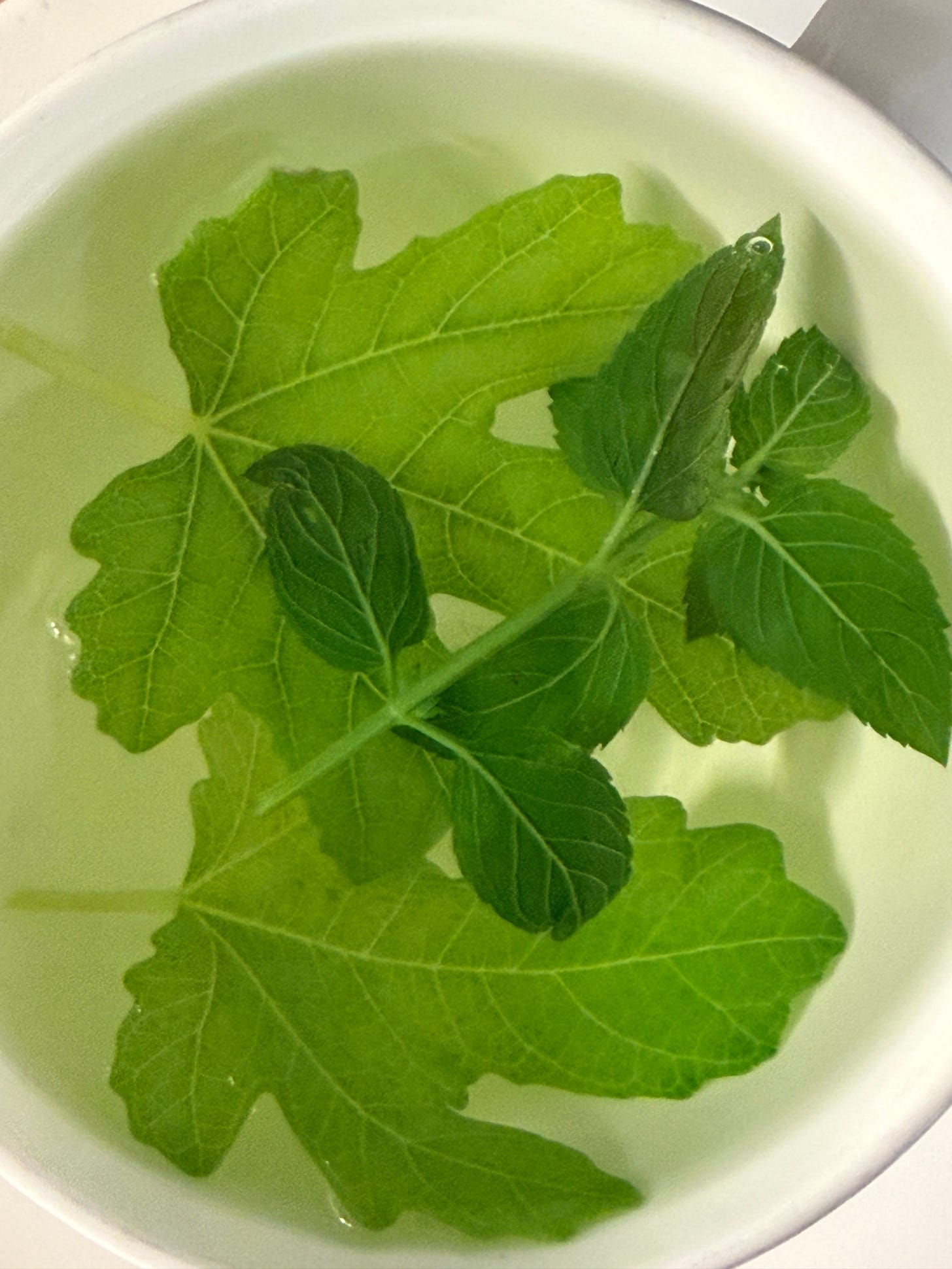
2 fresh young fig leaves
1 fresh small sprig of mint
250 ml water
Honey to taste (optional)
Check the leaves are clean and add to a large cup or mug. Bring the water to the boil and add to the leaves. Stand for 10 min and then strain off the infusion. Drink hot optionally adding a teaspoon of honey to taste. Or you can allow the strained liquid to cool and use to make a refreshing cordial with ice.
Conclusion
The fig is such an amazing plant. The Fig and Mint Leaf tea is delicious, very fragrant and refreshing. And I do love a couple of dried figs when I am feeling nibblish. They hit the right sweet spot and have the bonus of adding fibre to the diet. At our cottage home we have several ‘Brown Turkey’ figs stagnating in pots and I realise they are not appreciated enough. I feel I may have underestimated the potential of the fig, and am keen now to try several more varieties for both fruits and leaves!
References
Abbasi S, Kamalinejad M, Babaie D, et al. 2017. A new topical treatment of atopic dermatitis in pediatric patients based on Ficus carica L. (fig): A randomized, placebo-controlled clinical trial. Complementary Therapies in Medicine 35: 85–91. doi: https://doi.org/10.1016/j.ctim.2017.10.003.
Abe T, Koyama Y, Nishimura K, et al. 2022. Efficacy and safety of fig (Ficus carica L.) leaf tea in adults with mild atopic dermatitis: A double-blind, randomized, placebo-controlled preliminary trial. Nutrients 14(21). doi: 10.3390/nu14214470.
Baohong L, Zhongyuan L, Ying T, et al. 2023. Latex derived from Ficus carica L. inhibited the growth of non-small cell lung cancer (NSCLC) by regulating the caspase/gasdermin/AKT signaling pathway. Food and Function 14(4): 2239–2248. doi: 10.1039/d2fo02284b.
Li Z, Yang Y, Liu M, et al. 2021. A comprehensive review on phytochemistry, bioactivities, toxicity studies, and clinical studies on Ficus carica Linn. leaves. Biomedicine and Pharmacotherapy 137: 111393. doi: https://doi.org/10.1016/j.biopha.2021.111393.
Salah M , Badr G, Hetta HF, et al. 2022. Fig latex inhibits the growth of pathogenic bacteria invading human diabetic wounds and accelerates wound closure in diabetic mice. Scientific Reports 12(1): 21852. doi: 10.1038/s41598-022-26338-0.
Thanks for reading Medicinal Tree Woman! This post is public so feel free to share it.
Comments
Nothing yet. Say the first thing.
Sign in to join the conversation.