
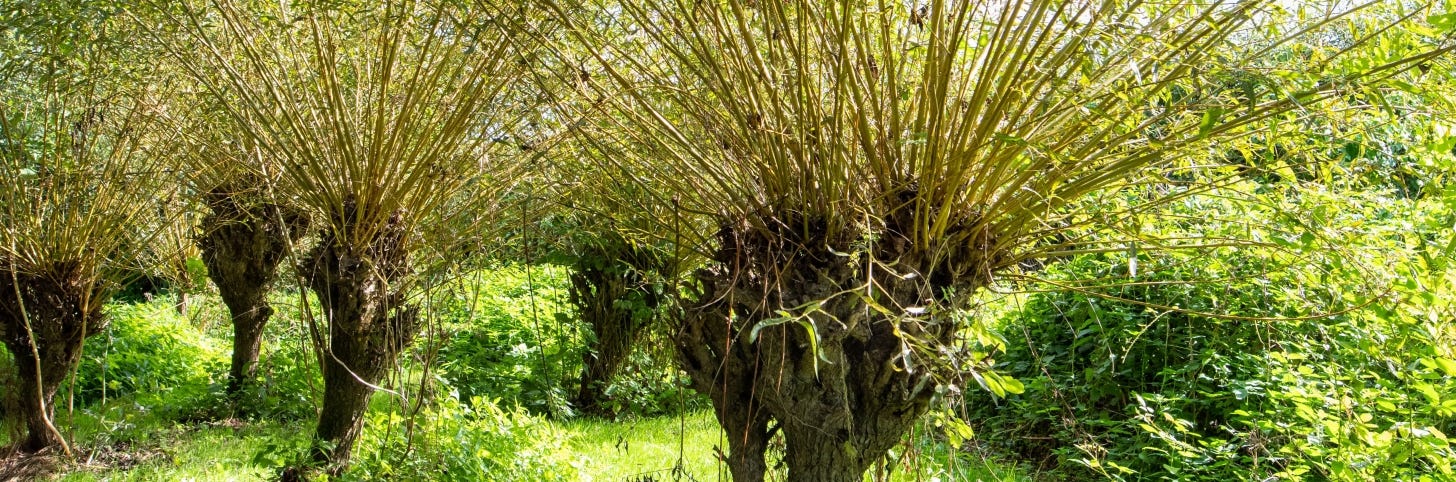
Pollarding of trees can be used to provide abundant quantities of medicinal bark, leaves, flowers and fruits as a sustainable harvest which can be repeated year after year. There is often limited space in a garden, so pollarding is a great way of pruning trees to fit, ideal for permaculture projects in allowing layers of planting and reducing shade over other plants. By cutting back a woody stem we can obtain many benefits for the tree too. In this post I summarise information about how this pollarding approach works for herbal medicines, which trees are ideal, with examples of some used for common complaints such as coughs, colds, joint pain, constipation and more.
Why pollarding is good for us and for trees
Pollarding is an ancient method of cropping trees on a continuous basis, much used in the past for products such as timber and forage for animals. There are many advantages to this pruning process, making trees more manageable, ensuring abundant crops, improving tree lifespan, and reducing shade for plants below. So it is not surprising that pollarding is often an important component of the permaculture approach and maintains trees in their youthful state. Pollarding enables tree harvests from branches without killing the tree. For medicinal use the copious production of leaf matter is ideal for drying for herb teas or making fresh herb tinctures, useful if harvesting medicinal leaves of ginkgo, sweet chestnut, willow and others. In fruit production, if pollarded reasonably low then fruit is in range for picking from branches by hand, or perhaps within reach of short ladders. For medicinal supplies, the pollarding approach can be used for sourcing elderberries, hawthorn berries and other berries used in herbal medicine, providing the pollard cycle allows fruiting wood to be produced.
Medicinal Tree Woman is a reader-supported publication. To receive new posts and support my work, consider becoming a free or paid subscriber.
What exactly is pollarding?
Usually pollarding involves cutting the main trunk or stem of an established tree at a height, from 1-2 m, causing buds under the bark to sprout. This has provided an ideal way to produce branches for medicinal bark. Pollarding is effectively done in winter or early spring months when there is less interference with growth, and the tree has some time to recover. At first the hard cuts of a pollard can look rather savage. But then new shoots and long straight stems rapidly appear. Cut across the tree stem with a sharp tree saw (or use a chainsaw if you are properly trained and protected). Cutting creates a wound so it is important to have sharp tools and cut cleanly across and at a slight angle so that water sheds away. The practice of repeat pruning the upper stem and branches effectively maintains the tree in a partially juvenile state and fresh regrowth may be prolific.
How often to harvest and pollard?
The frequency of pollarding depends on how much growth occurs and the tree species. For vigorous plants like cherry and willow throwing up young stems to produce foliage or bark, a cycle of 1 or 2 years might be appropriate. However, if flowers and fruits are wanted then they are produced on one-year-old growth so that the harvest may have to wait for 2 or 3 years or longer. The ideal time to carry out pollarding for bark is just as leaves are beginning to emerge because the bark will readily peel off due to the rising sap. Other trees may be harvested during spring or even summer for leaves every 2-3 years such as ginkgo or mulberry, effectively being pruned later in the year when the leaf crop is suitably grown. For supplies of flowers and fruit (such as hawthorn species), it is possible to pollard alternate trees in winter so that there are one-year old stems to produce flower buds.
Some cautions
Some planning may be needed to begin pollarding established trees. Avoid establishing trees like willow near to water supplies and buildings. Pollarding a tree when it is too old can result in failure to grow, so may have to be done over a 2-3 year period. And pollarding may not be advisable for trees in shaded areas as recovery may be problematic, forcing the plant to produce long spindly shoots to reach the light. Some older trees can produce a multitude of stems or ‘watershoots’ which may not be the desired outcome if too crowded so that they have to be further thinned.
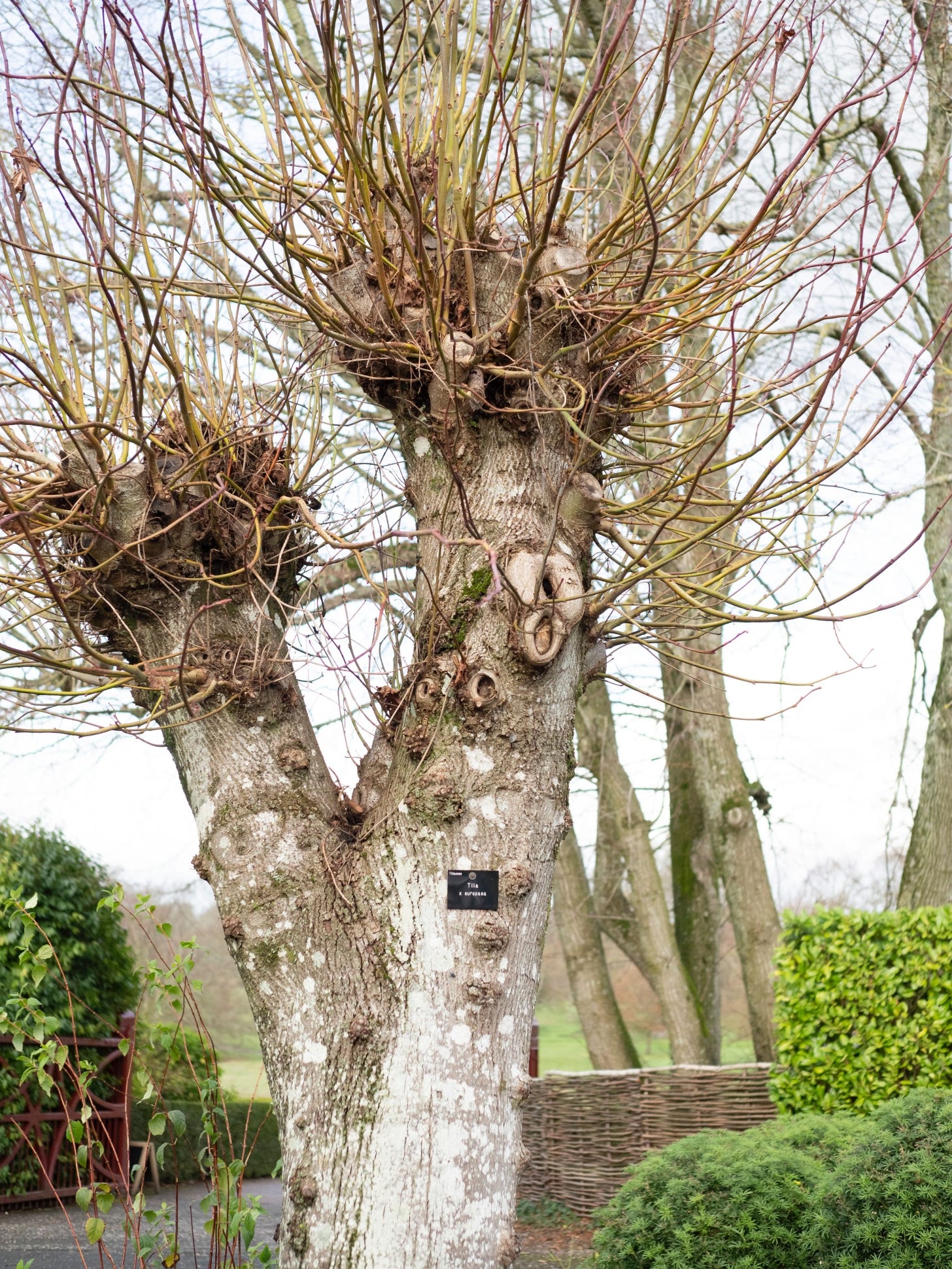
Bear in mind that pollarding does imply a commitment to maintaining a suitable cutting regime. Ongoing management involves repeated pollarding on a regular cycle as well as thinning when appropriate or cutting out any dead or spindly branches. This may not need to be every year but will need to be done sooner or later. If pollarding is not carried out, the branches will just continue to grow larger, maybe presenting risks of breaking off or becoming diseased. Pollarding at head height or above does bring some risks. Consider the height of pollarding and be aware that a stepladder will be needed for access above 1.5-2 m. It is not advisable to use a chain saw above head height unless you are suitably trained!
Some medicinal tree species for pollarding
Many species of trees can be pollarded. Possible broadleaf species for a temperate climate include alder, ash, beech, cherry, elder, elm, lime, maple, oak, sycamore, willow and most fruit trees. Most conifers cannot be successfully pollarded although there are exceptions such as ginkgo, juniper and yew. Unusually, we managed to maintain a pollarded Douglas fir in our medicinal woodland for quite a few years.
Bird cherry (Prunus padus), for bark to use in a syrup for a dry cough. Cutting the leader produces a few vigorous and upright branches ideal for bark and additional growth needs to be cut back every 2-3 years.
Elder (Sambucus nigra), for flowers and fruit used in cough and cold remedies. Has vigorous growth of numerous stems, flowers and fruit are produced in the second year.
Ginkgo (Ginkgo biloba), cultivated for leaf production for anti-inflammatory tea and tincture. Whole branches can be cut back in summer for harvest of leaves.
Hawthorn (Crataegus monogyna), for flowers or berries used in extracts against high blood pressure. Younger trees are ideal for pollarding and if cut alternate years they produce 1 year-old stems for flowers and fruits.
Lime (Tilia x europea and other species), for flowers for a popular calming tea. Commonly pollarded at head height or thereabouts.
White willow (Salix alba), for leaf and young bark for arthritis and other inflammatory complaints. As a vigorous grower needs pollarding almost every year and further thinning of these stems may be needed. Less vigorous is violet willow (Salix daphnoides) with more active ingredients in the bark.
Many other trees could be pollarded for medicinal supplies including crab apple, eucalyptus, horsechestnut, mulberry, sweet gum. You can see more in the book Trees and Shrubs That Heal which contains 80 tree profiles.
Other thoughts about pollarding
The video here shows how a very large willow stump produces slender branches which can then be peeled for bark.
But I have struggled to obtain much information about pollarding various tree species other than ash, hazel and willow! So I have had to develop practical experience through pollarding trees in our cottage garden and medicinal woodland project. This post summarises that experience and draws on several past blog posts here and here. A lot more knowledge is still needed for sharing good practice in pollarding for a medicinal forest garden. I have seen some great suggestions on renovating old orchard trees but there are many unanswered questions on pollarding other younger trees for bark and leaves. It is not always clear how soon pollarded trees can flower and fruit again, whether there is a best tree age for high constituent levels in medicinal supplies, or if it is OK to pollard and then remove subsequent branches over a longer period of years, and more. So there is plenty more still to find out!
Afterthought
It is the season for thoughtful present buying. If you know someone who is interested in herbal medicine and trees then did you also know that you can get a signed copy from the author (that’s me!) at the Medicinal Forest Garden Trust website shop. But hurry as the last posting date for book parcels for Christmas in the UK is 17 December 2025!
Comments
Nothing yet. Say the first thing.
Sign in to join the conversation.