

Hello everyone,
Welcome to Issue #202 of CAFÉ ANNE!
Yes it is true—I had the best birthday week ever last week. There was a fancy dinner (in Jersey City!), and friends from out of town, and chocolate cake, and then chocolate cupcakes, and then turtle chocolate cake. Plus, on my actual birthday, my pal Xeni in Brooklyn Heights had me as a guest reader at her monthly Furman Street Salon for local writers, so I got to pontificate about my favorite topic, CAFÉ ANNE! Plus, reader Lisa W. Venmo’d me $34—enough to buy another loaf of the bread at Meadow Lane I wrote about last issue!
I also received the greatest birthday present ever. Check this out:
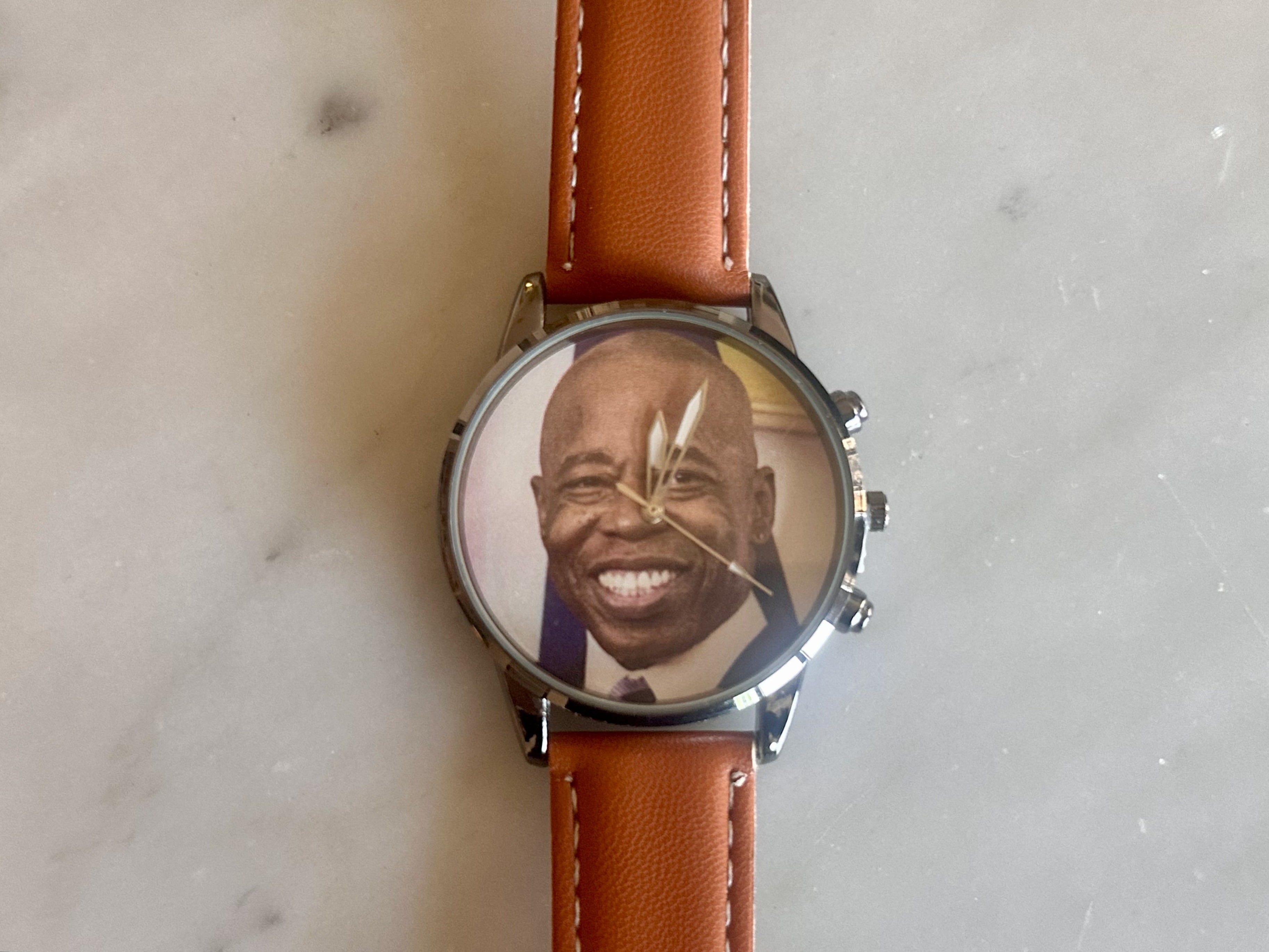
Yes, I know what you are asking: “Where can I get my own Eric Adams Watch® Eric Adams watch?” Sorry, it’s a custom job!
In other news, big changes on the newsletter front. Starting next week, I’ll be working at New York Magazine as a staff writer for their Curbed section—which is dedicated to all things NYC. They reached out because they like what I’m doing with this newsletter! This is a temporary gig—I’m filling in for twenty weeks for a staff writer going on leave.
I’m super excited because I love New York Magazine. Also, I will be working in an OFFICE for the first time since 2013. Unlimited free coffee! It’s in the Financial District, so I can ride my bike over the Brooklyn Bridge to work. I’m jazzed for all the people I’ll meet and fun stories I’ll be covering!
The downside is that I can’t be cranking out CAFÉ ANNE on a weekly basis while I’m at NY Mag because this newsletter is nearly a full-time job in itself. Going forward, I will be publishing CAFÉ ANNE as often as I can—hopefully every three weeks or so.
I’m not sure what will happen at the end of August when the NYC Mag gig ends—it depends how I’m doing on the paid subscription front. Right now, we’re at 475 paids, and I really do need roughly 800 paids to keep publishing weekly. Otherwise I’ll continue publishing CAFÉ ANNE less often so I have time to take more freelance jobs that pay. Up ‘til now, I’ve been subsidizing this free newsletter with my retirement savings, but that nonsense has got to stop!
So with that, huge and extra heartfelt sourdough shoutouts to this week’s super generous new paid subscribers Jan S., Everett C., Rose R., Cora V. Diane T., Wen, and Rachel C.! That’s enough $$$ to buy 17 loaves from Meadow Lane or 150 loaves from Trader Joe’s! Hmm.
Finally, I’m not sure when the next issue will drop, but I’m aiming for Monday, April 20. And I’m very excited for this week’s issue, of course, in which I met two guys at the Staten Island Mall. Please enjoy.
Regards!
Anne


The following are advertisements from CAFÉ ANNE sponsors.
CRYING LAUGHING: STORYTELLING AND IMPROV SHOW (THIS SAT 4/4)
Watch two storytellers get vulnerable with personal narratives, followed by improvisers uncovering the absurdity and hope within the tough stuff. We’ll cry until we laugh and laugh until we cry! It’ll be a night of laughs and heart you won’t want to miss. Grab your tickets!

HEALING THROUGH WRITING FESTIVAL (Mar 30–Apr 2).
A free 4-day online gathering for curious humans who suspect their life is stranger (and more meaningful) than they admit. Explore memoir-writing & somatic storytelling with 25+ writers & healers. Your subway ride might be a chapter! Register today!

Interested in advertising your product/service or promoting your own newsletter in the next issue of CAFÉ ANNE? Click here for details.


In a recent issue of Rob Stephenson’s wonderful The Neighborhoods newsletter, an aside in his account of his visit the Staten Island Mall (the largest mall in NYC!) caught my attention:
“While a steady stream of customers patronized the numerous shoe stores and boutiques, most of the action centered around the clusters of massage chairs scattered throughout the complex. Large groups of older men had colonized them, their legs swaddled by the pleather flanges of the well-worn seats as they gossiped and swapped stories. The chairs weren’t actually doing any active massaging, but the men standing nearby still seemed to envy their sedentary peers as they dominated the conversation from their inert thrones.”
I immediately imagined a throng of gruff old men in tracksuits smoking giant unauthorized cigars—with the peons fetching Cinnabons for the big shots in the chairs. Wow! Clearly, I had to check out this scene for myself. It would be the best story ever!
Last week, I made the two-hour bus and train journey to the shopping center, texting Rob on the way. “Heading out to the Staten Island Mall to check out the massage chair scene!” I wrote. “Any tips?”
“Uhm, bring crisp bills?” he replied. “And some hand sanitizer?”
Upon reaching the mall, I found a cluster of massage chairs on the mezzanine level with fantastic views of the parking lot. I did not, however, see any old men swapping stories. Much like everywhere you go these days, the scene was dominated by folks staring glumly at their phones.
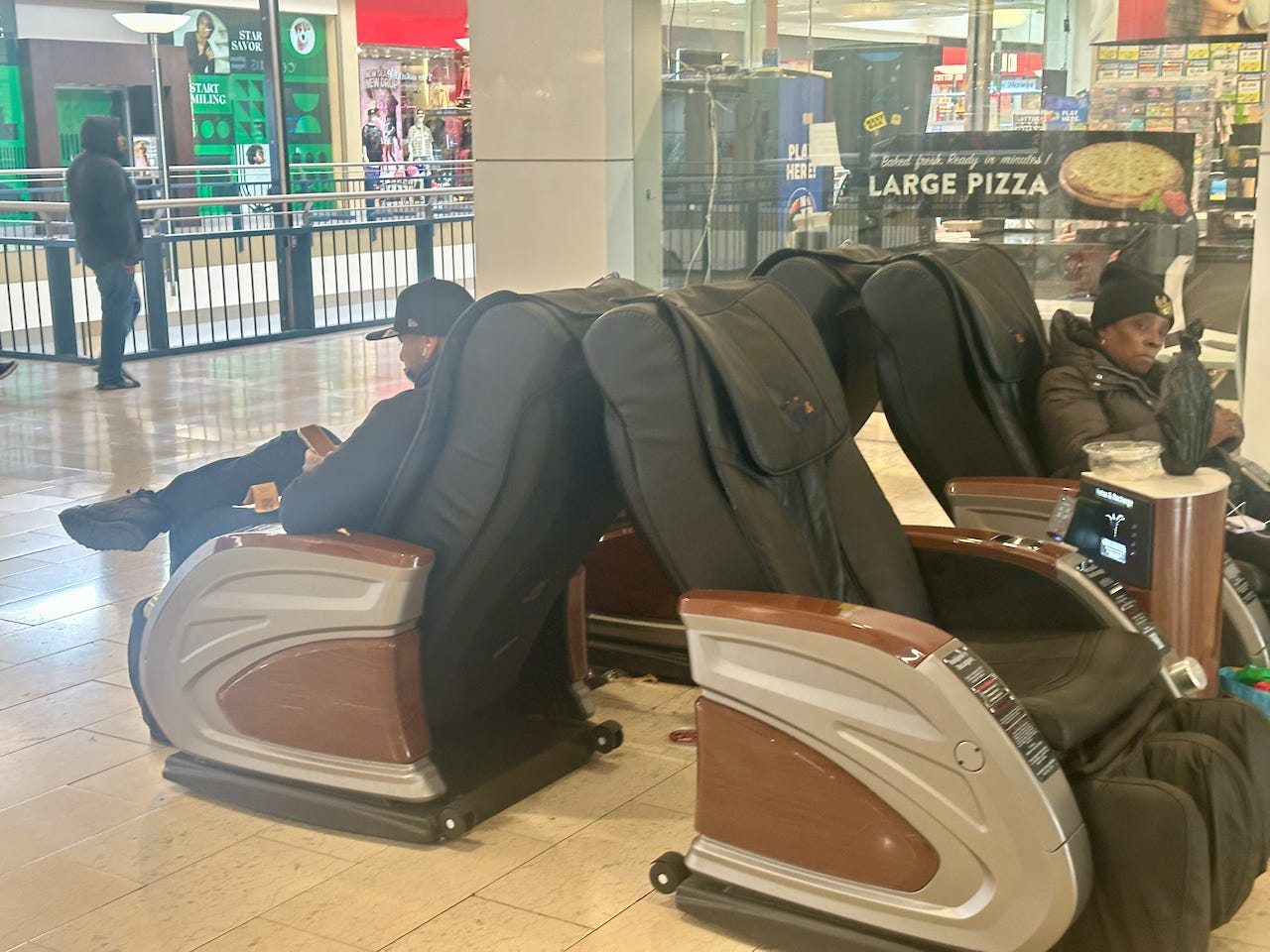
I sent Rob another text. “Were you seeing older black guys or Italian types?”
His reply: “Russians I think.”
My heart sank. “Oh no!” I replied. “I should have asked you before I set out. Russians NEVER talk!!!”
Rob’s reassuring response: “You can get anyone to talk.”
Hoping the Russians would materialize later, I decided to kill time at Gloria Jean’s, the mall café.

I ordered a cappuccino and looked around. The place was empty with the exception of two older men in the back. One, a fellow in a red Flash logo tee-shirt, was expounding at length. The other, in a Yankee cap and zipper hoodie, stared straight ahead, nodding occasionally. I tried to eavesdrop but was beyond hearing range.
Then it occurred to me. I was at the mall to report on old men hanging out together. Why not these two?
I introduced myself and asked if I could interview them for my blog. “Maybe you could tell me your life story,” I said.
It’s funny where people start when presented with such a question. Harold, the chatty gentleman in the Flash T-shirt, told me he was born and raised in Brooklyn—and hated living in Staten Island! Paul, the fellow in the Yankee cap, told me he’d been married for 40 years, his wife died in 2012, and he was not looking for another relationship. Maybe he thought I was hitting on him!
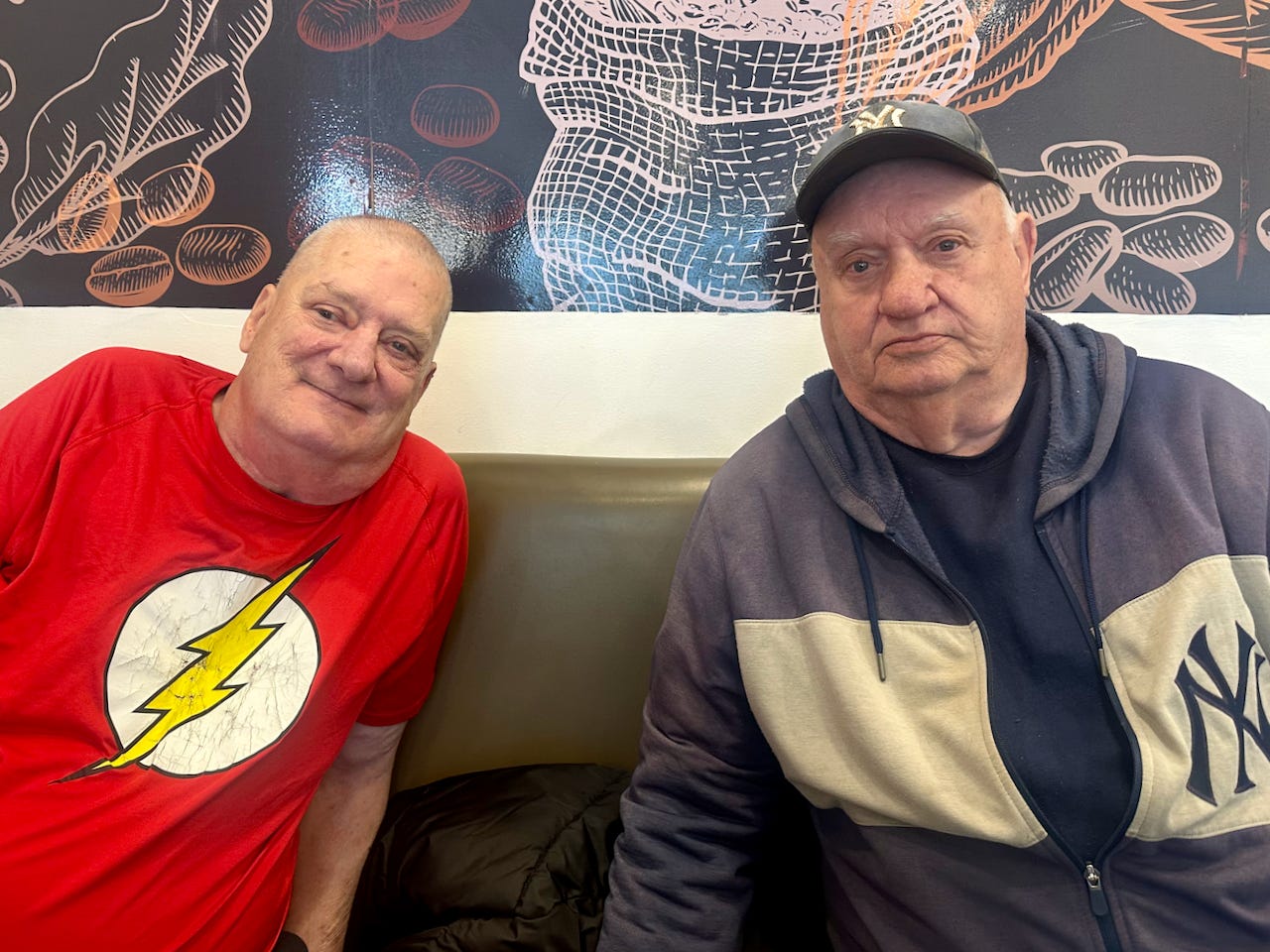
With their permission, I sat and hit the record button. Harold asked where I lived. I said Brooklyn, and that was all he needed to get going.
“I come from a big Italian family, all my family’s from there. I was born in St Mary’s Hospital, Canarsie,” he said.
It’s funny—New York natives, especially old-timers, will always tell you what hospital they were born in.
Harold still has folks in Brooklyn: “I have a cousin that lives where the yuppies live,” he said. “But a lot of my family has passed. In 2006, my father died. In 2007, my mother died. I lost a sister in 2008, at 52. I got one sister left. Me and her are not even on talking terms no more. It’s a shame, because it’s only me and her.”
“I was married into a Yugoslavian-Albanian family,” Harold continued. “I was married for seven years. To be quite honest with you, it was nothing but pure hell.”
“Oh no!” I said, hoping he’d elaborate.
“It was a waste of time. A waste of time!” said Harold. “You know, Yugoslavia-Albanian people are funny. They’re matchmakers. She was not supposed to marry an American.”
The marriage produced a “beautiful daughter,” who lives in New Jersey. “And I’m blessed with four grandchildren,” he said. “My oldest granddaughter is 22 years old. Last year, she scored a $65,000 job in Manhattan!”
Harold went on for a while about his grandkids before returning to his own life: “Brooklyn born, came to Staten Island—I lived a life of pure hell!”
He moved to the apartment complex across the street from the mall in 2023. He hates it. “It’s not me, where I am. What are we living in? Condos? What are they?”
“Condos,” said Paul.
“So you guys are neighbors,” I said.
“In a way,” said Paul. “Different floors.”
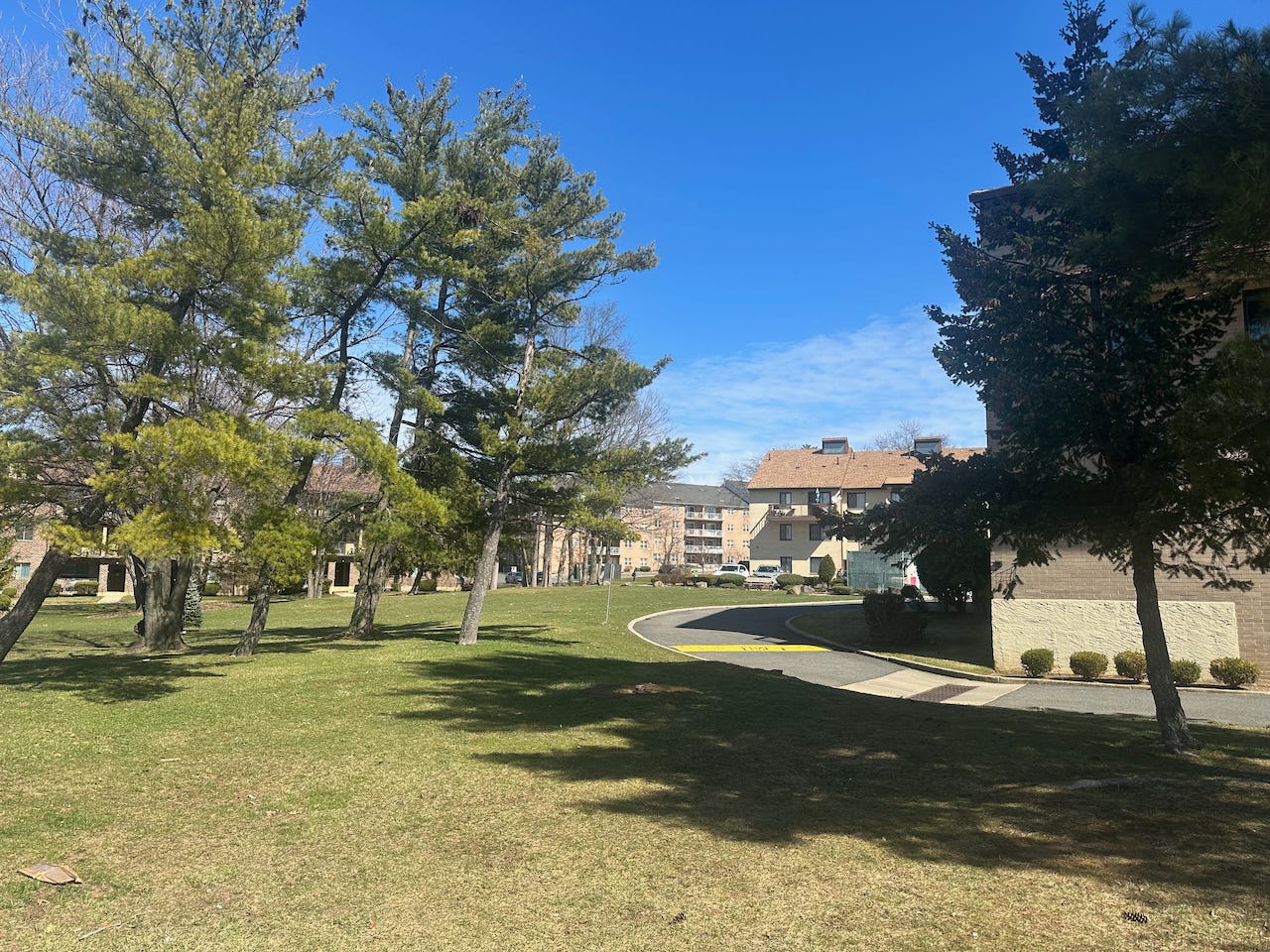
I asked how they met.
“We met in the—what do you call that thing?” said Harold. “The shack overlooking the parking lot. I can never pronounce the name.”
“The gazebo,” said Paul.
“You don’t talk much,” I observed.
“I never did,” said Paul.
But then Paul started on his own story. His manner was so low-key, I had to lean in to hear. He was born in Harlem, in 1946. He never met his father. When he was twelve, his mother died and he went to live with his aunt in Brooklyn.
“I graduated high school,” said Paul. “It took a while. I went to night school, summer school, but I got it. I worked, always worked. I got my own apartment. Then I met somebody in a bar where I hung out.”
“You mean a lady?” I asked.
“Yeah, a bunch came in,” said Paul. “I knew her brother. They came in all together. I asked, ‘Is that your sister?’ he said, ‘Yeah, you want to meet her?’ I says, ‘Alright, I will.’”
At the brother’s invitation, Paul paid a call at her family’s home. “We got to know each other. That went for almost a year,” he said. “And then I said, I don’t know why, I said, ‘Want to get married?’ And she goes, ‘Yeah.’”
He made it sound so simple!
“When you first saw your wife, what did you like about her?” I asked.
“I don’t honestly know. You ever get just a feeling? She was Irish and Polish,” said Paul. “She could be, you know, Irish. But some reason, we always worked things out.”
Paul drove a delivery truck for a commercial laundry, then a taxi: “It wasn’t an enjoyable job,” he said. “But I made money. James Caan got in my cab once. Dustin Hoffman, he got in the front with me.”
Paul’s favorite passengers were (surprise!) the quiet folks who didn’t try to make small talk.
“Did you know every street in the city?” I asked.
“Manhattan, yeah,” said Paul. “Anywhere else, I’d tell the passenger, ‘I don’t know where you’re going. You know how to get there?’”
“So if they didn’t know how to get there,” I asked, “what would you do?”
“I’d tell them, ‘You don’t know, and I don’t know—what the hell you want to me do?’ And they’d get out of the cab,’” said Paul.
For some reason we both found this funny. I laughed and laughed, and Paul cracked a smile for the first time.
Paul went on to tell me how he retired early and traveled with his wife before she died. He has four kids and ten grandkids. At age 80, he’s never used a computer and has no cell phone. No wonder he was so relaxed!
While Paul was talking, Harold, who is ten years younger, interrupted several times to display photos of his family on his phone and, at the first opportunity, broke in to continue his own story.
“I was born and raised in Brooklyn,” Harold said for the third time. “I lived in Brooklyn 40 years. I ran a rough life.”
Harold said he’d made two big mistakes. First, the marriage. It was so bad, he never married again: “I’ve been by myself too long. It’s always good to have, like, some kind of a companion or something.”
The other was never graduating high school. Harold’s uncle could have gotten him a job with the gas company. “I could have been set for life,” he said. Instead, he dropped out and worked for his dad in construction. And partied. “I never shot heroin,” said Harold. “I never smoked that glass pipe. But I smoked weed, I snorted cocaine, I did uppers, downers. I did it all. I guess that’s the main reason why I’m suffering now.”
After his marriage ended, Harold moved back in with his parents and came along when they moved to Staten Island.
“To be honest with you, I wish to God I could go back to Canarsie,” said Harold. “But it’s not the way it was. It’s all black. I’m not prejudiced or nothin’, but I’m being honest. On a summer night, you used to sit out with your neighbor, two in the morning, with the anisette. You can’t even walk down the street there in the daytime anymore. I left Canarsie 30 years ago. Never went back.”
“How do you know what it’s like now?” I asked. (Canarsie is as about as boring as a NYC neighborhood can get these days—super suburban, families, trees, etc.)
Harold said that his nephews—brothers who work for the Staten Island Ferry—live in nearby Garritsen Beach, and tell him what’s happening.
“You know, when I was in Canarsie, to be honest with you, it was all mob-controlled,” he continued. “The big boys owned that neighborhood, I went to school with two of them. I went with Patty Testa. I went with Anthony Senter. Patty Testa—he had five used car lots. He is no longer. They killed him.”
[I later looked them up. Known as the “Gemini Twins,” Senta and Testa were found guilty of racketeering and ten counts of murder.]
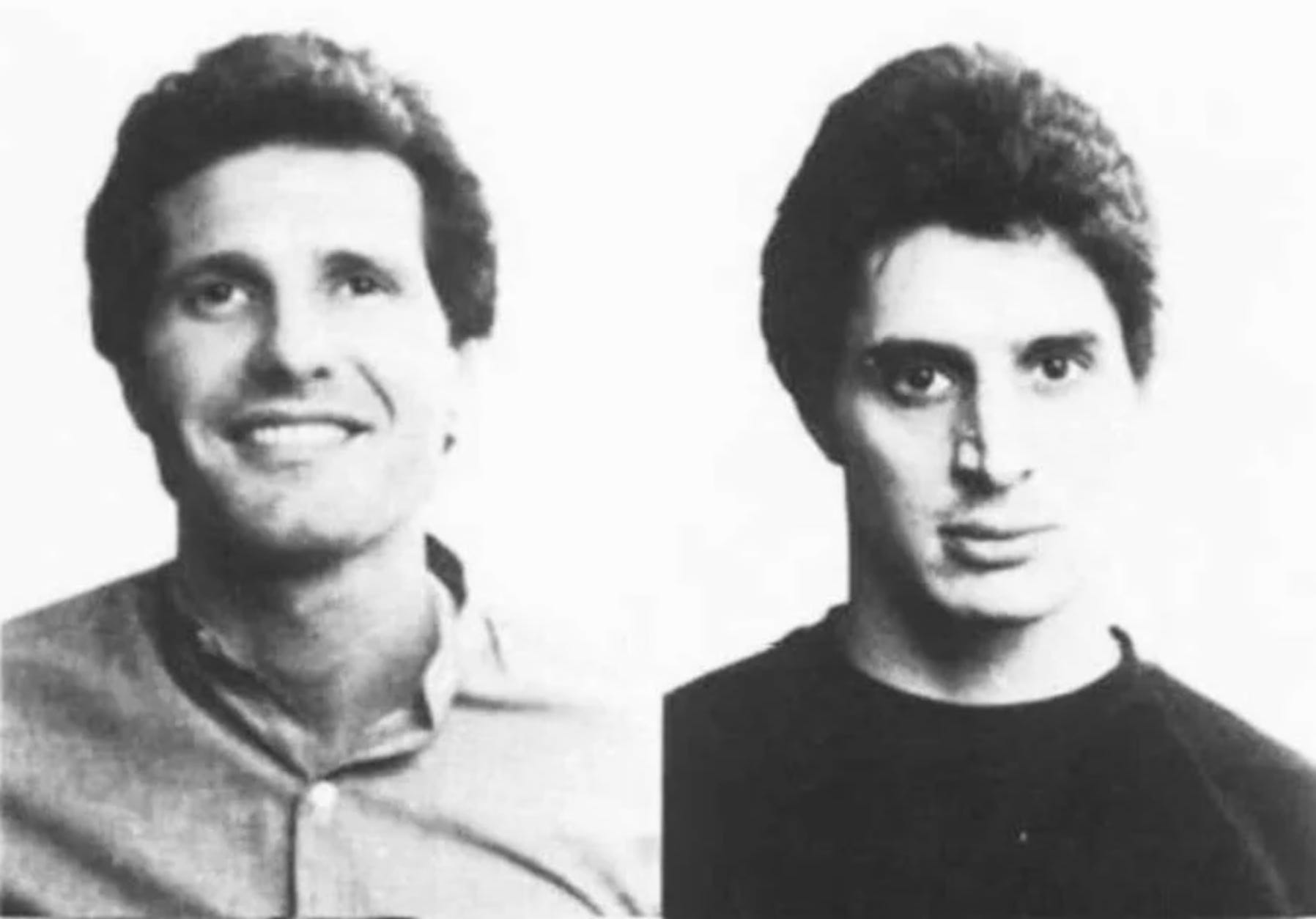
When mob control loosened, whites left the neighborhood, said Harold. “We all got scared, we took off, okay? Some of us went to Staten Island, some of us went to Jersey.”
“I don’t like it out here, period,” he continued. “You know, I’ve been out here maybe a good 25, 30 years. The pandemic killed everything out here. This mall is fading big time.”
“What used to be here that you liked?” I wondered.
“When Sears was here? It used to be a lot better,” said Harold.
I hadn’t met a person as determinedly negative as Harold in a long time. It was truly a marvel. “I’m curious,” I said, “What was the best part of your life?”
“The best part?” said Harold. “Hmm. To be quite honest with you, nothing!”
Harold was, however, looking forward to visiting his daughter next week in New Jersey, for his birthday. “Maybe when I come back, I’ll have a different attitude,” he said.
Harold spends a lot of time with Paul. Every morning they cross the street to the mall, buy lotto tickets and visit the café. In the evening, they do it again.
“We just get out. That’s what old people do,” said Paul, rejoining the conversation.
I asked what they like about each other.
“You know, we get along together,” said Harold. “This is our hangout. When the weather warms up, we sit outside. I know if things were really down and I needed him, I know he would be there for me in a heartbeat. And I hope he knows it goes both ways.”
“He’s someone that you can find and get out for a while,” said Paul. “We talk about our wonderful lives.”
“How would you describe Harold?” I asked.
“What do you mean, ‘describe?’” said Paul. “I don’t describe. I don’t make judgments anymore. As long as you treat me decent, I’ll treat you decent.”
Harold took this opportunity to explain how he treats his home care attendants very nicely, and how poorly they treat him in return.
“Harold says he’s not happy,” I said to Paul. “Are you happy?”
“More or less,” said Paul. “I think I did alright. I was with one woman for forty years. I’m doing what I like to do, being with my kids, watching my grandkids grow up, just being here. Now it’s just the little things, that’s all. I never thought I’d see 80 years old, with my drinking and everything. So I’m satisfied.”
“Do you think that when Harold goes to New Jersey, he’ll get a new attitude?” I asked.
“I hope so, yeah! I hope he does,” said Paul. “When you get older, you can’t let things get you down. It’s very, very tough. I have my down days. But if you can’t get up, then that’s it.” He paused. “We gonna be in the paper?”
An hour had passed. It was time for Harold and Paul to head home. “Nice meeting you,” they said, shaking my hand.
I returned to the massage chairs. To my delight, there they were: a cluster of old men, gossiping and swapping stories. I approached with my best smile and told them what I was up to.
Rob was right: they were all Russian.
And I was right too: they didn’t want to talk.

CAFÉ ANNE, a free weekly newsletter about NYC, is created by Brooklyn journalist Anne Kadet. Subscribe to get the latest issue every Monday.
No posts
Comments
Nothing yet. Say the first thing.
Sign in to join the conversation.