

Hello, it’s time for another installment of FLIGHT, about my year of travel around Europe, following in the footsteps of bold women writers and artists who redefined their lives on their own terms.
Thank you for supporting this work! It means the world to me as I rebuild my life and spread my wings as a creative writer (after nearly 30 years as an academic).
Here is the full list of installments, from the beginning, updated as new ones appear. You can catch up here anytime.
This week’s installment is about my fascination with the writer Kay Boyle and how she led me to Paris—and on my journey around Europe in search of a new life. This part of the memoir is longer than the others I have shared so far, so I’ve cut it in two. It will conclude next week. I want to keep these segments manageable and, ideally, contained, so they can be read on their own or in sequence. I hope you enjoy learning about Kay Boyle, a writer who deserves to be remembered and who is dear to my heart.
“The writing or a reading of biography is a privilege in that it allows . . . . the other to pass through us like a ghost in order to learn about the sense others made of their lives as we try to make sense of our own.”
—Ursula Tidd, Simone de Beauvoir
“I’ve always had a strong sense of the presence of ghosts,” the woman across from me says.
I’ve met up with an American woman I connected with online. Sitting in a cafe in Montmartre, she tells me about her decision to retire from her Silicon Valley job and move to Paris when somehow we land on the topic of ghosts. They have followed her throughout her life, apparently.
I’m going to need some breakfast if we’re going to have this conversation. She is happy with just her coffee and recommends the petit dejeuner, which is French for carbs with a side of caffeine—a huge chunk of baguette, a croissant, butter, jam, orange juice, and a coffee.
As I make a flaky mess on my side of the table, relishing each buttery bite, she tells me she always knew she would move to Paris someday. “Someone was pulling me here” she says.
It seems that someone was the 17th-century courtesan, art patron, and writer, Anne de l’Enclos. Ninon, as she was known, became her life coach, of sorts, teaching her how to be a Parisian. Reading everything she wrote became not only a discovery of a past life but an initiation into a new one.
Something similar has been happening to me as well. The 20th-century writer Kay Boyle has been a sort of spirit guide for me, pointing the way forward out of the wreckage of my life. I’m supposed to be writing her biography—and what is writing someone’s biography but a kind of haunting?—but instead, she has led me here.
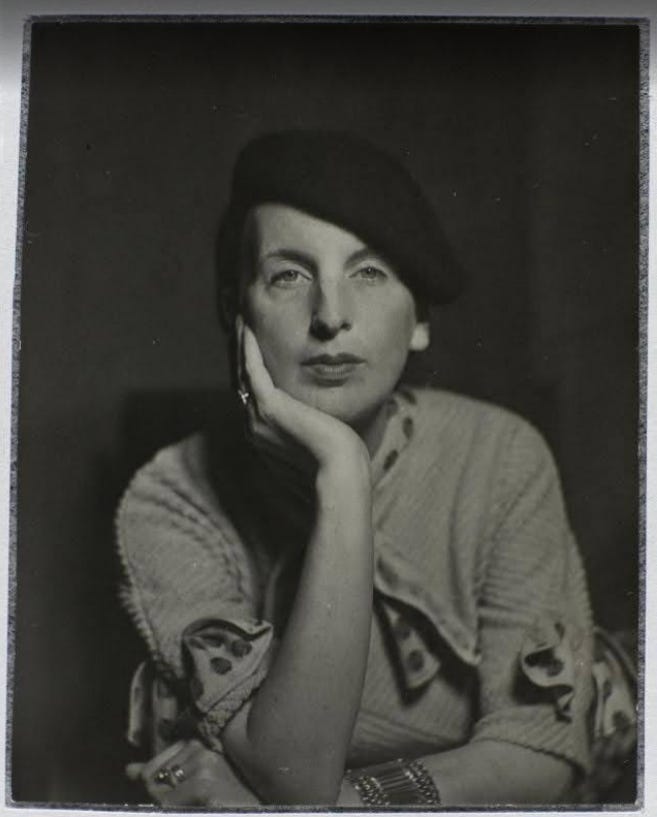
Kay Boyle was a part of the so-called Lost Generation in Paris in the late 1920s—but, unlike her famous male contemporaries, she truly has been lost. No one seems to know who she is anymore.
After most of them left, she stayed in Europe through the thirties and the beginning of the forties, Europe’s darkest years, writing about the rise of Nazism in Austria and the fall of France to the Germans. She even came back to Europe after the war and wrote stories about occupied Germany for The New Yorker. I’ve never read anything like them.
During those years, she chronicled the personal toll of Europe’s fall into madness and helped shape the modern short story. But like most other women writers of the era, she has been overshadowed by Hemingway, Fitzgerald, and Joyce. (In the “Lost Generation” section at Shakespeare and Company, the famous Paris bookstore, they take up nearly all of the shelf space. You’ll have to go to the rare bookstore next door to find a volume or two by Kay Boyle. Very little of her work is still in print.)
Although I spent the past four years researching her biography, something made me dissatisfied with telling her story while I put my own on hold. I wanted to live vicariously through her, but a voice inside my head kept getting louder. It said, When you are on your deathbed, how will you know that you have really lived?
Comments
Nothing yet. Say the first thing.
Sign in to join the conversation.