

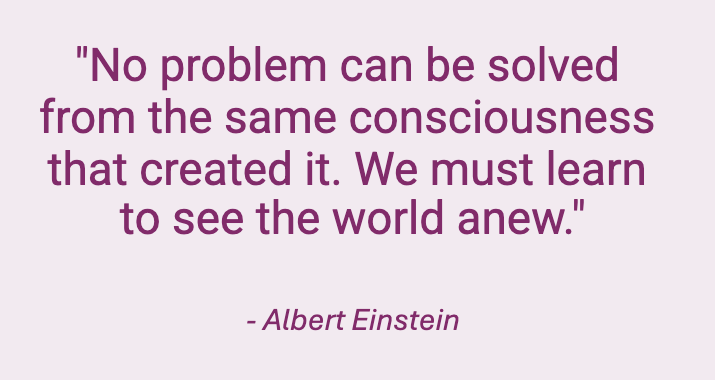
To tackle today's complex challenges, we need more than new tools and techniques - we need new ways of thinking. Mental models shaped by 20th-century mechanistic approaches often fail us when confronting 21st-century complexity.
I believe three critical mindset shifts make the difference between success and failure. These shifts don't just change what we do - they transform how we see and engage with complex problems.
Our education and training have conditioned us to break problems into separate parts and solve each in isolation. This approach generally works well for complicated problems - those problems that submit to analysis and, with enough expertise applied, are predictable. Problem is, this approach falls short with complex ones - those problems that shape-shift, only able to be understood in hindsight.
Breaks problems into isolated components.
Focuses on direct cause-and-effect relationships.
Assumes problems have clear boundaries.
Seeks to optimize individual parts.
Aims for control and predictability.
Sees interconnections between elements.
Explores indirect, non-linear relationships.
Recognizes that boundaries are permeable.
Seeks to nudge the system.
Aims for influence and adaptation.
Systems thinking, like the concept of Wu Wei from Lao Tzu's Tao Te Ching1, recognizes the interconnectedness of elements. True progress comes not from attempting to force change in isolated parts but from shifting the web of interconnected relationships itself. We move beyond the individual parts to focus on the field comprising the interactions of the parts. It is from these interactions that capacity can be released and progress made.
"A system is never the sum of its parts; it's the product of their interactions." — Russell Ackoff
Systems thinking reflects the principles of deep collaborative work, particularly the work of connection. It shines best where there is no direct path to the desired outcome, where artful navigation outperforms attempts to forcefully control and direct solutions.
Complex problems are riddled with paradoxes - seemingly contradictory states or tensions that cannot be resolved by choosing one over the other.
Forces choices.
Sees tensions as problems to eliminate.
Seeks single "right" answers.
Values consistency and clarity.
Assumes trade-offs are inevitable.
Embraces the tension of competing truths.
Sees paradoxes as sources of creativity.
Seeks integrated approaches.
Values nuance and complexity.
Finds ways to transcend apparent trade-offs.
As Niels Bohr so aptly put it:
"The opposite of a correct statement is a false statement. But the opposite of a profound truth may well be another profound truth."
Deep exploration of these paradoxes helps collaborators surface a shared ambition and principles to work by. Essential steps when it comes to surfacing and tapping into the latent capacity within our systems.
As today's problems grow bigger, harder, and more frequent, we often wonder how we'll ever have enough time, resources, or knowledge to solve them. We need to move from a scarcity mindset to one of abundance. One that assumes that together we have everything we need.
Focuses on what's missing or insufficient.
Competes for limited resources.
Hoards information and capabilities.
Sees problems as zero-sum games.
Assumes "not enough to go around.”
Focuses on collective resources and possibilities.
Pools and shares resources.
Openly exchanges information and ideas.
Seeks mutual gains and synergies.
Assumes "together we have enough.”
By pooling our resources and ideas, we allow more to be done with an - apparent - less. What is really happening is a release of the latent capacity that was there all along – it simply needed to be exposed and joined up.
"We knew we would never get enough funding on our own... It was a bold moment bringing it all together."
These mindset shifts aren't just intellectual exercises - they become ways of being that transform how we engage with complex challenges:
Systems thinking becomes systems sensing - feeling the interconnections and flows, and developing more responsive and nuanced ways to tackle tough challenges.
Paradox thinking becomes paradox dancing - moving fluidly among co-existing truths, honouring the possibilities within.
Abundance thinking becomes abundance living - generously sharing and creating together within closed systems that feedback the benefits.
As leadership scholar Peter Senge notes:
"I believe that the prevailing system forces people to work harder and harder to compensate for failing to tap the spirit and collective intelligence that characterizes working together at its best."
These three mindset shifts - systems thinking, paradox thinking, and abundance thinking - help us tap that spirit and collective intelligence. They enable us to collaborate more effectively and tackle complexity in ways better suited to today's challenges, and so close the current performance gap.
Which of these mindset shifts do you find most challenging?
Join the conversation…
Are you ready to go Beyond Individual Scale and unlock the abundance within our systems?
In this series, I share deeper dives into what it takes to go Beyond Individual Scale and activate collective impact.
»»» Click here for next article in series «««
Lao Tzu -Tao Te Ching crica 400BCE
No posts
Comments
Nothing yet. Say the first thing.
Sign in to join the conversation.