

Does it feel like problems are hitting faster than you can solve them? That despite working harder, smarter, and longer, you're still somehow falling behind?
You're not alone. And it's not your imagination.
Today's most pressing problems - from climate adaptation to digital transformation to healthcare reform—share three characteristics that combine to create what I call the Complexity Curve:
Complex problems are hitting us faster than ever before. In my own lifetime, the world has witnessed a ten-fold increase in the number of natural disasters. Where I call home, the Asia-Pacific region, has experienced 29% of global natural disasters in the 30 years to 20191.
The frequency of other challenges, such as pandemics, is also increasing and likely to continue. The time between major disruptions is shrinking, giving us less recovery time before the next wave hits.
The size and impact of problems are increasing. More impacts are felt not just locally but regionally and globally. Larger numbers of people are affected, and those impacts persist over time.
Consider the substantial learning loss due to school closures during the COVID-19 pandemic, reported in countries like the Netherlands2, or the degradation in social skills among US students3. What might once have been contained locally now ripples across countries and generations.
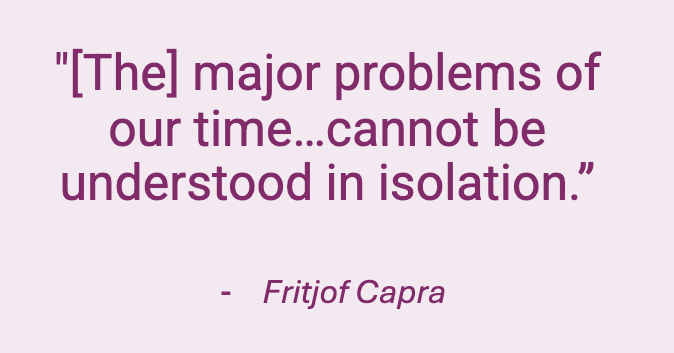
Perhaps most challenging of all is how today's problems are interconnected, interdependent, and dynamic. Different components of one problem are inescapably connected to components of another:
Economic inequality is connected to education, healthcare, and employment
Climate change impacts agriculture, migration, and geopolitics
Digital transformation affects labour markets, privacy, and mental health
Actions in one problem space affect not only the problem itself but others it intertwines with. This multiplicity leads to increased unpredictability and complexity. And these problems don't sit still - they evolve over time, shifting in response to our attempts to solve them.
The mismatch between our typical approaches and the reality of the Complexity Curve leads to what I call the Performance Gap - the growing distance between the complexity of our challenges and our ability to keep up.
We're applying 20th-century methods to 21st-century problems.
When faced with complex problems, we instinctively treat them as if they were merely complicated. We analyse, break into parts, plan, execute, and review. There's comfort in this process - it's familiar and gives us the illusion of control.
But then reality intervenes:
The ecosystem changes around us
People behave in unpredictable ways
Decisions seem inconsistent and contradictory
The problem morphs into something new
External factors become more (or less) important
Priorities shift
Key players change
Our carefully crafted plans don't survive contact with reality because they're built on a fundamental misunderstanding of the problem type we're facing.
To understand why our approaches fall short, it helps to recognise that there are different types of problems. My favourite way to look at these is using Snowden’s domains:
Clear: Direct, predictable, cause-and-effect relationships exist, solved with best practices (a game of noughts and crosses)
Complicated: Multiple parts and paths but still predictable, solved with expert knowledge and choosing from good practices (a game of chess)
Complex: Unpredictable, emergent behaviour, solved with experimentation (a game of poker)
Chaotic: No discernible cause-and-effect, solved with rapid stabilization (children playing)
Our education systems, organizational structures, and management approaches were largely designed for clear and complicated domain problems. But today's most pressing challenges are primarily complex or even chaotic.
When we apply mechanistic approaches to complex problems:
We waste resources on solutions that can’t work
We experience action masquerading as progress
We burn out our people and organizations
We lose trust when promised outcomes don't materialize
We fall further behind the Complexity Curve
The Performance Gap widens, and with it, our collective frustration – and exhaustion.
So what's the alternative? How do we close the Performance Gap and catch up to the Complexity Curve?

Are you ready to go Beyond Individual Scale and unlock the abundance within our systems?
In this series, I share deeper dives into what it takes to go Beyond Individual Scale and activate collective impact.
»»» Click here for next article in series «««
https://www.visionofhumanity.org/wp-content/uploads/2020/10/ETR_2020_web-1.pdf
Engzell, P., Frey, A., & Verhagen, M. D. (2021). "Learning loss due to school closures during the COVID-19 pandemic." Proceedings of the National Academy of Sciences, 118(17).
Dorn, E., Hancock, B., Sarakatsannis, J., & Viruleg, E. (2020). "COVID-19 and student learning in the United States: The hurt could last a lifetime." McKinsey & Company
*Fritjof Capra (1996). “The Web of Life: A New Scientific Understanding of Living Systems”
No posts
Comments
Nothing yet. Say the first thing.
Sign in to join the conversation.