
I am a sociologist, and for my ERC Starting Grant proposal I ventured into relatively new territory: studies of activist mental health and well-being. Social psychological research on collective action was not completely unknown to me — I had read these studies and knew quite well what social psychology has explored so far when it comes to activism. But the broader issues — how mental health and well-being are addressed in social psychology, and what fresh theories and approaches exist to the social dimensions of mental health and well-being — were less familiar. So, for this project, I needed to do some reading. But first, I needed to find the appropriate literature.
The old school way
When I was an undergraduate student, the way we were taught to look for literature was by perusing references in the articles or books we managed to identify as relevant; you might call them “starters.” You find something that is (remotely) relevant on a library shelf or on JSTOR, and then go down the rabbit hole of its references, leading to more reference lists, and so on and on.
Luckily, today we have access to all kinds of digital technology to make this search easier. Most people will have heard of and used Google Scholar, the first step for many trying to find scientific literature on a topic. But it’s often quite random and unpredictable in which entries it prioritizes, and sometimes you still don’t find what you need. Still, it’s a good way to identify those “starter” articles or books. That’s what I did first when I started looking for social psychological accounts of activism and well-being.
Research Rabbit
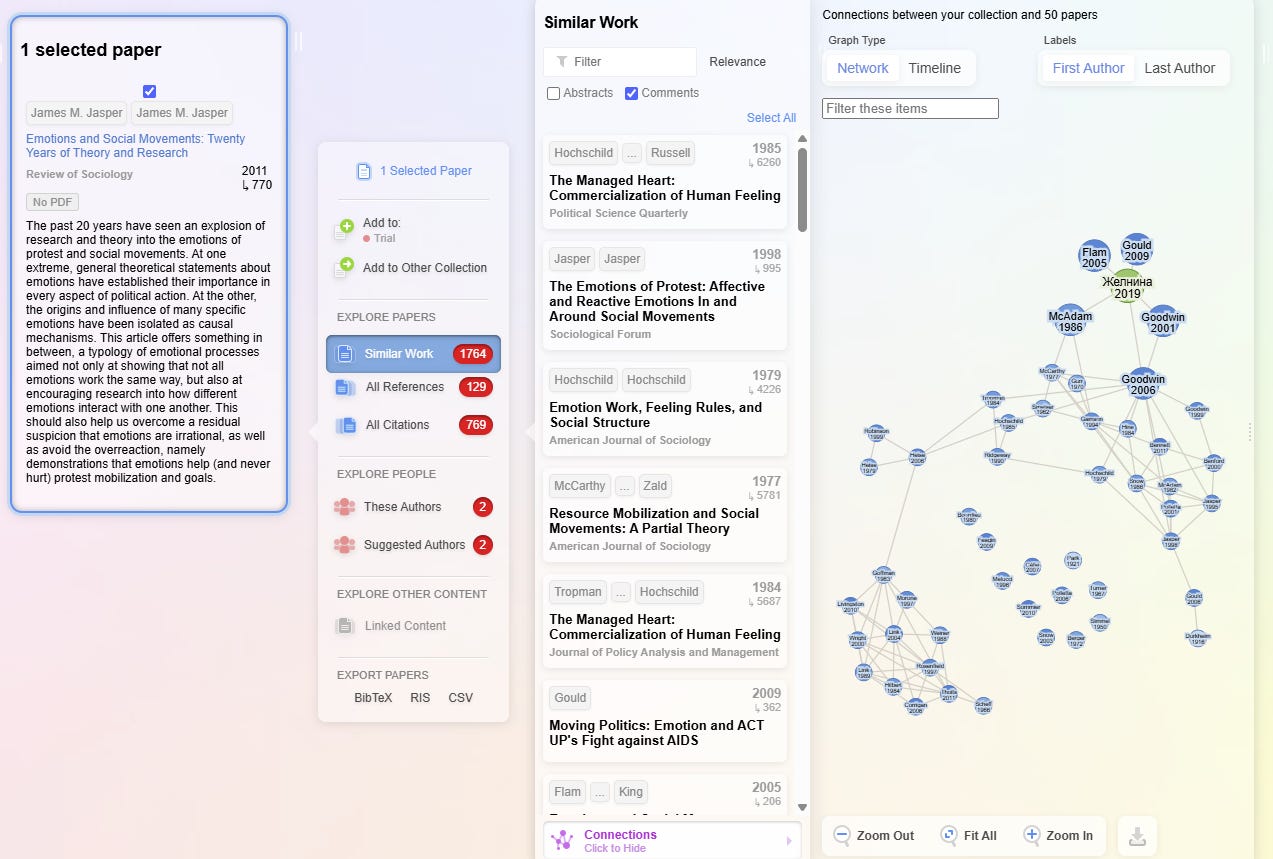
My second step — and this has been the case for a while now - is to turn to one of my favorite AI-powered tools: Research Rabbit. There are probably similar services out there, but Research Rabbit is my go-to whenever I need to venture into the unknown and explore new literature (this is not sponsored, just to be clear; I just like and use this free service myself).
The good thing about it is that it’s very powerful and free, though I’m not sure how it’s supported. There are different ways of using it, but the one I like most is closest to the approach I learned as an undergrad: you enter the DOI of your “starter” paper and let Research Rabbit find the connections by browsing the reference lists for you. It then creates a convenient network visualization of citations, influences, and similarities. By adding more papers to the collection, you can see clusters of sources that cite each other, which helps identify different approaches to the problem you’re interested in.
Deep Research
I also tried using ChatGPT’s Deep Research function. I’m not sure how this one operates, so I hesitated to trust it, but it actually brought me some sources I had missed when doing the literature search my usual way - some not peer-reviewed, but still respectable white papers. The good thing about it is that it actually gives you a reference to an existing source, and you can double-check it yourself. Deep Research browses online sources on a given topic and can capture open-access peer-reviewed articles, but its approach to resources is more relaxed and inclusive than the classic approach to scientific literature I like in Research Rabbit. It also writes a text for you, summarizing the sources, whereas Research Rabbit only provides references and abstracts - meaning you still have to do the reading and summarizing yourself, if you have access to the full texts via your university library.
Overall, I think the digital and AI-powered tools for scientific research available today make it possible to write ambitious, interdisciplinary proposals in less time and with more depth. And you don’t even need to change the way you think about working with new literature. For me, Research Rabbit works because it uses the same principle I learned in analog times, but with convenient visualizations (in previous posts, I mentioned that I’m a visual thinker - and seeing the connections in the literature is really my cup of tea). I also like that, while it makes patterns and clusters in the literature visible, I still have to read the sources myself. Deep Research is tempting as a shortcut, but for now I prefer tools that keep me closer to the literature itself.
Comments
Nothing yet. Say the first thing.
Sign in to join the conversation.