
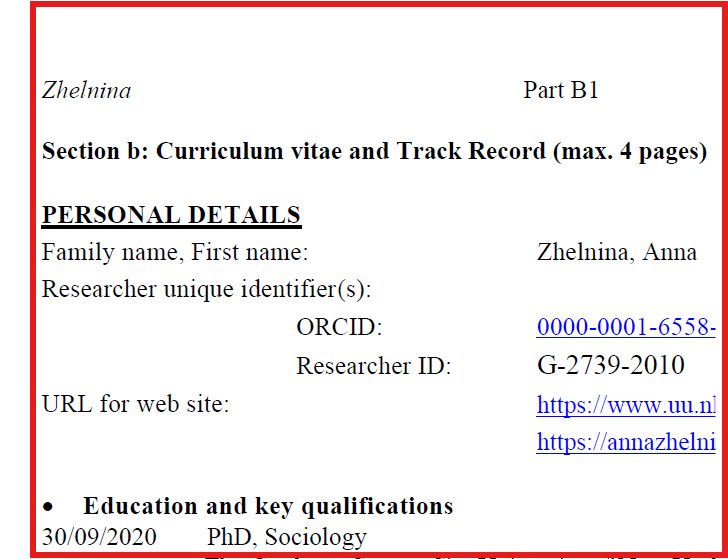
One thing I quite ignored when preparing the application was my CV. I thought I had what I had, it looked decent enough, and adding a CV to my B1 would just be a mechanical action of cutting the CV I had to include only the information relevant for the grant application and moving sections around to correspond with the subheadings suggested in the template. In 2024, when I was applying, the template asked for max. 4 pages and had some suggested subheadings, but also made it clear that it could be modified as one saw necessary.
At first, I approached the task mechanically: just filling out the suggested sections (personal details, education and key qualifications, current positions, research achievements, etc.). I used the same bullet-point structure I had in my regular CV. Having filled everything out this way, I was left with under two pages of text. I didn’t worry too much about it: at every ERC-related workshop and in every YouTube video I saw, the speakers made sure to emphasize that the ERC Starting Grant is for scholars launching their independent research careers, so the CV will be judged according to one’s career stage. I did see my limitations: so far, I didn’t have any PhD supervision experience or any major individual grants. I listed my experience of being part of a team in major research projects, though, highlighting if I had a leadership role in them (as a co-PI, a work package lead).
I felt quite good about it until I received feedback on my part B1, of which the CV is part, from my research support contact person.
She pointed out that I was losing an opportunity by not using all four of the pages and by sticking to the dry bullet-point format.
I had heard that the narrative CV format was gaining popularity in Europe, but had never tried or even seen one myself. So, I followed the advice to explicate and elaborate on the points in my CV, especially the ones that might seem like limitations. I think, in the end, my CV was a mix of the standard and the narrative form, and I used up the full four pages.
For example, I added a summary to precede my “Research Achievements” section, framing my research interests and previous work as stepping stones toward the project I was suggesting. This seven-line paragraph was followed by the nine publications I thought were most relevant to the project but also demonstrated my ability to publish solo. For each publication, I also added a couple of lines under the reference to explain what’s inside and why it was relevant for the project. For example, in some articles I developed concepts that fed into the project, or applied theoretical approaches and methods that would be part of it.
I followed the same approach in other sections: bullet points followed by a short explanation of their relevance/importance. For example, in “Peer Recognition,” I explained the importance of the awards I received (they were an acknowledgment of the innovative nature of my work); in the section on research project administration I listed my experience of leadership positions in team projects and explained what I did in these roles and how it prepared me to lead something as big as an ERC Starting Grant; and in teaching and supervision I made sure to mention that I had been involved in informal mentoring of PhD students and was a PhD student rep on the board of a major research network. I removed the phrase “even though I have no PhD supervision experience” I initially had there. The reader would be able to see it for themselves — no need to draw extra attention to the fact :)
I think the advantage of doing it this way, instead of just cramming as many achievements as possible into these pages, was helping the evaluators see a story: a biography of a future PI who, even if she doesn’t have all the formal experience, is mindful of the experience she does have and can use in the next logical step.
The reason I now tell everyone that they shouldn’t ignore the CV part as a technicality is the way the reviewers referred to mine: I could see in their comments (and evaluators are asked to assess your promise as a PI in a separate section of the evaluation form) that they responded to what I did in the narrative parts, in my explanations. It was easier for them to see why all of this mattered and how it was all connected.
Comments
Nothing yet. Say the first thing.
Sign in to join the conversation.