
Hello gorgeous humans,
Can you believe it’s January? I can. I worked through most of the december holidays and I’m going to do some relaxing now: I’ve been working hard this winter getting new book pitches ready, making custom illustrated recipes, and shipping mini-cookbooks from Etsy orders. (As you’re reading this, the shop is closed for my break, but you can set a notification on Etsy when it opens again!) I also had some client work and have much enjoyed being on Substack, writing notes about creativity and sharing snippets of my art.
I’ve been listening to a lot of lately while I work on new book illustrations, which is great. I love learning about different ways of looking at life. I can’t listen to them while I write, for obvious reasons, because otherwise my writing about food or for new kids book ideas would suddenly have a random SCHOPENHAUER inserted like it’s a swear word. Come to think of it, it’s probably a great exclamation for stubbing your toe.
Before we delve into the subject of rice and equality (and nasi goreng), I had an inkling to share…
My online course is live!
I’ve also worked on an online course teaching my collage techniques, but in a floral setting. If you wanted to learn how to illustrate with collage, this is your sign. I’ve filmed four super laid-back video workshops for you on how to collage gorgeous floral projects. Have a look!


On to the subject of today
Now, let’s start this new year by talking about something I often take completely for granted: rice. But not just rice as a grain you boil in your pot. I’m talking about rice as proof that humans have known how to build abundance through cooperation for literally a thousand years.
How is that? In the highlands of Bali, a farmer is opening the water gates to his rice terrace. He’s not just watering his own field: he is part of a 1,000-year-old cooperative system called subak, where every decision about water flow, planting schedules, and pest management is made democratically by the entire farming community.
This is something essential to the world that I’m obsessed with right now. It’s a story about cooperation, about agricultural systems that work, about food justice, and about why the West doesn’t talk nearly enough about any of it. (Or: think about it, as we are chowing down rice like it has magically appeared.)
The basics: why rice matters
Rice feeds more than half the world’s population. It’s been domesticated independently in at least three different places across three different continents. It shaped empires, trade routes, and the way humans organized themselves around shared water systems. It’s also deeply tied to colonialism, extraction, and the erasure of African and Asian agricultural knowledge.
Here’s something they probably didn’t teach you in school: rice wasn’t domesticated in just one place. While Asian rice (Oryza sativa) was being cultivated in the Yangtze River valley of China around 8,000-9,000 years ago, African rice (Oryza glaberrima) was independently domesticated in the inner Niger River delta of West Africa around 3,000 years ago. West African farmers developed sophisticated rice cultivation techniques, including tidal irrigation systems. The rice fields of the Senegambia region fed powerful empires like Mali and Songhai. When you cook rice tonight, you’re connected to 10,000 years of human innovation, experimentation, and mutual aid. That’s revolutionary!
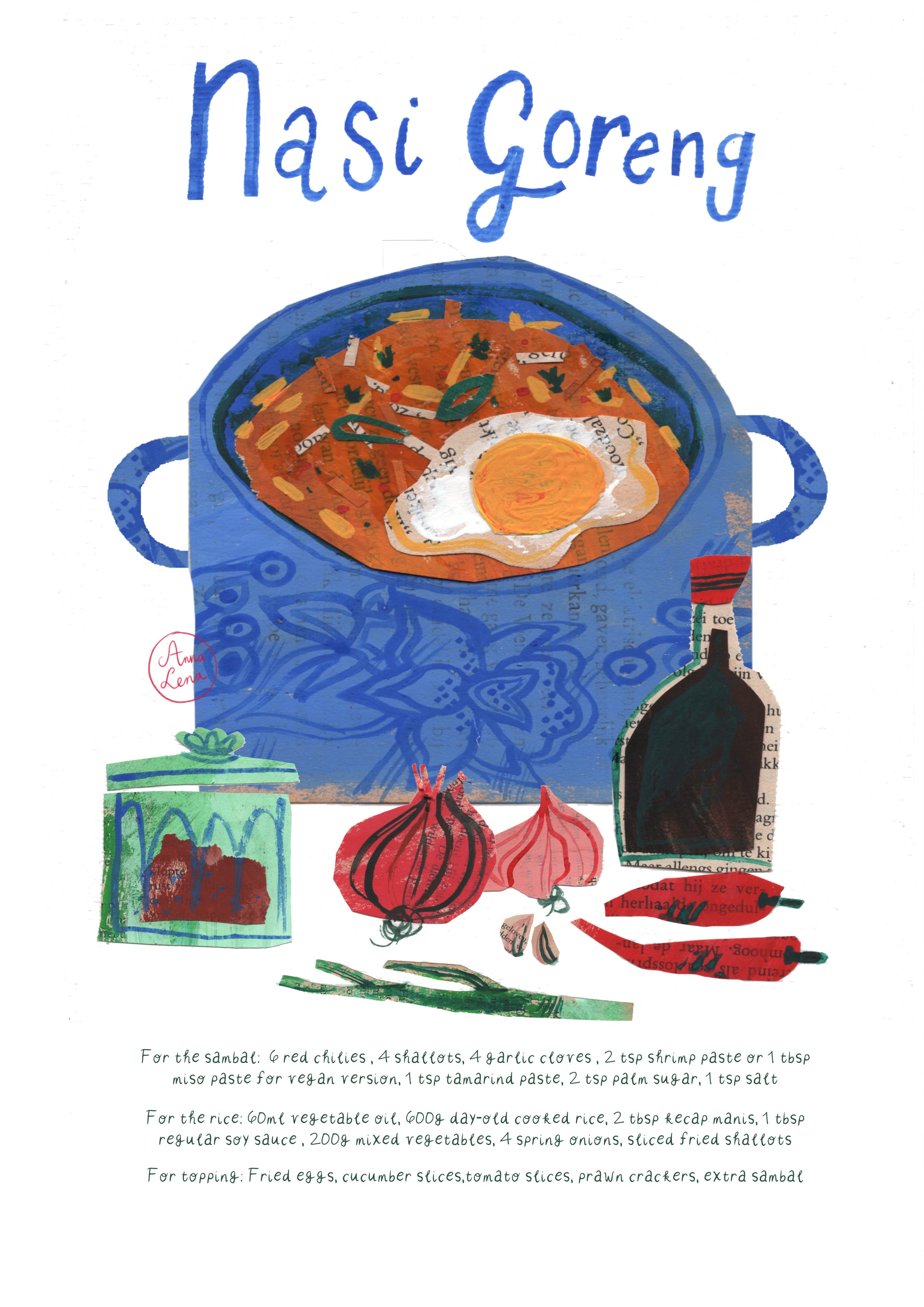
Okay, enough heavy stuff (for now). Let’s cook. Nasi Goreng, Indonesian fried rice, is the perfect example of how rice becomes something more than just a grain. It’s comfort food, it’s a way to use leftover rice, it’s infinitely adaptable, and it’s deeply tied to Indonesian food culture and the resilience of everyday cooking.
The key to great fried rice is day-old rice! Fresh rice is too moist and will get mushy. Day-old rice has dried out slightly, so the grains stay separate and get that perfect slightly crispy texture: the soul of Nasi Goreng is the sambal: the spicy, aromatic paste that coats every grain.
Nasi Goreng
Serves 4
For the sambal
6 red chilies (use fewer for less heat, or substitute with 2 tsp chili paste)
4 shallots, roughly chopped
4 garlic cloves
2 tsp shrimp paste OR 1 tbsp miso paste for vegan version
1 tsp tamarind paste
2 tsp palm sugar or brown sugar
1 tsp salt
For the rice
60ml (¼ cup) vegetable oil
600g (about 4 cups) day-old cooked rice, broken up with your hands
2 tbsp kecap manis
1 tbsp regular soy sauce
200g mixed vegetables (green beans, cabbage, carrots, bell peppers: whatever you have)
4 spring onions,
sliced fried shallots for garnish
For topping
Fried eggs (one per person)
Cucumber slices
Tomato slices
Prawn crackers (krupuk)
Extra sambal
Steps
Blend all the sambal ingredients in a food processor or pound them in a mortar and pestle (traditional method, better flavor, great arm workout, though I personally am weak and need to lie down after) until you have a rough paste. Don’t make it completely smooth: some texture is good.
Heat 2 tablespoons of oil in a large wok or wide pan over medium heat. Add your sambal paste and cook, stirring frequently, for 5-7 minutes until it’s fragrant and the oil starts to separate. You want it to darken slightly and smell absolutely incredible. This step is crucial! you’re developing the flavor base for everything.
If you’re using harder vegetables like carrots or green beans, add them now and stir-fry for 2-3 minutes. If using softer vegetables like cabbage, wait until the next step.
Turn the heat to high. Add the remaining oil if the pan looks dry. Add your day-old rice, breaking up any clumps with your spatula. Stir-fry for 3-4 minutes, letting the rice get a bit crispy in places. You want some grains to get golden and toasted.
Add the kecap manis and soy sauce. Keep stir-frying for another 2-3 minutes until every grain is coated and slightly caramelized. Add softer vegetables and spring onions now if you haven’t already.
Taste and adjust seasoning! You might want more kecap manis (for sweetness), more soy sauce (for salt), or more sambal (for heat).
Pile the rice onto plates. Top with fried eggs, cucumber and tomato slices, fried shallots, and extra sambal on the side.
Notes: The kecap manis is non-negotiable, it gives Nasi Goreng its distinctive sweet-savory flavor. If you absolutely can’t find it, mix regular soy sauce with molasses or brown sugar, but it won’t be quite the same. For vegan version: skip the eggs, use miso paste instead of shrimp paste, add cooked tempeh or tofu. The key to great fried rice is HIGH HEAT and not overcrowding the pan. Work in batches if needed!
Thanks for reading The Illustrated Kitchen! This post is public so feel free to share it.
Cooking the food is nice, but we partake in a system that’s quite frankly, QUITE wrong. When we talk about “sustainable agriculture” or “food security,” we need to center the people who’ve been practicing it for millennia: small-scale farmers, Indigenous communities, and traditional water cooperatives.
Buy rice from cooperatives and fair-trade sources when possible. Learn about and share stories of Indigenous agricultural systems. Defend communal water rights against privatization. Recognize that “development” and “modernization” often mean destroying functional systems for - yes- profit. Profit that does not reach those that need it. Understand that food justice is climate justice is social justice.

There is more Illustrated Kitchen…
My newsletter is free forever for everyone, but I like to give people the opportunity to dive a little deeper or just support my work for the price of a yummy baked good a month. That’s why the rest of this story is for paid subscribers: you’re super welcome to try it for a bit!
You’ll get:
Behind-the-scenes collage pics: See how I created these artworks!
Deep dive in food systems: The erased history of rice, when farmers moved mountains, all about the subak system, pilaf as a continental connector, food as a weapon, and why water justice matters now more than ever.
Illustrated bonus goodie (downloadable!): A world map of rice!
Studio notes: Work-in-progress shots, updates on my new book pitches and client work, and the reference books I used for this research
Paid subscribers get extended food histories, recipe variations, illustrated kitchen guides, quarterly collectible food references, and studio access.
Founding members get everything above PLUS a year-end illustrated cookbook with all 12 months of recipes!
Join The Illustrated Kitchen Table
Creating these illustrated food history stories is part of my full-time freelance practice, including the kids’ book projects I do, and there are several ways you can help keep these monthly journeys coming:
Want more illustrated food history?
📖 My mini cookbook This Better Pan Out collects my favorite illustrated recipes in one printable booklet → Get it here
🎨 Recipe prints, botanical art, and kitchen goods at my Etsy shop → annalenamakes.etsy.com
🌸 Learn my collage illustration techniques with the Floral Collage Course → Start creating
📚 Kids’ nonfiction books about food lore and history → Browse books
Become a paid subscriber:
If you really want to support this work and can swing it, paid subscriptions help me dedicate more time to deep research and elaborate illustrations. But I want to be clear, free subscribers are just as valued, and I’ll always share the stories with everyone along with the artwork for the recipes. Paid support simply means I can say “yes” to fewer commercial projects and “yes” to more time researching farming systems and drawing water cooperatives.
Whatever feels right for you, I’m grateful you’re here reading about agricultural justice and making Nasi Goreng with me.
x, Anna Lena
Loved this story? Hit subscribe for monthly illustrated journeys through food history, and check out my Etsy shop at annalenamakes.etsy.com for illustrated kitchen goods and my cookbook “This Better Pan Out.” For more food history adventures, including books for kids, visit annalena.nl.
P.S. Want to learn my collage illustration techniques? Check out my Floral Collage Course — same process I use for food art, just with flowers!
Comments
Nothing yet. Say the first thing.
Sign in to join the conversation.